
Why reliable bus providers matter for group travel
TL;DR:
- Reliable bus providers ensure safety, punctuality, and legal compliance for all group sizes. They meet regulatory standards like CVOR, NSC, and ATPDR to minimize liability and prevent delays. Choosing compliant, well-maintained fleets and trained drivers guarantees safer, more dependable event transportation.
Reliable bus providers are defined as operators who consistently deliver safe, punctual, and legally compliant transportation for groups of any size. For event planners, school administrators, and corporate decision-makers, the choice of bus provider directly determines whether a group arrives safely and on time. A single unreliable operator can derail a conference, a school trip, or a corporate outing before it begins. Understanding why reliable bus providers matter is the first step toward protecting your event, your participants, and your organisation’s reputation.
Why reliable bus providers matter: compliance and legal standards in Canada
Reliable group transportation in Canada is built on a foundation of provincial and federal regulations. Planners who skip this step when vetting providers take on real legal and financial risk.
Ontario’s Commercial Vehicle Operator’s Registration (CVOR) system is the most direct measure of a bus operator’s compliance record. Every commercial vehicle must display a valid CVOR number on both sides of the vehicle. Failure to display a CVOR number results in fines up to $500 under the Highway Traffic Act. That fine signals something more important: an operator who ignores visible compliance requirements is unlikely to excel at the less visible ones.
Beyond CVOR, Transport Canada administers the National Safety Code (NSC), a framework of 16 standards that harmonise safety performance ratings across every province. The NSC framework evaluates carriers based on inspections, collision records, and convictions. A poor NSC rating triggers Carrier Safety Reviews, which carry costly sanctions and can suspend operations entirely.
Federal accessibility rules add another layer. The Accessible Transportation for Persons with Disabilities Regulations (ATPDR) apply to federally regulated operators offering interprovincial or international service. ATPDR compliance is mandatory for operators with 10 or more staff, effective february 2026, and covers staff training, accessible equipment, and boarding assistance. Charter-only operators and buses with fewer than 40 seats are currently exempt, but planners booking interprovincial routes must confirm compliance directly.
Key compliance requirements for Ontario bus operators include:
- Valid CVOR number displayed on both sides of every commercial vehicle
- Legible, reflective vehicle lettering that passes roadside inspection
- Licensed drivers with accurate hours-of-service logs
- Regular vehicle inspections to maintain a clean CVOR safety rating
- NSC-aligned safety performance ratings based on inspections and collision records
- ATPDR staff training for operators running interprovincial routes with 10 or more employees
Non-compliance at any of these points exposes planners to liability and puts passengers at risk.
How does vehicle quality affect passenger safety and event timing?
A well-maintained bus fleet is the physical expression of a provider’s reliability. Vehicle condition directly affects both passenger safety and whether your group arrives on time.

Modern motor coaches are built with features that older vehicles lack: electronic stability control, advanced braking systems, and climate control that keeps passengers comfortable on long routes. These are not luxury additions. They are safety systems that reduce the probability of incidents. An ageing fleet with deferred maintenance is a scheduling risk as much as a safety risk. A breakdown on the 401 does not just delay arrival. It can cancel an event entirely.
Non-compliant vehicle lettering is the primary reason Ontario commercial vehicles fail roadside inspections. That detail matters because a failed inspection pulls a vehicle off the road immediately. Planners who book with operators who cut corners on visible compliance should expect the same approach to mechanical maintenance.
Regular safety inspections and compliance audits separate professional operators from casual ones. Providers who schedule inspections proactively, rather than reactively, maintain tighter control over their fleet’s condition. That discipline shows up as punctuality, fewer cancellations, and consistent passenger comfort.
- Ask providers for their vehicle inspection schedule and the average age of their fleet
- Confirm that buses are equipped with working climate control, seatbelts, and accessibility ramps where required
- Request evidence of recent safety audits or third-party inspection records
Pro Tip: Request the CVOR safety rating of any Ontario bus operator before signing a contract. A clean rating confirms the operator maintains licensed drivers, accurate logs, and regular inspections. You can verify ratings through the Ontario Ministry of Transportation.
Why do driver training and operational management define service reliability?
A well-maintained bus driven by an undertrained or poorly managed driver is still an unreliable service. Driver quality and operational coordination are the human side of reliability.
Driver qualification in Canada is governed by provincial licensing requirements and, for interprovincial routes, by federal standards aligned with the NSC. Operators who invest in ongoing driver training go beyond the minimum. Federal accessibility training requirements under ATPDR include accessible announcements, boarding assistance, and proper use of mobility aid spaces. Drivers who receive this training serve all passengers better, not just those with disabilities.
Operational management determines what happens when something goes wrong. The four areas where professional operators distinguish themselves are:
- Dispatch coordination: A dedicated dispatcher monitors routes in real time and reroutes drivers around delays before they compound.
- Customer communication: Planners receive proactive updates rather than discovering problems on the day of travel.
- Emergency protocols: Trained drivers and support staff follow documented procedures for breakdowns, medical events, or route disruptions.
- Hours-of-service compliance: Accurate hours-of-service logs prevent fatigued driving, which is one of the leading causes of commercial vehicle incidents.
Pro Tip: When evaluating a provider, ask specifically how they handle a last-minute vehicle breakdown. A professional operator will describe a documented backup protocol. A vague answer is a red flag.
What are the practical benefits of choosing reliable bus providers?
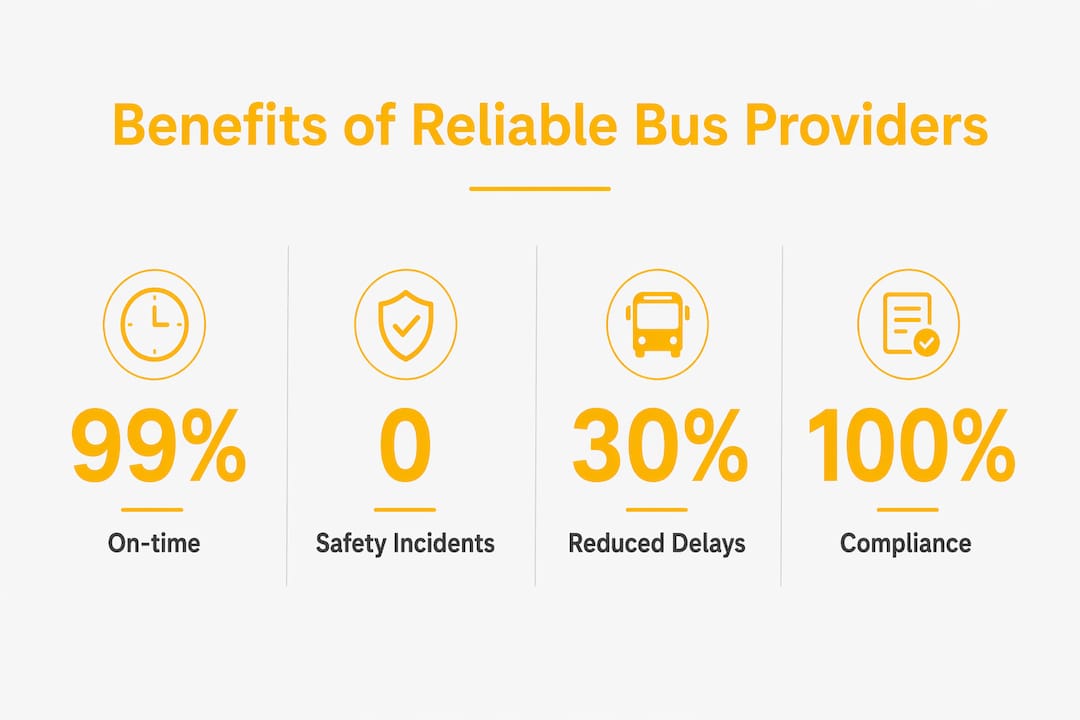
The benefits of reliable transportation extend well beyond the ride itself. For planners, reliability translates into measurable outcomes across safety, reputation, and cost.
A reliable provider reduces the probability of cancellations and delays. That reduction protects the event schedule and the planner’s professional reputation. Participants who arrive late or not at all affect attendance numbers, speaker schedules, and catering logistics. One transportation failure can undermine months of planning.
Legal liability is a direct concern for corporate decision-makers and school administrators. Booking a provider who fails to meet CVOR, NSC, or ATPDR standards exposes the organising body to liability if an incident occurs. A compliant provider transfers that risk back to the operator, where it belongs.
| Benefit | Impact for planners |
|---|---|
| Punctual arrivals | Protects event schedules and participant experience |
| Regulatory compliance | Reduces legal liability for the organising body |
| Trained drivers | Improves safety outcomes and accessibility for all passengers |
| Fleet maintenance | Lowers the risk of breakdowns and last-minute cancellations |
| Clear communication | Gives planners real-time updates and reduces day-of surprises |
The economic argument is straightforward. A cheaper provider who cancels or arrives late costs more in disruption than the savings on the original quote. Reliability is the more cost-effective choice when the full picture is considered.
How to select bus providers for reliable, compliant group transportation
Choosing the right bus company requires a structured evaluation process. Planners who ask the right questions before booking avoid the most common failures.
Start with regulatory verification. A provider’s CVOR number and safety rating are publicly verifiable through the Ontario Ministry of Transportation. A clean CVOR safety rating requires licensed drivers, accurate hours-of-service logs, and regular vehicle inspections. Any provider unwilling to share this information should be removed from consideration immediately.
The criteria below form a practical checklist for evaluating any bus provider:
- CVOR registration: Confirm the operator holds a valid CVOR number and that it is displayed correctly on their vehicles
- NSC safety rating: Request the operator’s current safety performance rating under the National Safety Code framework
- Fleet age and condition: Ask for the average age of the fleet and the frequency of scheduled maintenance inspections
- Driver qualifications: Verify that drivers hold the appropriate provincial licence class and have completed relevant safety training
- Accessibility accommodations: For groups that include passengers with disabilities, confirm ATPDR-compliant equipment and trained staff
- Emergency protocols: Ask for a written description of the provider’s breakdown and delay response procedures
- Customer service responsiveness: Test response times before booking. A provider who takes days to reply to an inquiry will not perform better on the day of travel
Planners can also consult resources like bus rental safety in Toronto to understand what certifications and legal standards apply to their specific event type. For a structured approach to vetting, a planner’s quality guide covers the criteria in detail.
Pro Tip: Prepare a list of questions to ask bus companies before your first call with any provider. Operators who answer confidently and specifically are far more likely to deliver on the day.
Key takeaways
Reliable bus providers protect event planners, school administrators, and corporate decision-makers from safety failures, legal liability, and costly disruptions by meeting CVOR, NSC, and ATPDR standards consistently.
| Point | Details |
|---|---|
| CVOR compliance is non-negotiable | Verify every Ontario operator’s CVOR number and safety rating before booking. |
| NSC standards set the safety baseline | The 16-standard NSC framework determines whether a carrier is safe to operate across Canada. |
| Vehicle maintenance drives punctuality | A well-maintained fleet reduces breakdowns and protects your event schedule. |
| Driver training affects all passengers | ATPDR-compliant training improves safety and accessibility for every person on board. |
| Reliability outweighs upfront cost | A cheaper provider who fails costs more in disruption than a compliant one costs in fees. |
What I’ve learned from watching group travel go wrong
I’ve seen what happens when planners prioritise price over compliance. A corporate group of 45 people boards a bus whose operator has a flagged CVOR rating. The vehicle fails a roadside inspection 20 kilometres from the venue. The group stands on the shoulder of a highway for two hours while the organiser scrambles for alternatives. The event starts late, the keynote is cut short, and the planner spends the next week fielding complaints.
That scenario is not rare. It is the predictable result of skipping the vetting process. The operators who cause these situations are not always the cheapest option. Sometimes they present professionally and quote competitively. The difference shows up in the paperwork: their CVOR rating, their inspection records, their driver logs.
My advice to planners is direct. Treat regulatory compliance as a minimum qualification, not a bonus feature. An operator who cannot produce a clean CVOR rating and a documented maintenance schedule has already told you everything you need to know. The group transportation logistics involved in a large event are complex enough without adding an unreliable provider to the equation.
Reliability is not a premium. It is the baseline that every professional bus operator should meet. Planners who hold providers to that standard protect their participants, their events, and their own professional standing.
— Firoz
Torontobusrentals: group transportation built on compliance and care
Torontobusrentals operates a modern fleet of motor coaches and minibuses across Toronto, with a focus on safety compliance, professional drivers, and consistent service for groups of every size.

Every vehicle in the Torontobusrentals fleet meets Ontario CVOR requirements and undergoes regular maintenance inspections. Drivers are trained to professional standards, and the team coordinates dispatch and communication to keep planners informed throughout the journey. Whether you are organising a corporate outing, a school trip, or a large-scale event, Torontobusrentals provides group transportation solutions matched to your group size and schedule. Contact the team to confirm availability and discuss your specific requirements.
FAQ
What is a CVOR number and why does it matter?
A CVOR (Commercial Vehicle Operator’s Registration) number is a mandatory registration for Ontario commercial vehicle operators. It must be displayed on both sides of the vehicle, and failure to display it results in fines up to $500 under the Highway Traffic Act.
What is the National Safety Code for bus operators?
The National Safety Code is a Transport Canada framework of 16 standards that governs safety performance ratings for commercial motor carriers across Canada. NSC ratings are based on inspections, collision records, and convictions.
Do bus operators need to comply with accessibility regulations?
Federally regulated operators running interprovincial or international routes with 10 or more staff must comply with ATPDR accessibility standards, effective february 2026. Charter-only operators and buses with fewer than 40 seats are currently exempt.
How do I verify a bus provider’s safety record before booking?
Request the operator’s CVOR number and check their safety rating through the Ontario Ministry of Transportation. Also ask for their NSC performance rating, recent inspection records, and driver qualification documentation.
Why does vehicle maintenance affect event planning outcomes?
A poorly maintained bus is more likely to fail a roadside inspection or break down in transit, causing delays or cancellations. Regular inspections and a modern fleet are the clearest indicators that a provider will deliver on the day of your event.
Recommended
- Group Transportations & Shuttle Services | Toronto Bus Rentals
- Benefits of bus transportation for Toronto group travel planners
- Top benefits of bus rentals for Toronto events in 2026