
Why choose group transport for events and travel
TL;DR:
- Group transport moves multiple people in a shared vehicle, reducing costs and environmental impact. It simplifies logistics and ensures group arrival together, saving time and stress. Booking early and choosing the right vehicle size maximizes benefits for any event.
Group transport is the practice of moving multiple people together in a single shared vehicle, such as a charter bus or minibus, to reduce costs, lower emissions, and simplify logistics for everyone involved. For event planners and group organisers across Canada, choosing group transport over a fleet of individual cars is one of the most practical decisions you can make. A single well-chosen vehicle replaces a dozen separate bookings, parking headaches, and the stress of keeping everyone on schedule. The advantages of group travel compound quickly once you factor in cost sharing, environmental impact, and the simple relief of having your whole group arrive together.
How does group transport deliver cost savings?
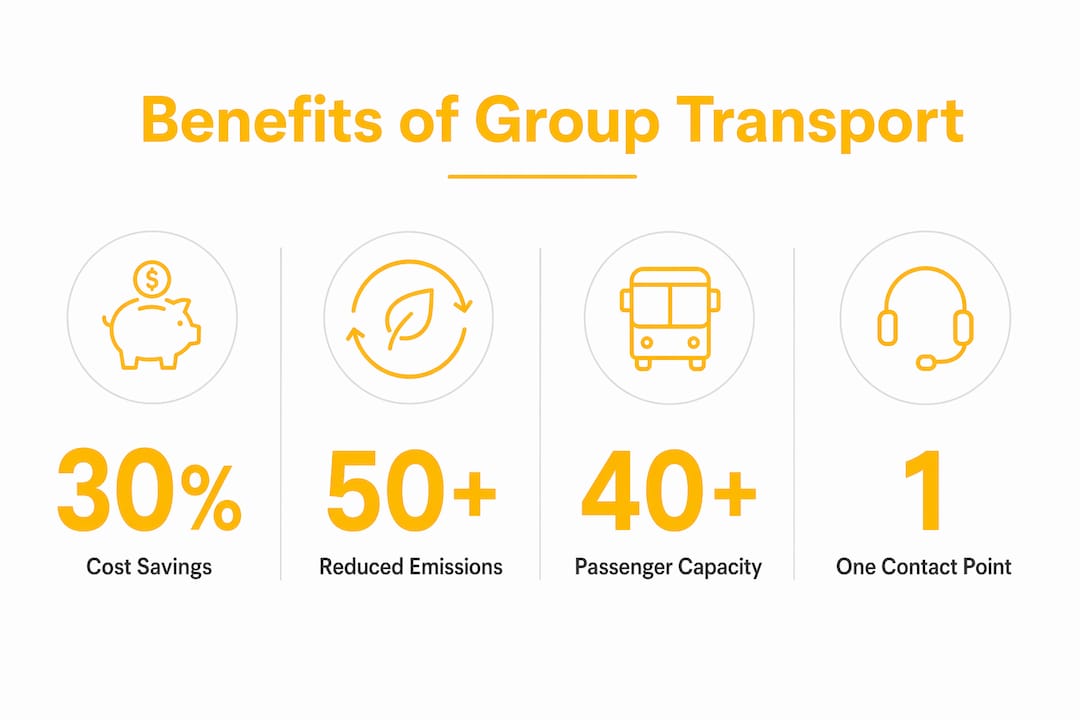
Charter bus rental costs are typically lower per passenger than flights, rental cars, or multiple private vehicles combined. The savings come from a straightforward principle: one vehicle, one fuel bill, one driver, split across every seat on the bus.
When you arrange group transport, you eliminate several hidden costs that individual travel quietly accumulates:
- Parking fees at venues, airports, and hotels add up fast, especially in Toronto’s downtown core.
- Multiple fuel charges across several cars cost far more than a single tank for a coach.
- Coordination time spent chasing down late arrivals or managing separate itineraries has a real dollar value for any organisation.
- Rental car deposits and insurance multiply with every additional vehicle your group books.
Organisations save on per-person cost and administrative overhead by consolidating travel into one vehicle. That consolidation also simplifies payment: one invoice, one point of contact, one confirmation.
Pro Tip: Book your group transport at least four to six weeks before your event date. Early bookings give you more vehicle options and better rates, particularly during peak seasons like june through september in Toronto.
The indirect savings are just as real as the direct ones. When your group travels together, you spend less time managing logistics and more time focused on the event itself. For corporate planners, that recovered time has measurable value.
What environmental benefits does group transport offer?
Group transport is one of the most effective tools available for reducing the carbon footprint of large events. The numbers are striking: a 12-metre motorcoach carrying just 11 riders already produces fewer greenhouse gas emissions than a single private automobile. That efficiency multiplies dramatically when the coach carries 40 or more passengers.
Motorcoach travel is widely recognised as a carbon bargain. Driving alone in an SUV produces the largest carbon footprint among common travel modes, while motorcoaches and trains sit at the opposite end of the scale. For event planners with sustainability goals, this distinction matters.
The environmental case for group transport goes beyond emissions per kilometre:
- Urban congestion drops when dozens of individual cars are replaced by one coach. Fewer vehicles on the road means less idling, less fuel waste, and cleaner air near event venues.
- Parking demand shrinks significantly, which reduces the land and energy used to manage large event footprints.
- Electric fleet growth strengthens the case further. Research from McMaster University shows that full electric transit buses could reduce emissions by more than 92% compared to diesel equivalents. Canada’s electric grid and manufacturing capacity position it well to lead this transition.
Choosing group transport is not just a logistical decision. For organisations with environmental commitments, it is a concrete, measurable action that supports climate goals without requiring any sacrifice in comfort or convenience.
How does group transport improve event logistics?
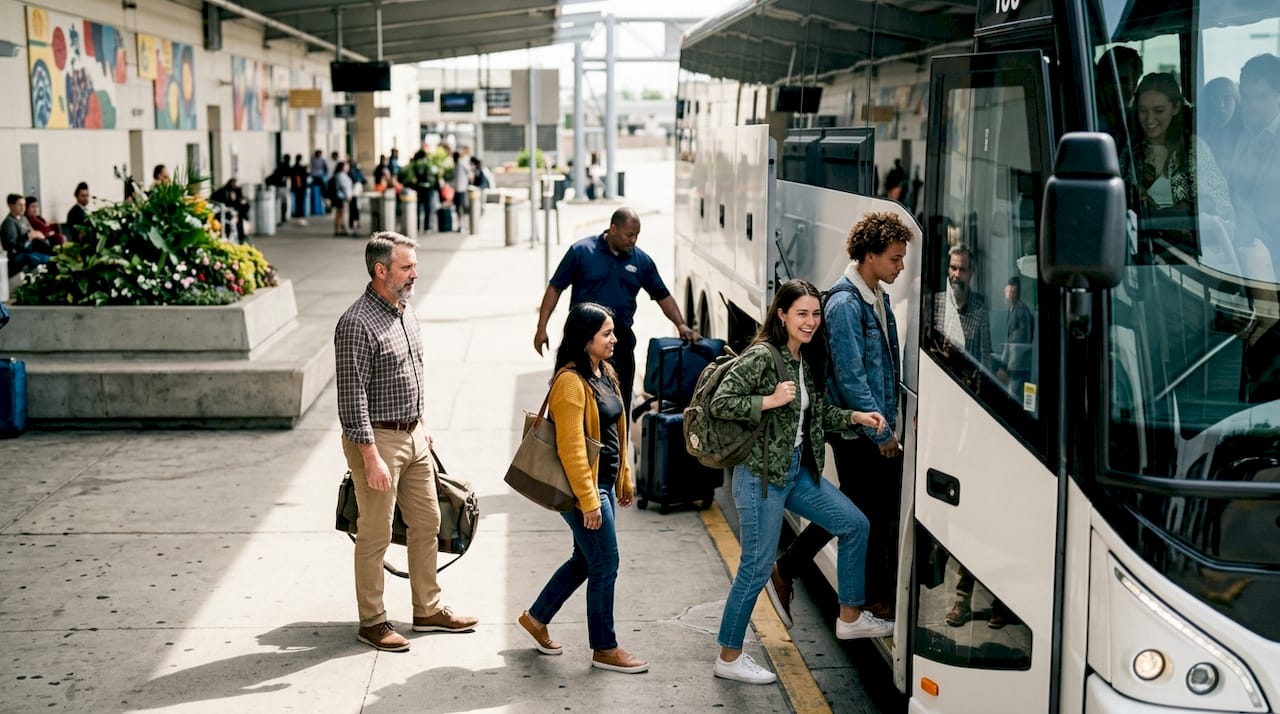
Coordinating multiple vehicles substantially increases the risk of delays and logistical failures. Group transport keeps all travellers on the same vehicle, which simplifies timing, communication, and the overall flow of your event.
The practical advantages show up at every stage of planning:
- Single departure point. Everyone boards at one location at one time. There is no confusion about which car to follow or which route to take.
- Unified arrival. Your group walks in together, which matters for corporate events, weddings, and sports outings where timing and first impressions count.
- Real-time communication. When your group is on one vehicle, a single announcement reaches everyone. No group chats, no missed calls, no stragglers.
- Reduced organiser stress. You manage one driver and one schedule instead of a rotating cast of volunteers navigating unfamiliar routes.
- Venue coordination. Coordinated shuttle services reduce the footprint of large events and help venues manage arrivals more effectively.
Pro Tip: Share the driver’s contact number with your group the day before the event. A single point of contact for last-minute questions prevents confusion and keeps your schedule intact.
For large events in Toronto, where traffic and parking are genuine constraints, the logistics advantage of group transport is not a minor convenience. It is the difference between an event that runs smoothly and one that starts 45 minutes late because half your guests are circling for parking.
What are the main group transportation options?
Group transport options vary by vehicle size, amenities, and comfort level to suit different group sizes and event requirements. Choosing the right vehicle type is as important as choosing the right date.
| Vehicle type | Capacity | Best suited for | Key features |
|---|---|---|---|
| Minibus | 10–20 passengers | Small corporate groups, airport transfers, intimate events | Compact, easy to park, cost-effective for small groups |
| Standard coach | 36–46 passengers | Corporate outings, school trips, sports teams | Climate control, reclining seats, luggage storage |
| Full-size motorcoach | Up to 50 passengers | Large events, multi-stop tours, weddings | Onboard restrooms, Wi-Fi, premium seating |
| Shuttle service | Varies | Recurring venue-to-venue transfers, conferences | Flexible scheduling, high-frequency runs |
Minibuses serve groups of 10–20 passengers and work well for airport transfers, small corporate teams, or intimate social events. Standard coaches in the 36–46 passenger range cover most corporate outings, school trips, and sports team travel. Full-size motorcoaches accommodate up to 50 passengers and add amenities like onboard restrooms, Wi-Fi, and premium seating for longer journeys.
The right match depends on three factors: group size, trip duration, and the level of comfort your group expects. A 45-minute transfer to a venue calls for different priorities than a four-hour trip to Niagara Falls. For multi-day or cross-border travel, a full-size motorcoach with onboard facilities is the clear choice. For a quick corporate shuttle across Toronto, a minibus keeps costs down without sacrificing reliability.
When evaluating providers, ask specifically about driver credentials, vehicle age, and what happens if a mechanical issue arises on the day of your event. A reliable provider answers those questions directly and without hesitation.
For events that include catering or food service alongside transport, coordinating with event catering specialists who handle large groups can round out your logistics planning effectively.
Key takeaways
Group transport is the most cost-effective, environmentally responsible, and logistically sound choice for moving groups of ten or more people to any event or destination.
| Point | Details |
|---|---|
| Cost sharing reduces per-person spend | One vehicle splits fuel, parking, and rental costs across every passenger. |
| Motorcoaches are a carbon bargain | A full coach produces far fewer emissions per passenger than individual SUVs or flights. |
| Unified travel simplifies event logistics | One departure point and one arrival eliminates the coordination failures that delay events. |
| Vehicle type must match group size | Minibuses suit 10–20 passengers; full-size motorcoaches serve up to 50 with added amenities. |
| Early booking protects your options | Booking four to six weeks out secures better rates and more vehicle choices. |
What I’ve learned from watching group transport go wrong
Firoz here. After years of working with event planners and corporate clients across Toronto, the pattern I see most often is this: groups underestimate their size and overestimate their ability to self-coordinate.
A team of 22 people will confidently say they can manage with personal vehicles. Then the event day arrives, three people are stuck in traffic on the Gardiner, two others went to the wrong entrance, and the organiser is fielding phone calls instead of running the event. It is a predictable failure, and it is entirely avoidable.
The second mistake I see is choosing a vehicle based on the minimum headcount rather than the comfortable headcount. A 20-passenger minibus filled to capacity with luggage and equipment is not a comfortable ride. Booking one size up costs marginally more and makes a real difference in how your group feels when they arrive.
The environmental angle is one that more corporate clients are starting to take seriously, and rightly so. When a company replaces 15 individual car trips with one motorcoach, the emissions reduction is not symbolic. It is concrete and reportable. For organisations with sustainability commitments, that matters to stakeholders.
My honest advice: treat group transport as a core part of your event plan, not an afterthought. The providers worth working with will ask you detailed questions about your schedule, your group’s needs, and your contingency plan. If a provider just quotes you a price without asking those questions, keep looking.
— Firoz
Group transport solutions from Torontobusrentals
Planning a group event in Toronto and need reliable, comfortable transport? Torontobusrentals offers a full range of vehicles, from compact minibuses for smaller gatherings to full-size motorcoaches for large corporate and social events.

Whether you are organising a school trip, a corporate outing, a wedding, or a sports team transfer, Torontobusrentals matches your group size and event needs with the right vehicle and an experienced driver. The fleet covers everything from 18-passenger shuttles to 47-passenger school buses, with professional service built around your schedule. Reach out to Torontobusrentals to get a quote and confirm availability for your event date.
FAQ
What is group transport and who uses it?
Group transport is the movement of multiple people together in a shared vehicle such as a charter bus, minibus, or shuttle. It is used by corporate teams, schools, wedding parties, sports teams, and event organisers who need reliable, coordinated travel.
How much does group transport cost compared to individual travel?
Group transport costs less per person than booking individual rental cars, flights, or taxis because fuel, driver, and vehicle costs are shared across all passengers. The savings grow with group size.
How many people do you need for group transport to make sense?
Group transport becomes cost-effective and logistically practical for groups of ten or more people. Minibuses serve groups of 10–20, while full-size coaches accommodate up to 50 passengers.
Is group transport better for the environment than individual cars?
A motorcoach carrying 40 or more passengers produces significantly fewer greenhouse gas emissions per person than individual SUVs or flights. Full electric buses could reduce emissions by more than 92% compared to diesel models.
How far in advance should you book group transport?
Booking four to six weeks before your event date is recommended. Early booking secures better rates, more vehicle options, and gives your provider time to plan the route and logistics properly.
Recommended
- What is private group transport? Your complete guide
- Group transportation explained: efficient solutions for Toronto events
- Defining event group transportation for planners