
What is on-time transport for event bus rentals?
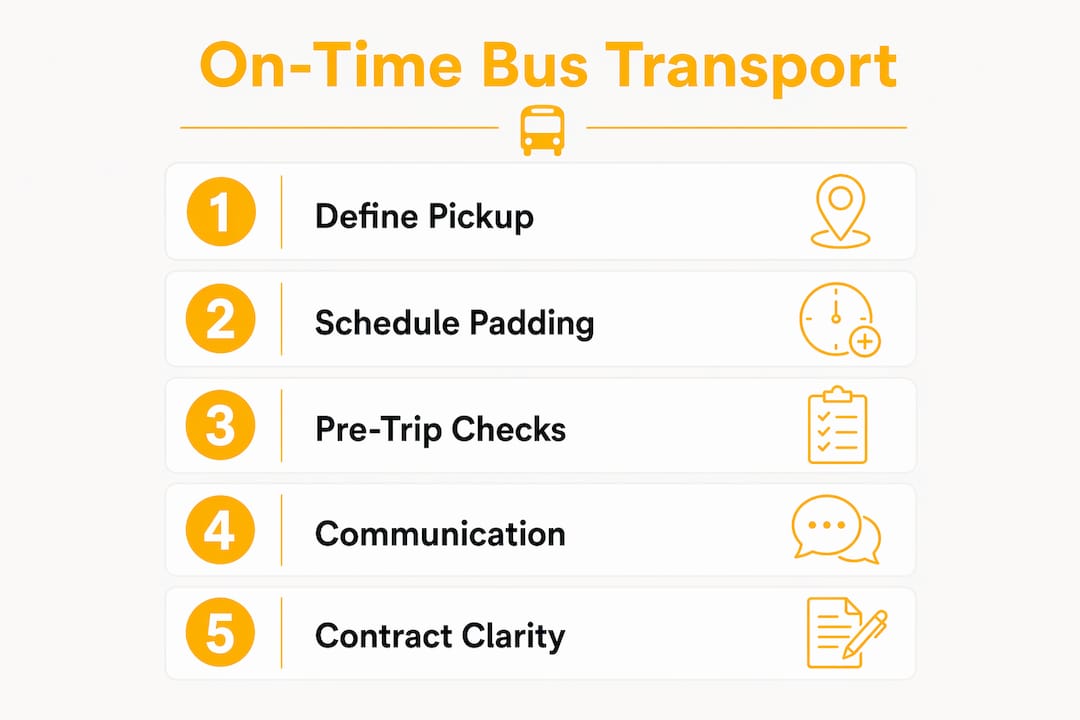
On-time transport means your vehicle and driver are ready to depart within an agreed pickup window, and every arrival is measured against a defined threshold — typically zero minutes early to five minutes late. That window is not a courtesy; it is a measurable commitment called on-time performance (OTP), expressed as a percentage of departures that meet it. Three actions lock it in from the start: confirm the exact pickup readiness time in writing, require pickup and drop-off windows in your contract, and request real-time GPS tracking for the event day. Torontobusrentals builds all three into every booking.
Table of Contents
- What does on-time performance actually look like?
- Why punctual group transport matters more than planners expect
- What causes late buses and how operators prevent them
- What your contract and pre-booking checklist should include
- How much schedule padding is actually enough?
- Day-of communication protocols that keep schedules on track
- How schedule tightness affects what you pay
- Toronto-specific factors that affect your schedule
- Key takeaways
- Why contract clarity matters more than most planners realise
- Reliable event transport starts with the right partner
- Useful sources
What does on-time performance actually look like?
On-time performance is expressed as a percentage of trips that meet a defined arrival or departure window. The most widely used threshold in group transport is zero minutes early to five minutes late — meaning a vehicle arriving four minutes late still counts as on time, but one arriving six minutes late does not. An operator running 80 of 100 departures within that window holds an 80% OTP.
Two metrics work together here. Runtime is the scheduled travel time between pickup points. OTP measures how often actual arrivals hit the schedule. Understanding both matters because runtime and OTP are complementary: a tighter runtime looks efficient on paper but drags OTP down when traffic intervenes.
Verification methods to request from your operator:
- GPS tracking logs with timestamped location data
- Driver manifest with recorded pickup and drop-off times
- Post-event OTP summary showing percentage of stops met within window
- Dispatch confirmation of driver arrival at staging zone before the scheduled pickup
You can also schedule bus pickups with defined windows built into the itinerary, which gives both you and the operator a shared reference point on the day.
| Metric | What it measures | Practical use |
|---|---|---|
| Runtime | Scheduled travel time between stops | Sets the baseline for realistic itineraries |
| OTP % | Share of departures within the agreed window | Benchmarks operator reliability |
| On-time threshold | Acceptable deviation (e.g., 0–5 min late) | Defines what counts as a late departure |
| Wait time | Time beyond scheduled departure held for passengers | Triggers overtime charges in most contracts |
Why punctual group transport matters more than planners expect
A late bus at the start of an event does not just inconvenience guests. It compresses every subsequent segment of your programme. A 20-minute delay at pickup can mean a missed venue slot, a catered meal served cold, or a speaker starting to an empty room. The role of transport in event planning is structural, not peripheral — it sets the tempo for everything else.
Operationally, lateness triggers costs. Drivers accumulate duty hours, overtime fees kick in, and last-minute vehicle swaps (when available at all) carry premium pricing. Reputationally, guests remember the bus that was late far longer than the dinner that was excellent. For professional event organisers, a single high-profile transport failure can follow them into the next client conversation.
What causes late buses and how operators prevent them
The most common causes of late departures are traffic congestion, boarding delays, route diversions, vehicle mechanical issues, weather, and insufficient driver rest. Each one has a corresponding mitigation — and you should be asking about all of them at the quote stage.
Cause-and-mitigation pairs to confirm with your operator:
- Traffic congestion → padded runtimes on known congestion segments, not uniform padding across every leg
- Boarding delays → pre-distributed passenger manifest, designated boarding order, luggage staging area
- Route diversions → driver route briefing completed before departure, alternate route pre-loaded in GPS
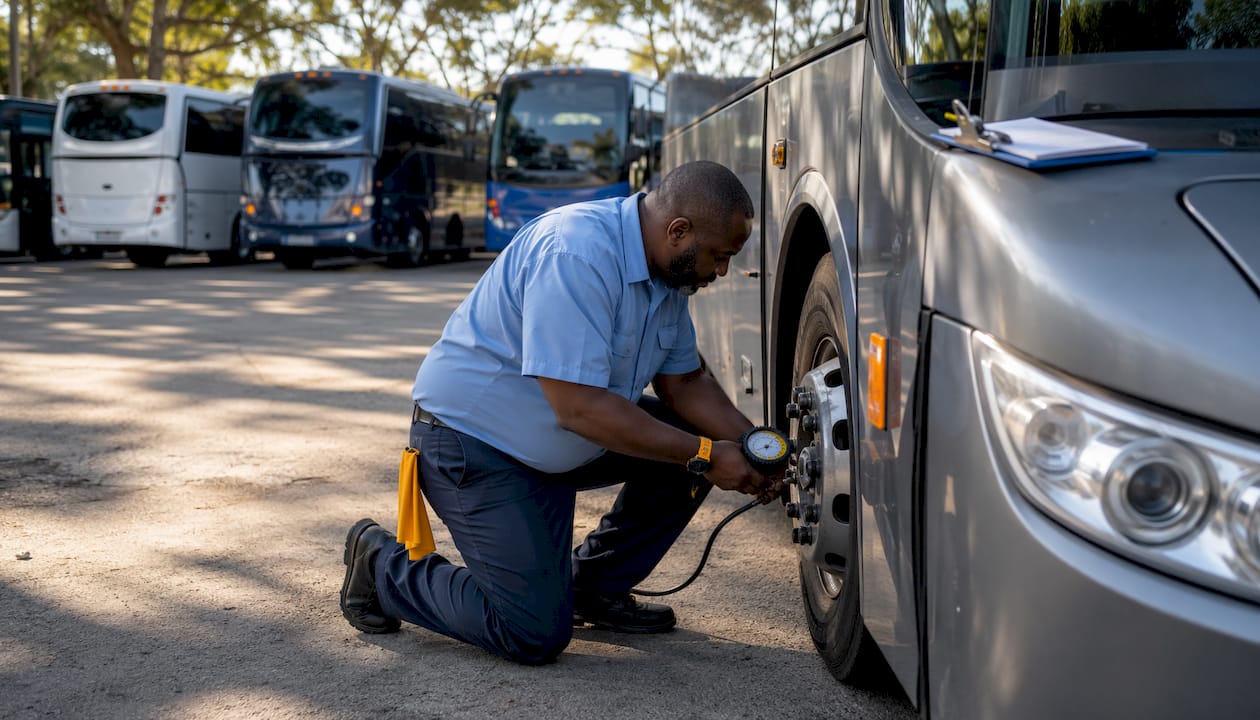
- Mechanical issues → documented pre-trip vehicle inspection, contingency vehicle on hold for large events
- Weather → adjusted departure times communicated 24 hours in advance, real-time dispatch monitoring
- Driver fatigue → confirmed rest period between shifts, duty-hour log available on request
Pro Tip: Ask your operator whether pre-trip vehicle checks are documented. Driver readiness and pre-trip inspections are low-cost mitigations that cut the most common causes of event-day delays — and a reputable operator will have the paperwork to prove it.
What your contract and pre-booking checklist should include
Booking lead time shapes your options. Industry guidance suggests booking well ahead for typical events, and substantially earlier for peak months like May and December. Leave that too late and you lose negotiating room on both price and contract terms.
Pre-booking checklist:
- Finalised passenger manifest with names and accessibility needs
- Confirmed pickup addresses with landmarks and staging instructions
- Luggage policy communicated to all passengers in advance
- Accessibility requirements noted (mobility devices, ramp-equipped vehicles)
Contract clauses to require:
- Defined pickup window with a specific “driver ready by” time
- Acceptable arrival deviation (e.g., 0–5 minutes late)
- Wait-time fees: rate per hour and when the clock starts
- Overtime rate and billing increment (per 15 minutes, per 30 minutes)
- Contingency vehicle provision for groups over a defined size
- Cancellation window and refund terms
- OTP reporting commitment for multi-stop itineraries
Questions to ask at the quote stage:
- Is GPS tracking included, and can I access it live on the day?
- How many years has the assigned driver operated in Toronto?
- Are vehicle maintenance records available on request?
- Who handles loading-zone permits for our venue?
The event transportation checklist from Torontobusrentals covers these items in a format you can adapt directly for your next booking.
How much schedule padding is actually enough?
More padding raises OTP, but too much padding reduces efficiency and can create unrealistic expectations for drivers on long event days. The goal is selective padding: add buffer where congestion or complexity is predictable, not uniformly across every leg.
Padding rules of thumb by trip type:
- Short inner-city shuttles: Add moderate padding per leg during peak hours; none required off-peak for straightforward routes.
- Medium inter-borough trips: Add padding for known congestion windows; build in a stop buffer per scheduled rest stop.
- Long out-of-town journeys: Add padding for the first leg and additional time per subsequent stop; confirm rest-stop timing with the driver in advance.
- Boarding time: Allocate roughly one minute per passenger for boarding; scale proportionally for larger groups.
Pro Tip: Build one true buffer block into your daily itinerary — a dedicated slack slot, not spread across every leg. One late segment will not cascade into the rest of your programme if that buffer exists. Place it after the highest-risk leg, usually the first pickup or the post-event egress.
Planners who arrive 30 minutes before the driver to handle manifest reconciliation and luggage staging consistently achieve cleaner departures than those who arrive with the group.
Day-of communication protocols that keep schedules on track
Clear communication on the event day is the difference between a schedule that holds and one that unravels at the first delay. Integrated dispatch and communication platforms reduce coordination errors and give you real-time visibility — request them explicitly when booking.
Suggested communication timeline:
- 48 hours before: Confirm driver name, vehicle plate, and staging location in writing
- 24 hours before: Send passenger one-page itinerary with arrive-by times, luggage limits, and boarding order
- 2 hours before: Group SMS reminder with pickup location and arrive-by time
- 30 minutes before: Driver check-in confirmation at staging zone
- On departure: Headcount against manifest before doors close
A single organiser backup contact — someone the driver can reach if the primary planner is unavailable — prevents the most common day-of communication breakdown. Tools like scheduling and dispatch coordination apps can centralise these touchpoints so nothing falls through the gaps.
Passenger instructions matter as much as operator readiness. Guests who know their arrive-by time (not just departure time), their luggage limit, and their boarding position board faster and with fewer questions.
How schedule tightness affects what you pay
Tighter schedules cost more. Less operational slack means a higher probability of overtime, and operators price that risk into quotes for events with compressed timelines. Common contract add-ons include waiting time charged at the operator’s hourly rate, overtime for drivers beyond the contracted hours, additional mileage, and after-hours staging or parking fees.
Charges to clarify before signing:
- Waiting time: hourly rate and when the clock starts (scheduled departure or actual driver arrival)
- Overtime: rate per increment and maximum billable hours
- Extra mileage: per-kilometre rate beyond the quoted route
- Staging fees: parking or holding costs at event venues
Negotiation tips: Ask for a capped wait fee so a delayed guest cannot generate unlimited charges. Request a single flat overtime rate rather than a tiered structure. Clarify exactly how billing time is measured — clock start and stop — in writing.
Vehicle choice also affects cost and timing. Coach buses suit longer trips and carry amenities that reduce passenger fatigue; minibuses work better for short, flexible routes where boarding speed matters more than comfort.
Toronto-specific factors that affect your schedule
Toronto’s morning rush runs roughly 7:00–9:30 AM and the afternoon peak from 4:00–6:30 PM on weekdays. Post-event egress from Scotiabank Arena, Rogers Centre, or the Exhibition grounds can add 30–45 minutes to downtown pickups — plan for it, not around it.
Loading-zone access at major venues often requires advance coordination with venue operations staff or a City of Toronto permit for private staging. For multi-vehicle events, confirm whether your pickup zone can accommodate the full fleet simultaneously or whether staggered arrivals are needed.
Pro Tip: For accessible transport, build extra boarding time into your schedule — mobility device securement adds 5–10 minutes per passenger. Confirm ramp-equipped vehicle availability when you book, not the week before. Toronto’s municipal event rules may also require accessible vehicle ratios for publicly funded events.
Wedding and corporate event planners will find wedding logistics guidance useful for staging and pickup timing examples specific to Toronto venues.
Key takeaways
On-time transport for event bus rentals requires defined pickup windows, realistic padding, and contract clarity — without all three, lateness is a scheduling outcome, not a surprise.
| Point | Details |
|---|---|
| Define pickup windows in writing | Require a specific “driver ready by” time and an acceptable deviation (e.g., 0–5 min late) in every contract. |
| Use selective padding | Add buffer on high-risk legs only; plan 30 minutes of boarding time per 30 passengers. |
| Build one daily buffer block | A single slack slot after the riskiest leg prevents one delay from cascading through the full itinerary. |
| Confirm Toronto-specific factors | Account for rush hours, venue staging permits, and accessible vehicle requirements before finalising your schedule. |
| Book with Torontobusrentals | Torontobusrentals provides GPS tracking, contract-ready pickup windows, and accessible fleet options for Toronto events. |
Why contract clarity matters more than most planners realise
The most common mistake I see event planners make is treating the transport contract as a formality rather than a risk document. A vague pickup time (“morning departure”) is not a commitment — it is an invitation to dispute. The same goes for overtime language: if the contract does not define when the clock starts, you have no leverage when the bill arrives.
Padding is the other underestimated variable. Planners often cut it to make the itinerary look tighter and more professional. The result is a schedule that works perfectly in a spreadsheet and falls apart the moment a guest is five minutes late to the staging zone. Realistic padding, applied selectively to the legs where congestion or complexity is predictable, is what separates a schedule that holds from one that requires constant improvisation.
Torontobusrentals prioritises pre-trip vehicle checks and driver briefings precisely because these steps cost almost nothing but prevent the failures that cost planners the most — a mechanical delay at pickup, a driver unfamiliar with the venue’s loading zone, a manifest that does not match the headcount. Contract clarity and operational preparation are not competing priorities. They are the same priority.
Reliable event transport starts with the right partner
When your event schedule has no room for a late bus, the operator you choose matters as much as the contract you sign. Torontobusrentals provides GPS-tracked, professionally driven group transport across Toronto with contract-ready pickup windows, wait-time terms, and accessible fleet options built in from the start.

Whether you are coordinating a corporate shuttle, a wedding convoy, or a multi-stop conference transfer, Torontobusrentals can review your draft itinerary for on-time risk before you finalise it. For high-capacity events, the motor coach options for Toronto groups include full SLA language and real-time dispatch support. Request a quote today and get a transport plan built around your schedule, not the other way around.
Useful sources
The claims in this article draw on the following sources. Use them to verify metrics, review planning frameworks, or adapt templates for your own events.
- On-time performance definition and measurement — Wikipedia overview of OTP thresholds and calculation methods across transport modes
- Runtime vs. on-time performance — Trapeze Software — backs the runtime/OTP trade-off and padding efficiency claims
- Group travel planning guide — QuatroBus — source for the 30-minute boarding rule of thumb, planner arrival timing, and daily buffer block insight
- Charter bus rental guide — booking lead-time recommendations (1–3 months standard; 6–9 months for peak periods)
- Operator terms and conditions — Groupbus — reference for waiting-time clauses, overtime fees, and contract add-ons
- Event transportation checklist for planners — Torontobusrentals — internal checklist resource planners can adapt for their own bookings
- How to assess bus rental quality — Torontobusrentals — guidance on evaluating fleet condition, driver qualifications, and safety records
Recommended
- Bus rental checklist for events: guide for Toronto planners
- Event transportation planning basics: a planner’s guide
- Event transportation checklist for planners: 2026 guide
- Role of transportation in event planning: 2026 guide