
What is multi-stop transport? A guide for Toronto event planners
Multi-stop transport is a chartered bus or shuttle that moves the same group through several scheduled pick-up or drop-off points under a single booking. One vehicle, one driver, one supplier to manage. For event planners in Toronto, that simplicity is the whole point: instead of coordinating a dozen rideshares or hoping guests find the right subway stop, everyone arrives together, on time, at every venue on the itinerary.
When does it make sense? Use it whenever your group must stay together across two or more locations and timing actually matters. Think wedding guests moving from hotel to ceremony to reception, corporate teams hitting three client sites in a day, or conference attendees shuttling between a hotel and a convention centre. The moment you have fixed arrival times at multiple points, multi-stop chartering is almost always the right call.
Two rules to lock in before anything else:
- Get an all-inclusive quote. Itemised add-ons (waiting time, parking, permits) can inflate a seemingly low base rate significantly on a complex route.
- Build the itinerary around your fixed events first. Ceremony start time, flight arrival, venue access window — those are your anchors. Everything else fits around them.
Table of Contents
- What is multi-stop transport used for?
- How is multi-stop transport priced?
- How do you plan a multi-stop itinerary?
- Which vehicle fits your multi-stop day?
- Common mistakes planners make with multi-stop transport
- Sample multi-stop itinerary template
- How to book multi-stop transport in Toronto
- Key takeaways
- A planner’s honest take on multi-stop days in Toronto
- Torontobusrentals: ready for your next multi-stop event in Toronto
- Useful sources
What is multi-stop transport used for?
The most common use cases share one trait: the group cannot split up without creating a logistics problem.
- Wedding guest transfers: hotel to ceremony, ceremony to reception, reception back to hotel. Three stops, one vehicle, no lost guests.
- Corporate off-sites and multi-venue days: teams visiting two or three office locations, a client site, and a dinner venue. A multi-stop charter keeps the schedule intact.
- Airport collections with multiple hotels: picking up delegates at Pearson, then dropping at three downtown hotels in sequence.
- Conference and trade-show shuttles: looping between a hotel block and a convention centre every 30–45 minutes.
- School excursions and sport team logistics: fixed departure windows, predictable group sizes, zero tolerance for stragglers.
- Wine tours and corporate social events: where groups must remain together across several venues for both safety and experience reasons.
When not to use it: very small groups (two or three people) with flexible timing, single-passenger airport runs, or highly spontaneous routing where a rideshare app is genuinely faster and cheaper. Multi-stop chartering earns its cost when synchronised arrivals matter and the group is large enough that splitting up creates real risk.
One underused tactic: consolidating pickups into a central assembly point rather than doing door-to-door collections. Fewer stops means less exposure to cascading delays and a lower overall charter time.
Pro Tip: If more than a third of your guests are coming from the same hotel or neighbourhood, designate that location as your primary pick-up point. You will cut 20–30 minutes off the route and reduce your quoted service hours.
How is multi-stop transport priced?
Pricing is rarely a flat rate. Providers calculate quotes from several variables, and understanding them lets you evaluate proposals side by side without surprises.
Primary price drivers:
- Total service hours (from vehicle dispatch to return)
- Mileage driven across all stops
- Waiting and standby time at each stop
- Vehicle type and passenger capacity
- Driver overtime if the day crosses regulated hour thresholds
- Permits, parking fees, or loading-zone costs at specific Toronto venues
Pricing models you will encounter:
- Hourly plus mileage: common for shorter or more flexible itineraries; costs climb quickly if stops run long.
- Point-to-point flat quotes: fixed price per leg; works well when timing is predictable.
- All-inclusive day rate: one number covers vehicle, driver, fuel, waiting time, and standard permits. For complex multi-stop days, all-inclusive pricing gives you the clearest picture of actual cost.
Worth knowing: experts recommend building a 15–30 minute buffer into every stop transition. A single stop running 20 minutes late can push every subsequent arrival off by 45 minutes or more once traffic and re-boarding are factored in. That buffer time is billable standby — so building realistic dwell times into your itinerary upfront is cheaper than paying overtime later.
One extra stop sounds minor. In practice, it adds drive time, standby time, and often a permit or loading fee. Ask your provider to model the cost difference between four stops and five before you finalise the route.
How do you plan a multi-stop itinerary?
Planning a multi-stop charter around real timing rather than rough estimates is what separates a smooth event day from a cascading series of delays.
Before you book, confirm:
- Final passenger count and any accessibility requirements
- Complete stop list with full addresses and venue contact names
- Loading zone availability and access windows at each stop
- Whether any venue has height or turning-circle restrictions
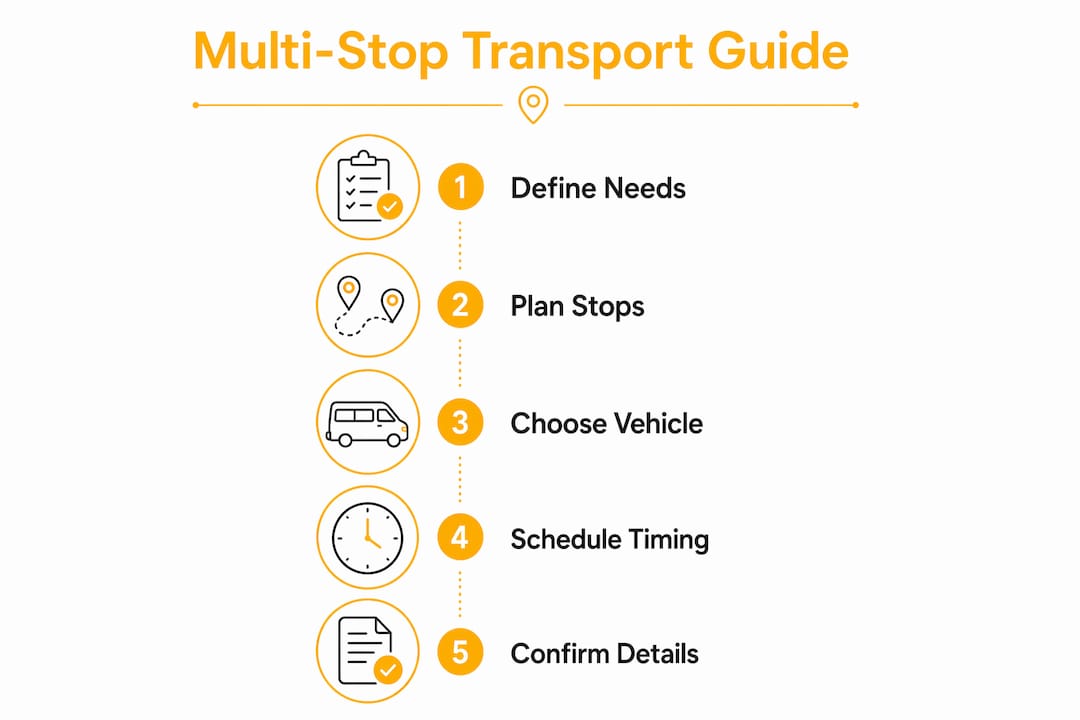
Build the schedule in this order:
- Lock in your fixed events: ceremony time, flight arrival, venue open time.
- Work backwards and forwards from those anchors to set departure windows.
- Add realistic dwell time at each stop. For 30 passengers, budget at least 30 minutes of boarding time; scale up for luggage or accessibility needs.
- Insert a 15–30 minute buffer between each transition.
- Identify where driver breaks fall and confirm they comply with regulations.
On the day:
- Designate a single point of contact who travels with the group and communicates directly with the driver.
- Send passengers a one-page brief: pick-up time, pick-up location, and what to do if they miss the bus.
- Have a contingency plan for one stop running long — know in advance which buffer you will absorb and which downstream stop can flex.
Pro Tip: Walk or drive each loading zone 24–48 hours before the event. Toronto venues vary widely in access: some have dedicated coach bays, others share a single lane with delivery trucks. Knowing this in advance prevents a 15-minute delay on the day.

Which vehicle fits your multi-stop day?
Vehicle choice follows group size, luggage volume, and how often passengers are reboarding. Matching the vehicle to the trip profile rather than just the head count saves money and avoids access problems.
Practical access constraints to check:
- Turning circle and lane width at each venue
- Loading-zone length (full coaches need more kerb space than minibuses)
- Door height and step height for passengers with mobility needs
- Whether an accessibility lift is required
| Vehicle type | Typical capacity | Luggage space | Urban access | Best for |
|---|---|---|---|---|
| Minibus (18-passenger) | mid-sized groups | Moderate | Excellent | Small groups, tight city stops, frequent reboarding |
| Mid-size coach | mid-sized groups | Good | Good | Mid-size groups, mixed urban/highway legs |
| Full-size coach (46–47 passenger) | large groups | Excellent | Limited at tight venues | Large groups, long-haul comfort, airport runs |
For groups under 20 with multiple urban stops, an 18-passenger minibus typically offers the best combination of access and cost. For 40-plus passengers or itineraries with significant luggage, a 47-passenger coach is the practical choice even if it requires pre-clearing loading zones.
Common mistakes planners make with multi-stop transport
Treating a coach like a private car. A 47-passenger coach cannot pull up to a restaurant entrance, wait five minutes, and move on. It needs a loading zone, a confirmed dwell window, and passengers ready to board. Fix: communicate exact boarding times to guests and assign someone at each stop to herd the group.
Underestimating boarding time. Groups with luggage, children, or elderly passengers take significantly longer to board than a planner imagines. A stop budgeted at 10 minutes can easily run 25. Fix: use the 30-passengers-equals-30-minutes rule as your baseline, then add time for any complicating factors.
Ignoring driver-hour thresholds. If your itinerary crosses regulated driving-hour limits, the contract will require a second driver or overtime rates. This is one of the most common sources of unexpected final billing. Fix: ask about the driver-hour threshold during the quote call, not after you receive the invoice.
Pro Tip: Ask every provider: “What happens if we run 90 minutes over?” The answer tells you whether overtime is billed by the hour, by the half-day, or as a flat penalty. That one question can save hundreds of dollars in surprises.
Sample multi-stop itinerary template
The table below shows an 8-hour event day with four stops. Drive and dwell times are illustrative; adjust for your specific Toronto route and group size.
| Scheduled time | Activity | Drive (min) | Dwell (min) | Buffer (min) |
|---|---|---|---|---|
| — | Depart Hotel A (primary pick-up) | — | 30 | 15 |
| — | Pick up at Hotel B | 20 | 15 | 10 |
| 10:10 | Arrive venue / conference centre | 15 | — | 20 |
| — | Depart for dinner venue | 25 | 90 | 15 |
| — | Return to Hotel A | 20 | 20 | 10 |
How to scale this for your event:
- Add 10 minutes of dwell time per additional 10 passengers above 30.
- For Toronto rush-hour legs (7–9 AM, 4–6:30 PM), increase drive estimates by 30–50%.
- If any stop involves luggage loading, add a separate 10–15 minute luggage window rather than absorbing it into dwell time.
- For groups using the group travel planning guide, cross-reference your timeline against the checklist there before finalising.
How to book multi-stop transport in Toronto
Questions to ask every provider:
- Is the quote all-inclusive (fuel, driver, waiting time, permits)? What triggers additional charges?
- What is the driver-hour threshold, and what are the overtime or second-driver costs?
- Does the driver have experience with Toronto loading zones and event venues?
- What insurance and operating licences does the company hold?
- Are accessible vehicles or lifts available if needed?
- What are the cancellation and amendment terms?
Trust signals to request:
- Published fleet descriptions with capacity and amenity details
- Safety procedures and driver vetting policies
- Sample contract or service agreement
- References or case studies from Toronto events of similar scale
Reviewing a provider’s group transportation logistics guide before your first call gives you a baseline for what a prepared local operator should already know.
Handling last-minute changes on the day:
- Confirm the driver has a direct mobile number for your on-site contact.
- Agree in advance on how additional stops or extended waiting time will be billed.
- If a stop is cancelled, notify the driver at least 30 minutes before the scheduled departure from the previous stop to avoid standby charges.
For international planning benchmarks, how operators handle group transport logistics in other markets offers useful context on what best-practice booking checklists look like.
Key takeaways
Multi-stop transport works when you anchor the itinerary to fixed events, build realistic buffers at every stop, and get an all-inclusive quote before committing.
| Point | Details |
|---|---|
| Definition | A chartered bus serving multiple pick-up/drop-off points under one booking, managed by one supplier. |
| Top pricing drivers | Service hours, mileage, standby time, vehicle type, and driver overtime are the main cost variables. |
| Buffer rule | Add 15–30 minutes between every stop transition to prevent cascading delays across the itinerary. |
| Vehicle match | Choose by luggage volume and access constraints, not head count alone; minibus for tight urban stops, full coach for 40-plus. |
| Torontobusrentals | Offers all-inclusive quotes, a mixed fleet (minibus to 47-passenger coach), and local Toronto loading-zone experience. |
A planner’s honest take on multi-stop days in Toronto
The biggest gap between a multi-stop plan that works and one that falls apart is almost never the route. It is the assumptions baked into the timeline. Planners consistently underestimate how long 40 people take to board a coach after a three-hour dinner, or how a single venue running 20 minutes late turns into an hour of compounding delays by the end of the night.
The fix is not more detailed spreadsheets. It is building the itinerary the way experienced operators do: start with the times that cannot move, add honest dwell windows, then insert buffers as a structural feature rather than an afterthought. A 15-minute buffer feels like wasted time on paper. On the day, it is the reason your guests arrive at the reception before the speeches start.
One more thing: the single point of contact rule is not optional. When the driver needs a decision and there are three people on the phone giving different answers, the bus sits still. Assign one person, give them authority, and make sure the driver has their number before the vehicle leaves the depot.
Torontobusrentals: ready for your next multi-stop event in Toronto
When your event itinerary has more than two stops and timing actually matters, you need a provider who already knows the loading zones, has the right vehicle for your group size, and will give you one number that covers everything.

Torontobusrentals operates a mixed fleet across Toronto, from compact 18-passenger minibuses for tight urban routes to 46-passenger coaches for large corporate and wedding groups. Every quote is all-inclusive: vehicle, driver, fuel, and standard waiting time, with no hidden permit or standby fees added after the fact. The team handles itinerary review, loading-zone checks, and on-day driver communication so your single point of contact has one number to call if anything shifts. Get your group transportation quote and send through your stop list — the team will come back with a route-specific price and any access flags worth knowing before the day.
Useful sources
Pricing, buffers, and driver-hour guidance:
- Group Transportation Planning Guide — all-inclusive pricing models and central pick-up point strategy
- How to Plan a Multi-Stop Charter — real-timing principles, cascading delay risk, and 15–30 minute buffer recommendation
- Charter & Shuttle Bus Rental Knowledge Centre — driver-hour thresholds and secondary-driver cost triggers
Vehicle selection and group travel planning:
- How to Plan Group Travel by Bus — vehicle-to-group matching and dwell-time planning by passenger count
- Ideal Multi-Stop Itineraries — use-case examples for corporate off-sites, wine tours, and wedding transfers
Toronto-specific trust signals and fleet details:
- Group Transportation Logistics Explained for Event Planners — Torontobusrentals planning guide and fleet overview
| Source | Supports |
|---|---|
| Charter a Coach planning guide | All-inclusive pricing, central pick-up strategy |
| Foxbus multi-stop charter guide | Buffer rules, real-timing principles, cascading delay |
| Holiday Coach knowledge centre | Driver-hour thresholds, overtime billing |
| QuatroBus group travel guide | Dwell-time planning, vehicle-to-group matching |
| Torontobusrentals logistics guide | Fleet descriptions, Toronto-specific trust signals |
Recommended
- Role of transportation in event planning: 2026 guide
- Defining event group transportation for planners
- How bus rentals streamline event logistics in Toronto