
What is comfort travel for groups: a Toronto planner’s guide
TL;DR:
- Comfort travel in group coach bookings means privately reserved transportation that reduces passenger fatigue and simplifies logistics. Key amenities include onboard restrooms, climate control, reclining seats, and well-planned rest stops, with operator discipline being essential. Proper documentation and advanced booking ensure safe, comfortable journeys tailored to each event type.
Comfort travel, in the context of group charter and coach bookings, means privately reserved transportation that removes every logistical burden from passengers so they arrive refreshed and ready. For event planners, that definition has three immediate implications: confirm the operator holds a valid CVOR (Commercial Vehicle Operator’s Registration) and adequate commercial liability insurance, verify that the coach includes an onboard restroom, reclining seats, and reliable climate control, and request a documented itinerary with scheduled rest stops before signing anything.
Before you read further, here is what to check first:
- CVOR and insurance — request the operator’s CVOR extract and insurance certificate before any deposit
- Core amenities — onboard restroom, reclining seats, and climate control are non-negotiable for trips over two hours
- Itinerary with rest stops — a comfort-focused operator plans these in advance, not on the fly
- Driver credentials — ask for proof of professional training and current licence class
- Torontobusrentals — offers group transportation services in Toronto covering all of the above
Table of Contents
- What does comfort travel actually mean for charter coaches?
- Which amenities should you request on a comfort coach?
- Why does comfort travel matter for your group?
- Which event types call for comfort travel?
- How do you plan and book comfortable group travel?
- What safety and compliance documents should you request?
- Day-of coordination checklist
- Key takeaways
- The part most planners overlook
- Torontobusrentals: group comfort transport built for Toronto events
- Useful sources for planners
What does comfort travel actually mean for charter coaches?
The phrase “comfort travel” gets used loosely, so it helps to define it by outcomes rather than marketing copy. A charter bus or motor coach qualifies as comfort travel when it reduces passenger fatigue, keeps a group productive or engaged on arrival, and simplifies logistics for the organiser. The vehicle is privately reserved for your group, which means no strangers, no fixed public-transit stops, and no coordinating a dozen separate cars.
Charter coaches are typically equipped with restrooms, reclining seats, climate control, Wi-Fi, and entertainment systems. Those features matter, but comfort travel is really about four categories working together:
- Vehicle design and seating — legroom, recline, headrests, and individual lighting
- Climate and air quality — consistent heating and cooling regardless of season
- Onboard services — restroom access, Wi-Fi, power outlets, tray tables
- Operator planning — route discipline, rest-stop scheduling, driver hours, and accessibility
One clarification worth making: this guide covers group coach and charter transportation. It has nothing to do with travel apparel, consumer packing products, or any other use of the phrase you may have encountered online.
Which amenities should you request on a comfort coach?
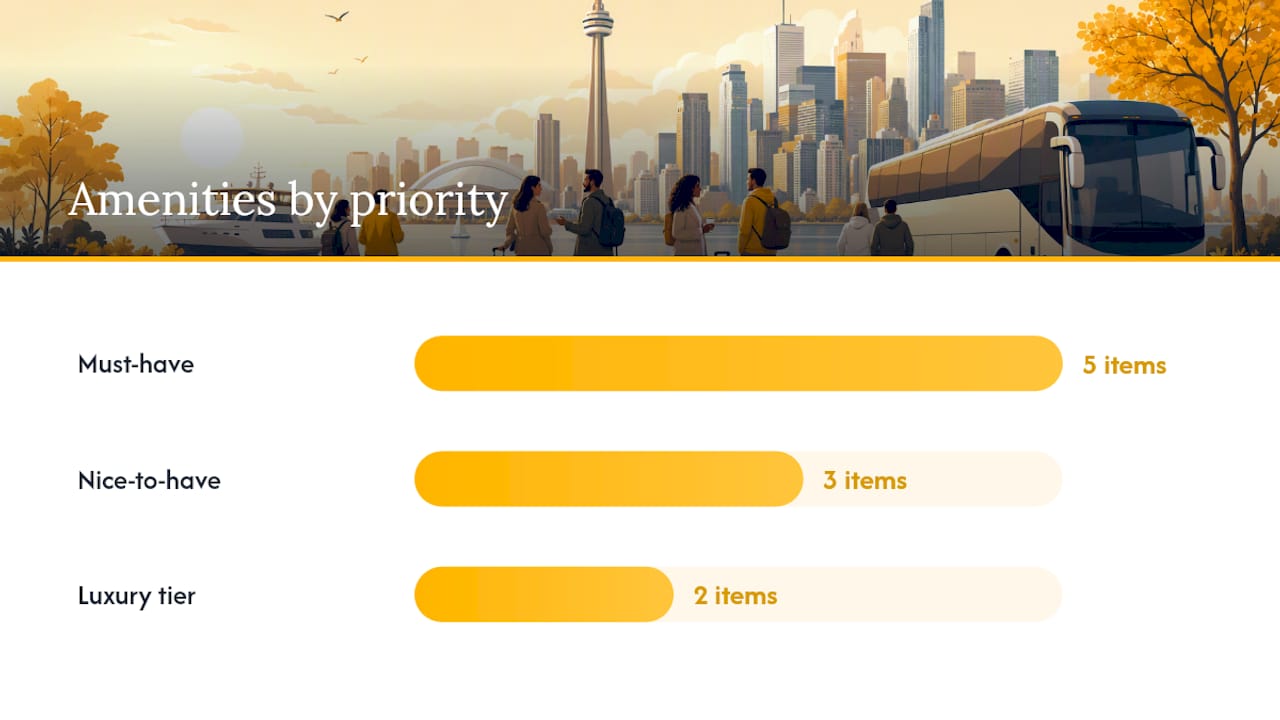
Not every amenity matters equally, and knowing the difference saves you money and avoids contract surprises. Here is a priority breakdown organisers can paste directly into an RFP.
Must-have (non-negotiable for any multi-hour trip)
- Onboard restroom — Canadian routes often have long stretches between service areas, making this mandatory rather than optional
- Reliable climate control — Toronto winters and humid summers both demand it
- Reclining seats with adequate legroom — the single biggest driver of passenger fatigue on runs over 90 minutes
- Seat belts on every seat
- Sufficient luggage capacity for your group’s gear
Nice-to-have (worth requesting, worth negotiating)
- Wi-Fi and power outlets — critical for corporate groups, less so for school trips
- Tray tables and individual reading lights
- USB charging ports at every seat
Luxury tier (event-specific)
- Private row or lounge seating configurations
- Premium catering or beverage service
Pro Tip: For trips under two hours within the Greater Toronto Area, you can reasonably trade Wi-Fi and tray tables for a lower rate. For anything over three hours or crossing into remote stretches, the onboard restroom and climate control move to the must-have column regardless of budget. Document every agreed amenity in the contract by name — “Wi-Fi available” is not the same as “Wi-Fi with guaranteed bandwidth.”
A full motor coach amenities checklist is available on the Torontobusrentals site and can be appended directly to your RFP.
Why does comfort travel matter for your group?
The central benefit is what industry practitioners call unburdening: when passengers are not driving, navigating, or hunting for parking, they arrive with their cognitive and physical energy intact. Bus companies position premium coach services on exactly this premise — reclining seats, generous legroom, power outlets, and complimentary Wi-Fi are not luxury add-ons but tools that keep people functional during the journey.
Chartering a coach removes driving responsibilities, reduces logistics overhead, and provides modern amenities designed for passenger comfort — turning travel time into productive or restorative time rather than a drain on the day.
For organisers, the practical payoff is measurable. Chartering reduces planning effort compared with coordinating multiple private cars or relying on public transit. Fewer moving parts means fewer delays, and fewer delays mean less liability exposure when a conference or ceremony has a fixed start time. Corporate charter services in Canada are specifically used to simplify logistics, improve employee experience, and reduce per-head transportation costs on group runs.
Which event types call for comfort travel?
Most group events benefit from a comfort-focused coach, but the specific priorities shift by use case.
- Corporate retreats and conferences — Wi-Fi and power outlets matter most; passengers often work en route
- School field trips and graduations — safety certification, seat belts, and driver credentials take priority
- Wedding guest transport — punctuality, clean interiors, and a polished vehicle appearance
- Sports team travel — luggage capacity for equipment bags and an onboard restroom for long away-game runs; Torontobusrentals offers dedicated sports team options sized for gear-heavy groups
- Multi-day tours — climate control, restroom, and overnight luggage storage become critical
- Airport shuttles — timing precision and luggage handling above all else
Each of these scenarios maps to a different amenity priority. Knowing your use case before requesting quotes means you get proposals that actually match your needs rather than a generic fleet list.
How do you plan and book comfortable group travel?
Criteria to confirm with every bid
- Passenger capacity and seat configuration
- Accessibility features (wheelchair lift, priority seating)
- Luggage specs (undercarriage bays, overhead storage)
- Full amenity list confirmed in writing
- Restroom availability and servicing schedule
- Driver hours, licence class, and training documentation
- Insurance limits and CVOR registration details
Questions to ask providers (paste into your RFP)
- “Can you provide your CVOR extract and current insurance certificate?”
- “What is the exact seat count and legroom measurement?”
- “Does the coach have a functioning onboard restroom? When was it last serviced?”
- “How do you schedule rest stops on a [X]-hour run?”
- “What is your deadhead distance policy and how is it priced?”
- “Who is the on-call contact if the vehicle has a mechanical issue en route?”
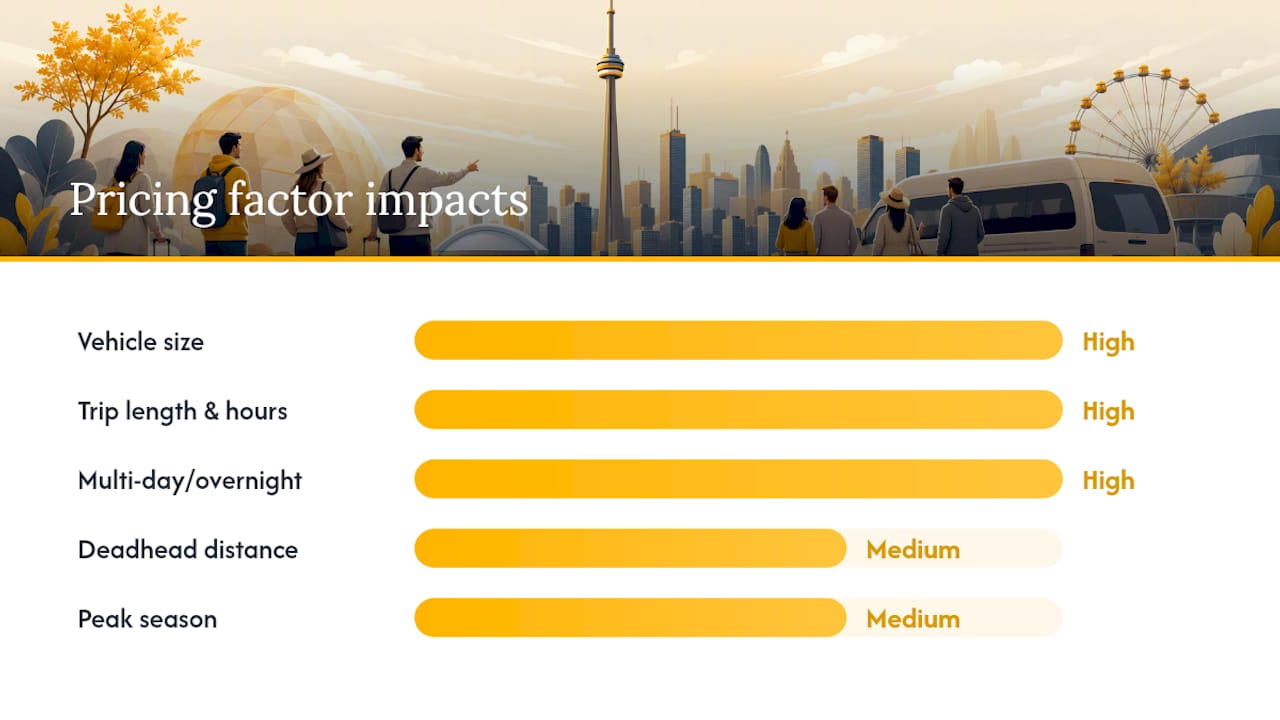
Pricing factors at a glance
| Cost driver | Impact level | Notes |
|---|---|---|
| Vehicle size (minibus vs. full coach) | High | Larger vehicles cost more per trip but less per seat |
| Trip length and hours | High | Billed by distance or by the hour depending on operator |
| Deadhead distance | Medium | Empty kilometres to/from your pickup point add cost |
| Multi-day or overnight | High | Adds driver accommodation and vehicle downtime fees |
| Peak season (summer, holidays) | Medium | Book earlier; rates rise with demand |
| Special permits or parking | Low–Medium | Downtown Toronto events may require event permits |
| Accessibility equipment | Low | Usually a modest add-on, not a major cost driver |
Timeline expectations
Book well in advance for standard Toronto-area runs. For multi-day trips, peak-season events, or larger groups, a longer lead time is recommended to ensure availability. Confirmation milestones to track: quote received, amenity list confirmed in writing, deposit paid, driver and vehicle assigned, final itinerary signed off.
Red flags in proposals: missing insurance details, vague CVOR references, no mention of rest-stop planning, and operators who cannot name the specific vehicle assigned to your booking.
For deeper guidance on choosing a motor coach for your event, Torontobusrentals has a dedicated planning resource.
What safety and compliance documents should you request?
Ontario operators running commercial passenger vehicles must hold a valid CVOR. That document is your first filter. Beyond it, request the following before any contract is signed:
- CVOR extract — confirms the operator is registered and in good standing with the Ontario Ministry of Transportation
- Vehicle inspection record — ask for the most recent pre-trip inspection and annual maintenance log
- Commercial liability insurance certificate — confirm coverage limits are appropriate for your group size and trip type
- Driver training documentation — professional training records and current licence class (Class B or C in Ontario for passenger vehicles)
- Fleet specifications — year, make, model, and photos of the specific vehicle assigned
Cross-check the CVOR number against the Ontario MTO’s public operator registry. Insurance certificates should show an expiry date beyond your event date. Driver licences should be current with no noted restrictions relevant to your route.
Day-of coordination checklist
A well-planned coach can still go sideways on the day without a clear boarding script. Follow these steps in order.
- Confirm arrival window — coach should arrive 20–30 minutes before boarding, not at departure time
- Assign a single on-site contact — one person handles all driver communication; avoid group-by-committee decisions
- Tag luggage before loading — colour-coded tags by destination stop prevent mix-ups on multi-stop runs
- Designate a loading crew — two people manage undercarriage bays; everyone else boards first
- Post clear signage — one sign at the boarding point with the vehicle description and departure time
- Brief passengers on onboard rules — food and drink policy, restroom schedule for long legs, phone etiquette
- Walk the coach before departure — check climate control, restroom, Wi-Fi, and seat recline are all functional
- Confirm rest stops with the driver — agree on timing and locations before pulling out of the lot
- Exchange contingency contacts — organiser’s mobile number with the driver; dispatcher’s number with the organiser
- Complete a post-drop handoff — confirm all passengers and luggage are accounted for before releasing the vehicle
Pro Tip: Run a three-minute coach check at handover: climate control on, restroom door opens and closes cleanly, Wi-Fi network visible on a phone, and every seat reclines. Takes less time than a coffee stop and catches 90% of day-of comfort failures before they become complaints.
For a full walkthrough of group transportation logistics, Torontobusrentals has a dedicated organiser resource.
Key takeaways
Comfort travel for groups means privately chartered coach transport that unburdens passengers through spacious seating, climate control, onboard services, and disciplined operator planning so every attendee arrives refreshed and ready.
| Point | Details |
|---|---|
| Define comfort by outcomes | Comfort travel reduces fatigue and simplifies logistics; verify amenities and operator planning, not just vehicle photos. |
| Must-have amenities | Onboard restroom, climate control, and reclining seats are non-negotiable for trips over two hours on Canadian routes. |
| Safety documents to request | Ask for the CVOR extract, vehicle inspection record, insurance certificate, and driver training proof before signing. |
| Book with lead time | Allow 4–6 weeks minimum for standard runs; 10 weeks for multi-day or peak-season events in Toronto. |
| Torontobusrentals | Offers coach, minibus, and shuttle options for corporate events, school trips, weddings, and sports teams across Toronto. |
The part most planners overlook
Comfort travel is not really about the seat width. Planners spend hours comparing legroom specs and Wi-Fi speeds, then hand the booking to an operator who has no documented rest-stop plan and a driver who has never run the route. That is where comfort actually breaks down.
The most underrated element in any group coach booking is operator planning discipline: how the dispatcher sequences rest stops, how they account for Toronto’s notoriously unpredictable traffic on the 401 or the Gardiner, and whether the driver has a contingency contact when something goes sideways. Physical amenities matter, but a well-maintained coach driven by an experienced operator who has pre-run the route will outperform a luxury vehicle with a disorganised dispatch every time.
The other thing planners consistently underestimate is the CVOR. Most treat it as a checkbox. It is actually a live performance record. Ontario’s Ministry of Transportation updates CVOR scores based on inspections, collisions, and convictions. An operator with a deteriorating CVOR score is telling you something about how they run their fleet — and that information is publicly verifiable before you pay a deposit.
Book the operator, not just the bus.
Torontobusrentals: group comfort transport built for Toronto events
Group travel in Toronto comes with real logistical pressure: downtown traffic, tight event timelines, and groups ranging from 18 to 46 passengers with very different comfort expectations. Torontobusrentals handles that range with a fleet that includes full-size 46-passenger coaches, minibuses, and accessible shuttle options, all with professional drivers trained for Toronto’s specific routes and conditions.

The fleet covers corporate events, school trips, weddings, sports team travel, airport shuttles, and multi-day tours. Every booking includes a documented itinerary, confirmed amenities, and a named driver contact before departure day. For corporate groups, transport options for Toronto outings are available with Wi-Fi and power as standard on full-size coaches.
Request a quote directly through the Torontobusrentals site and expect a response within one business day. Bring your group size, event date, and pickup/drop-off locations and the team will confirm vehicle availability, amenity specs, and pricing in a single exchange.
Useful sources for planners
- Ontario Ministry of Transportation — CVOR and operator licensing — verify operator registration status and CVOR standing
- Transport Canada — commercial passenger vehicle safety — federal safety standards and carrier regulations
- True North Living — how bus companies are redefining road travel — industry context on comfort positioning and amenity standards
- CheckMyBus — comfort considerations on Canadian routes — practitioner insight on rest stops and climate control for long-distance Canadian travel
- Torontobusrentals — why comfort matters in group bus rentals — operator perspective on comfort ROI for event planners
- Torontobusrentals — group transportation services overview — fleet options, vehicle sizes, and booking process
Recommended
- Why prioritize comfort in bus rentals for group travel
- Bus rentals for Toronto events: Cost, comfort, reliability
- Advantages of group travel: what you need to know
- Group travel planning: your complete 2026 guide