
What is accessible bus rental: Your guide to inclusive transport
Organising group transport for an event becomes significantly more complex when attendees use wheelchairs or mobility aids. Many event planners assume standard bus rentals automatically accommodate accessibility needs, only to discover critical gaps in safety features, securement systems, or compliance standards at the last minute. Accessible bus rental provides a specialised solution designed specifically to meet Ontario’s regulatory requirements while ensuring safe, dignified transport for individuals with mobility challenges. This guide explains what accessible bus rental truly means, the essential features that distinguish compliant vehicles, and practical steps to book reliable accessible transport in Toronto for your next event.
Table of Contents
- Key takeaways
- What is accessible bus rental and why does it matter?
- Key features and compliance standards of accessible buses
- Comparing private accessible bus rentals with public options in Toronto
- Booking practicalities and tips for event organisers in Toronto
- How Toronto Bus Rentals can support your accessible event transport needs
- Frequently asked questions
Key Takeaways
| Point | Details |
|---|---|
| Regulatory standards | Accessible buses in Ontario must meet RRO 1990 Regulation 629 and CSA D409 requirements to qualify as accessible transportation. |
| Safety features | Buses must include compliant wheelchair lifts or ramps with slip resistant surfaces and securement systems for safe boarding and travel. |
| Driver licensing | Operators and drivers must meet Ontario licensing requirements and training specific to accessible bus service. |
| Booking tips | Plan well in advance and verify insurance coverage and current compliance documents before finalising any accessible bus booking. |
What is accessible bus rental and why does it matter?
Accessible bus rental refers to the private charter or hire of buses specifically designed or modified to transport persons with disabilities in compliance with Ontario’s RRO 1990 Regulation 629 standards. These vehicles incorporate structural modifications, safety equipment, and operational features that enable individuals using wheelchairs, walkers, or other mobility aids to travel safely and comfortably. Unlike standard bus rental basics in Toronto, accessible rentals must satisfy rigorous technical specifications outlined in the Canadian Standards Association D409 standard, which governs wheelchair securement systems, lift mechanisms, and interior configurations.
Ontario Regulation 629 establishes mandatory requirements for accessible vehicles operating within the province. These include specifications for wheelchair lift dimensions, securement device strength, seat belt configurations, and driver visibility enhancements. Event organisers planning inclusive gatherings must understand these standards to ensure their chosen transport provider delivers genuinely accessible service rather than superficial accommodations.
Accessible bus rentals primarily benefit individuals who use wheelchairs, scooters, or walkers and cannot safely navigate standard bus steps or seating. This includes elderly attendees, people with permanent disabilities, and those recovering from temporary injuries. For event planners committed to inclusive experiences, accessible rentals eliminate barriers that would otherwise prevent participation.
Private accessible bus rental differs fundamentally from public transit accessibility services like Wheel-Trans or GO Transit. Public services operate on fixed routes and schedules with limited capacity for wheelchair users, while private rentals offer customised pickup locations, flexible timing, and dedicated capacity tailored to your event’s specific needs. When mastering bus rentals for events, understanding this distinction helps planners select appropriate transport solutions.
Common misconceptions about accessible buses include assuming any vehicle with a ramp qualifies as accessible or believing all rental companies maintain compliant fleets. Genuine accessibility requires comprehensive compliance with regulatory standards, not merely installing a single accessibility feature. Event organisers must verify specific compliance documentation rather than accepting general accessibility claims.
Pro Tip: Always request written confirmation that rental vehicles meet current CSA D409 standards and Ontario Regulation 629 requirements before finalising any accessible bus booking.
Key features and compliance standards of accessible buses
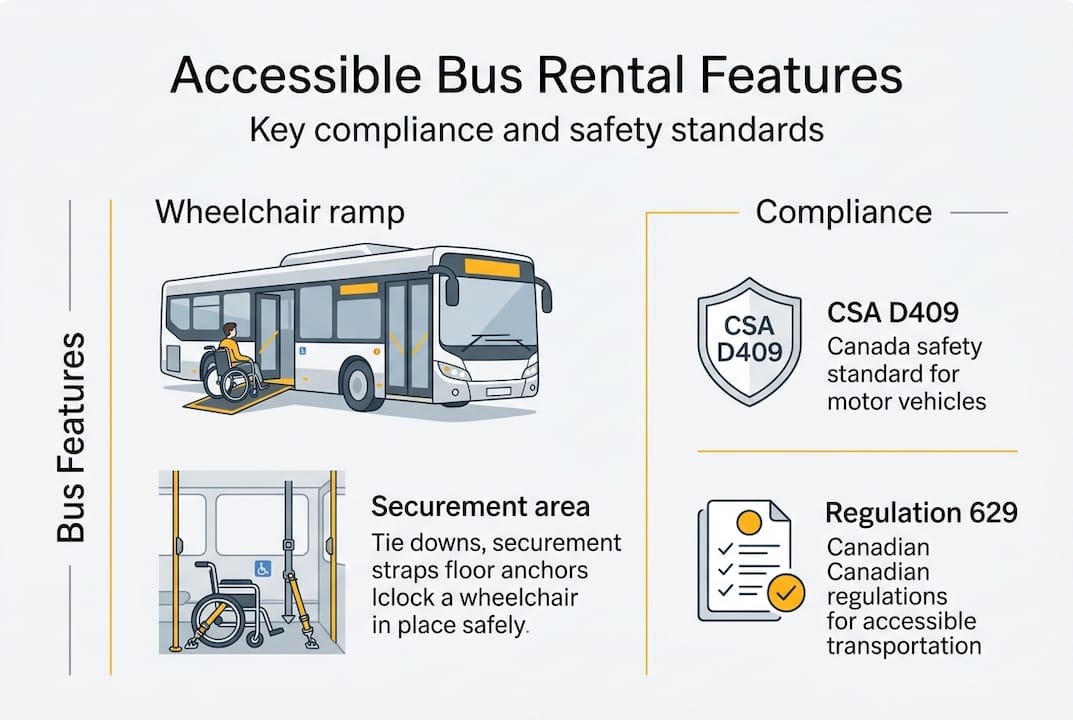
Compliant accessible buses incorporate multiple technical features working together to ensure safe transport. Wheelchair lifts and ramps must feature slip-resistant surfaces with secure raised edges to prevent wheelchairs from sliding during boarding. Lifts require weight capacity ratings clearly posted and regular maintenance certification. Ramps must deploy at safe angles, typically no steeper than 1:6 ratio, to allow independent boarding where possible.
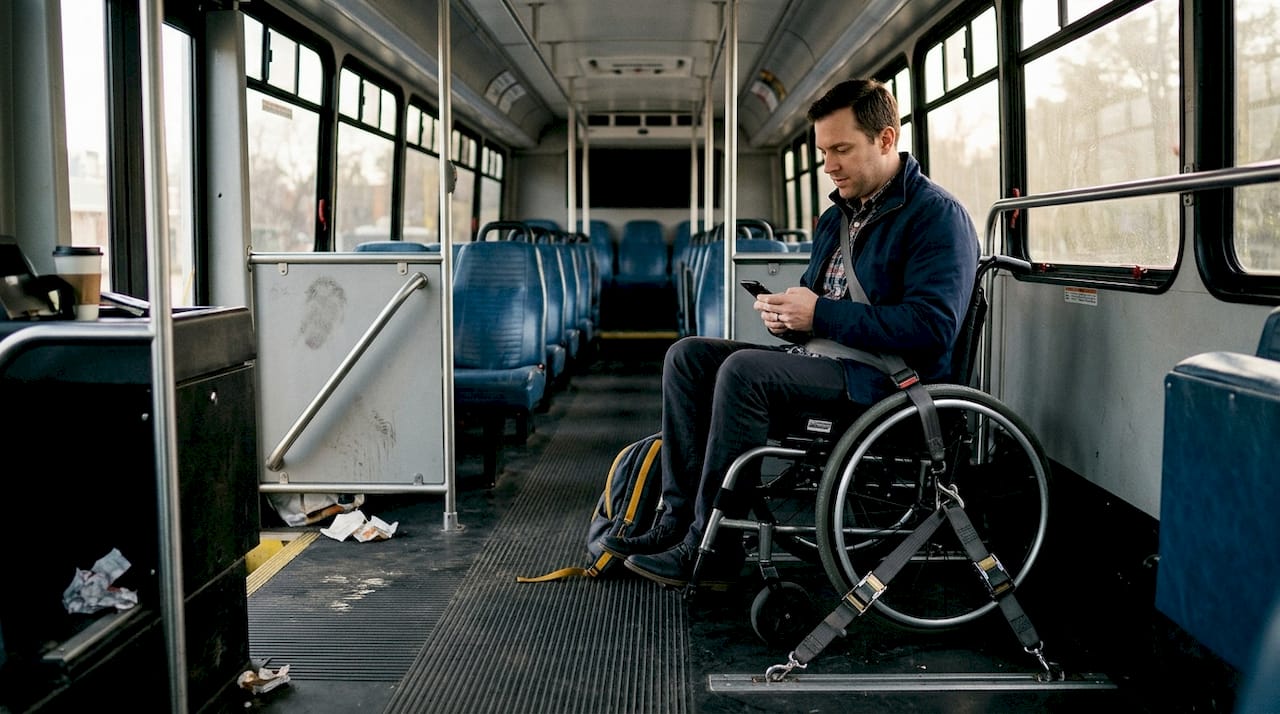
Securement areas within accessible buses provide designated spaces where wheelchairs anchor safely during transit. Ontario standards mandate specific dimensions for these areas, typically measuring at least 1,300 millimetres long by 800 millimetres wide to accommodate various wheelchair sizes. Each securement position requires four anchor points with high-tensile strength straps or clamps that limit forward, backward, and lateral movement during sudden stops or turns.
Safety equipment includes seat belts for wheelchair users, which must be separate from wheelchair securement devices. Drivers need enhanced visibility through specialised mirrors positioned to monitor wheelchair areas without leaving their seats. Interior lighting must illuminate securement areas adequately for safe boarding and disembarking during evening events.
Driver licensing requirements vary based on vehicle capacity and configuration. Operators of larger accessible minibuses carrying 10 to 24 passengers require Class F licensing, which mandates medical examinations and specialised training in passenger assistance and emergency procedures. Smaller accessible vans accommodating under 11 passengers require Class G licensing, though many providers mandate additional accessibility-specific training regardless of legal minimums. Understanding bus rental terminology helps clarify these licensing distinctions when evaluating providers.
Accessible vehicle securement specifications
| Feature | Specification | Purpose |
|---|---|---|
| Securement area dimensions | 1,300mm length × 800mm width minimum | Accommodates standard wheelchairs and small scooters |
| Anchor point strength | Minimum 1,350kg tensile strength per point | Withstands forces during emergency braking |
| Wheelchair lift weight capacity | 300–450kg typical range | Supports powered wheelchairs and occupant safely |
| Ramp deployment angle | Maximum 1:6 ratio (9.5 degrees) | Enables safe independent boarding |
| Seat belt configuration | Separate lap and shoulder belts | Provides occupant restraint independent of securement |
When chartering buses for Toronto events, verify that drivers hold appropriate licensing and have completed recent accessibility training. Ask providers to demonstrate securement procedures during vehicle inspections before finalising bookings.
Pro Tip: Request documentation showing the driver’s Class F or G licence, recent medical clearance, and completion certificates for accessibility training programmes within the past 12 months.
Comparing private accessible bus rentals with public options in Toronto
Toronto event planners face distinct choices when arranging accessible transport. Public transit services provide baseline accessibility, but private rentals offer advantages for event-specific needs. Understanding these differences helps you select appropriate solutions for your attendees.
Private accessible rental vs public transit comparison
| Factor | Private accessible rental | Public transit (GO Transit, TTC) |
|---|---|---|
| Wheelchair capacity | 1 to 6+ positions depending on vehicle size | Limited to 2 positions per bus |
| Scheduling flexibility | Fully customised pickup/drop-off times | Fixed route schedules |
| Route customisation | Door-to-door service to any accessible location | Limited to established transit routes |
| Cost structure | Per-trip or hourly charter rates | Per-person fare |
| Advance booking | Required, typically 48–72 hours minimum | Available for regular service; Wheel-Trans requires advance booking |
| Group coordination | Entire group travels together | Individuals travel separately on different vehicles |
Private accessible bus rentals excel for events requiring coordinated group arrival, such as weddings, corporate functions, or cultural celebrations. When your event timeline demands precise pickup and arrival times, private charters eliminate the unpredictability of public transit connections. The benefits of bus rentals for group travel multiply when accessibility needs require specialised equipment and trained assistance.
Public transit accessibility works well for individual daily commuting but presents challenges for event groups. GO Transit limits wheelchair securement to 2 positions per bus, meaning larger groups must split across multiple vehicles and coordinate separate arrivals. This fragmentation complicates event logistics and increases the risk of delayed or missed connections.
Retrofitting older buses to meet current accessibility standards presents significant technical and financial challenges. Structural modifications required for lift installation, floor reinforcement for securement anchors, and electrical system upgrades often exceed the vehicle’s remaining service value. Purpose-built accessible vehicles integrate accessibility features during manufacturing, resulting in superior safety, reliability, and compliance with Accessibility for Ontarians with Disabilities Act requirements. Event planners should prioritise providers operating purpose-built accessible fleets rather than retrofitted vehicles.
Cost considerations vary based on group size and event duration. Private accessible rentals typically charge hourly rates ranging from $150 to $300 depending on vehicle capacity, with minimum booking periods of 3 to 4 hours. For groups of 8 or more attendees requiring accessible transport, private charter costs per person often compare favourably to individual public transit fares, especially when factoring in coordination time and arrival reliability.
Exploring wheelchair accessible vehicle options in Canada reveals the range of purpose-built solutions available for different group sizes and accessibility requirements. When reviewing bus rental tips for events, prioritise providers who maintain modern, purpose-built accessible fleets with documented maintenance records.
Pro Tip: For events with 6 or more attendees using mobility aids, private accessible rentals typically deliver better value, reliability, and attendee experience than coordinating multiple public transit trips.
Booking practicalities and tips for event organisers in Toronto
Successful accessible bus rental bookings require attention to specific details that standard rentals may overlook. Follow these steps to ensure smooth, compliant transport for your event:
Contact rental providers 3 to 4 weeks before your event date, extending to 6 to 8 weeks during peak seasons (May through October, December holidays). Early booking secures vehicle availability and allows time for detailed accessibility planning.
Provide precise wheelchair and mobility aid dimensions to the rental company. Customers must inform providers of wheelchair dimensions to ensure compatibility with securement systems. Measure wheelchair length, width, and weight including the occupant, as securement areas have specific size and weight limits.
Confirm driver credentials by requesting copies of current Class F or G licensing, recent medical clearance certificates, and accessibility training completion documentation. Verify that assigned drivers have experience operating the specific accessible vehicle model you are booking.
Review cancellation policies carefully before signing contracts. Many accessible rental providers enforce strict cancellation terms, with cancellations under 2 hours incurring full charges due to the specialised nature of accessible vehicles and limited fleet availability.
Verify insurance coverage specifics, particularly regarding mobility aid damage. Standard rental insurance typically excludes mobility aid damage, meaning event organisers may need supplementary coverage if transporting expensive powered wheelchairs or medical equipment.
Conduct a pre-event vehicle inspection if possible. Visit the rental facility to examine securement systems, test lift or ramp operation, and confirm interior dimensions match your attendees’ needs. This inspection prevents surprises on event day.
Establish clear communication protocols with the rental company for event day coordination. Exchange mobile contact information for the driver, dispatcher, and event coordinator to enable real-time adjustments if pickup locations or timing require modification.
Confirm pickup and drop-off locations are genuinely accessible. Verify that venues provide level surfaces for ramp deployment, adequate clearance for lift operation, and accessible pathways between the vehicle stopping point and event entrance.
Understanding how to book charter buses provides foundational knowledge, but accessible bookings require additional verification steps. When exploring group transportation services, specifically request accessible vehicle options and confirm CSA D409 compliance in writing.
Additional fees may apply for extended waiting time, multiple pickup locations, or last-minute itinerary changes. Request a detailed written quote itemising all potential charges, including fuel surcharges, driver gratuity expectations, and overtime rates if your event extends beyond the initially booked hours. Comparing group transportation options for events helps identify providers offering transparent pricing without hidden accessibility surcharges.
Pro Tip: Book accessible bus rentals during weekday off-peak hours when possible. Weekend and evening rates typically run 20 to 30 percent higher, and vehicle availability decreases significantly during high-demand periods.
How Toronto Bus Rentals can support your accessible event transport needs
Planning inclusive events requires transport partners who understand both accessibility regulations and the practical realities of group coordination. Toronto Bus Rentals maintains relationships with accessible vehicle providers throughout the Greater Toronto Area, connecting event organisers with compliant, reliable transport solutions tailored to your specific needs.

Whether you are coordinating a corporate accessibility training session, a community celebration, or a wedding including guests with mobility challenges, experienced local providers familiar with Toronto venues and accessibility requirements deliver smoother event execution. Explore detailed information about group transportation services to understand capacity options, or review minibus rental options for smaller accessible groups. The comprehensive chartering buses guide walks through booking processes, timeline recommendations, and coordination strategies that ensure your accessible transport integrates seamlessly with overall event logistics.
Frequently asked questions
What is accessible bus rental?
Accessible bus rental is the private hire of vehicles specifically designed or modified to safely transport individuals using wheelchairs or mobility aids, meeting Ontario Regulation 629 and CSA D409 compliance standards. These vehicles feature wheelchair lifts or ramps, securement systems, and safety equipment that standard buses lack.
How can I confirm if a bus is truly accessible and compliant?
Request written documentation showing the vehicle meets current CSA D409 standards and Ontario Regulation 629 requirements. Ask for recent maintenance records for lifts and securement systems, and verify the driver holds appropriate Class F or G licensing with accessibility training certificates. Conduct a pre-rental vehicle inspection to physically examine securement areas, test lift operation, and confirm dimensions match your attendees’ mobility aid specifications.
What factors influence pricing for accessible bus rentals in Toronto?
Pricing depends on vehicle capacity (number of wheelchair positions), rental duration, pickup/drop-off locations, seasonal demand, and time of day. Expect hourly rates from $150 to $300 with 3 to 4 hour minimums. Weekend and evening bookings cost 20 to 30 percent more than weekday rates. Additional fees may apply for extended waiting time, multiple stops, or last-minute itinerary changes.
What are typical cancellation policies for accessible bus rentals?
Most providers require 48 to 72 hours notice for cancellations to avoid penalties. Cancellations within 24 hours often incur 50 percent charges, whilst cancellations under 2 hours typically result in full charges due to limited accessible vehicle availability and difficulty rebooking specialised equipment on short notice. Always review specific cancellation terms in your rental contract before signing.
What licensing and qualifications do drivers need for accessible buses?
Drivers operating accessible buses carrying 10 to 24 passengers require Class F licensing, which mandates medical examinations and passenger assistance training. Smaller accessible vans under 11 passengers require Class G licensing. Beyond legal minimums, reputable providers ensure drivers complete accessibility-specific training covering wheelchair securement procedures, lift operation, passenger assistance techniques, and emergency evacuation protocols for individuals with mobility challenges.
Recommended
- Bus Rental for Tourists: Safe and Flexible Group Travel
- Private Bus Hire in Toronto: Reliable Group Transport
- Bus Rental Industry Terminology: Planning Toronto Events
- Why rent buses in Toronto for smoother group travel