
What is a school trip charter? A guide for educators
TL;DR:
- A school trip charter involves the exclusive rental of a private bus or motorcoach with a custom itinerary, offering control over schedule, stops, and amenities. It provides better safety, comfort, and logistical simplicity for student groups compared to public transit or traditional school buses. Proper planning, early vehicle selection, and verifying operator credentials are essential to ensure a smooth, compliant trip.
A school trip charter is the exclusive hire of a privately owned motorcoach or bus arranged specifically for a student group, providing point-to-point transportation on a custom itinerary rather than a fixed public route. Unlike a standard yellow school bus or public transit, a chartered group transport gives your school full control over departure times, stops, and vehicle amenities. These arrangements typically accommodate anywhere from 16 to over 50 passengers depending on the vehicle selected. For educators and administrators in Toronto and across Canada, understanding this model is the first step toward planning student travel that is safe, organised, and genuinely comfortable.

What is a school trip charter and how does it work?
A school trip charter, known in the industry as a private charter bus rental, is a contracted exclusive hire of a motorcoach or minibus for a defined student group. The school negotiates the schedule, route, and stops directly with the provider. No other passengers share the vehicle. This is the defining difference from public transit or a shared shuttle service.
The charter operator assigns a professional driver to your group for the duration of the trip. Your itinerary governs the entire journey, from the school parking lot to the museum entrance and back. This model works for day trips, multi-day excursions, sports competitions, and overnight travel. The flexibility is the core value proposition for school administrators who need reliable, predictable logistics.
Federal and provincial regulations distinguish charter services from public transport by requiring negotiated schedules and excluding subsidised routes. This regulatory distinction matters because it prevents public transit agencies from undercutting private charter providers for school group contracts. In practical terms, it means your school is always working with a licensed private operator, not a transit authority.
What types of vehicles are used in school trip charters?
Motorcoaches and minibuses are the two primary vehicle categories used in school trip charters, and choosing between them depends on group size, trip distance, and the amenities your students need.
| Vehicle type | Seating capacity | Best for | Key amenities |
|---|---|---|---|
| Motorcoach | 50 to 56 passengers | Trips over 50 miles, overnight travel | Wi-Fi, onboard restroom, reclining seats, climate control |
| Minibus | 16 to 40 passengers | Local or shorter trips, smaller groups | Air conditioning, luggage storage, maneuverability in urban areas |
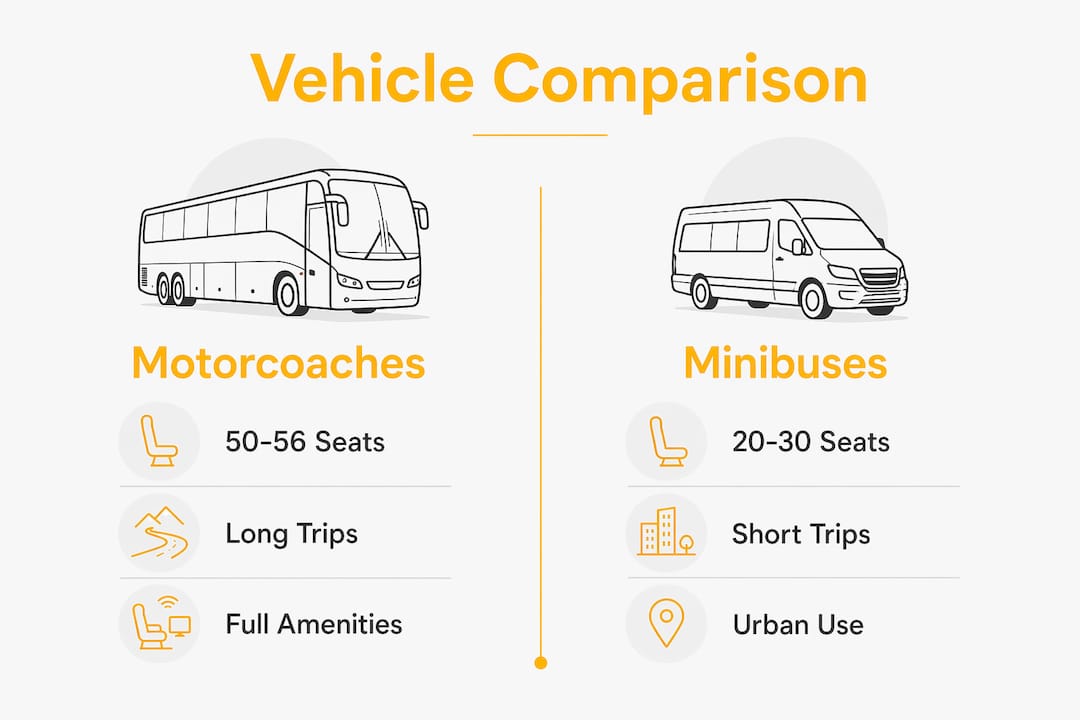
Motorcoaches are the standard choice for longer excursions. Trips over 50 miles generally require the climate control, reclining seats, and onboard restrooms that motorcoaches provide. This is not a comfort preference. It is a practical necessity when students are travelling for three or more hours each way. Many school districts use the 50-mile threshold as a formal policy trigger for upgrading from a standard school bus to a motorcoach.
Minibuses are the right call for urban field trips, visits to local science centres or theatres, or any outing where the group is under 40 students. They are easier to park near downtown venues, cost less per trip, and still offer a significantly better experience than a yellow school bus. For guidance on matching the right vehicle to your group’s needs, the motor coach selection guide from Torontobusrentals covers capacity, distance, and amenity trade-offs in detail.
Accessibility is another factor administrators often overlook until the last moment. If any students or chaperones require wheelchair access or mobility assistance, confirm that the vehicle is equipped with a lift or ramp before signing any contract. Luggage capacity matters too, particularly for overnight trips where students carry bags, instruments, or sports equipment.
Pro Tip: Book your vehicle type based on the longest leg of the journey, not the average. If one stretch of your trip is 60 miles, choose a motorcoach even if the total distance seems modest.
How do school trip charters differ from traditional school buses?
The distinction between a charter bus and a traditional yellow school bus goes well beyond appearance. Licensing, insurance, driver qualifications, and regulatory frameworks are all different, and those differences carry real implications for liability and trip planning.
Charter bus drivers are required to hold a Commercial Driver’s Licence (CDL) with a Passenger endorsement. Traditional school bus drivers must hold both the CDL Passenger endorsement and an additional School Bus endorsement. This means when you hire a charter operator, you are working with a driver qualified for commercial passenger transport, not specifically school bus operations. That distinction affects how you vet providers and what questions you ask during the booking process.
Insurance requirements are equally significant. Operators carrying 16 or more passengers are required to carry at least $5 million in liability insurance to protect passengers. This is a regulatory safeguard that applies to commercial charter operators. Many traditional school buses operated by school boards carry different coverage structures, which is why administrators often confuse the two when assessing liability for off-campus travel.
Key regulatory and operational differences include:
- Licensing: Charter operators hold commercial carrier licences; school boards operate under separate provincial frameworks.
- Insurance: Commercial charter operators carry $5 million liability minimums; school board vehicles vary by jurisdiction.
- Driver qualifications: Charter drivers hold CDL Passenger endorsements; school bus drivers require an additional School Bus endorsement.
- Route structure: Charters operate on negotiated, custom itineraries; school buses follow fixed, approved routes.
- Vehicle standards: Modern charter coaches include seatbelts throughout; many traditional school buses do not.
Professional charter operators provide seatbelts throughout their vehicles, which represents a meaningful safety upgrade over many conventional school buses. For longer trips where students are travelling at highway speeds for extended periods, this is a detail worth prioritising when comparing providers. The safety considerations for school events guide from Torontobusrentals outlines what to verify before committing to any provider.
What are the benefits of choosing a school trip charter?
School trip charters deliver four concrete advantages over public transit and standard school buses: improved safety, better group cohesion, superior comfort, and logistical flexibility.
Group safety and supervision. Chartering keeps your entire student group together in one vehicle under the supervision of designated chaperones. Public transit and personal vehicles scatter students across multiple routes and departure times, creating supervision gaps that are difficult to manage.
Comfort that supports learning. Wi-Fi, onboard restrooms, and entertainment systems create a travel environment where students arrive at their destination ready to engage rather than exhausted. A student who has spent three hours on a cramped school bus is not in the same learning state as one who travelled on a reclining seat with climate control.
Logistical simplicity. One vehicle, one driver, one departure time. Administrators managing 40 students across three parent cars or two transit routes are managing three times the variables. A charter collapses that complexity into a single, predictable operation.
Schedule and route flexibility. Charter itineraries are built around your programme, not a transit timetable. If the museum visit runs long or the return route needs to change, you negotiate directly with the operator. That flexibility is not available on public transit.
“Chartering keeps student groups together, fostering community and safety that personal vehicles or public transport often cannot ensure.” — Advantages of chartering for school trips
How to plan and book a school trip charter effectively
Effective planning for a school charter trip starts with a detailed itinerary and works backwards through driver regulations, cost structures, and provider vetting.
Build your itinerary first. A detailed itinerary allows charter operators to manage driver Hours-of-Service (HOS) rules and avoid delays on the day of travel. HOS regulations limit daily driving hours and mandate rest periods. If your itinerary requires more driving than one driver can legally complete, the operator needs to assign a second driver or restructure the schedule. Discovering this the week before departure creates unnecessary pressure.
Understand the cost models. Charter pricing typically follows one of three structures:
| Pricing model | How it works | Best suited for |
|---|---|---|
| Hourly rate | Charged per hour from departure to return | Short local trips with unpredictable timing |
| Per-mile rate | Charged based on total distance travelled | Long-distance trips with fixed routes |
| Daily flat rate | Fixed charge for a full day of service | Multi-stop day trips with a clear schedule |
Verify credentials before signing. When comparing providers, confirm the following:
- Valid commercial carrier licence and operating authority
- Proof of $5 million liability insurance coverage
- Driver CDL Passenger endorsement documentation
- Vehicle inspection records and maintenance history
- Clear cancellation and rebooking policy
Work with a direct operator rather than a broker where possible. Brokers add a margin and sometimes reduce your visibility into which specific company is actually operating your trip. When you book directly with a licensed operator like Torontobusrentals, you know exactly whose vehicles and drivers are serving your students. The school trip planning guide for administrators outlines a complete pre-booking checklist tailored to Ontario school groups.
Pro Tip: Request a written confirmation that specifies the exact vehicle model, driver name, and departure time at least 72 hours before the trip. Verbal confirmations leave too much room for day-of surprises.
Key takeaways
A school trip charter is the most controlled, compliant, and comfortable option for student group travel when you understand the vehicle types, regulatory requirements, and planning steps involved.
| Point | Details |
|---|---|
| Charter definition | Exclusive hire of a private motorcoach or bus on a custom itinerary for a student group. |
| Vehicle selection | Use motorcoaches for trips over 50 miles; minibuses suit smaller groups on local routes. |
| Regulatory distinction | Charter operators carry $5 million liability insurance and CDL Passenger-endorsed drivers. |
| Planning priority | Build a detailed itinerary first to comply with driver Hours-of-Service rules. |
| Key benefit | Charters keep student groups together, simplifying supervision and improving safety. |
What I have learned from watching schools plan charter trips
After years of working alongside educators and administrators organising group travel in Toronto, the pattern I see most often is this: schools underestimate how much the regulatory differences between charter buses and school buses actually matter until something goes wrong.
The licensing and insurance distinctions are not bureaucratic details. They determine who is liable if an incident occurs on the road. Administrators who treat provider vetting as a box-ticking exercise are the ones who end up with a vehicle that does not match the booking or a driver whose credentials are not what was promised.
The other thing I have observed is that vehicle choice is consistently made too late in the planning process. By the time an administrator realises their group of 48 students needs a motorcoach rather than a minibus, the preferred providers are already booked. The 50-mile threshold is a useful rule, but the real trigger should be student comfort and trip duration, not just distance.
What I genuinely believe is that school trip charters are underused in Canadian education travel. The logistical simplicity alone justifies the cost difference over coordinating parent vehicles or navigating transit schedules with a class of 35 teenagers. When educators embrace the charter model early in their planning cycle, the trips run better, the students arrive ready to learn, and the administrators spend the day supervising rather than troubleshooting.
— Firoz
Plan your next school trip with Torontobusrentals
Torontobusrentals has supported school groups across Toronto with motorcoach and minibus rentals built around student safety, comfort, and on-time performance. Whether you are organising a single-day field trip or a multi-day excursion, the fleet includes vehicles suited to every group size and trip distance.

Every booking includes a professionally licensed driver, verified insurance coverage, and a vehicle matched to your itinerary. For smaller groups, the 18-passenger minibus offers an affordable and manoeuvrable option for local trips. For larger classes or longer journeys, the 46-passenger coach delivers the comfort and capacity your students deserve. Contact Torontobusrentals to discuss your school trip requirements and receive a tailored quote.
FAQ
What is the school trip charter definition in simple terms?
A school trip charter is the exclusive rental of a private bus or motorcoach for a student group, operating on a custom itinerary rather than a fixed public route. The school controls the schedule, stops, and vehicle choice.
What is a school trip bus versus a charter bus?
A traditional school bus follows fixed routes under school board operation, while a charter bus is privately hired for a specific trip with a negotiated itinerary. Charter buses also carry higher insurance minimums and offer more passenger amenities.
How much does a school trip charter cost?
Pricing depends on the vehicle type, distance, and duration, with operators typically charging hourly, per-mile, or daily flat rates. Requesting quotes from licensed operators with a detailed itinerary in hand produces the most accurate estimates.
What should I verify before booking a school charter trip?
Confirm the operator holds a valid commercial carrier licence, carries at least $5 million in liability insurance, and employs drivers with a CDL Passenger endorsement. Also request vehicle inspection records and a written confirmation of the booking details.
How far in advance should I book a school trip charter?
Booking four to eight weeks in advance is standard for most school trips, though popular dates in spring and autumn fill quickly. For multi-day or long-distance trips requiring specific vehicle types, booking earlier gives you more options.
Recommended
- Why charter buses are essential for safe Toronto school events
- Essential bus rental tips for safe Toronto school trips
- School trip transportation explained: a 2026 guide