
Wedding transportation planning workflow for couples
TL;DR:
- Getting wedding transportation right involves early booking, detailed planning, and assigning a dedicated coordinator to ensure guest arrivals are timely and stress-free. Couples should map passenger groups, obtain multiple quotes, and build a detailed, flexible schedule with buffers for unforeseen delays. Using the same provider for all venues and communicating clearly with guests helps maintain flow and enhance guest experience on the big day.
Getting wedding transportation right is one of those details that can quietly make or break your entire day. A poorly coordinated wedding transportation planning workflow means guests arriving late, the bridal party scrambling, and a ceremony start that slips by 30 minutes before anyone notices. The pressure is real. But couples and wedding planners who build a phased, structured approach to their transportation plan for weddings discover something surprising: it actually removes stress rather than adding it. This guide walks you through every phase, from that first vendor call to the final shuttle home after the after-party.
Table of Contents
- Key takeaways
- Your wedding transportation planning workflow starts early
- Contracts, routes, and timing (8 to 3 months out)
- Final confirmation and day-of preparation
- Multi-venue logistics and guest shuttle strategy
- Troubleshooting common transportation challenges
- What I have learned about wedding transport planning
- Plan your Toronto wedding transport with confidence
- FAQ
Key takeaways
| Point | Details |
|---|---|
| Start booking early | Secure vehicles 12 to 9 months out, especially for peak season between April and October. |
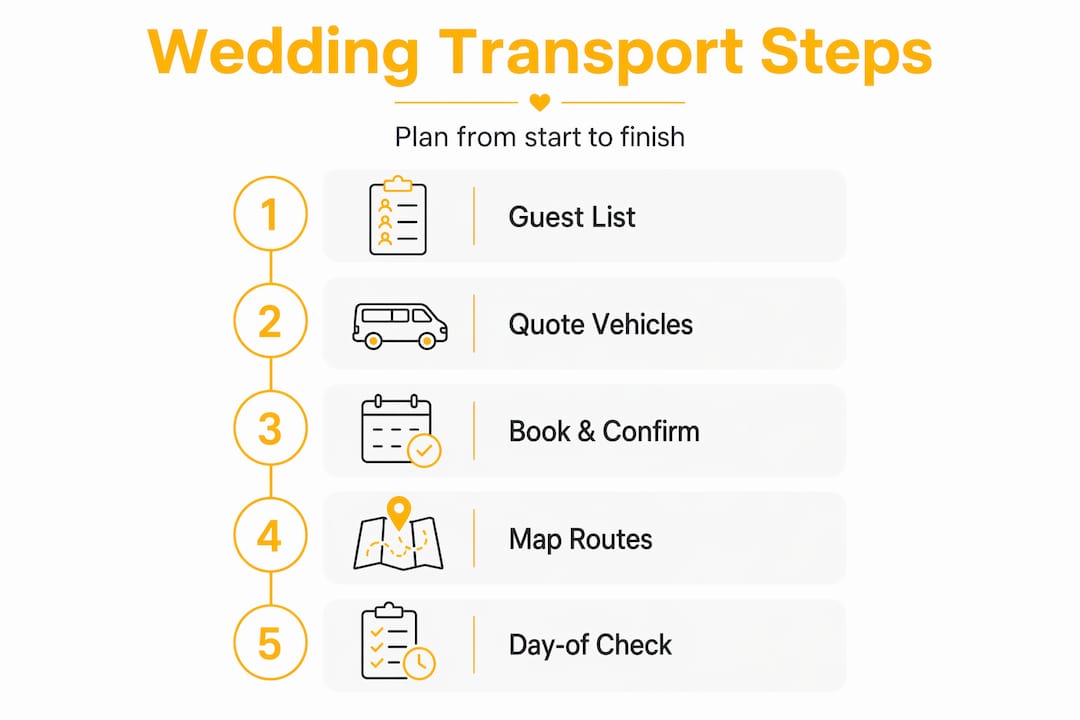
| Plan with phases | Break the workflow into four stages: booking, contract finalization, logistics, and final confirmation. |
| Build in buffer time | Account for loading, unloading, and formalwear when scheduling every transfer. |
| Assign a point person | A dedicated day-of coordinator who owns communication prevents confusion and chaos. |
| Use one provider across venues | Keeping the same transport company for all stops reduces guest confusion significantly. |
Your wedding transportation planning workflow starts early
The biggest mistake couples make is treating transportation as a last-minute detail. By the time most couples think about vehicles, the ones they actually want are already booked. Peak wedding dates fill quickly, and if you are marrying between April and October, booking 12 to 9 months out is not overcautious. It is necessary.
Start by mapping your passenger groups. These typically fall into four categories:
- The bridal party. Bride and groom transportation needs differ from the rest of the party. The couple often wants a private vehicle for a quiet moment between ceremony and reception.
- Family. Parents and grandparents may need dedicated transport, especially if your venues have limited accessible parking.
- Out-of-town guests. If a block of guests is staying at a hotel near the venue, a shuttle loop becomes almost non-negotiable.
- General guests. Anyone attending a venue with limited parking or in a city centre location will benefit from a group shuttle option.
Once you know your groups, evaluate the logistical reality of your venues. How far is the ceremony from the reception? Is there a photo location in between? Is parking at the venue limited or entirely unavailable? These answers drive your vehicle choices more than aesthetics ever will.
When comparing wedding car rental process options, get at least three quotes and ask specifically about vehicle capacity, included hours, overtime rates, and what happens if a vehicle breaks down. The difference between quotes is rarely just price. It is often what is included and what is not.
Pro Tip: When getting quotes, ask each provider to confirm in writing the exact vehicle you will receive, not just the category. Many couples book a “luxury coach” and receive something quite different on the day.
Contracts, routes, and timing (8 to 3 months out)
Once you have selected your providers, the work shifts from shopping to planning. This phase is where your transportation plan for weddings gets its structure. Contracts should be reviewed line by line. Pay particular attention to these four specifics:
- The exact vehicle make, model, and capacity listed on the contract
- The number of hours included and the per-hour overtime rate
- Cancellation and modification policies, including any change fees within 30 days of the event
- Whether gratuity is included or expected separately upon service
After contracts are signed, build your route and timing plan. This is the document that your driver will carry on the day, and it needs to be far more detailed than most couples expect. Think of it less as a schedule and more as a minute-by-minute script.
A useful format is a simple timing table like the one below:
| Time | Task | Location | Notes |
|---|---|---|---|
| 1:00 PM | Bridal party pickup | Bride’s home | Allow 20 min loading |
| 1:30 PM | Depart for ceremony | St. Andrew’s Church | 15 min drive |
| 2:00 PM | Ceremony begins | St. Andrew’s Church | Driver waits on site |
| 4:00 PM | Bridal party departs | St. Andrew’s Church | Photo stop en route |
| 4:30 PM | Arrive photo location | Riverdale Park | 45 min stop |
| 5:15 PM | Depart for reception | The Carlu | 20 min drive with buffer |
At this stage, contact both your ceremony and reception venues to confirm staging areas, parking access for large vehicles, and any loading zone restrictions. Many venues in Toronto, for example, have strict rules about coach access that are not mentioned until you ask directly. Communicating with hotels about shuttle staging is equally important if guests are travelling from a nearby accommodation block.

Final confirmation and day-of preparation
At the two-month mark, your wedding shuttle service coordination moves from planning to confirming. Guest counts shift, RSVPs trickle in, and people who said they would drive often change their minds. Revisit your shuttle capacity numbers and adjust if needed.
Key tasks in this phase include:
- Confirming pickup and drop-off times in writing with your transport provider
- Assigning named contacts to each vehicle (Maid of Honour for the bridal vehicle, Best Man for the groomsmen, a family member for the parent shuttle)
- Preparing guest-facing communication about shuttle logistics, including exact pickup locations, scheduled departure times, and a contact number for questions
- Building a backup plan for at least one contingency scenario
Early communication with guests about shuttle pickups is critical. Include exact pickup locations, the last scheduled shuttle departure, and a contact number in your wedding website, invitation inserts, and a text or email reminder sent the week before.
Two to three weeks out, do a complete run-through of the logistics. A finalised run-through at this stage should confirm all addresses, point-of-contact names, and any last-minute changes in writing. Do not rely on a phone conversation for a change that affects timing. Get it confirmed by email or message.
Pro Tip: Assign your day-of transportation point person before the wedding week. This person is not the couple. It is someone who can field driver calls, manage late guests, and make quick decisions without interrupting the ceremony.
Assigning a dedicated day-of coordinator who owns communication and troubleshooting is one of the most underrated decisions you can make in the entire planning process.
Multi-venue logistics and guest shuttle strategy
Weddings with multiple stops require a different level of thinking. When your guests are moving from a ceremony venue to a photo location to a reception hall, every transition is a potential point of confusion. The single most effective way to reduce that confusion is to use the same transport company across all venues. Continuity removes the need for guests to figure out which vehicle is theirs at each stop.
For guest shuttles, timing is everything. Shuttle departure should be 45 to 75 minutes before the ceremony start time to account for loading and travel. If your ceremony begins at 5:30 PM and the hotel is 25 minutes away, the last shuttle should leave no later than 4:45 PM. Tell guests to be ready at 4:30 PM. That gap is not padding. It is the difference between a full shuttle and a chaotic scramble.
When choosing vehicles for group transport, the decision often comes down to group size and function:
| Vehicle type | Best for | Capacity range | Key advantage |
|---|---|---|---|
| Charter coach | Large guest groups, hotel shuttles | 40 to 55 passengers | Cost-efficient per head, comfortable for longer distances |
| Party bus | Bridal party transfers, energetic moves between venues | 20 to 40 passengers | Entertainment features, keeps group together |
| Limousine | Couple’s private transport, small VIP groups | 8 to 14 passengers | Privacy, photo-worthy entrance |
| Trolley or vintage bus | Stylistic choice with character | 20 to 35 passengers | Doubles as decor and transport |
After-party transportation is the detail most couples forget entirely. Multiple return shuttle rounds after the reception accommodate guests leaving at different times and keep everyone safe when venues are not walkable from accommodations. Plan for at least two loops, not one.
Limos suit smaller groups and work well for private couple moments, while party buses handle larger groups and keep energy high between stops. Whatever you choose, your chauffeur must have the full route in advance, including every stop, timing expectation, and alternate contact.
Troubleshooting common transportation challenges
Even a well-built vendor transportation schedule can run into trouble on the day. The couples and planners who handle it well are the ones who prepared for it.
A common and costly oversight is underestimating loading and unloading time when guests are wearing formalwear. People move more slowly in dress shoes and gowns. Add this buffer deliberately into your schedule, not as an afterthought.
Here are the most common issues and practical fixes:
- Vehicle delays. Build 15-minute buffers between transfers. If a delay cascades, you want the buffer absorbed before it touches the ceremony.
- Route changes. If a road closure forces a detour, your driver needs an alternate route already mapped. Ask your provider in advance what their protocol is.
- Communication breakdowns. All last-minute changes should be confirmed in writing. A verbal “we’ll be there at 3” is not a confirmation.
- Weather contingencies. Buffers must account for weather, whether that means rain slowing boarding, heat requiring earlier pickups, or winter conditions requiring alternate routes.
- No-show guests. Shuttles run on schedule, not on headcount. Make that clear to guests in advance.
On the operational side, professional chauffeur services that offer on-call backup vehicles and detailed pre-event briefings are worth the premium. Having a backup vehicle option written into your contract is not paranoia. It is preparation.
“The success of wedding transportation hinges on controlling guest arrival timing and comfort, not just vehicle appearance.” Vogue
Effective transportation also integrates tightly with your photographer’s and venue coordinator’s schedules. Sharing a live vehicle tracking link or direct driver contact with those vendors can prevent small timing slips from becoming large ones.
What I have learned about wedding transport planning
I have seen more weddings than I can count where transportation was treated as a footnote. And almost every time, it showed. Not dramatically, but in the quiet stress of guests waiting in the wrong spot, a bridal party arriving flustered, or a reception that started 40 minutes late because no one thought through the transfer from the photo location.
What I have learned is this: how to plan wedding transport well is not about finding a beautiful vehicle. It is about owning the time around every transition. The couples who do this well are the ones who sat down months out, mapped every passenger group, and built a schedule with enough breathing room to absorb the unexpected.
I also think we underestimate how much guest experience lives in transportation. When guests arrive on time, comfortable and together, they walk into your reception already in a good mood. When they were confused about the shuttle, stuck in traffic alone, or circling for parking, they arrive frazzled. That mood carries into the room.
My advice: hire professionals who have done this before, assign someone who is not the couple to own it on the day, and do the homework early. The workflow is not complicated. It just requires attention at the right moments.
— Firoz
Plan your Toronto wedding transport with confidence

Toronto weddings come with unique logistical challenges: downtown venues with no parking, guests spread across multiple hotels, and venues that require advance approval for large coach access. Torontobusrentals specialises in exactly this kind of group wedding transport coordination, with modern motor coaches sized to fit everything from a 15-person bridal party to a 200-guest shuttle programme. Their team works with you on group transportation logistics and helps you build a vehicle plan that matches your venue layout, guest count, and timing needs. If you are building out your wedding transport workflow for 2026, explore motor coach options early and lock in your dates before peak season fills up.
FAQ
When should you start booking wedding transportation?
Book wedding transportation 12 to 9 months before your wedding date. Peak wedding season runs from April through October, and preferred vehicles book out quickly during those months.
How early should the guest shuttle leave before the ceremony?
The guest shuttle should depart 45 to 75 minutes before the ceremony begins. Tell guests to be ready slightly earlier than the actual departure time to prevent delays.
Do you need separate vehicles for the couple and guests?
Not always, but bride and groom transportation is typically separate from guest shuttles to provide a private, unhurried experience between ceremony and reception. The right split depends on group size and venue transitions.
What happens if the transport vehicle is delayed on the day?
Build 15-minute buffers between every transfer in your schedule, and confirm in advance that your provider has backup vehicle availability. Written confirmation of any last-minute changes is critical to avoid miscommunication.
Who should manage transportation on the wedding day?
Assign a dedicated point person, such as a planner, Maid of Honour, or trusted family member, to manage all transportation communication. The couple should not be fielding driver calls on the wedding day.
Recommended
- The ultimate wedding transportation checklist for Toronto couples
- How to organise bridal party transport for your Toronto wedding
- How buses enhance wedding planning in Toronto 2026
- Master the Wedding Shuttle Booking Process in Toronto