
Understanding bus capacity for groups: a planner’s guide
TL;DR:
- Getting group transportation wrong can lead to costly mistakes and uncomfortable trips. Planning involves considering bus types, passenger needs, luggage, accessibility, and trip duration to select the right vehicle size. Effective booking starts with accurate headcounts, factoring in buffers, and aligning bus capacity with comfort and safety requirements.
Getting group transportation wrong is an expensive lesson. You book a bus, guests show up, and suddenly you’re short ten seats or everyone’s crammed in with no room for luggage. Understanding bus capacity for groups is not as straightforward as checking a number on a website. The real answer depends on your group’s age range, luggage volume, accessibility needs, trip duration, and the difference between a bus’s legal maximum and what actually makes for a comfortable ride. This guide walks you through every dimension of that decision so you book right the first time.
Table of Contents
- Key takeaways
- Understanding bus capacity for groups: bus types explained
- Factors that affect bus capacity planning
- How to calculate the right bus size for your group
- Balancing capacity with passenger comfort
- My perspective on where group capacity planning goes wrong
- Plan your group trip with Torontobusrentals
- FAQ
Key takeaways
| Point | Details |
|---|---|
| Know your bus types | School buses, minibuses, charter coaches, and party buses each serve different group sizes and trip purposes. |
| Capacity numbers are a starting point | Legal maximums rarely reflect comfortable seating for adults on longer trips. |
| Factor in luggage and accessibility | Groups with baggage or mobility needs require more space per person than the seat count suggests. |
| Bigger is not always better | One large coach can be more efficient than two smaller vehicles for boarding and cost. |
| Match bus type to trip purpose | A school excursion, a corporate retreat, and a wedding transfer each call for a different seating configuration. |
Understanding bus capacity for groups: bus types explained
Before you can calculate group transportation needs, you need to know what your options actually are. Bus types vary more than most people realise, and each comes with a distinct capacity range, comfort level, and ideal use case.
| Bus type | Typical seating capacity | Best suited for |
|---|---|---|
| School bus | 48 to 72 passengers | Student field trips, educational programmes |
| Minibus / shuttle | 15 to 35 passengers | Corporate shuttles, small group transfers |
| Charter / coach bus | 36 to 56 passengers | Long trips, corporate events, group tours |
| Party bus | 20 to 30 passengers | Social events, celebrations, weddings |
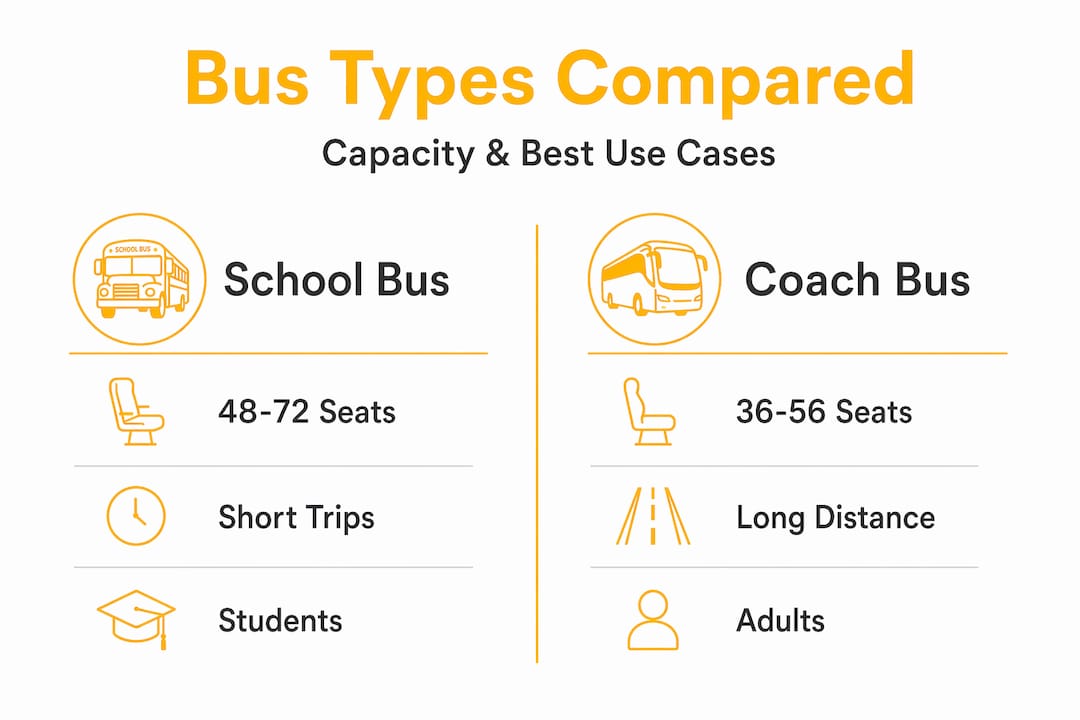
School buses are purpose built for frequent stops and high passenger density. School bus capacity ranges from 48 to 72 seats depending on whether you’re transporting children or adults. Children occupy less space per seat, so a bus rated for 72 young students may only accommodate 48 adults comfortably. This distinction trips up a surprising number of planners.
Minibuses and shuttle buses fill the gap between a 15-passenger van and a full coach. The 2024 Starcraft Allstar XL 32 is a strong example of this category, seating 27 passengers with customisable interior options and full accessibility compliance. These vehicles work well for corporate shuttle routes, hotel transfers, and smaller school groups where a full-sized coach would be underutilised.
Charter and motor coaches are the workhorse of large group travel. Charter buses seat between 13 and 56 passengers, with the most commonly booked configurations running at 36 or 56 seats. Premium coach buses like the Volvo 9700 seat up to 54 passengers while offering integrated power outlets, restrooms, and climate control. For groups travelling more than two hours, that extra legroom is not a luxury. It’s what prevents a miserable trip.

Party buses represent a niche but important category. Party buses typically accommodate 20 to 30 passengers, with interiors configured for socialising rather than linear seating. They are popular for weddings, stagettes, and corporate celebrations where the ride itself is part of the experience.
For a detailed side-by-side look at how comfort and capacity differ between vehicle classes, Torontobusrentals has a useful breakdown of luxury vs. standard bus options for Toronto planners.
Factors that affect bus capacity planning
Seat count is the starting number, not the final answer. Bus capacity planning for groups involves several variables that shrink the effective passenger count before a single person boards.
Group composition matters more than most coordinators anticipate. A group of 40 university students with backpacks travels very differently than 40 seniors attending a theatre matinée. Older passengers may require wider seating, aisle access, or mobility aid storage. Children require supervision ratios that affect how many adult chaperones occupy seats. Effective group transport planning must account for trip purpose to genuinely optimise capacity selection.
- Luggage and gear volume: Overnight trips, sports teams, and conference attendees carry significantly more than day trippers. Most coach buses provide undercarriage luggage bays, but minibuses and school buses offer limited storage. If your group is bringing large equipment or checked baggage, subtract seats to account for onboard storage needs.
- Accessibility requirements: Wheelchair-accessible buses designate specific floor areas for mobility devices, which reduces the standing or seating count for ambulatory passengers. Canadian transportation regulations set minimum accessibility standards, and you should confirm compliance before booking.
- Trip duration and comfort thresholds: For trips under 45 minutes, a tighter seating arrangement is tolerable. For journeys over two hours, passengers need adequate legroom, a restroom on board, and ideally individual climate controls. A bus at 90% capacity on a short city transfer feels very different at 90% capacity on a four-hour highway run.
- Number of vehicles versus one larger bus: Running two 36-passenger coaches looks cheaper on paper but creates boarding complexity, fuel overhead, and coordination challenges. Articulated high-capacity buses solve throughput issues partly through extra doors and spacious interiors, a principle that applies equally when choosing between one large coach and multiple smaller ones.
Pro Tip: When calculating your group size, add a 10% buffer above your confirmed headcount. Last-minute additions are nearly universal in group travel, and arriving one seat short creates far more chaos than having a spare row available.
How to calculate the right bus size for your group
Getting the maths right on group bus seating capacity comes down to a clear, repeatable process. Here is how to approach it.
- Confirm your actual headcount. Count confirmed attendees, not projected ones. Use an RSVP deadline and then apply the 10% buffer mentioned above.
- Classify your group’s needs. Are there passengers requiring accessible seating? Will anyone bring oversized luggage or equipment? Does your group include children who require more chaperone seats?
- Determine your effective capacity. Take the bus’s stated maximum, subtract any seats lost to accessibility configurations or onboard storage, and you have your working number.
- Match to trip length and comfort level. A 56-seat coach at full capacity works for a 30-minute corporate shuttle. For a four-hour conference transfer, you want that same group in a 56-seat coach at no more than 80% occupancy to allow comfort seating.
- Confirm luggage storage. Ask your provider specifically about undercarriage bay volume, not just total seat count.
- Review safety certifications. Motorcoach buses with reinforced cages and full air ride suspension meet different safety standards than transit buses. For long-distance group trips, this distinction matters for both passenger comfort and insurer requirements.
A common pitfall is treating capacity as binary. Planners either pack every seat or book a bus far too large because they are nervous about space. Both create problems. An oversized bus for a small group is expensive and can feel impersonal. An overcrowded bus creates safety concerns and unhappy passengers. The goal is matching bus capacity for events to your group’s real and specific needs.
Pro Tip: For group transportation solutions by size, ask your rental provider to show you configurations for one size below and one size above your target. Seeing the difference firsthand helps you make a better-informed decision.
Balancing capacity with passenger comfort
There is a genuine tension between maximising the number of seats and giving passengers enough space to feel comfortable. Understanding bus sizes means understanding where that tension lives and when it matters.
| Scenario | Group size | Recommended bus | Occupancy rate |
|---|---|---|---|
| School field trip (day) | 45 students + 5 adults | 56-seat coach | 89% |
| Corporate retreat (4 hrs) | 36 employees | 56-seat coach | 64% |
| Wedding transfer (45 min) | 28 guests | 36-seat charter | 78% |
| Conference airport shuttle | 20 attendees | 27-seat minibus | 74% |
The table above reflects practical booking decisions, not theoretical maximums. Notice that the corporate retreat uses a 56-seat coach for only 36 people. That is not inefficiency. That is the right call for a four-hour trip where passengers need to spread out, store bags overhead, and move around during rest stops.
Amenities change the equation significantly. A coach with onboard restrooms removes the need for scheduled stops every 90 minutes, which affects your total trip time. Buses with premium sound insulation and full air suspension reduce fatigue on long hauls, which matters enormously for corporate or school groups where people need to arrive alert and in good spirits.
One larger bus also simplifies logistics in ways that ripple through your entire event. One driver, one vehicle, one departure time, one arrival. Splitting a group across two smaller buses doubles your coordination effort and creates two windows for things to go wrong.
My perspective on where group capacity planning goes wrong
I’ve seen coordinators approach bus booking the same way they’d book a hotel room, by filling every available space and calling it done. In my experience, that thinking is the single biggest source of group travel complaints.
The most common error I observe is ignoring the difference between seated capacity and travel capacity. A school bus rated for 72 children is not comfortable for 72 adults carrying bags on a two-hour highway journey. These are fundamentally different situations, but the number on the booking form looks identical.
What I’ve learned is that the best group transportation decisions come from coordinators who think backwards from the passenger experience rather than forward from the seat count. Start with: how do I want my group to feel when they arrive? Then choose the vehicle that makes that outcome possible.
I’ve also noticed that schools and corporations tend to underestimate how much accessibility planning affects capacity. Building in space for mobility aids, seating early boarding passengers near the front, and confirming restroom access are not afterthoughts. They are the decisions that determine whether a trip runs smoothly or becomes a complaint session.
The coordinators who nail this consistently are the ones who call their provider with specific questions, not just a headcount. They ask about the exact configuration, the luggage bay dimensions, and the onboard amenities. That conversation takes ten minutes and saves hours of frustration on the day.
— Firoz
Plan your group trip with Torontobusrentals
Whether you are coordinating a corporate outing, a school excursion, or a large-scale event transfer, Torontobusrentals offers a fleet sized for every group and every trip type in Toronto. From school bus rentals with up to 47 seats to fully appointed motor coaches for large groups, every vehicle comes with a professional driver and a team that understands the specific demands of group logistics.

Getting capacity right starts with a conversation. The Torontobusrentals team will walk you through your options based on your confirmed group size, trip length, and comfort requirements. You can also explore the full range of group transportation services to find the configuration that fits your event. Reach out today and book with confidence.
FAQ
How many people fit on a standard charter bus?
Most charter buses seat between 36 and 56 passengers, though comfort on longer trips improves when occupancy stays around 70 to 80% of maximum capacity.
What is the difference between a school bus and a coach bus for groups?
School buses seat up to 72 children or 48 adults and are built for frequent stops and short trips. Coach buses offer more legroom, luggage storage, and onboard amenities, making them better suited for longer group travel.
How do I calculate the right bus size for my group?
Start with your confirmed headcount, add a 10% buffer, then subtract seats for accessibility needs and luggage storage. Match the remaining number to a bus that runs at 75 to 90% occupancy for short trips, or closer to 65 to 80% for journeys over two hours.
Does trip length affect which bus size I should book?
Yes. For trips under one hour, booking at near-full capacity is reasonable. For trips of two hours or more, allow extra space per passenger and confirm the bus has onboard restrooms and adequate luggage storage.
Can I book a bus for a group smaller than its maximum capacity?
Absolutely. Booking a slightly larger bus than your headcount requires is often the smarter choice. It accommodates last-minute additions, provides luggage room, and gives passengers a noticeably more comfortable ride, particularly on longer routes.
Recommended
- Find the right bus type for your Toronto event
- Why book a bus for conferences: a smarter group travel solution
- Examples of group transportation solutions by size