
The role of group tours: benefits, logistics, and impact
TL;DR:
- Group tours offer cost savings, exclusive perks, and social bonding benefits for participants.
- Keeping groups under 30 maximizes interaction, flexibility, and overall experience quality.
Group tours are organised travel experiences that coordinate shared itineraries, expert guides, and collective logistics to deliver social connection, cost savings, and reduced planning stress for participants. The industry standard for unlocking group benefits starts at a 10-person minimum, which triggers access to discounted pricing and private transfers. Professional travel advisors recommend capping groups at 30 or fewer travellers to preserve interaction quality and flexibility. Whether you are planning a corporate retreat, a school excursion, or a leisure trip with friends, understanding how group tours work gives you a real advantage before you book.
What are the main advantages of group tours for travellers?
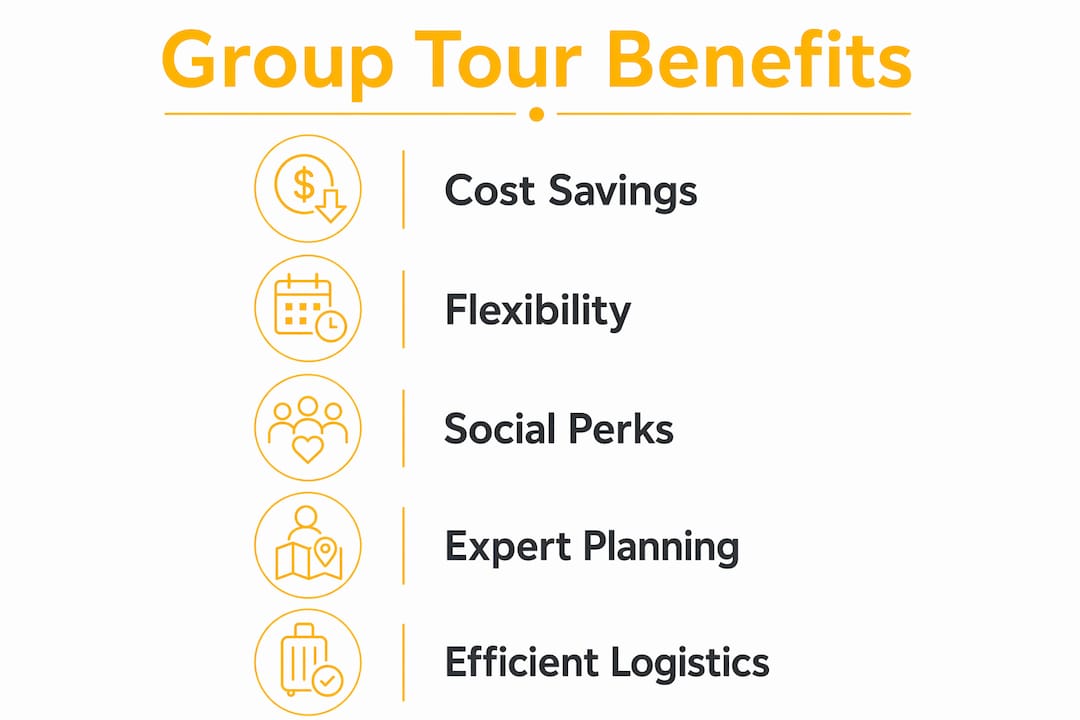
Group tours deliver concrete financial and logistical benefits that solo or independent travel simply cannot match. The advantages of group travel go well beyond splitting a dinner bill.
Cost savings and booking flexibility
Group bookings offer lower deposits, price-drop guarantees, and the ability to change plans with minimal penalties. That financial cushion matters when you are coordinating a dozen or more people with different schedules. Price protection means that if rates drop after you book, your group benefits automatically. Change penalties are often waived within agreed timelines, which gives organizers room to adjust without financial loss.
Exclusive perks and social connection
Group tours unlock exclusive perks such as discounted excursions, complimentary activities, block seating on flights, and private airport transfers for groups of 15 or more. These are not available to individual travellers at the same price point. Beyond the perks, group travel experiences create genuine social bonds. Shared challenges, like a delayed flight or a rainy hike, build trust and camaraderie faster than most team-building exercises back home.
Stress reduction through expert planning
Expert coordinators handle the logistics so participants can focus on the experience. Routing, accommodation, meals, and activity bookings are managed centrally, which removes the cognitive load that makes independent travel exhausting for large groups. For corporate planners and event organisers, this is the single most underrated benefit of group travel.
- Lower deposits reduce upfront financial risk for organisers
- Price-drop guarantees protect the group budget automatically
- Private transfers activate at 15 or more travellers
- Discounted excursions and complimentary activities add value without extra cost
- Centralised planning eliminates coordination chaos across multiple travellers
Pro Tip: Book your group as early as possible. Early bookings typically secure the best price protection terms and give your coordinator more room to negotiate exclusive perks with suppliers.
How does group size shape the tour experience?
Group size is the single most influential variable in group trip dynamics. It determines how personal the experience feels, how flexible the itinerary can be, and how well guides can serve each participant.
The optimal range and what happens outside it
Professional advisors recommend a maximum of 30 travellers for the best group tour experience. Groups of 40 to 50 travellers feel impersonal. Guides cannot maintain meaningful interaction with that many people, dining reservations become difficult to manage, and spontaneous itinerary changes are nearly impossible. At the other end, small groups of 5 to 15 travellers allow deeper cultural immersion, more customisation, and genuine conversation with local guides.
| Group size | Experience quality | Flexibility | Best suited for |
|---|---|---|---|
| 5–15 travellers | High personalisation | Very flexible | Cultural immersion, custom itineraries |
| 16–30 travellers | Balanced interaction | Moderately flexible | General tours, corporate retreats |
| 31–50 travellers | Reduced personalisation | Limited flexibility | Large events, conferences |
| 50+ travellers | Impersonal | Very limited | Mass tourism, large conventions |
The table above shows a clear pattern. As group size grows past 30, the quality of individual experience drops noticeably. Dining logistics alone become a significant challenge. A restaurant that seats 20 comfortably becomes a logistical problem for 45 people arriving at once.
Pro Tip: If your group exceeds 30 people, consider splitting into two sub-groups with separate guides. Each sub-group gets a better experience, and the overall tour runs more smoothly.
What logistical structures make group tours run smoothly?
The operational model behind a well-run group tour is more structured than most travellers realise. Effective logistics are what separate a memorable trip from a frustrating one.
The three-layer guide system
A layered guide structure using a trip leader, national guide, and local guides is the most effective model for group tours. Each layer serves a distinct purpose. The trip leader manages the overall group experience and handles escalations. The national guide provides destination-wide knowledge and coordinates between cities or regions. Local guides deliver hyper-specific expertise at each stop, from museum context to restaurant recommendations.
This structure means the group always has someone with current, relevant knowledge. A national guide knows the country’s transport network. A local guide knows which market stall is worth visiting and which to skip. Together, they give participants a depth of experience that a single guide cannot provide.
Centralised coordination and transparent pricing
- Appoint a single point of contact for all group communications before the trip begins.
- Use a centralised itinerary document that every participant can access and update in real time.
- Confirm all supplier bookings, including accommodation, transport, and excursions, at least 60 days in advance.
- Establish a group expense policy upfront to avoid disputes over shared costs.
- Review insurance coverage for the full group, including cancellation and medical provisions.
Booking directly with tour operators avoids agent commissions and ensures funds go toward better hotels and inclusions rather than intermediary fees. Transparent, all-inclusive pricing also makes it easier for participants to understand exactly what they are paying for. Hidden costs are the fastest way to erode trust within a group.
Centralised administration and clear communication are critical to managing group travel complexity. When one person owns the logistics, decisions get made faster and disruptions get resolved before they escalate. For event planners, this principle applies directly to group transportation logistics, where a single coordinator managing vehicle schedules prevents the confusion of multiple drivers and pickup points.
How do group tours support organisational goals?
The importance of group tours extends well beyond leisure. For organisations, group travel is a diagnostic tool and a culture-building investment.
“Group travel should be viewed as a strategic investment in company culture rather than a simple expense. The shared experience of navigating a new environment together builds cross-department collaboration and employee engagement in ways that a conference room never can.”
Source: Inspired Travel Group
Complex group travel logistics reveal team dynamics under real pressure. A delayed connection, a missed transfer, or a supplier error exposes how a team communicates, who leads under stress, and where coordination breaks down. That information is genuinely useful for managers and HR teams. It is also why the impact of group travel on organisations goes far beyond the trip itself.
Planning for corporate retreats versus leisure groups
Corporate group tours require a different planning framework than leisure trips. The goals are different. A leisure group wants enjoyment and relaxation. A corporate group needs the trip to deliver measurable outcomes, whether that is improved team cohesion, cross-department relationships, or simply a shared reference point that employees talk about for years.
Companies that handle group travel centrally with dedicated advisors reduce disruptions, improve duty of care, and lift overall morale. The ROI on a well-executed culture trip is real, but it requires flawless execution. A poorly managed corporate tour can damage morale rather than build it. That is why organising a group tour for a company requires more rigour than planning a personal holiday.
For organisations planning corporate event travel, the transportation layer is often the first thing to get wrong. Reliable, comfortable vehicles with professional drivers remove one of the biggest variables from an already complex logistical equation.
Key takeaways
Group tours deliver the most value when size, structure, and logistics are managed deliberately rather than left to chance.
| Point | Details |
|---|---|
| Group size matters most | Cap groups at 30 travellers to preserve interaction quality and itinerary flexibility. |
| Minimum threshold for benefits | A 10-person minimum unlocks discounted pricing, price protection, and private transfers. |
| Three-layer guide model | Trip leader, national guide, and local guides together deliver the best participant experience. |
| Direct booking saves money | Booking directly with operators avoids commissions and funds better inclusions. |
| Corporate tours need clear goals | Organisational group travel requires measurable outcomes and centralised coordination to deliver ROI. |
Why group size is the variable most planners underestimate
I have seen organisations spend weeks debating destination and budget while barely discussing group size. That is backwards. Group size determines almost everything else: the guide structure you need, the venues that will accommodate you, the flexibility you have on the day, and the quality of experience each participant walks away with.
The 30-person cap is not an arbitrary number. It reflects the practical limits of meaningful guide-to-participant interaction. Once you go past that threshold, you are no longer running a group tour. You are running crowd management. The social dynamics shift, the spontaneity disappears, and the experience starts to feel like a conveyor belt.
For corporate planners, I would add one more thing. The group travel planning steps that matter most are the ones nobody talks about: setting clear behavioural expectations, establishing a single decision-maker for on-the-ground calls, and building buffer time into every transition. Those three things separate a trip that builds culture from one that creates resentment.
The organisations that get the most from group travel treat it as a programme, not an event. They debrief afterward, they track what changed, and they use the experience to inform how they work together when they are back at the office.
— Firoz
Group transportation that keeps your tour on schedule
Reliable transportation is the foundation of any well-run group tour. Without it, even the best itinerary falls apart at the first pickup.

Torontobusrentals provides modern motor coaches and school buses for group tours, corporate outings, school trips, and special events across Toronto. Every vehicle comes with a professional driver, so your group arrives together, on time, and without the stress of coordinating multiple cars or rideshares. The 47-passenger school bus rental is a practical solution for mid-sized groups that need comfort, reliability, and straightforward pricing. For groups of any size, Torontobusrentals handles the transportation layer so your coordinator can focus on the experience, not the logistics. Contact Torontobusrentals to get a quote for your next group tour or event.
FAQ
What is the minimum group size for a group tour?
The industry standard is a 10-person minimum to unlock group benefits such as discounted pricing and private transfers. Groups of 15 or more typically qualify for private airport transfers.
How many people should be in a group tour for the best experience?
Professional travel advisors recommend a maximum of 30 travellers to maintain personalised interaction and itinerary flexibility. Groups larger than 40 to 50 people tend to feel impersonal and are harder to manage on the ground.
What is a three-layer guide structure in group tours?
A three-layer guide structure uses a trip leader, a national guide, and local guides at each destination. This model ensures the group always has someone with current, relevant knowledge at every stage of the tour.
Are group tours worth it for corporate teams?
Group travel is a strategic investment in company culture that builds cross-department collaboration and reveals team dynamics under real conditions. Centralised coordination and clear goals are what determine whether a corporate group tour delivers measurable value.
What are the financial advantages of booking a group tour?
Group bookings typically include lower deposits, price-drop guarantees, and reduced change penalties compared to individual bookings. Booking directly with tour operators also avoids agent commissions, which means more of the budget goes toward better accommodation and inclusions.
Recommended
- Why rent for group tours: benefits, cost and safety
- Tour group travel essentials: your complete packing guide
- Group travel solutions explained: your 2026 planning guide