
Terms and conditions in bus rental: what you need to know
TL;DR:
- Bus rental agreements contain key clauses on payment, cancellation, liability, and conduct that define renter and operator responsibilities. Understanding these provisions helps renters negotiate terms, prepare for financial liabilities, and align internal deadlines with contractual requirements. The agreement shifts significant legal and financial risks to the renter, emphasizing the importance of thoroughly reviewing indemnification, force majeure, and cancellation clauses before signing.
Terms and conditions in bus rental are the contractual provisions that define what both the customer and the bus company must do before, during, and after a trip. These provisions cover payment schedules, cancellation rights, liability limits, behavioural expectations, and what happens when something goes wrong. Reading them carefully before signing a bus rental agreement is the single most effective way to avoid unexpected costs and disputes. This article breaks down the clauses you will encounter, explains what they mean in practice, and shows you how to protect your interests when booking group transportation.
What are the common clauses in a bus rental agreement?
A standard bus hire agreement is not a single clause. It is a layered document that assigns responsibility for nearly every scenario that could arise during a booking. Understanding the structure of these provisions gives you the ability to negotiate from a position of knowledge rather than assumption.
The most common provisions you will encounter include:
- Reservation and payment terms. Many operators require full payment at the time of booking. Private event bookings are frequently paid in full at reservation, with no refunds issued for cancellations within 14 days. This is not unusual. It is the industry standard for private charters.
- Cancellation and refund policies. These define the window within which you can cancel without penalty, the percentage of your deposit you forfeit after that window closes, and whether any credit is offered in lieu of a refund.
- Liability waivers. Operators routinely require customers to waive liability for injuries however caused, including injuries resulting from the company’s own negligence. This is a significant clause that many renters overlook entirely.
- Indemnification clauses. These go further than a waiver. They require the renter to actively cover the company for claims, legal costs, and damages arising from the renter’s negligent or wilful acts. Renter indemnification clauses transfer financial risk for claims arising from misuse, but many insurance policies exclude voluntary indemnity liabilities, which means you may need to verify your own coverage before signing.
- Force majeure provisions. These clauses excuse one or both parties from performance when an event outside their control makes the trip impossible. The critical detail is procedural. Parties must show causation, lack of control, and comply with notice and mitigation requirements or the defence fails entirely.
- Behavioural conduct rules. Operators specify prohibited items and actions onboard, including smoking, disruptive conduct, and dangerous materials. Violations carry financial consequences and can result in removal from the vehicle.
Pro Tip: Read the indemnification and force majeure clauses first. They are the provisions most likely to cost you money if something goes wrong, and they are almost always buried at the back of the document.
How do cancellation policies and payment terms affect your booking?

Cancellation and payment terms are where most renters encounter their first surprise. The financial structure of a bus rental booking is rarely as simple as “pay and cancel if needed.” Operators build in specific windows, penalties, and conditions that shift the risk of a cancelled trip almost entirely onto the customer.
Here is how these terms typically work in sequence:
- Deposit at booking. Most operators require a non-refundable deposit to confirm your reservation. The deposit amount varies, but it commonly represents 25 to 50 per cent of the total fare.
- Final payment deadline. The remaining balance is due by a specified date before the trip, often 14 to 30 days in advance. Missing this deadline can result in automatic cancellation of the booking without a refund of the deposit.
- Cancellation window. If you cancel before the stated deadline, you may recover part or all of your payment beyond the deposit. If you cancel after the deadline, the full amount is typically forfeited.
- Overtime and additional service fees. If your trip runs longer than the booked hours, or if you request stops or route changes not included in the original agreement, additional charges apply. These fees are rarely capped in the contract, so they can accumulate quickly.
- Differences between private events and public tours. Public tour bookings sometimes carry more flexible cancellation terms because operators can resell individual seats. Private charters, where the entire vehicle is reserved for one group, almost never offer refunds once the cancellation window has passed.
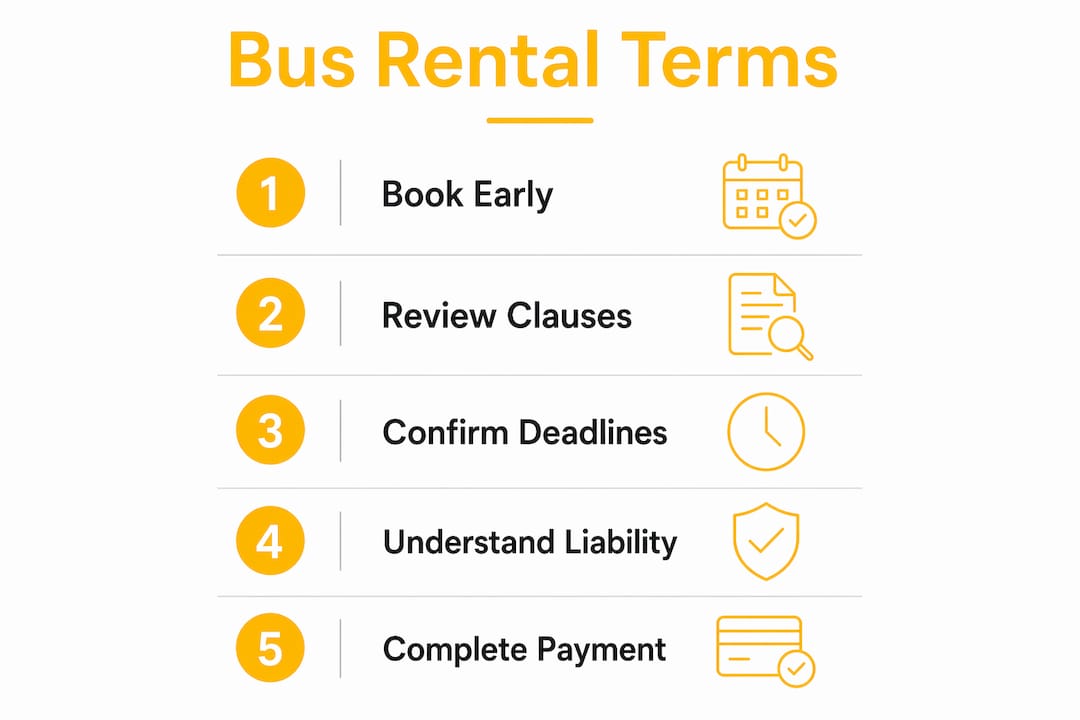
The practical implication of this structure is that your internal planning deadlines must be set earlier than the operator’s deadlines. Aligning customer deadlines earlier than the vendor’s allows you to release unsold spaces and avoid attrition penalties on group bookings. If you are coordinating a corporate event or group tour, confirm your final headcount at least a week before the operator’s payment deadline, not on the day it falls due.
Pro Tip: Request a written confirmation of every deadline at the time of booking. Verbal assurances about flexibility do not override the written terms of a bus rental agreement.
What rights and responsibilities do renters have under bus rental terms?
Renters carry more legal responsibility under a typical bus hire agreement than most people realise. The document you sign is not simply a receipt for transportation. It is a transfer of risk, and several of its provisions place significant obligations on you personally and on every member of your group.
The core renter obligations include:
- Maintaining proper conduct. You are responsible for the behaviour of every person travelling in your group. If a member of your party causes damage or disrupts the trip, the financial and legal consequences fall on the lead renter.
- Assumption of risk. Bus rental tour agreements include explicit assumption of risk clauses covering travel conditions, weather, and activities such as alcohol consumption on licensed tour vehicles. Signing the agreement means you accept these risks as inherent to the experience.
- Compliance with prohibited items rules. Smoking is typically prohibited onboard, with fees of $150 or more applied automatically for violations. Dangerous items, open containers outside of designated areas, and certain food and beverage restrictions are standard across most operators.
- Financial liability for damage. If your group damages the vehicle, you are liable for repair costs. Cleanup fees apply for spills, excessive mess, or any condition that requires the vehicle to be taken out of service before the next booking.
Violations of conduct rules can result in immediate removal from the vehicle without any refund of the fare paid. This is not a discretionary penalty. It is a contractual right the operator holds, and it is enforceable.
The indemnification obligation deserves particular attention. If a claim arises from your group’s behaviour, the operator can pursue you for their legal costs and any damages awarded. Before signing any agreement that includes an indemnification clause, confirm that your personal or organisational insurance policy covers this type of voluntary liability. Many standard policies do not.
How do regulatory and procurement contexts shape bus rental terms?
The terms and conditions you encounter depend significantly on whether you are booking through a private operator or within a public-sector or institutional procurement framework. These two contexts produce very different contractual structures.
| Context | Key characteristic | Practical implication |
|---|---|---|
| Private charter | Operator-drafted terms, flexible negotiation | Terms favour the operator; negotiation is possible before signing |
| Public-sector procurement | Formal published dates and multi-year contract periods | Internal timelines must align precisely with contract start and end dates |
| Institutional group booking | Procurement rules may override vendor T&Cs | Compliance obligations extend beyond the rental agreement itself |
| Regulatory compliance | Charter service definitions affect permitted use | Operators must adhere to rules that go beyond contract language |
Public-sector minibus contracts specify published dates and contract durations that govern the entire service period, which differs substantially from a consumer-facing booking. If your organisation is procuring bus services under a formal tender or institutional agreement, the terms of service for bus rental will include multi-year service periods and formal start and end date requirements. Misaligning your internal procurement calendar with these dates creates compliance gaps that can expose your organisation to liability.
Regulatory definitions also matter. Ken Presley of the United Motorcoach Association has noted that regulatory definitions of charter service materially affect compliance and contractual obligations in bus rentals. An operator providing a service that meets the regulatory definition of a charter must comply with rules that apply regardless of what the contract says. This is a layer of obligation that sits above the rental agreement itself.
One further distinction worth noting: passenger rights frameworks that apply to air carriers do not extend to bus rentals. A 2026 Federal Register rule requires air carriers to post passenger rights summaries, but no equivalent statutory protection exists for bus passengers. This means your rights as a bus renter are defined almost entirely by the contract you sign, not by legislation.
Key takeaways
A bus rental agreement transfers significant financial and legal risk to the renter, making it the most consequential document in any group transportation booking.
| Point | Details |
|---|---|
| Read liability and indemnification clauses first | These provisions shift financial responsibility to you and may not be covered by standard insurance policies. |
| Set internal deadlines before the operator’s | Aligning your group’s confirmation timeline earlier than the vendor’s deadline prevents attrition penalties. |
| Conduct rules bind your entire group | The lead renter is responsible for every passenger’s behaviour, including financial consequences for violations. |
| Private and public contracts differ significantly | Procurement-context agreements include formal date requirements that consumer-facing terms do not. |
| No statutory passenger rights apply to bus rentals | Your protections come from the contract alone, not from legislation equivalent to air carrier rules. |
What I’ve learned from reading the clauses most people skip
After reviewing bus rental agreements across dozens of group bookings, the pattern is consistent. Renters focus on the price, the vehicle size, and the pick-up time. They skim the indemnification clause, skip the force majeure section entirely, and assume the cancellation policy is more flexible than it is. The surprises always come from the paragraphs they did not read.
Force majeure clauses are the most misunderstood provision in any travel contract. Renters assume that if something outside their control cancels a trip, they will receive a full refund. The clause does not work that way. It excuses the operator from performance. Whether you receive a refund depends on whether the clause includes a termination right for the customer, and many do not. A well-drafted force majeure clause should include clear definitions of covered events, timely notice obligations, and mitigation duties. If the clause you are signing does not include these elements, you are accepting a one-sided risk allocation.
My practical advice is direct. Before signing any bus rental conditions document, confirm three things. First, does your insurance cover the indemnification obligation? Second, what is the exact cancellation deadline and what percentage do you forfeit after it passes? Third, does the force majeure clause give you any termination right, or does it only protect the operator? These three questions will tell you more about the real terms of your booking than anything else in the document.
Negotiation is possible, particularly for large group bookings or repeat business. Operators who want your business will often adjust deposit structures or clarify ambiguous clauses if you ask before signing. Once the agreement is executed, that leverage is gone.
— Firoz
Plan your Toronto group trip with confidence

Torontobusrentals provides clear, straightforward bus rental agreements for corporate events, school trips, weddings, and group tours across Toronto. Every booking comes with transparent payment terms, defined cancellation policies, and direct communication from a team that understands what organisations need before they commit to a contract. If you are coordinating group transportation in Toronto and want to understand exactly what you are agreeing to before you sign, Torontobusrentals makes that process straightforward. Explore the full range of bus rental options for group events and get in touch to discuss terms that work for your specific booking.
FAQ
What do terms and conditions in bus rental typically cover?
Bus rental terms and conditions cover payment schedules, cancellation deadlines, liability waivers, indemnification obligations, conduct rules, and force majeure provisions. These clauses define the rights and responsibilities of both the renter and the operator for the full duration of the booking.
Can I negotiate the terms in a bus rental agreement?
Negotiation is possible before signing, particularly for large group bookings or repeat clients. Once the agreement is executed, the written terms govern the relationship entirely, so raise any concerns before you sign.
What happens if I cancel a bus rental after the deadline?
Cancellations after the stated deadline typically result in forfeiture of the full amount paid, including any deposit. Some operators offer credit toward a future booking, but this is at their discretion and must be confirmed in writing.
Are bus passengers protected by passenger rights legislation?
No equivalent statutory passenger rights framework applies to bus rentals in the way that air carrier rules apply to flights. Your protections as a bus renter come from the contract for bus rental you sign, not from legislation.
Who is responsible if a member of my group damages the bus?
The lead renter is responsible for all damage caused by any member of the group. Repair costs, cleanup fees, and any loss of service charges are billed to the person who signed the rental agreement.
Recommended
- Master the bus rental booking process for group events
- Bus Rental for Tourists: Safe and Flexible Group Travel
- How to rent a bus in Toronto for seamless group travel
- Master bus rental agreements for Toronto group travel