
Sustainable transportation for events: a 2026 planner’s guide
TL;DR:
- Transportation causes 60 to 90 percent of an event’s carbon footprint, making it the top sustainability focus. Choosing venues with transit access and early planning of group logistics significantly reduce emissions. Accurate measurement relies on real-time data collection through registration and check-in processes.
Sustainable transportation for events is defined as the deliberate selection and management of travel options that minimise carbon emissions across every stage of an event’s lifecycle. Transportation accounts for 60–90% of an event’s total carbon footprint, dwarfing the contributions of venue operations and catering combined. That single figure reframes the entire sustainability conversation. No amount of compostable cutlery or LED lighting offsets a fleet of single-occupancy cars or unnecessary short-haul flights. For event planners, the most impactful sustainability decision is not what happens inside the venue. It is how attendees get there.
What are the main contributors to transportation emissions at events?
Attendee travel overwhelms every other emission source at most events. International flights are the single largest driver, particularly for conferences that draw delegates from multiple countries. A delegate flying from Vancouver to Toronto generates roughly the same carbon output as dozens of local attendees taking public transit for an entire week.
Local ground transport is the second major contributor. The specific mix of modes matters enormously. An event where 500 attendees each arrive by private car produces far more emissions than the same crowd arriving by coach or subway. Venue location compounds this: a venue on the outskirts of a city with no rail access forces attendees into cars by default.
The key emission sources at a typical large event include:
- International air travel: The dominant factor for multi-city or national conferences, often accounting for the majority of total transport emissions.
- Domestic flights: Short-haul flights between Canadian cities carry a disproportionately high carbon cost per kilometre compared to rail.
- Private car trips: Single-occupancy vehicles to and from the venue, including last-mile trips from transit hubs.
- Ride-share and taxi fleets: Individually booked rides that create vehicle surges and idle time outside venues.
- Event shuttle fleets: Diesel-powered shuttle buses without modern emissions controls.
Transportation demand management (TDM) must begin early in the planning process to address these sources before they become locked in. Waiting until the week of the event to think about attendee travel is the most common and costly mistake planners make.
Which sustainable transportation modes work best for events?
The right mix of eco-friendly event transport depends on your venue, attendee origin, and budget. No single mode solves everything, but some deliver far more impact per dollar than others.
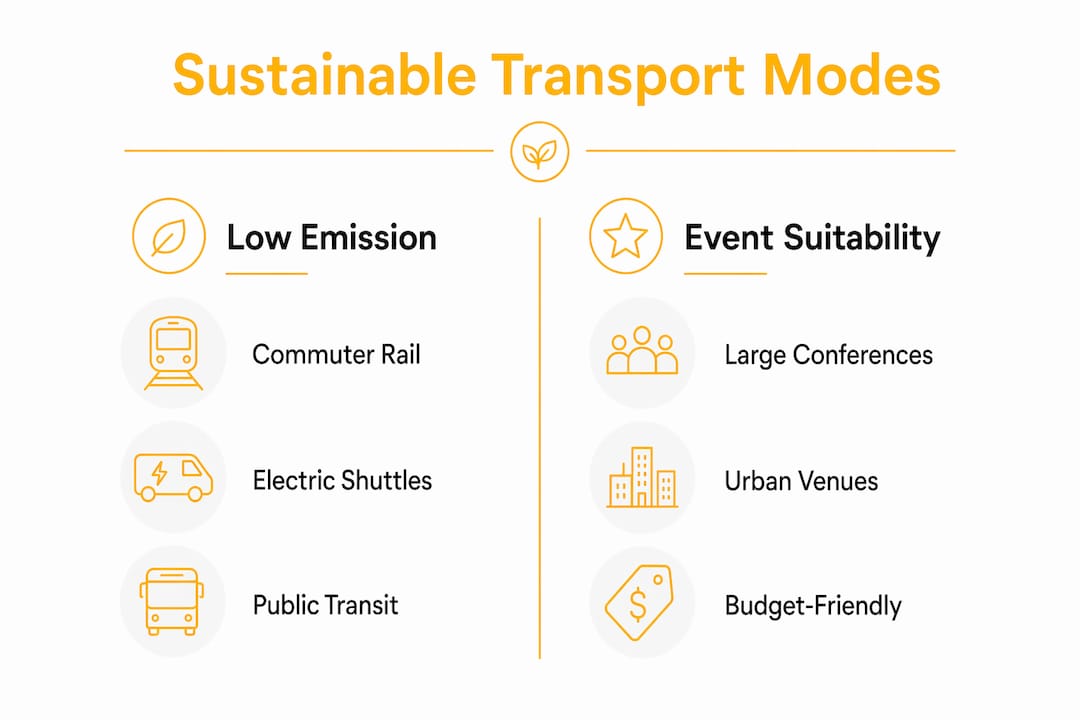
| Transport mode | Emission impact | Cost relative to private car | Best suited for |
|---|---|---|---|
| Commuter rail and subway | Very low | Lower per seat | Urban venues near transit hubs |
| Group motor coach | Low per seat | Competitive at scale | Suburban venues, airport transfers |
| Electric or hybrid shuttle | Very low | 10–20% premium | Short loops, hotel to venue runs |
| Cycling and walking routes | Zero | Free | Dense urban areas, short distances |
| Shared ride with EV filter | Low | Similar to standard ride-share | Last-mile gaps, small groups |
Public transit is the most accessible low-carbon option for urban events. Planners who negotiate group transit passes or provide subsidised TTC day passes see measurable shifts in attendee travel behaviour. The key is removing the friction: attendees choose transit when it is cheaper, faster, and clearly signposted.
Group rail bookings work well for conferences drawing attendees from across Ontario. Via Rail offers group booking discounts that can make train travel cost-competitive with economy flights, especially on the Toronto-Ottawa and Toronto-Montreal corridors. The carbon saving per seat is substantial.
Electric and hybrid vehicle shuttles carry a 10–20% cost premium over standard diesel coaches. That premium is real, but it shrinks when spread across a full coach load. Flat-rate, private group transit staged at the venue also prevents the post-event congestion and price surges that plague events relying on individual ride-share bookings. Reliable departures and returns are a practical benefit that attendees notice immediately.
Pro Tip: Book electric or hybrid motor coaches at least eight weeks before your event. Green vehicle capacity fills faster than standard fleets, particularly during peak conference season in spring and autumn.
How to integrate sustainable transportation into event logistics and planning
Treating transport as an afterthought is the single biggest mistake in sustainable event logistics. The decisions that most determine your transport emissions are made months before the event, not days before.
A practical integration process follows this sequence:
Choose the venue first based on transit access. Cities with strong rail infrastructure produce events with substantially lower attendee carbon footprints. Venue location with easy rail access is the most effective single strategy for reducing transport emissions. Prioritise venues within 500 metres of a subway or GO Train station.
Map attendee origins during registration. Ask delegates to indicate their city and preferred travel mode at sign-up. This data shapes your transport plan and identifies where group bookings will have the most impact.
Apply TDM principles from the first planning meeting. TDM means actively managing how people travel, not just providing options. This includes incentives for low-carbon choices, disincentives for driving alone, and clear communication about alternatives.
Negotiate group rates with transit providers. Contact the TTC, GO Transit, or Via Rail directly. Group agreements are available and often underused by event planners.
Stage flat-rate group coaches at the venue. Contract a fixed-price motor coach service for hotel-to-venue and venue-to-transit-hub runs. This removes the ride-share surge risk entirely and gives attendees a reliable, predictable option. A solid event transportation checklist covers every staging detail.
Communicate transport options clearly and early. Send attendees a transport guide at least three weeks before the event. Include transit maps, group coach schedules, cycling routes, and any travel subsidies on offer.
Coordinate with local transit authorities. For events over 1,000 attendees, contact the relevant transit authority directly. Many will adjust service frequency or add temporary stops for large gatherings.
Pro Tip: Include a transport mode question in your event registration form. The data you collect improves your emissions modelling and helps you right-size your coach bookings before you commit to contracts.
What are the financial implications of sustainable event transport?
Sustainable transport adds 5–15% to event transport budgets on average. That increase is real, but it is manageable with the right planning approach.
The main cost drivers include:
- EV and hybrid vehicle premiums: Electric and hybrid coaches typically cost 10–20% more per vehicle than standard diesel equivalents. Booking in volume reduces this gap.
- Transit subsidies for attendees: Providing subsidised or free transit passes adds a direct cost but shifts attendees out of cars and taxis, reducing the number of coaches you need to stage.
- Early booking requirements: Green vehicle fleets are smaller than standard fleets. Booking late means paying a scarcity premium or losing access entirely.
The offsets are equally real. Group rail bookings and virtual participation tiers both reduce the total number of physical attendees needing ground transport. A well-designed hybrid event that gives remote delegates live Q&A access and genuine networking tools can shift a meaningful portion of your audience online, cutting transport costs and emissions simultaneously.
The most effective financial approach is to treat sustainable transport as a line item from the first budget draft, not an add-on after other costs are set. Planners who build green transport into the initial budget avoid the painful trade-offs that come from retrofitting sustainability into a plan built around conventional transport assumptions. For a breakdown of group transportation by event size, the cost differences between options become much clearer.
How do you measure and report transportation sustainability outcomes?
Measurement is where most event sustainability programmes fall short. Vague commitments to “greener travel” are not enough. ICCA’s updated benchmarks require concrete carbon data and transparent documentation to enable year-over-year improvement. That standard is now the baseline expectation for professional events.
Practical measurement steps include:
- Collect travel mode data at registration. Ask every attendee how they plan to travel. This is your baseline dataset.
- Use QR codes and check-in integration for real-time capture. Real-time emissions data via QR codes at check-in yields higher quality modelling than post-event surveys. Attendees are present and engaged, so response rates are far higher.
- Benchmark against ISO 20121. ISO 20121 is the international standard for sustainable event management. It provides a recognised framework for calculating and reporting transport emissions.
- Report results to attendees and stakeholders. Publish your transport emissions figure in the post-event report. Transparency builds credibility and creates accountability for the next event.
- Set specific KPIs for the next event. Examples include: reduce private car arrivals by 20%, increase transit use to 60% of attendees, or cut per-delegate transport emissions by 15%.
The sustainability in logistics field has developed robust carbon accounting methods that translate directly to event transport. Applying these methods gives your emissions data credibility with sponsors, certification bodies, and attendees who scrutinise sustainability claims.
Key takeaways
Sustainable transportation for events is the highest-impact sustainability action available to planners, because transport emissions represent 60–90% of total event carbon output.
| Point | Details |
|---|---|
| Transport dominates event emissions | Transportation accounts for 60–90% of an event’s carbon footprint, making it the top priority. |
| Venue selection is the first decision | Choosing a venue with strong rail and transit links reduces attendee car dependency before planning begins. |
| Flat-rate group coaches prevent chaos | Contracted group transit eliminates ride-share surges and gives attendees reliable, low-emission departures. |
| Budget for a 5–15% transport premium | Green transport costs more upfront but group bookings and virtual tiers offset the increase. |
| Measure with real-time data capture | QR-code check-in integration produces more accurate emissions data than post-event surveys. |
Why transport is the sustainability decision planners keep getting wrong
I have seen event planners spend months agonising over biodegradable lanyards and locally sourced catering while booking a suburban venue with no transit access. The emissions from that venue choice will outweigh every other sustainability effort combined. That is not an exaggeration. It is what the data shows.
The second mistake I see constantly is relying on ride-share apps as the default last-mile solution. Ride-share vehicles idle outside venues, create congestion, and surge in price the moment an event ends. Attendees end up frustrated, and the carbon cost is higher than a well-staged coach. Contracting flat-rate group transport is not glamorous, but it solves both problems at once.
The measurement gap is the third issue. Planners collect post-event surveys that maybe 20% of attendees complete, then use that thin data to claim emissions reductions. Embedding travel mode questions into registration and using QR check-in to capture real-time data takes almost no extra effort and produces numbers you can actually defend to sponsors and certification bodies.
My honest recommendation is to treat transport as the centrepiece of your sustainability programme, not a footnote. Pick the venue based on transit access first. Book group coaches early. Collect real data. Report it honestly. Everything else follows from those four decisions.
— Firoz
How Torontobusrentals supports green event transport in Toronto
Event planners working toward lower-carbon events need a ground transport partner who understands both logistics and sustainability goals. Torontobusrentals provides motor coach group travel options for Toronto events, with flat-rate pricing that eliminates the surge risk and logistical unpredictability of individual ride-share bookings.

Whether you are running a corporate conference, a multi-day summit, or a large private gathering, Torontobusrentals offers group transportation logistics expertise to match your attendee volume and venue location. Flat-rate contracts, professional drivers, and reliable staging make it straightforward to deliver on your sustainability commitments without adding operational complexity. Contact Torontobusrentals to discuss a transport plan that fits your event’s size, schedule, and environmental targets.
FAQ
What percentage of event emissions comes from transportation?
Transportation accounts for 60–90% of an event’s total carbon footprint. Venue operations and catering together represent a much smaller share, making attendee travel the top sustainability priority.
What is the most effective way to reduce transport emissions at an event?
Choosing a venue with strong rail and transit access is the single most effective strategy. Cities with robust rail infrastructure produce events with substantially lower per-attendee carbon footprints than venues requiring private car travel.
How much does sustainable event transport cost compared to standard options?
Sustainable transport typically adds 5–15% to event transport budgets. Electric and hybrid vehicles carry a 10–20% premium, but group bookings and virtual participation options offset much of that increase.
What is TDM and why does it matter for event planning?
Transportation demand management (TDM) is the practice of actively influencing how attendees travel, using incentives, communication, and transit partnerships. TDM must begin early in the planning process to avoid operational strain and neighbourhood disruption on event day.
How should planners measure transport emissions after an event?
Planners should collect travel mode data at registration and use QR-code check-in integration to capture real-time attendance data. This approach produces more accurate emissions modelling than post-event surveys and aligns with ISO 20121 reporting standards.
Recommended
- Event transportation checklist for planners: 2026 guide
- Corporate transportation trends 2026: what leaders must know
- Defining event group transportation for planners