
Smart transportation ideas for Toronto corporate events
TL;DR:
- Effective corporate event transportation in Toronto requires strategic planning, demand-aware dispatch, and local expertise to handle unique venue and traffic challenges. Planners should analyze attendee movement, build buffers, and select flexible solutions like dynamic shuttles or private coaches to ensure reliability and smooth flow. Partnering with experienced local providers enhances resilience, minimizes delays, and delivers a seamless attendee experience.
Coordinating group transport for a corporate event sounds straightforward until the reality sets in: multiple pickup locations across the city, departments arriving at staggered times, and a hundred attendees spilling out of a conference hall at once. A single booking is rarely enough. What separates a smooth event from a logistical disaster is strategic planning, the right mix of vehicles, and a team that understands Toronto’s unique traffic patterns, venue corridors, and peak demand windows. This guide walks you through every critical decision you need to make before the first bus rolls.
Table of Contents
- How to evaluate transportation options for corporate events
- Top corporate event transportation ideas in Toronto
- Comparing your options: Which solution is best for your team?
- Practical tips for seamless group coordination
- The overlooked truths of group transportation for events
- Toronto event transportation made easy with local experts
- Frequently asked questions
Key Takeaways
| Point | Details |
|---|---|
| Demand-driven scheduling | Smart shuttle plans adjust vehicle numbers in real time to meet attendee flow and reduce wait times. |
| Compare for your needs | Consider group size, event type, and local Toronto venues when choosing between shuttles, private coaches, and mini-buses. |
| Monitor operational KPIs | Track on-time performance and reliability to improve each event’s logistics and attendee satisfaction. |
| Plan for surges | Anticipate high-demand periods after event sessions and assign additional vehicles to avoid long pickup lines. |
How to evaluate transportation options for corporate events
Before you look at a single vehicle catalogue or compare pricing, you need to understand your event’s specific movement patterns. Not every corporate gathering has the same attendee flow. A team-building day at a venue in the Distillery District runs differently from a multi-day conference near the Metro Toronto Convention Centre, where shuttle demand can spike dozens of times throughout the day.
Start by mapping out three things: where your attendees are coming from, when they need to arrive and depart, and how many distinct pickup or drop-off zones you are working with. This sounds simple, but many planners skip it and end up with vehicles in the wrong place at the worst time.
Key selection criteria to work through:
- Attendee volume and flow: How many people need transport at any single window, and does that number change throughout the day?
- Venue access: Some Toronto venues have restricted vehicle lengths, loading bay constraints, or designated drop-off zones that rule out larger coaches.
- Schedule flexibility: Will the itinerary shift if a session runs long? Your transport provider needs to accommodate that reality.
- Traffic conditions: King Street, the Gardiner Expressway, and the DVP all have predictable congestion windows. Build buffer time into every leg.
- Surge periods: Lunch breaks and post-session windows create sudden demand spikes that a fixed schedule cannot absorb.
“Reliable event transportation is not about booking enough vehicles for the average moment. It’s about planning for your busiest moment, then adding a buffer.”
Event-day shuttle operations need demand-aware dispatch tactics such as headway control and temporarily reallocating vehicles to peak zones. Headway refers to the time interval between shuttle arrivals at a stop. Shortening headway during high-volume periods reduces wait times dramatically and prevents queue pile-ups at your main entrance.
You should also understand what an event shuttle service actually involves operationally, including how dispatch communication works on the day, before you commit to a model.
Pro Tip: Build a simple demand heat map for your event before speaking with any provider. Mark the 30-minute windows when the most people will need a vehicle. Showing this to your transport partner immediately elevates the quality of the plan you receive back.
Do not default to whatever the venue suggests or what worked for a generic corporate outing two years ago. Every event has its own rhythm, and your transport strategy should reflect that.
Top corporate event transportation ideas in Toronto
Now that you know what matters most in your selection process, explore these top transport solutions and what makes them a fit for Toronto events.
1. Dynamic shuttle buses with headway management
The most versatile option for mid-to-large groups is a scheduled shuttle bus with dynamic frequency adjustment. Rather than running on a rigid timetable, these shuttles respond to observed demand. When a session ends and 80 people head to the lobby at once, you want a plan that already accounts for this window, not one that leaves them waiting 25 minutes for the next vehicle. A post-session surge needs an explicit post-session window and a headway and fleet rebalancing mechanism to prevent long waits at pickup zones.
2. Private charter coaches for multi-stop routes
Charter coaches are ideal when your group needs flexible drop-off points across the city, such as downtown hotels, a Scarborough training facility, and a North York office in the same evening run. They offer comfort, a professional driver, and the ability to customise the route in real-time if traffic or scheduling shifts.
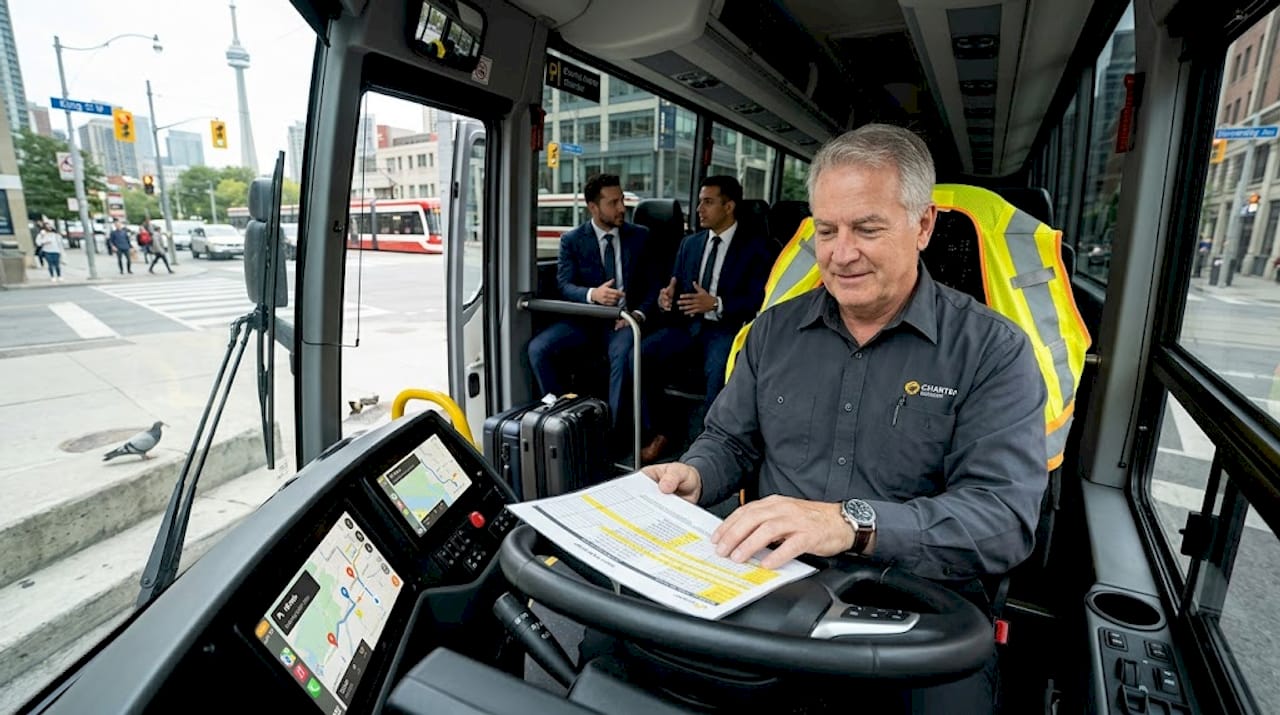
3. Mini-coaches for smaller teams or off-peak legs
Not every group movement requires a 55-seat coach. Mini-coaches carrying 20 to 30 passengers are perfect for department-specific outings, executive transfers, or early-morning runs when overall demand is low. They are also easier to manoeuvre through tighter Toronto streets and venue laneways.
4. Branded shuttles for enhanced attendee experience
If your corporate event has a strong brand presence, a wrapped or branded shuttle adds a memorable touchpoint. Attendees boarding a vehicle that carries your company’s colours and logo feels intentional and polished. It also helps with wayfinding at large venues with multiple transport options.
5. Point-to-point group rideshares for irregular travel patterns
When attendee arrival times are genuinely staggered and unpredictable, a coordinated group rideshare approach, pre-booked through a single account and managed centrally, can fill gaps that scheduled shuttles miss. This works well for small satellite offices where only five to ten staff are travelling together.
When you are ready to move from concept to execution, reviewing a guide on setting up shuttle service for an event will save you significant time on the operational details. For recurring corporate needs, it is also worth exploring dedicated corporate shuttle services that can be structured around your organisation’s ongoing schedule rather than rebuilt for each event.
Pro Tip: For events over 150 attendees, always have at least one standby vehicle on reserve. The cost is modest compared to the reputational risk of leaving a group stranded because a coach had a mechanical issue.
Comparing your options: Which solution is best for your team?
With options outlined, compare them quickly to clarify which ideas are best suited to your event’s audience and schedule.
| Transport option | Passenger capacity | Flexibility | Best use case | Relative cost |
|---|---|---|---|---|
| Dynamic shuttle bus | 40 to 55 | High (headway adjustable) | Large conferences, multi-session events | Moderate |
| Private charter coach | 40 to 60 | Very high (custom routing) | Multi-stop city routes, team outings | Moderate to high |
| Mini-coach | 20 to 30 | Moderate | Small teams, off-peak legs, executive transfers | Low to moderate |
| Branded shuttle | 30 to 55 | Moderate | High-profile brand events, award ceremonies | Moderate to high |
| Group rideshare (coordinated) | 4 to 10 per vehicle | Very high | Irregular schedules, satellite offices | Variable |
The role buses play in corporate group travel is often underestimated. A well-managed coach does more than move people. It sets the tone for the event, keeps groups intact, and removes the cognitive burden of individual travel decisions from your attendees.
One metric worth building into your planning is on-time performance. Transportation KPIs such as on-time performance, reliability, and operational benchmarks are useful for tuning service levels. The standard target most planners aim for is 95% or higher on-time arrival rates across all legs. Top-tier providers serving critical events often target 99%.
Before signing any agreement, run through a structured bus rental checklist to confirm that every operational detail, from driver briefing protocols to vehicle backup plans, is clearly covered.
What the table does not show is how each option handles the unexpected. Charter coaches and dynamic shuttles both excel here because they involve direct communication with a driver or dispatcher. Coordinated rideshares, while flexible, offer less control when you need to reroute on the fly.
Practical tips for seamless group coordination
Knowing the pros and cons is one thing; now, level up your event with these actionable strategies used by experienced Toronto planners.
1. Map your surge windows in advance. Identify every point in your event schedule where 30 or more people could seek transport simultaneously. Lunch breaks, end-of-session moments, and award dinner departures are the usual suspects.
2. Assign a dedicated transport coordinator. This person should have direct contact with the dispatcher or driver throughout the event. Do not route transport changes through a general event staff member who is also managing registration and catering questions.
3. Communicate pickup details proactively. Send attendees clear written instructions before the event and a reminder on the day. Include the exact pickup location, the shuttle number or colour, and estimated departure times. Ambiguity causes clustering at the wrong entrance and missed vehicles.
4. Use technology to your advantage. Real-time vehicle tracking apps and group communication tools allow your coordinator to see where vehicles are and push updates to attendees instantly. This is especially valuable at large Toronto venues where the walk from one entrance to the shuttle bay can take several minutes.
5. Reallocate vehicles during the event, not after. Streamlining event logistics requires live decision-making. If one pickup zone is overwhelmed while another is quiet, move a vehicle immediately rather than waiting for the scheduled rotation.
6. Build a contingency buffer into the schedule. Add 15 minutes of flex time to every critical transport leg. Toronto traffic is genuinely unpredictable, and a buffer protects your timeline without requiring heroic driving.
“The biggest mistake corporate planners make is treating transport as a fixed infrastructure problem. It is actually a fluid operations problem, and the best coordinators treat it that way in real time.”
Shuttle service for corporate events works best when the planner and provider have established a clear communication chain before event day. Set up a group chat with your driver contacts and dispatcher 24 hours in advance.
Also, keep in mind that benchmarks for shuttle metrics are not universally standardised across the industry. Use KPIs as internal targets and calibrate them against your event’s actual risk tolerance rather than assuming an industry number automatically applies to your context.
The overlooked truths of group transportation for events
After sharing hands-on tactics, it is worth pausing for a candid look at what most official advice glosses over.
Here is the uncomfortable truth most transport guides will not tell you: checklists are useful, but they create a false sense of control. A perfectly formatted checklist does not prepare you for 200 attendees exiting a ballroom 20 minutes early because a keynote ended ahead of schedule. Real Toronto events have a life of their own, and the planners who handle transport best are the ones who treat their plan as a living document rather than a fixed script.
External benchmarks are similarly overrated as a standalone tool. As the evidence on KPI standardisation shows, empirical benchmarks for corporate shuttle metrics are not widely standardised. A 95% on-time target means very little if your provider defines “on-time” as arriving within 10 minutes of schedule while you define it as within 2 minutes.
What actually works is building genuine resilience into your transport strategy. That means a standby vehicle, a dispatcher you can call directly, and a coordinator with the authority to make real-time decisions without approval delays. It also means briefing your transport provider on the spirit of your event, not just the logistics spreadsheet.
The corporate shuttle planning approach that consistently delivers results focuses on relationship over transaction. Providers who understand your organisation’s culture, your attendees’ expectations, and Toronto’s specific venue constraints will outperform a lower-cost option that treats your event like just another booking.
Post-session surges, in particular, expose the gap between planned and resilient transport. Any experienced Toronto planner has a story about 150 people leaving a session simultaneously and overwhelming a pickup zone designed for a gentle trickle. The solution is never more signage. It is always more vehicles and faster communication.
Toronto event transportation made easy with local experts
Having explored options and pitfalls, take the stress out of execution by turning to trusted local providers who cater to Toronto’s unique event demands.
Working with a provider who knows Toronto intimately makes a measurable difference. Local knowledge of venue loading bays, peak congestion corridors, and neighbourhood-specific restrictions translates directly into fewer delays and smoother attendee experiences on the day.

Toronto Bus Rentals specialises in exactly this kind of strategic group transport for corporate events. Whether you need a full fleet of dynamic shuttles for a conference or a private charter for a team outing in the city, the focus is always on reliability, professional drivers, and real-time flexibility. Explore motor coach solutions built for group efficiency, or follow the simple steps to rent a bus for your next corporate outing and get a plan that actually matches your event’s demands.
Frequently asked questions
What is the most efficient way to transport large groups for a Toronto company event?
Dynamic shuttle services with demand-aware scheduling are most efficient for large groups, as they allow reallocation of vehicles during peak times and significantly reduce wait times at busy pickup zones.
What is the industry standard for on-time performance with event transport?
Aiming for at least 95% on-time arrivals is a widely referenced target, though top-performing providers may target 99% or higher for events where delays carry significant reputational risk.
How can planners handle attendee surges after sessions end?
Assign extra vehicles to post-session windows in advance and establish a live communication line with your dispatcher so that fleet rebalancing can happen immediately rather than after a queue has already formed.
How should benchmarks influence my transportation strategy?
Treat KPI benchmarks as useful internal targets rather than hard industry rules, since corporate shuttle metrics are not uniformly standardised and your event’s specific risk profile should guide your actual goals.
Recommended
- Master the role of buses in corporate travel for Toronto events
- Blog – Toronto Bus Rentals
- Why bus rentals are essential for Toronto events: Cost, ease, safety
- How bus rentals streamline event logistics in Toronto