
Simple steps to rent a bus for your corporate outing
Organising transportation for corporate outings in Toronto can feel overwhelming when you’re juggling headcounts, budgets, and tight schedules. Your team deserves a seamless travel experience that lets everyone arrive together, relaxed and ready to engage. This guide walks you through the exact steps to rent a bus for your corporate event, from initial planning to post-trip follow-up, so you can focus on what matters most: creating memorable experiences for your colleagues.
Table of Contents
- Key takeaways
- What you need before renting a corporate outing bus
- Step-by-step process to book a bus rental for your corporate event
- Common mistakes to avoid and troubleshooting tips
- What to expect during and after your corporate outing bus rental
- Discover professional corporate bus rental services in Toronto
- Frequently asked questions
Key Takeaways
| Point | Details |
|---|---|
| Exact passenger count | Survey your team and confirm the final headcount including last minute additions to avoid booking errors. |
| Thorough itinerary and buffers | Map every stop and departure time with extra buffer to accommodate Toronto traffic and return schedules. |
| Upfront budget approval | Obtain internal approval for your budget ceiling before requesting quotes to prevent delays. |
| Right vehicle for group | Decide on vehicle type based on group size and trip length, with minibuses for small groups and full size coaches for larger groups. |
What you need before renting a corporate outing bus
Successful bus rentals start long before you contact a provider. Preparation saves time, money, and stress.
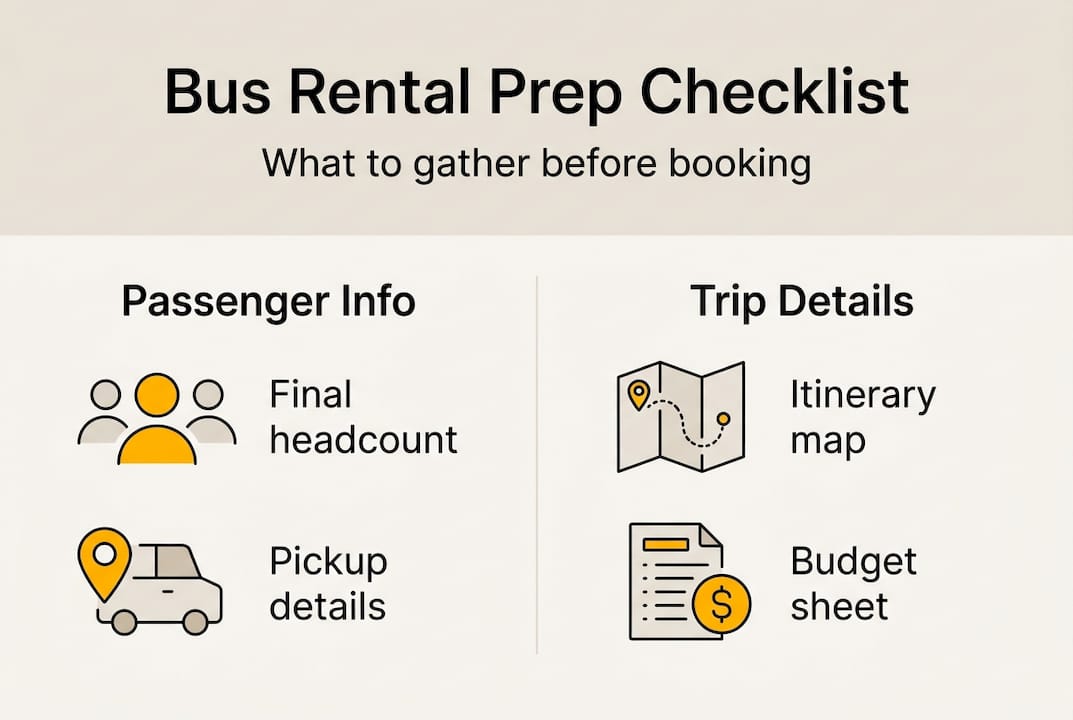
First, establish your exact passenger count. Don’t estimate. Survey your team and account for last-minute additions or cancellations. A group of 30 requires different equipment than 50, and understanding group size and trip details is essential before booking to avoid errors. Include special needs: wheelchair accessibility, extra luggage space, or child safety seats.
Next, map your complete itinerary. Where are you going? How many stops? What’s the total distance? Drivers need precise pickup locations, departure times, and return schedules. Toronto traffic patterns vary dramatically by time of day, so build buffer time into your timeline. A trip to Niagara Falls requires different planning than a quick jaunt across the city.
Budget clarity comes third. Corporate bus rentals typically range from $150 to $300 per hour depending on vehicle size and amenities. Factor in gratuities (usually 15–20% of the base rate), potential overtime charges, and fuel surcharges. Get internal approval for your budget ceiling before requesting quotes, so you’re not scrambling later.
Pro Tip: Create a simple spreadsheet tracking passenger names, pickup locations, dietary restrictions, and emergency contacts. Share it with your rental company 48 hours before departure to streamline coordination.
Decide on vehicle type based on group dynamics and trip length. Minibuses work beautifully for teams under 25, whilst full-size coaches suit larger groups needing onboard amenities. Consider trip duration: a two-hour journey warrants reclining seats and climate control, whilst a 20-minute shuttle prioritises efficiency over luxury.

| Preparation item | Timeline | Why it matters |
|---|---|---|
| Final headcount | 2 weeks before | Locks in vehicle size and prevents capacity issues |
| Complete itinerary | 3 weeks before | Allows accurate time and cost estimates |
| Budget approval | 4 weeks before | Enables confident booking without delays |
| Special requirements | 2 weeks before | Ensures proper vehicle selection and equipment |
Finally, gather necessary documentation. Some corporate policies require formal transportation contracts, insurance certificates, or vendor registration forms. Check your organisation’s procurement rules early. Having paperwork ready accelerates the booking process and prevents administrative bottlenecks.
Step-by-step process to book a bus rental for your corporate event
Once you’ve prepared, following a structured booking process prevents common mistakes and delays. Here’s exactly how to secure your corporate bus rental.
Research local bus rental companies. Start with Toronto-based providers who understand local routes and traffic patterns. Check online reviews, ask colleagues for referrals, and verify how long each company has operated. Established providers typically maintain newer fleets and employ experienced drivers.
Request detailed written quotes from at least three companies. Specify your exact requirements: date, time, passenger count, itinerary, and desired amenities. Ask each provider to itemise costs including base rate, fuel surcharges, driver gratuity, parking fees, and any overtime provisions. Vague quotes lead to surprise charges later.
Verify credentials and insurance coverage. Every legitimate bus company must hold proper licensing from Ontario’s Ministry of Transportation. Request copies of their commercial vehicle operator registration, liability insurance (minimum $5 million coverage), and recent safety inspection records. Don’t skip this step; it protects your organisation from liability if incidents occur.
Inspect vehicles or request recent photos. If possible, visit the company’s facility to see buses firsthand. Check seat condition, cleanliness standards, and amenity functionality. Can’t visit? Ask for dated photos of the specific vehicle assigned to your booking, not generic stock images.
Confirm capacity matches your needs precisely. A bus rated for 50 passengers means 50 standard seats. Factor in luggage, equipment, or presentation materials that might occupy seats. Overcrowding violates safety regulations and creates uncomfortable conditions.
Review and sign the rental contract carefully. Read cancellation policies, payment schedules, and liability clauses. Clarify what happens if the bus breaks down or arrives late. Get everything in writing: verbal promises don’t hold up if disputes arise.
Provide final details one week before departure. Confirm pickup addresses, contact phone numbers for the day of travel, and any route changes. Share your passenger manifest if required. Clear communication prevents day-of confusion.
Pro Tip: Schedule a brief call with your assigned driver 48 hours before departure. Discuss parking access at your pickup location, any route preferences, and how to handle unexpected delays. This personal connection ensures smoother execution.
Payment terms vary by provider. Most require a deposit (typically 25–50% of total cost) at booking, with the balance due 7–14 days before travel. Some accept corporate purchase orders, whilst others require credit card or electronic transfer. Clarify payment methods early to avoid processing delays.
Common mistakes to avoid and troubleshooting tips
Even experienced planners encounter challenges. Planning errors and lack of communication cause the majority of corporate bus rental problems. Here’s how to sidestep common pitfalls.
Last-minute bookings severely limit your options. Toronto’s corporate event season peaks in spring and autumn. Booking two weeks before a popular Friday departure might leave you with subpar vehicles or inflated prices. Secure your bus 4–6 weeks ahead, especially for groups over 30.
Inaccurate passenger counts create cascading problems. Overestimating wastes budget on unused capacity. Underestimating forces uncomfortable crowding or emergency vehicle upgrades at premium rates. Build a 10% buffer into your initial booking, then finalise numbers two weeks out.
Vague communication with providers breeds misunderstandings. “We need a bus for Friday” tells them nothing useful. Specify: “We need a 40-passenger coach for Friday, June 12, 2026, departing 123 Bay Street at 8:00 AM, travelling to Niagara-on-the-Lake with two stops, returning by 6:00 PM.” Precision prevents errors.
“The difference between a smooth corporate outing and a transportation disaster often comes down to one thing: whether the event planner communicated exact requirements upfront. Assumptions kill logistics.”
Ignoring Toronto traffic realities derails schedules. The Gardiner Expressway crawls during rush hour. The DVP becomes a car park when accidents occur. Always pad your timeline by 20–30% for urban routes. A trip that takes 45 minutes at 10:00 AM might require 75 minutes at 8:00 AM.
Failing to plan for contingencies leaves you vulnerable. What if the bus breaks down en route? What if your driver calls in sick? Reputable companies maintain backup vehicles and driver pools, but confirm their contingency protocols in writing. Keep the company’s emergency contact number readily accessible on event day.
Neglecting to brief passengers causes boarding delays. Send a pre-trip email outlining departure time, pickup location, what to bring, and expected return time. Remind attendees that buses can’t wait indefinitely for stragglers. Clear expectations keep everyone on schedule.
Pro Tip: Designate one person as the transportation coordinator for your event. This individual handles all communication with the bus company, manages the passenger manifest, and serves as the on-site contact during travel. Centralised coordination prevents conflicting instructions.
If problems arise during your trip, address them immediately. Driver running late? Call the company’s dispatch for updates. Climate control malfunctioning? Request roadside assistance. Document issues with photos and notes for post-trip resolution.
What to expect during and after your corporate outing bus rental
Knowing what happens during execution and follow-up helps you manage expectations and improve future events.
On departure day, professional drivers arrive 10–15 minutes early to inspect the vehicle and prepare for boarding. They’ll verify the route, confirm your contact information, and review any special instructions. Expect courteous, uniformed drivers who prioritise safety and passenger comfort.
During travel, monitor group comfort discreetly. Is the temperature appropriate? Are passengers finding seats comfortable? Modern coaches include amenities like Wi-Fi, power outlets, and entertainment systems, but functionality varies. Address concerns with the driver politely; they can often make real-time adjustments.
Pro Tip: Bring a small emergency kit containing pain relievers, motion sickness tablets, phone chargers, and bottled water. These simple items solve common passenger discomfort issues without requiring stops.
Drivers handle route navigation, but stay aware of major delays. If traffic or weather significantly impacts your schedule, discuss options with the driver: alternative routes, adjusted stop times, or modified return plans. Flexibility prevents minor issues from becoming major disruptions.
| During-trip checklist | Action |
|---|---|
| Departure punctuality | Note actual departure time vs. scheduled |
| Driver professionalism | Observe communication and driving behaviour |
| Vehicle cleanliness | Check condition matches pre-trip expectations |
| Amenity functionality | Test Wi-Fi, climate control, restroom if applicable |
| Passenger feedback | Informally gauge satisfaction during travel |
After your event, evaluating service quality helps improve future corporate event transport planning. Within 48 hours, send a brief survey to participants asking about their transportation experience. Keep it simple: three to five questions about comfort, timeliness, and overall satisfaction.
Contact the bus company within one week to provide feedback. Highlight what worked well and address any concerns professionally. Strong providers value constructive input and often offer solutions for future bookings. If service exceeded expectations, write a positive review online; if problems occurred, document them clearly and request resolution.
File all documentation: contracts, receipts, correspondence, and feedback summaries. This record proves invaluable when planning next year’s events or if billing disputes arise. Many organisations maintain a transportation vendor scorecard tracking reliability, cost, and service quality across multiple bookings.
Consider establishing a preferred vendor relationship if you organise frequent corporate outings. Regular clients often receive priority booking, volume discounts, and enhanced service. Annual contracts can lock in favourable rates and guarantee vehicle availability during peak seasons.
Discover professional corporate bus rental services in Toronto
Now that you understand the complete rental process, connecting with experienced providers makes execution effortless. Toronto Bus Rentals specialises in corporate group transportation, offering modern coaches with professional drivers who understand business event requirements.

Whether you’re organising a small team outing or a large company conference, their diverse fleet accommodates any group size. From efficient minibuses for intimate gatherings to full-size coaches for major corporate events, you’ll find vehicles equipped with the amenities your team expects. Their streamlined booking process and transparent pricing eliminate the guesswork from group transportation planning. Toronto-based event planners consistently choose providers who combine local expertise with reliable service, and exploring trusted alternatives helps you make informed decisions for your organisation’s specific needs.
Frequently asked questions
What is the best bus size for small corporate outings?
Minibuses accommodating 15–25 passengers work perfectly for small corporate groups. They offer comfortable seating, easy manoeuvrability through Toronto streets, and lower rental costs than full-size coaches. For intimate team-building events or executive retreats, minibus rentals provide the right balance of comfort and efficiency without feeling oversized.
How far in advance should I book a corporate bus rental?
Book your corporate bus 4–6 weeks before your event date, especially during peak seasons (May–June and September–October). Earlier booking secures better vehicle selection, competitive pricing, and preferred departure times. Last-minute bookings often result in limited availability and premium rates. Following proper booking timelines prevents unnecessary stress and ensures your preferred vehicle type remains available.
What amenities can I expect on a corporate charter bus?
Modern corporate charter buses typically include air conditioning, reclining seats, overhead storage, and tinted windows. Many feature Wi-Fi connectivity, power outlets at each seat, and entertainment systems. Larger coaches often include onboard restrooms, whilst luxury models offer leather seating and enhanced climate control. Amenity availability varies by vehicle type and rental company, so specify your requirements when booking. Sports team charter services often showcase premium amenity packages adaptable to corporate needs.
What happens if the bus breaks down during our corporate outing?
Reputable bus rental companies maintain backup vehicles and 24/7 roadside assistance programmes. If mechanical issues occur, the company dispatches a replacement bus or technician immediately. Your rental contract should specify response times and contingency protocols. Always save the company’s emergency contact number in your phone before departure. Professional providers prioritise minimising disruption and ensuring your group reaches destinations safely, even if equipment failures occur.
Can I customise the route or make multiple stops during the rental?
Yes, corporate bus rentals offer flexible routing to accommodate your specific itinerary. Discuss all planned stops, timing requirements, and route preferences during booking. Additional stops or route changes may affect pricing, depending on distance and duration. Communicate any mid-trip adjustments directly with your driver, who can accommodate reasonable requests within safety and schedule constraints. Clear upfront communication about your complete itinerary ensures accurate quotes and prevents confusion on event day.
Recommended
- Guide to Chartering Buses for Toronto Events
- Master the role of buses in corporate travel for Toronto events
- Sports Team Charter Bus Rentals & Minibus
- School Trip Bus Rental Guide for Safe Group Travel
- Corporate Event Luxury Car Rental Vancouver