
School trip transportation explained: a 2026 guide
TL;DR:
- Effective school trip transportation involves choosing compliant vehicles, vetting providers thoroughly, and planning headcounts and accommodations early.
- Rigid adherence to safety regulations, such as daily vehicle inspections and driver hour limits, is essential to prevent costly violations and safety incidents.
School trip transportation is the coordinated process of arranging safe, compliant vehicles and services for student group travel during educational excursions. For teachers and school administrators, this process involves far more than booking a bus. It requires understanding vehicle options, federal safety regulations, chaperone logistics, parental communication, and funding eligibility for students with special needs. Get any one of these elements wrong and the consequences range from a missed departure window to a regulatory fine or, worse, a preventable safety incident. This guide breaks down every layer of school trip transportation so you can plan with confidence.
School trip transportation explained: types of vehicles and when to use them
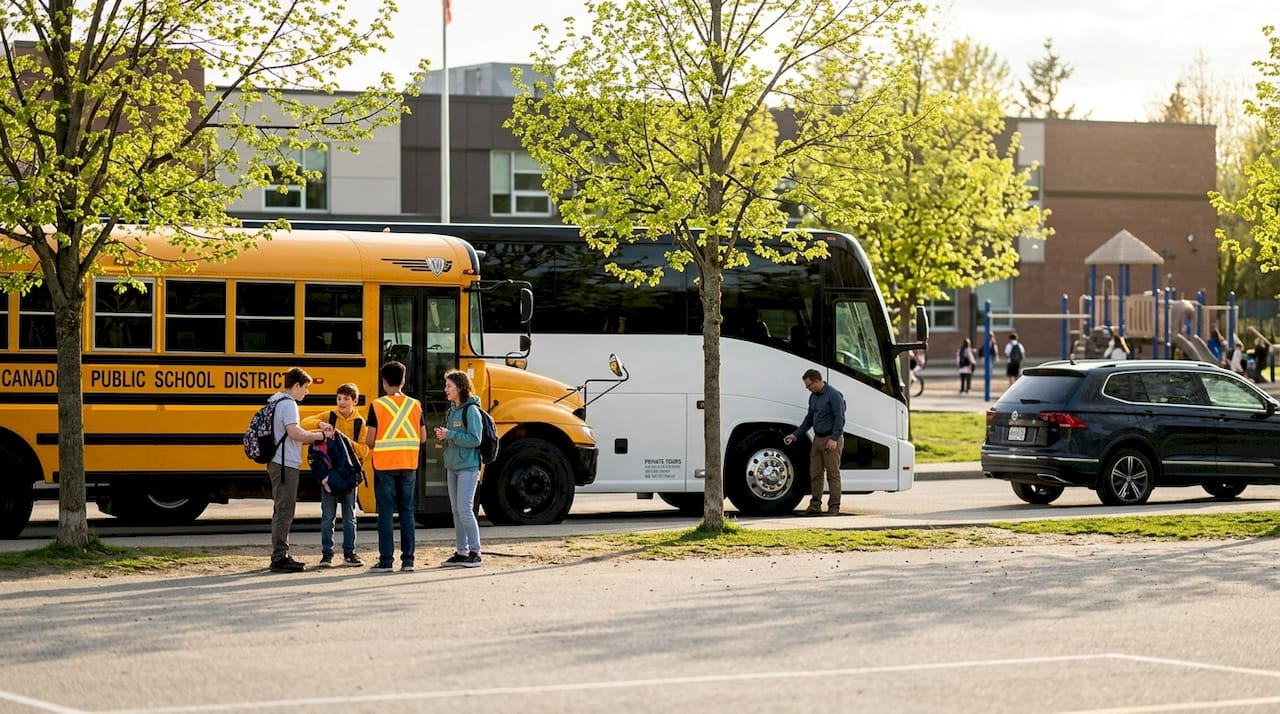
The most common vehicle options for school outings are standard school buses, charter coaches, district SUVs, parent carpools, and public transit. Each carries a different safety profile, capacity, cost structure, and regulatory footprint. Choosing the wrong one for your trip type is one of the most common planning errors educators make.
| Vehicle type | Capacity | Best for | Regulatory burden | Relative cost |
|---|---|---|---|---|
| Standard school bus | 48–72 students | Day trips, local routes | High (DVIR, FMCSA) | Low |
| Charter coach | 40–56 passengers | Long distance, overnight | High (licensed carrier) | Medium to high |
| District SUV | 7–15 passengers | Small groups, admin use | Moderate | Low |
| Parent carpool | 4–6 per vehicle | Short local trips | Low (district policy) | Very low |
| Public transit | Variable | Urban field trips | Low | Very low |
Standard school buses are the default for most day trips because they are already district-owned, drivers are vetted, and costs are absorbed into the school’s operational budget. Charter coaches become the better choice for trips exceeding two hours or requiring overnight travel, since they offer reclining seats, luggage storage, and onboard washrooms that a school bus cannot provide. District SUVs work well for small specialist groups such as a science team or debate squad travelling to a regional competition.
Parent carpools are useful for short local trips but carry real liability exposure. Many districts now prohibit them for overnight travel entirely. Jordan District’s policy requires all overnight transportation to use approved commercial carriers or district vehicles, with no private vehicles permitted. That policy exists for good reason. Insurance coverage for student passengers in a private vehicle is inconsistent and often inadequate.
Pro Tip: Before booking any vehicle, calculate your confirmed headcount plus chaperones, then add 10% buffer capacity. Arriving at a venue with students standing in the aisle because someone miscounted is both unsafe and embarrassing.
What are the key safety and regulatory requirements for school trips in 2026?
Safety compliance for school trip transportation is governed primarily by the Federal Motor Carrier Safety Administration under 49 CFR, and it applies the moment a school bus leaves for a field trip. Educators who assume these rules only apply to daily home-to-school routes are mistaken.
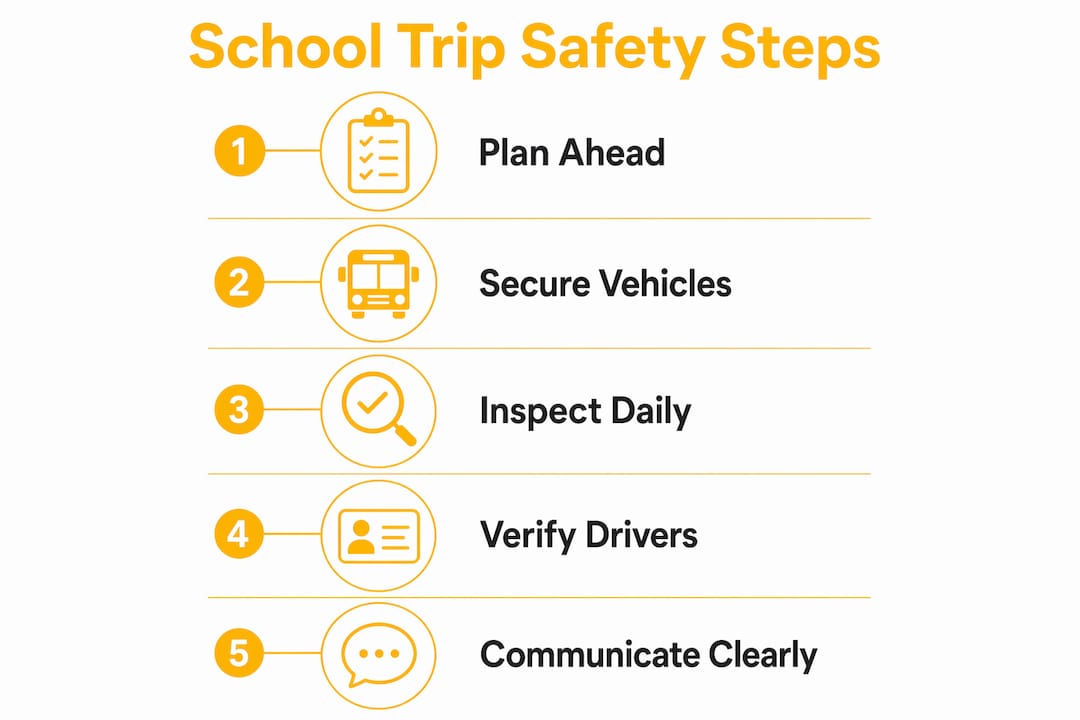
The most operationally significant requirement is the Driver Vehicle Inspection Report. Daily DVIRs are mandatory for passenger-carrying vehicles including school buses, even on days when no defects are found. Missing a single day’s report carries a fine of $1,270 per violation. That is not a theoretical risk. It is a documented penalty that districts have paid.
The daily inspection itself must cover 11 vehicle components plus school-bus-specific safety features such as stop-arm mechanisms, emergency exits, and mirrors. For trips that cross provincial or state lines, stricter DVIR compliance applies beyond what is required for local routes. This means your transport provider needs to be fully aware of the trip’s geography before departure, not after.
Driver hours are equally regulated. FMCSA 49 CFR limits duty and rest hours for drivers on overnight trips, and districts bear the cost of driver rest and relief when those limits are reached. For a three-day trip, this can mean budgeting for a second driver or a mid-trip driver swap. Ignoring this requirement does not just create a compliance problem. It creates a fatigue risk for the person responsible for your students’ lives.
Beyond vehicle mechanics and driver hours, vetting your transport provider with the same rigour you apply to daily student transport is the professional standard. Check safety records, confirm insurance coverage, and verify the carrier’s operating licence before signing any contract.
- Confirm the carrier holds a valid operating licence for passenger transport
- Request proof of commercial liability insurance naming the school district
- Verify the driver’s abstract and training certifications
- Obtain a copy of the vehicle’s most recent inspection report
- Confirm the provider’s DVIR compliance process in writing
Pro Tip: Keep all compliance documents in a shared digital folder accessible to your school’s administration office. If a regulator requests records during or after a trip, you need them in under five minutes, not five days.
How do logistics like headcounts, chaperone ratios, and parent communication work?
Accurate headcounts and chaperone ratios are not just administrative formalities. They directly affect seat allocation, subgrouping on the vehicle, and departure timing. An error here creates a cascade of problems that no amount of goodwill can fix on the day.
Chaperone-to-student ratios typically range from 1:5 to 1:8 depending on grade level and destination risk. A Grade 3 class visiting a science museum warrants a tighter ratio than a Grade 11 group attending a university lecture. Once you have your ratio confirmed, you know exactly how many seats you need and how to assign students to chaperones on the vehicle.
Here is a practical logistics sequence that works for most school outings:
- Confirm total student count and finalize chaperone assignments at least three weeks before departure.
- Use a digital platform to collect parental permission, emergency medical information, and payment in a single step. One-step digital collection reduces administrative errors and eliminates the paper-chase problem.
- Set up a carpool sign-up tool for any parent-driven transport component, listing available seats and pickup details clearly.
- Brief chaperones at least one week before the trip. Cover their assigned student group, emergency contacts, and the day-of communication chain.
- Print a physical roster for each chaperone and the lead teacher. Digital tools fail at the worst moments.
- Assign a single point of contact for the transport provider on the day of travel. Confusion about who speaks for the school wastes time and creates safety gaps.
Parent communication deserves its own attention. Send a detailed pre-trip letter at least two weeks out covering departure time, return time, what students should bring, and who to contact with questions. A follow-up reminder 48 hours before departure cuts the number of last-minute calls you receive on the morning of the trip.
What funding options exist for students with special transportation needs?
Students with Individualised Education Programmes (IEPs) have specific transportation rights that affect how you plan and fund school trip logistics. Ignoring these requirements is not just an oversight. It is a potential violation of federal education law.
Special education aid can cover transportation costs tied to off-site programmes or field trips for students with IEPs, depending on the jurisdiction. This means the cost of a wheelchair-accessible vehicle or a dedicated aide travelling with a student may be recoverable through special education funding rather than the general trip budget.
Key considerations for planning transportation for students with special needs:
- Contact your special education coordinator at least six weeks before any overnight trip to confirm eligibility and funding pathways.
- Identify whether the student requires a specialised vehicle, an onboard aide, or simply a specific seating arrangement.
- Where feasible, include students with IEPs on the same vehicle as their peers. Separate transport is sometimes necessary but should not be the default.
- Document all transportation accommodations in the trip planning file for funding reporting and audit purposes.
- Confirm that your chosen transport provider has accessible vehicles available and that drivers are trained in relevant protocols.
Pro Tip: Coordinate with your special education team during the initial planning phase, not after the vehicle is booked. Retrofitting accessibility accommodations into a confirmed booking is expensive and sometimes impossible.
How to apply these principles and organise a safe school trip
Putting school trip transportation principles into practice comes down to sequencing your decisions correctly and building in enough lead time to handle the unexpected. Overnight trip procurement requires earlier planning workflows than day trips because of restrictions on eligible carriers, driver hours, and approval processes. Start planning overnight trips at least eight weeks out.
For day trips, a four-week lead time is workable if your district has pre-approved transport providers. If you are sourcing a new provider, add two weeks for vetting. Districts should verify both legal authorisation of operators and document compliance thoroughly for audit readiness. That dual-check process takes time, so build it into your timeline.
Contingency planning is the element most educators skip. What happens if the vehicle breaks down en route? Who has the authority to arrange alternative transport? What is the protocol if a student becomes ill and needs to return before the group? These scenarios are not rare. Having written answers to each of them before departure is the mark of a well-organised trip.
Transportation planning decisions are influenced by administrative and legal risk tolerance, and they require institutional support to reduce the burden on individual teachers. If your school does not have a standardised trip planning template, advocate for one. The time you invest in building that system pays back on every subsequent trip.
Key takeaways
Effective school trip transportation requires selecting compliant vehicles, vetting providers rigorously, finalising headcounts and chaperone ratios early, and coordinating special needs accommodations before any booking is confirmed.
| Point | Details |
|---|---|
| Match vehicle to trip type | Charter coaches suit overnight and long-distance trips; school buses work best for local day trips. |
| DVIR compliance is non-negotiable | Missing a daily inspection report carries a $1,270 fine per violation under FMCSA 49 CFR. |
| Finalise headcounts before booking | Chaperone ratios of 1:5 to 1:8 determine seat allocation and subgrouping on the vehicle. |
| Collect permissions digitally | One-step digital collection of consent, medical info, and payment reduces administrative errors. |
| Plan IEP accommodations early | Special education funding may cover accessible transport costs; confirm eligibility six weeks out. |
What I’ve learned from watching school trips go sideways
I have seen well-intentioned teachers arrive at a departure point with 47 students and a bus booked for 40. I have seen overnight trips cancelled the morning of departure because no one confirmed the driver’s hours compliance. These are not fringe cases. They are predictable failures that happen when transportation planning is treated as an afterthought rather than the foundation of the entire trip.
The regulatory side of school trip transportation has tightened considerably. The DVIR requirements, driver hour limits, and carrier vetting standards that apply in 2026 are more rigorously enforced than they were five years ago. Schools that rely on informal arrangements or assume their usual provider is automatically compliant for field trip routes are taking on real institutional risk.
What I find most encouraging is that the tools available to planners have improved at the same pace. Digital permission platforms, online carpool organisers, and provider verification databases have removed most of the manual friction from the process. The schools that use these tools well are the ones that get students to and from destinations safely, on time, and without the administrative chaos that used to define field trip season.
The single most important shift any school can make is treating transportation planning as a specialist task that deserves dedicated time and institutional support, not something a classroom teacher squeezes in between marking and parent interviews.
— Firoz
How Torontobusrentals supports school group travel in Toronto
Planning safe and compliant transportation for school outings is significantly easier when you work with a provider who understands the regulatory and logistical requirements from the start.

Torontobusrentals offers a fleet of modern, licensed motor coaches suited to school group travel across Toronto and beyond. Every vehicle meets safety inspection standards, and professional drivers are fully vetted and experienced with student group transport. Whether you are organising a day trip to a local museum or a multi-day educational excursion, Torontobusrentals provides flexible vehicle options to match your group size and itinerary. Explore group transportation options for your next school trip, or review bus rental tips to prepare your booking with confidence.
FAQ
What is school trip transportation?
School trip transportation is the coordinated arrangement of safe, compliant vehicles and services for student group travel during educational excursions. It covers vehicle selection, driver vetting, regulatory compliance, and logistical planning.
What vehicle types are best for school excursions?
Standard school buses suit local day trips, while charter coaches are better for long-distance or overnight travel due to their greater comfort and luggage capacity. District policy and group size should guide the final choice.
Are daily vehicle inspections required for school trip buses?
Daily Driver Vehicle Inspection Reports are mandatory under FMCSA 49 CFR for school buses used on field trips, including days with no defects found. Missing a report carries a fine of $1,270 per violation.
Can special education funding cover school trip transport costs?
Special education aid can cover transportation costs tied to off-site programmes or field trips for students with IEPs, depending on the jurisdiction. Confirm eligibility with your special education coordinator at least six weeks before the trip.
How early should you start planning school trip transportation?
Day trips require at least four weeks of lead time when using pre-approved providers. Overnight trips need a minimum of eight weeks due to carrier eligibility restrictions, driver hour compliance, and district approval processes.
Recommended
- Essential bus rental tips for safe Toronto school trips
- How to book a school trip bus efficiently in Toronto
- School Trip Bus Rental Guide for Safe Group Travel
- Types of buses for schools: A guide for administrators