
School trip bus solutions for school administrators
Before you confirm any school trip, get written proof of liability insurance, a copy of the driver’s commercial licence, and the vehicle’s inspection records from your charter operator. That single step prevents the most common compliance failures boards face when trips go sideways.
What to request before booking:
- Certificate of liability insurance (policy declarations page, minimum $1,000,000 third-party liability)
- Driver commercial licence numbers and written background-check confirmation
- Vehicle inspection and maintenance records (CSA D250 compliance for school buses)
- Written contract with cancellation terms, deposit amount, and refund conditions
- Signed passenger roster for each vehicle
Transport Canada confirms students are significantly more likely to arrive safely on a school bus than by car. The vehicle type matters, but so does the operator behind it.
Never accept verbal assurances on insurance. Board guidelines consistently require written certificates forwarded to your health and safety officer before the trip departs. One more firm rule: 15-passenger vans are generally prohibited for student transport under Canadian board policies.
Contact Torontobusrentals.ca or your board’s transport office with this checklist to lock dates and confirm compliance.
Table of Contents
- What does a solid school trip bus booking checklist cover?
- Torontobusrentals makes compliant school trips straightforward
- Key takeaways
What does a solid school trip bus booking checklist cover?
Lead time and timing
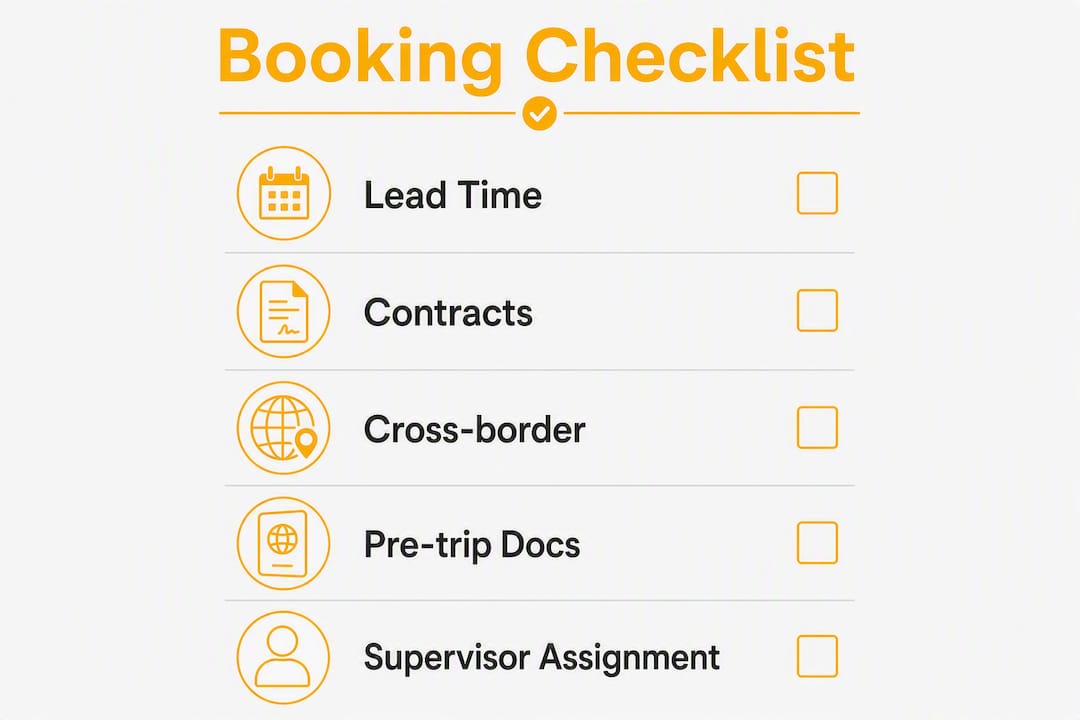
Book at minimum several business days ahead; Near North District guidelines set that as the floor for arranging transportation. For May and June trips, when demand peaks, several weeks is realistic. Multi-day or out-of-province trips need even more runway to confirm operator authority and any required trip permits.
Contracts and deposits
Your written contract should name the vehicle type and capacity, the exact route, departure and return times, the deposit amount (typically 20–30% of the total), and the cancellation policy with specific refund timelines. If a term is only spoken, it does not exist. Watch for contracts that omit liability limits or leave driver qualifications vague — those are red flags worth walking away from.
Cross-border and out-of-province trips
Buses used for student transport that meet passenger or weight thresholds are commercial vehicles, which triggers hours-of-service, logbook, and inspection obligations. Cross-border travel into the U.S. can require trip permits and IFTA compliance. Confirm the operator’s authority for your destination in writing and budget for permit fees.
Pre-trip documentation
Every bus needs a passenger roster and parental consent forms on board. Assign a designated supervisor who carries copies of all rosters, student medical forms, and the trip report. Alberta division procedures, for example, require a formal transportation trip report documenting kilometres and driver details for accurate chargebacks.
Torontobusrentals makes compliant school trips straightforward
School administrators who’ve worked through the checklist above know the hardest part is finding an operator who can hand over every document without a chase. Torontobusrentals does exactly that.


The fleet includes 47-passenger school buses and accessible options, all operated by commercially licensed drivers with background-check documentation on file. Torontobusrentals provides issued certificates of insurance, vehicle inspection logs, and written contract templates with clear cancellation and fee terms — the full package your board’s health and safety officer needs.
On pricing: rates are structured by hour, kilometre, or day depending on trip length, with minimums that vary by vehicle type. Overnight trips add driver accommodation and meals; cross-border routes add permit costs. HST applies. Getting a written quote early locks the rate and starts the paper trail.
Pro Tip: Ask for the certificate of insurance and driver licence numbers in your first email exchange. Any reputable operator sends them without hesitation. Delays or deflection at that stage tell you everything.
The typical booking path runs: initial inquiry → written quote and contract (within 24–48 hours) → deposit and confirmation → pre-trip paperwork exchange one week before departure. For peak months, start that sequence six to eight weeks out.
Request your quote and compliance documents at the school trip planning page — or call directly to confirm vehicle availability and get the certificate of insurance in hand.
Key takeaways
Securing written proof of insurance, driver credentials, and a signed contract before confirming any school trip is the single action that keeps your board compliant and your students protected.
| Point | Details |
|---|---|
| Insurance minimum | Boards commonly require a $1,000,000 third-party liability certificate; get it in writing, not verbally. |
| Prohibited vehicles | 15-passenger vans are banned for student transport under most Canadian board policies. |
| Lead time | Book at least five business days ahead; six to eight weeks for peak months or multi-day trips. |
| Cross-border compliance | Out-of-province and U.S. trips trigger commercial vehicle rules, logbook requirements, and trip permit fees. |
| Torontobusrentals | Provides 47-passenger school buses, accessible options, commercial drivers, and full compliance documentation for Toronto school trips. |
Recommended
- Essential bus rental tips for safe Toronto school trips
- School trip transportation explained: a 2026 guide
- Types of buses for schools: A guide for administrators