
Trends in school transportation 2026: what administrators need to know
TL;DR:
- School transportation in Canada faces rising costs, fleet electrification, and service gaps that impact budgets and equity. Administrators must plan early, coordinate funding, workforce training, and regulatory compliance to maintain service levels in 2026. Effective long-term strategy integrates funding, technology, workforce development, and student needs to adapt to ongoing sector changes.
School transportation in Canada is defined by a convergence of rising costs, regulatory reform, fleet electrification, and widening service gaps that are reshaping how districts move students in 2026. The trends in school transportation 2026 are not abstract policy shifts. They are budget decisions that cut bus routes, regulatory changes that delay vehicle procurement, and workforce gaps that leave electric buses sitting idle. Administrators and transportation coordinators who understand these pressures now will be better positioned to protect service levels, manage costs, and meet their legal obligations to all students.
What are the biggest trends in school transportation 2026?
The dominant force reshaping school transport operations in 2026 is financial pressure. The Calgary Board of Education is raising fees by nearly 40%, moving from $360 to $500 per rider for the 2026–27 school year, driven by depleted reserves and rising fuel and labour costs. That single figure signals a broader pattern: districts across Canada are passing operational costs directly to families.
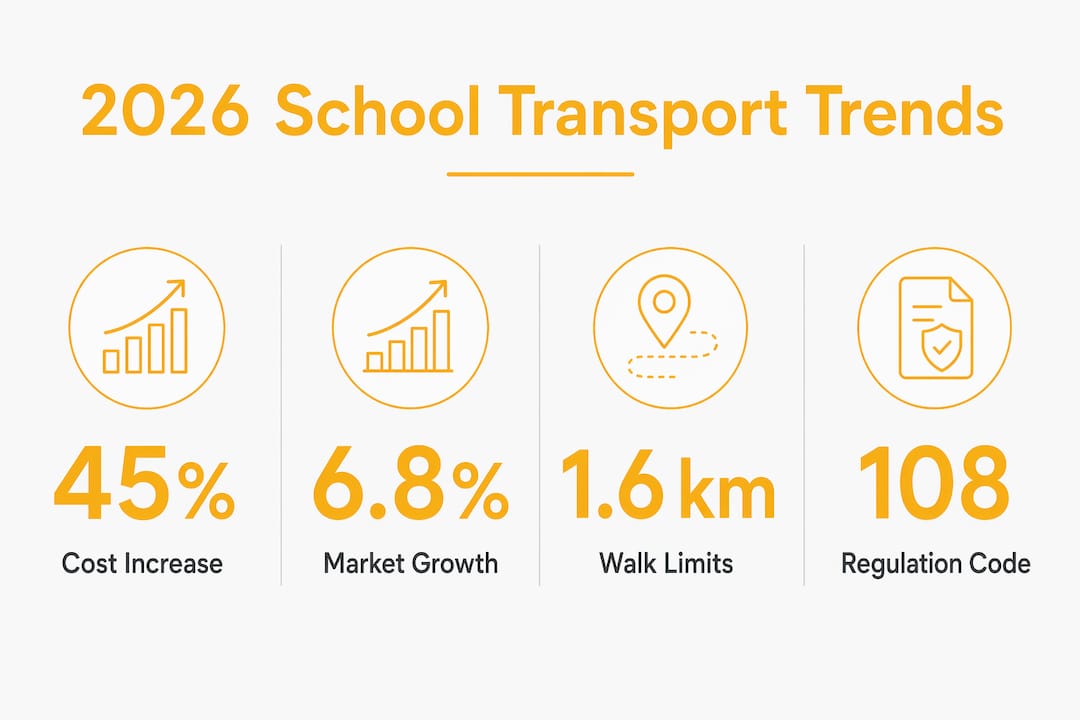
Eligibility zones are shrinking at the same time. Alberta districts have adjusted walk-limit thresholds to 1.6 km for grades 1–6 and 2.0 km for grades 7–12 under new provincial regulations. Fewer students qualify for bus service, which reduces ridership numbers and, in theory, lowers costs. In practice, it shifts the burden onto families and raises equity concerns for students in lower-income neighbourhoods.
Funding sustainability is the underlying problem. Hay River’s decision to discontinue school bus service for 2026–27 illustrates what happens when one-time federal grants disappear. The projected deficit of $49,654 was manageable in isolation. Without recurring federal support, the service became unviable. One-time grants are not a funding model. Districts that built service levels around them are now absorbing the consequences.
Inflation compounds every line item. Fuel costs, driver wages, and parts procurement have all risen faster than most district transportation budgets anticipated. The result is a sector under structural financial stress, not a temporary shortfall.
Pro Tip: When presenting your 2026–27 transportation budget to your board, separate recurring operational costs from one-time grant revenue. Boards that conflate the two consistently underestimate structural deficits.
How is electrification changing the future of school buses?
The Canadian school bus market reached $685.4 million in 2026 and is projected to grow at a 6.8% CAGR through 2035. Ontario and British Columbia are driving demand for electric and mid-size models. That growth reflects real procurement activity, not just policy aspiration.
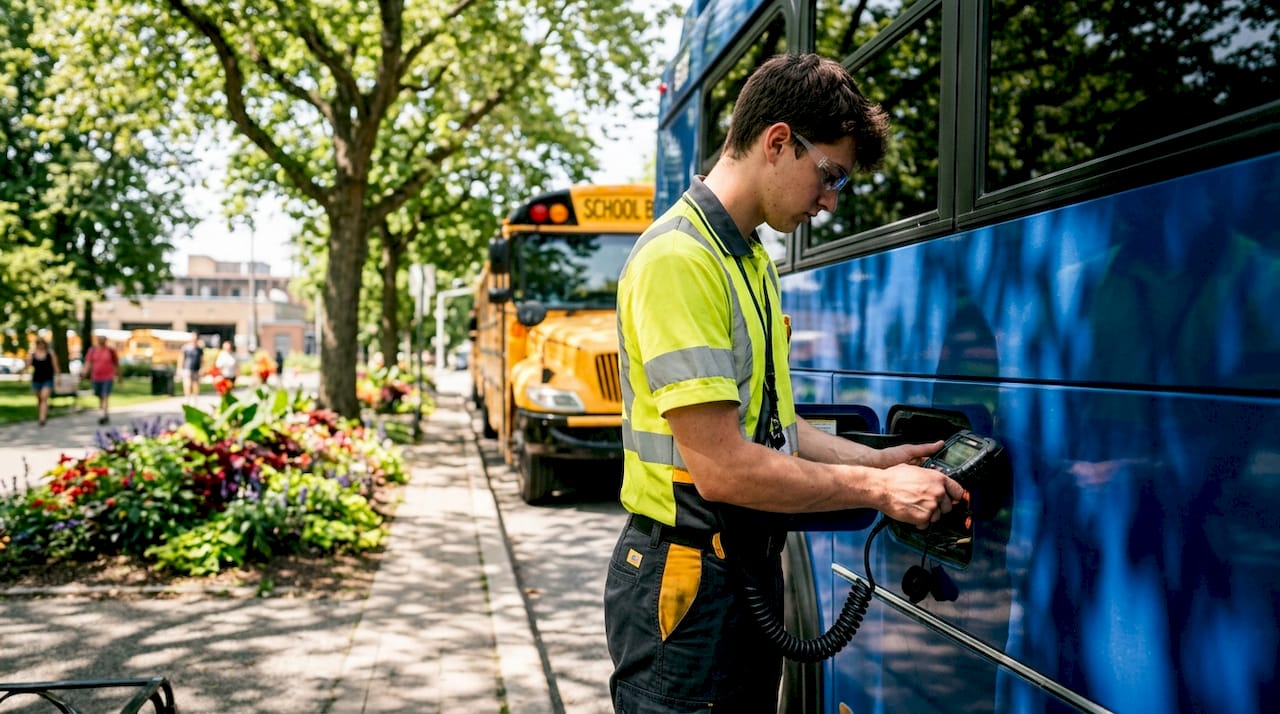
Electric fleet adoption is increasingly shaped by software, not just hardware. Districts are selecting sub-150 kWh battery packs sized for 80–120 km daily routes, using energy management software to avoid costly midday charging. The logic is straightforward: a smaller, well-managed battery pack costs less upfront and integrates more easily with existing charging infrastructure. Administrators who treat electrification as a vehicle purchase rather than a systems decision will overspend and underperform.
Regulatory timelines are adding procurement complexity. Transport Canada’s proposed amendments to CMVSS 108 require sequential LED lighting patterns for stop-sign arms and crossing gates. Manufacturers must redesign affected components, and analysts expect production bottlenecks in 2027 and 2028 as a result. Districts that delay procurement decisions will face longer lead times and potentially higher prices.
| Regulatory standard | Change required | Expected impact |
|---|---|---|
| CMVSS 108 (lighting) | Sequential LED activation on stop arms and crossing gates | Redesign cycles; 2027–2028 production bottlenecks |
| CMVSS 220 (rollover) | Updated rollover structural standards | Affects new model certification timelines |
| Provincial zero-emission mandates | Fleet electrification targets by province | Accelerates procurement planning requirements |
Pro Tip: Contact your preferred bus manufacturer now about CMVSS 108 compliance timelines. If they cannot confirm delivery before 2027 production constraints hit, accelerate your order or identify an alternative supplier.
For administrators planning school bus bookings for 2026, understanding these regulatory timelines is as important as understanding your route requirements.
What workforce challenges are slowing electric bus adoption?
Electric bus adoption depends on technician readiness, and most fleets are not there yet. Upskilling bus technicians in battery safety and diagnostic software is identified as the critical barrier to reliable electric fleet operation. Without trained technicians, districts become dependent on OEM service contracts, which are expensive and slow.
The workforce challenge has two layers. The first is technical: electric bus systems require knowledge of high-voltage battery management, thermal regulation, and proprietary diagnostic platforms that differ significantly from diesel maintenance. The second is demographic: labour shortages and an aging workforce in small transport companies are already limiting capacity. Retiring diesel mechanics are not being replaced at the same rate by technicians qualified for electric systems.
Certification pathways exist but are underused. The CSA Group publishes standards relevant to electric vehicle safety, and Red Seal certification covers heavy-duty equipment technicians. Neither pathway currently includes electric bus-specific modules as a standard requirement. Districts and transport operators that wait for the training ecosystem to mature will fall further behind.
The practical risk is service disruption. An electric bus that cannot be serviced locally sits out of rotation. That means fewer vehicles on routes, larger loads on remaining diesel buses, and higher per-student costs. Structural labour issues must be addressed alongside electrification to make the transition equitable and sustainable.
- Audit your current technician team’s qualifications against electric bus service requirements before committing to EV procurement.
- Request that your transport operator provide a written workforce training plan as a condition of any new electric bus contract.
- Advocate with provincial ministries to include electric bus technician training in public funding programme conditions.
- Monitor CSA and Red Seal programme updates for new electric vehicle certification modules.
How are accessibility gaps widening under current school transport trends?
Budget-driven service reductions are hitting students with disabilities hardest, and the cuts are often invisible. School districts frequently use terms like “attrition” or “capacity issues” to describe reduced accessible transportation services. Students lose access to routes they are legally entitled to, but the reduction never appears as a formal policy decision.
The funding gap is measurable. Inclusive education designations rose 46.6% over ten years, and autism designations rose 192% over the same period. Funding did not keep pace. The result is rationing: districts quietly reduce services because they cannot afford to maintain them, and students with disabilities absorb the consequences.
“Service cuts often hidden in staffing vacancies or ‘under review’ classifications mean students with disabilities lose transportation access without any formal acknowledgement that a cut has occurred. Accurate tracking is the first line of defence against unrecognised exclusion.”
The real-world impact is attendance. Students who cannot get to school do not learn. Families who cannot arrange alternative transport face impossible choices. Districts that rely on self-funded school infrastructure solutions, such as self-funded school lockers, understand that sustainable school services require transparent planning and dedicated funding, not creative accounting.
Administrators can take concrete steps to address this:
- Audit accessible transportation records quarterly, tracking service changes by student designation rather than by route.
- Require that any staffing vacancy affecting accessible transport be reported to the board as a service reduction, not an operational gap.
- Engage disability advocacy groups in annual transportation planning reviews.
- Document all “under review” service classifications with timelines and resolution criteria.
What strategies should administrators use for 2026 transportation planning?
Effective 2026 transportation strategies start with procurement timing. CMVSS 108 compliance requirements will create manufacturer bottlenecks in 2027 and 2028. Districts that begin procurement cycles now secure delivery before constraints peak. Waiting for budget certainty is a false economy when lead times are measured in years.
Route optimisation software is the second priority. Energy management platforms that match battery capacity to route length reduce charging costs and extend vehicle life. The same platforms generate data that supports funding applications and board reporting. Administrators who treat these tools as optional are leaving both efficiency and evidence on the table.
Workforce planning must run parallel to fleet planning. A district that procures ten electric buses without a technician training plan has created a liability, not an asset. Build training timelines into procurement contracts and budget for external certification support.
- Begin electric bus procurement conversations with manufacturers immediately to avoid 2027–2028 bottlenecks.
- Integrate route optimisation and energy management software into your fleet planning process before the next budget cycle.
- Require transport operators to submit workforce training plans covering electric bus diagnostics and battery safety.
- Review eligibility zone policies annually against equity data, particularly for students with disabilities and low-income families.
- Separate one-time grant revenue from recurring operational funding in all budget presentations to your board.
- Monitor Transport Canada regulatory updates for CMVSS 108 and CMVSS 220 amendments that affect vehicle specifications.
For administrators reviewing types of buses for schools, matching vehicle specifications to route requirements is the foundation of cost-effective planning.
Key takeaways
The most urgent priority for school transportation administrators in 2026 is integrating financial planning, regulatory compliance, and workforce development into a single, coordinated strategy rather than treating each as a separate operational problem.
| Point | Details |
|---|---|
| Rising costs are structural | Fee hikes and funding losses reflect long-term budget pressure, not temporary shortfalls. |
| Electrification requires systems thinking | Battery sizing, software, and technician training must be planned together, not separately. |
| Regulatory timelines are real | CMVSS 108 changes will cause production bottlenecks in 2027–2028; procure early. |
| Accessibility cuts are often hidden | Track service changes by student designation to prevent unrecognised exclusion. |
| One-time grants are not a funding model | Build budgets on recurring revenue; Hay River’s service loss is a cautionary example. |
What the 2026 trends reveal about long-term school transport planning
The pattern I see across these 2026 developments is a sector that has been managing short-term pressures with short-term tools for too long. One-time federal grants covered operational deficits that should have triggered structural funding reviews. Eligibility zone expansions reduced costs on paper while shifting real burdens onto families. Electric bus procurement moved ahead of technician training because the vehicles were visible and the workforce gap was not.
What concerns me most is the accessibility dimension. The language of “attrition” and “capacity issues” is not neutral. It is a mechanism for reducing legally mandated services without political accountability. Administrators who accept that framing are not protecting their districts. They are accepting liability while students lose access to school.
The districts that will manage 2026 well are the ones treating transportation as an integrated system: funding, vehicles, routes, workforce, and student needs all connected. That means harder conversations with boards, more detailed reporting, and less tolerance for budget language that obscures service reductions. It also means building relationships with regulators and industry partners before procurement crises force reactive decisions.
The technology is genuinely promising. Energy management software and right-sized electric fleets can reduce costs and emissions simultaneously. But the technology only delivers if the workforce is ready and the funding is sustainable. Those conditions do not appear on their own.
— Firoz
School transportation support from Torontobusrentals
Planning school group transport in the current environment requires reliable partners who understand both compliance requirements and operational realities.

Torontobusrentals provides school bus rental options for Toronto-area schools managing field trips, athletic events, and group travel needs. The fleet includes 47-passenger school buses operated by professional, licensed drivers who meet provincial safety standards. For administrators coordinating school trip transportation under tighter budgets and stricter compliance requirements, Torontobusrentals offers straightforward booking, transparent pricing, and vehicles suited to the 2026 academic year’s demands. Contact Torontobusrentals directly to discuss your school’s specific route and scheduling requirements.
FAQ
What is causing school bus fees to rise in 2026?
Fee increases in 2026 reflect depleted district reserves, higher fuel and labour costs, and the loss of one-time federal funding. The Calgary Board of Education raised fees from $360 to $500 per student for 2026–27.
How does CMVSS 108 affect school bus procurement?
Transport Canada’s proposed CMVSS 108 amendments require sequential LED lighting on stop-sign arms and crossing gates, forcing manufacturer redesigns. Production bottlenecks are expected in 2027 and 2028, making early procurement the lower-risk option.
Why are electric school buses harder to maintain than diesel buses?
Electric buses require technicians trained in high-voltage battery safety and proprietary diagnostic software. Most current technician pools are trained for diesel systems, creating a skills gap that increases OEM service dependency and operational risk.
How can administrators protect accessible transportation services?
Track service changes by student designation rather than by route or staffing category. Require that any vacancy affecting accessible transport be reported as a service reduction, and engage disability advocacy groups in annual planning reviews.
What is the Canadian school bus market projected to be worth?
The Canadian school bus market reached $685.4 million in 2026 and is projected to grow at a 6.8% CAGR through 2035, driven by demand for electric and mid-size models in Ontario and British Columbia.
Recommended
- Booking buses for schools 2026: the complete planning guide
- Role of transportation for educational outings: 2026 guide
- School trip transportation explained: a 2026 guide