
School event transport guide for administrators
TL;DR:
- Effective school event transportation involves careful planning of vehicle selection, booking early, and verifying safety and accessibility compliance to ensure student safety and smooth logistics. Choosing the appropriate vehicle, such as a school bus, minibus, or charter coach, depends on trip distance, group size, and amenities required for comfort. Early booking, detailed documentation, and clear communication with stakeholders help prevent disruptions and manage last-minute challenges efficiently.
Effective school event transportation is the organised process of selecting, booking, and managing vehicles to move students safely between school and off-site events. Whether you are coordinating a field trip to the Ontario Science Centre, a sports tournament across the city, or a graduation ceremony at a downtown venue, the decisions you make about transport directly affect student safety, event timing, and your school’s liability. This school event transport guide covers every stage of the planning process, from assessing your group’s needs to troubleshooting day-of challenges, so you can move forward with confidence.
What do you need to prepare before arranging school event transport?
Sound preparation is the foundation of every successful school trip. Before you contact a single provider or request a quote, you need a clear picture of four core variables: group size, event location, schedule, and student needs.

Start by confirming your headcount. A group of 20 students calls for a minibus, while 45 or more students will require a full-size coach or multiple vehicles. Factor in chaperones, teachers, and any equipment such as musical instruments or sports gear. Underestimating capacity is one of the most common and costly planning errors administrators make.
Accessibility is non-negotiable. Students with mobility requirements or special educational needs must be accommodated from the outset, not as an afterthought. Transport for students with SEND becomes legally binding when it is included in a student’s Education, Health and Care Plan, which means the school carries direct responsibility for arranging appropriate vehicles and trained passenger assistants.
Budget planning deserves the same rigour as safety planning. Identify your funding source early, whether that is a school board allocation, parent contributions, or a community grant. Once you have a realistic budget, you can compare vehicle types without overspending or under-delivering on comfort.
Legal and safety compliance is the final prerequisite. Safety standards for school transport require vehicles to have seatbelts, drivers to pass enhanced background checks, and vehicles to undergo periodic inspections. Confirm these requirements with your local school board and the Ontario Ministry of Education before signing any contract.
- Confirm final headcount including chaperones and equipment
- Identify any students with accessibility or medical needs
- Set a firm budget with a contingency of at least 10%
- Verify driver certification and vehicle inspection records
- Review your school board’s transport policy and liability guidelines
Pro Tip: Request a written copy of the provider’s insurance certificate and driver credentials before you pay any deposit. This single step protects your school if an incident occurs.
How do different transportation options compare for school events?
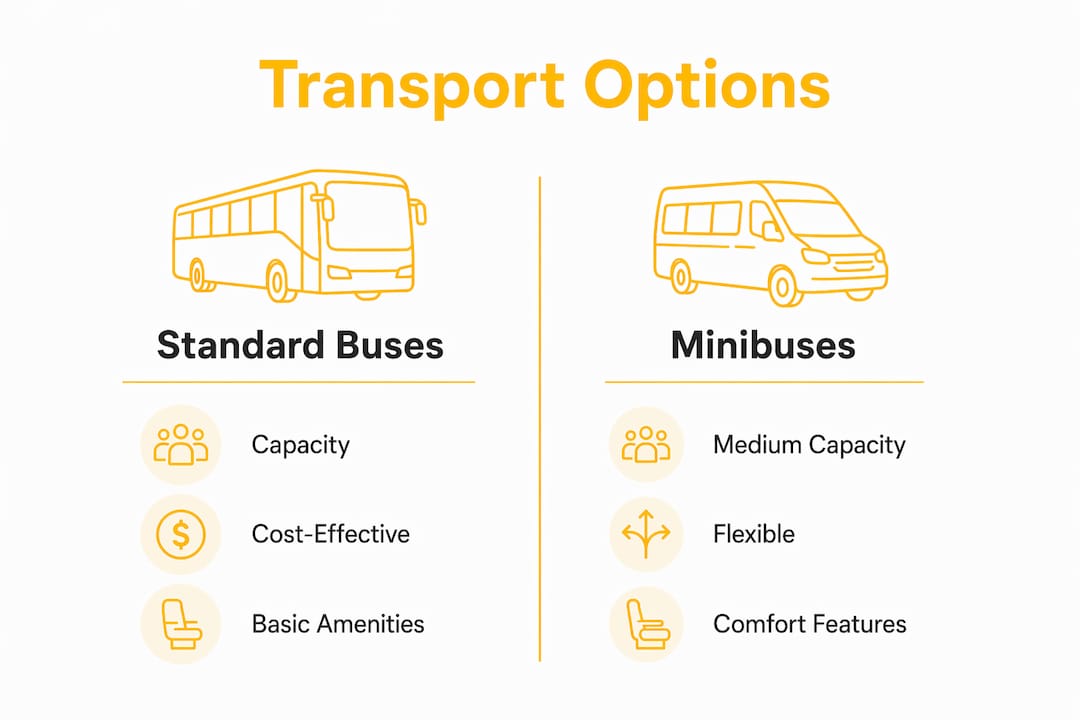
Choosing the right vehicle type is the most consequential decision in planning transportation for school events. The three main options are standard school buses, minibuses, and charter motorcoaches, and each suits a different set of circumstances.
Standard school buses are familiar, cost-effective, and widely available through school board fleets. They work well for short local trips where comfort is secondary to cost. Their limitations become apparent on longer journeys: no climate control beyond basic heating, limited luggage space, and bench seating that becomes uncomfortable after an hour.
Minibuses fill the gap between a school bus and a full coach. They typically seat 12 to 24 passengers and are well-suited to smaller groups attending workshops, museum visits, or inter-school competitions. Their compact size makes parking and urban navigation straightforward, which matters when your destination is a busy downtown venue.
Charter motorcoaches are the preferred choice for longer or multi-stop trips. A 50-mile threshold is the common industry benchmark for switching from a standard school bus to a charter coach, because the added amenities including climate control, reclining seats, onboard restrooms, and luggage bays make a material difference to student comfort and behaviour on extended journeys. For multi-day excursions or trips to destinations outside the Greater Toronto Area, a charter coach is the industry standard.
| Vehicle type | Capacity | Relative cost | Key amenities | Best suited for |
|---|---|---|---|---|
| Standard school bus | 48–72 students | Low | Basic seating, heating | Short local trips under 30 km |
| Minibus | 12–24 passengers | Medium | Air conditioning, luggage space | Small groups, urban events |
| Charter motorcoach | 40–55 passengers | Higher | Climate control, restrooms, Wi-Fi | Long-distance or multi-day trips |
Pro Tip: For trips over 50 miles, always request a coach with an onboard restroom. Unscheduled rest stops add 20 to 40 minutes to your travel time and disrupt event schedules.
When evaluating your school event travel options, also consider:
- Whether the trip involves overnight luggage that requires undercarriage storage
- Whether the route includes highway driving where seatbelt compliance is critical
- Whether the event venue has a designated bus drop-off zone large enough for a full coach
Reviewing a dedicated school bus rental guide before you request quotes will help you frame the right questions for providers and avoid paying for capacity or features you do not need.
What are the best practices for booking and managing school event transport?
Booking transport is a process, not a single phone call. Following a structured sequence reduces errors, protects your budget, and gives you clear documentation if anything goes wrong.
- Book early. Booking charter buses six months ahead for peak seasons secures availability and better rates. For standard school trips, a minimum of two to four weeks is the baseline. June graduations and September orientation events fill up fast across Toronto.
- Vet your provider. Verify provider credentials and safety ratings before committing. Ask for proof of commercial vehicle insurance, driver licensing under the Ontario Highway Traffic Act, and a current vehicle inspection certificate.
- Confirm the route and schedule in writing. Share the event programme with your driver at least 48 hours before departure. Include pick-up times, drop-off addresses, expected return time, and any planned stops. Ambiguity in the schedule is the leading cause of delays.
- Brief your chaperones. Every adult on the vehicle should know the emergency contact list, the driver’s name and mobile number, and the protocol for a medical incident or vehicle breakdown.
- Document everything. Keep a signed copy of the transport contract, the driver’s credentials, the vehicle registration, and your school’s parental consent forms in a single folder. Digital copies stored in Google Drive or Microsoft OneDrive are accessible from any device on the day.
- Communicate with parents. Stakeholder communication throughout planning is a proven factor in transport success. Send parents a written itinerary with departure times, the vehicle type, and an emergency contact number at least one week before the event.
Pro Tip: Use the bus rental checklist for events as a pre-departure sign-off tool. Running through it the morning of the trip takes five minutes and catches the details that fall through the cracks under pressure.
What common challenges arise in school event transport?
Even well-planned trips encounter problems. Knowing the most frequent issues in advance lets you build solutions into your plan rather than improvising under pressure.
Last-minute cancellations and changes are the most disruptive challenge. A provider cancellation the day before a major event can derail months of planning. Mitigate this by confirming the booking 72 hours before departure and asking your provider for a written cancellation and substitution policy at the time of booking.
Student behaviour on vehicles affects both safety and driver performance. Establish clear conduct expectations with students before they board. Assign seating in advance for younger groups, and position chaperones at the front, middle, and rear of the vehicle. Drivers are responsible for the road; chaperones are responsible for the students.
Accessibility and special accommodations require advance coordination. If a student uses a wheelchair, confirm that the vehicle has a functioning lift and that the driver is trained to operate it. Do not assume this is standard. Community engagement and child wellbeing principles recommend consulting directly with families of students with additional needs when forming transport plans, which produces better outcomes and avoids day-of surprises.
Delays and emergencies need a written contingency plan. Identify a secondary contact at the event venue, know the nearest hospital to your destination, and carry a first aid kit on every vehicle.
The most overlooked element in school event transport is the return journey. Administrators plan the departure in detail and treat the return as an afterthought. Confirm your pick-up window with the venue, build in 30 minutes of buffer, and make sure every student knows the exact meeting point before they leave the bus.
Key takeaways
Successful school event transport requires early preparation, the right vehicle choice, and clear communication with every stakeholder involved.
| Point | Details |
|---|---|
| Prepare before you book | Confirm headcount, accessibility needs, budget, and legal compliance before contacting providers. |
| Match vehicle to trip length | Use minibuses for small urban groups and charter coaches for trips exceeding 50 miles. |
| Book well in advance | Secure peak-season transport at least six months ahead; standard trips need two to four weeks minimum. |
| Vet every provider | Verify insurance, driver licensing, and vehicle inspection records before signing any contract. |
| Plan for the return trip | Confirm pick-up windows, build in buffer time, and brief students on the meeting point before departure. |
What I have learned from years of watching school trips go sideways
The administrators who handle school event transport best share one habit: they treat the transport plan as seriously as the event programme itself. I have seen beautifully organised field trips unravel because the bus was booked for the wrong date, or because nobody confirmed whether the coach had a working lift for a student who needed it.
The conventional wisdom is to book early and choose a reputable provider. That is correct, but it is incomplete. The real differentiator is specificity. A booking confirmation that says “one bus, 9 a.m.” is not a transport plan. A transport plan names the driver, specifies the vehicle registration, lists every stop with a time, and includes a contact number for the provider’s dispatch team.
I also think the industry undersells the value of charter coaches for school trips. Schools default to the cheapest option, which is often a standard school bus, and then spend the trip managing restless students who have been sitting on hard bench seats for two hours. A charter coach with reclining seats and climate control costs more per seat, but it changes the tone of the entire trip. Students arrive at the destination settled rather than agitated, and that matters for learning outcomes and behaviour.
Finally, do not underestimate the parent communication piece. Engaging parents and the community in transport planning is not just good practice. It is a trust-building exercise that reduces complaints and increases cooperation on the day. A two-paragraph email sent a week before the trip answers 80% of the questions you would otherwise field by phone.
— Firoz
How Torontobusrentals can support your school event

Torontobusrentals provides school administrators and event coordinators across Toronto with a fleet that covers every group size, from compact minibuses for 12 to 24 passengers to 47-passenger school buses built for larger groups. Every vehicle meets Ontario safety standards, and every driver holds the required commercial licensing and background clearance for student transport. Booking is straightforward: contact the team with your date, group size, and destination, and they will confirm availability and provide a clear quote. For events during the June graduation season or September orientation period, booking four to six weeks ahead is strongly recommended to secure your preferred vehicle. Torontobusrentals also offers minibus rental options for smaller school groups needing flexible, city-friendly transport.
FAQ
What is a school event transport guide?
A school event transport guide is a structured planning resource that helps administrators select vehicles, book providers, and manage logistics for off-site school events. It covers preparation, vehicle comparison, booking timelines, and safety compliance.
How far in advance should you book transport for a school event?
Book at least two to four weeks ahead for standard trips and six months ahead for peak-season events such as June graduations. Early booking secures availability and typically reduces costs.
What vehicle is best for school trips over 50 miles?
Charter motorcoaches are the industry standard for trips exceeding 50 miles. They offer climate control, onboard restrooms, and luggage storage, which improve student comfort and reduce unscheduled stops.
What safety checks should you do before booking a school transport provider?
Verify the provider’s commercial vehicle insurance, driver licensing under provincial regulations, and current vehicle inspection certificate. For groups that include students with special needs, confirm that trained passenger assistants are available.
How do you handle last-minute transport changes for a school event?
Confirm your booking 72 hours before departure and obtain a written cancellation and substitution policy from your provider at the time of booking. Keeping a secondary provider contact on file gives you a fallback if the primary arrangement falls through.
Recommended
- School trip transportation explained: a 2026 guide
- Event transportation checklist for planners: 2026 guide
- Essential bus rental tips for safe Toronto school trips