
Safety checklist for bus rentals: a guide for event planners
TL;DR:
- A safety checklist for bus rentals verifies that operators and vehicles meet safety standards before passengers board. Planners should check regulatory compliance, vehicle condition, driver qualifications, and safety culture through simple, verifiable steps. Following these measures reduces the risk of accidents and liability during group transportation.
A safety checklist for bus rentals is the primary verification tool event planners use to confirm that a motorcoach, its driver, and the operating company all meet federal and provincial safety standards before a single passenger boards. Getting this wrong is not a paperwork problem. It is a liability and a life-safety issue. Federal law requires commercial passenger carriers to carry at least $5 million in public liability insurance. The FMCSA SAFER system gives you free, instant access to any carrier’s safety rating. These two checks alone filter out a significant portion of unsafe operators before you ever visit a vehicle.
What does a safety checklist for bus rentals include?
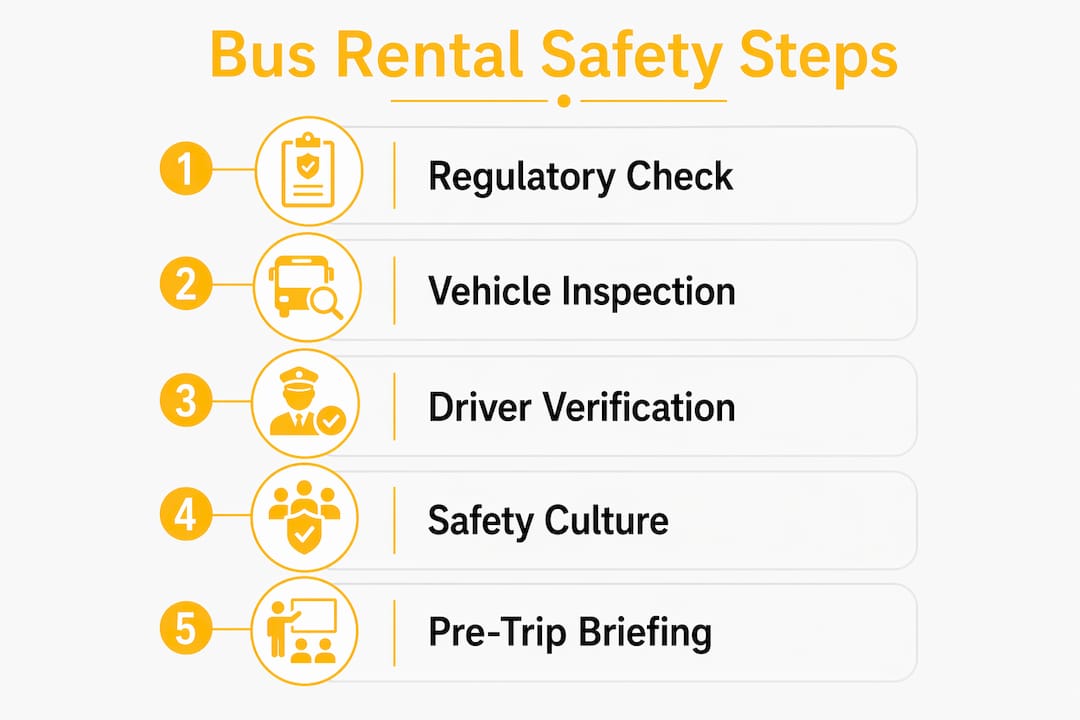
A complete bus rental safety checklist covers four areas: regulatory compliance, vehicle condition, driver qualifications, and company safety culture. Each area has specific, verifiable standards. You do not need to be a transport professional to check them. You need to know where to look and what a passing result looks like.
The industry term for this process is pre-trip due diligence. It combines a pre-booking compliance review with an on-site vehicle inspection and a post-booking confirmation protocol. Event planners who treat these as separate steps, rather than one continuous process, catch more problems before departure.
How do you verify a bus company’s regulatory compliance?
Regulatory compliance is the first filter on your bus rental inspection list. A company that fails here should not make it to the vehicle inspection stage.
Start with the FMCSA SAFER system at safer.fmcsa.dot.gov. Every commercial carrier operating in North America has a USDOT number. Enter it into SAFER and look for one result: Satisfactory. A “Conditional” or “Unsatisfactory” rating is a firm disqualifier. These ratings signal active compliance problems, not minor paperwork gaps.
Next, confirm insurance. Federal law mandates $5 million in public liability coverage for motorcoaches. Request a Certificate of Insurance directly from the company and verify it names the correct vehicle type. A certificate that does not match the vehicle you are booking is not valid coverage for your group.
Key compliance checks to run before booking:
- USDOT number: Confirm it is active and matches the company name.
- FMCSA safety rating: Accept only “Satisfactory.” Walk away from anything else.
- Certificate of Insurance: Minimum $5 million, vehicle-specific, current expiry date.
- Operating authority: Confirm the company holds active passenger carrier authority.
- DOT audit history: Bus companies face compliance audits every 2–3 years. Brake violations account for 41% of audit failures, and tyre issues account for 21.4%. Ask when the last audit occurred.
Pro Tip: Save the FMCSA SAFER snapshot as a PDF the day you book. Ratings can change, and having a dated record protects you if a dispute arises later.
How to inspect the vehicle before your group travels
Vehicle condition is the second layer of your bus rental inspection list. Regulatory compliance tells you about the company. The vehicle inspection tells you about the specific coach your passengers will ride in.
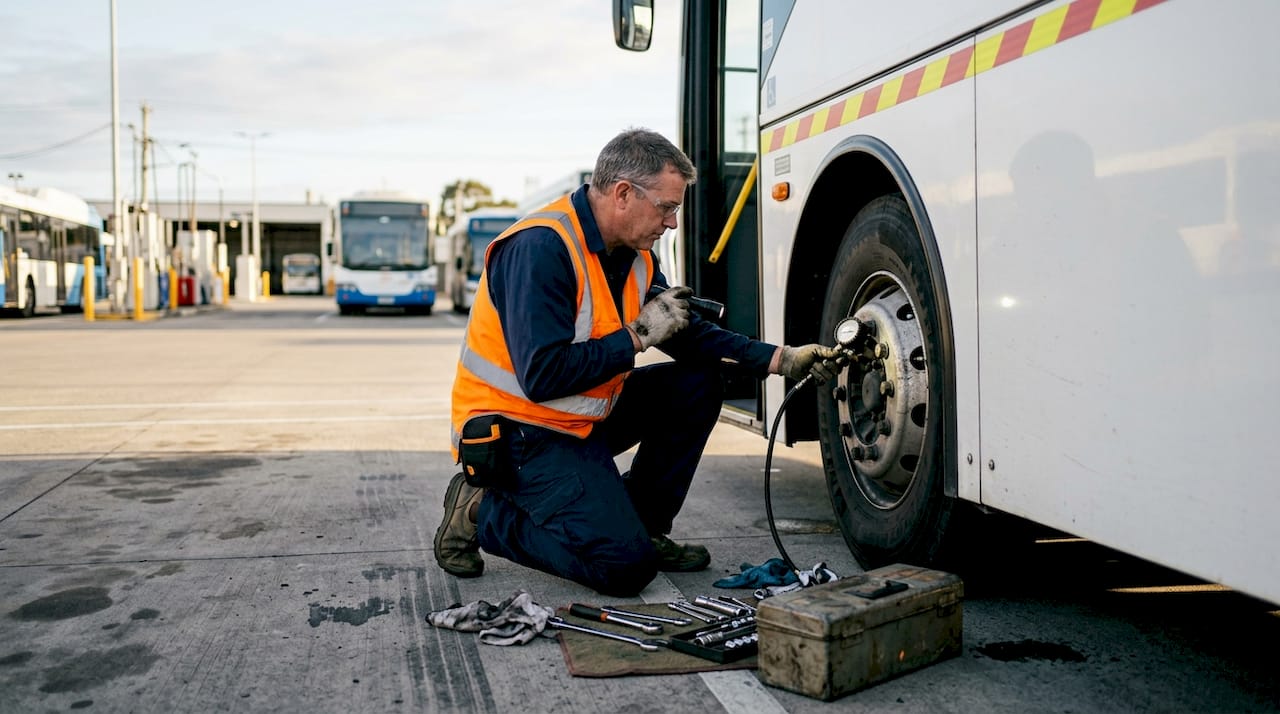
Brakes, tyres, and lighting defects account for the majority of preventable safety violations on charter buses. These are also the easiest items to check visually before departure.
The core vehicle inspection points
- Seatbelts: Check every seat. Lap-and-shoulder belts must latch and retract cleanly. On vehicles over 26,000 lbs., seatbelt presence is a federal requirement.
- Brakes: Ask the driver to demonstrate air pressure build-up and listen for leaks. A healthy air brake system holds pressure without continuous cycling.
- Lighting: Walk the exterior. Headlights, brake lights, and turn signals must all function. A single non-working brake light is a violation.
- Emergency equipment: Confirm a mounted fire extinguisher, reflective triangles, and a stocked first aid kit are present and accessible.
- Tyres: Look for even tread depth and no visible sidewall cracking. Dual rear tyres should not show contact wear between them.
- ADA equipment: If any passenger requires a wheelchair lift, test it before boarding. A lift that fails on-site is not a minor inconvenience. It is a safety and legal issue.
| Inspection item | What to look for | Pass condition |
|---|---|---|
| Seatbelts | Latch, retract, no fraying | All seats functional |
| Air brakes | Pressure holds, no audible leaks | Stable gauge reading |
| Exterior lighting | All lights illuminate | Zero non-functioning lights |
| Emergency kit | Fire extinguisher, triangles, first aid | All present and accessible |
| Tyres | Tread depth, no cracking | Even wear, no visible damage |
Companies that use electronic Driver Vehicle Inspection Reports with GPS timestamps demonstrate a higher level of real-time oversight. Ask whether the company uses digital DVIRs. A yes is a strong signal of genuine compliance commitment.
Pro Tip: Request the most recent DVIR for your assigned vehicle before the trip date. A reputable operator will provide it without hesitation.
What driver qualifications should you confirm?
Driver qualifications are the most overlooked section of any checklist for renting a bus. Planners often assume the company handles this. The NTSB and FMCSA both place responsibility on the organiser to ask the right questions.
The mandatory baseline for any commercial passenger driver is a Commercial Driver’s Licence (CDL) with a Passenger (P) endorsement. No endorsement means the driver is not legally qualified to carry your group. This is non-negotiable.
Key driver qualification checks:
- CDL with P endorsement: Verify the licence class and endorsement code. Ask to see it.
- Medical certification: As of 2026, paper medical cards are no longer accepted. Medical fitness is verified electronically through State Motor Vehicle Records. Ask the company to confirm their drivers are current in the system.
- Drug and alcohol testing: Drivers must be enrolled in the Federal Drug and Alcohol Clearinghouse. Random drug testing runs at 50% annually, with alcohol testing at 10%. Ask for written confirmation of programme participation.
- Hours of service: Federal rules cap driving at 10 hours within a 15-hour on-duty window. Confirm your trip itinerary does not require the driver to exceed these limits.
- Trip-specific experience: A driver with motorcoach experience on highway routes is not automatically the right choice for a narrow urban venue with tight loading zones. Ask about relevant experience.
“The NTSB recommends that event planners explicitly require driver safety briefings on seatbelt use and emergency exits as a written condition of the booking contract.” — NTSB charter trip safety guidance
That recommendation carries weight. A pre-trip passenger safety briefing is not a courtesy. It is a documented safety procedure that reduces injury risk in the event of an accident.
How do you assess a bus company’s overall safety culture?
Safety culture is harder to measure than a USDOT number, but it is just as telling. The best practices for bus rentals go beyond paperwork. They show up in how a company communicates, maintains its fleet, and responds to problems.
Maintenance programmes that follow 49 CFR 396 schedules are a baseline requirement for compliant operators. Ask whether the company tracks maintenance digitally. Companies using fleet management software with automated service reminders are far less likely to defer critical repairs.
Watch for these signals when evaluating a company:
- Pricing: A quote that is significantly below market rate is a warning sign, not a bargain. Suspiciously low rental prices often reflect deferred maintenance or skipped compliance costs. Professional operators carry high fixed costs from insurance and federal mandates.
- Responsiveness: How quickly does the company answer detailed safety questions? Slow or vague responses to compliance questions predict slow responses during an actual incident.
- Contingency planning: Ask directly: what happens if the assigned vehicle has a mechanical issue the morning of your event? A reliable company has a documented backup protocol.
- References and memberships: Industry association membership and verifiable client references from similar events are positive indicators.
- Technology use: Companies using digital DVIRs, GPS fleet tracking, and electronic maintenance logs demonstrate a culture of accountability.
Pro Tip: Ask for two client references from events similar in size and type to yours. A company confident in its safety record will provide them immediately.
What steps should you take after booking to stay safe?
Post-booking safety steps are where most event planners lose focus. The contract is signed, the date is set, and attention shifts to other logistics. These final steps are what close the gap between a good booking and a safe trip.
- Confirm insurance documentation. Request the Certificate of Insurance again within one week of your event. Policies can lapse or change. A current certificate on file is your protection.
- Verify vehicle assignment. Confirm the specific vehicle make, model, and plate number assigned to your group. This prevents last-minute substitutions with uninspected coaches.
- Arrive early for an on-site check. Build 20–30 minutes into your schedule before boarding. Walk the exterior, check the emergency equipment, and confirm the driver’s licence and endorsement.
- Require the pre-trip safety briefing. The NTSB recommends this briefing cover seatbelt use and emergency exit locations. If it is written into your contract, the driver is obligated to deliver it.
- Establish a communication channel. Have a direct mobile number for a company dispatcher, not just the driver. If an incident occurs mid-trip, you need someone who can coordinate a response immediately.
Passenger behaviour also matters. Brief your group before they board. Remind them to remain seated while the vehicle is moving and to use seatbelts at all times. A driver cannot manage passenger safety and the road simultaneously.
Key takeaways
A complete safety checklist for bus rentals covers regulatory compliance, vehicle condition, driver qualifications, and company safety culture. Skipping any one of these areas leaves your group exposed to preventable risk.
| Point | Details |
|---|---|
| Verify FMCSA rating first | Only a “Satisfactory” rating confirms a carrier meets federal safety standards. |
| Confirm $5 million insurance | Request a current Certificate of Insurance matching your specific vehicle type. |
| Check CDL with P endorsement | No Passenger endorsement means the driver is not legally qualified for your group. |
| Require digital medical verification | Paper medical cards are no longer valid as of 2026; confirm electronic verification. |
| Demand a pre-trip safety briefing | Write the NTSB-recommended passenger briefing into your booking contract. |
What I have learned from watching planners skip the hard questions
By Firoz
After years of working in group transportation, the pattern I see most often is not ignorance. It is misplaced trust. Planners assume that because a company has a website, a phone number, and a reasonable price, the compliance side is handled. It rarely is, not without verification.
The FMCSA SAFER check takes four minutes. Requesting a Certificate of Insurance takes one email. Asking to see a driver’s CDL endorsement takes thirty seconds at the vehicle. None of these steps are burdensome. They feel awkward only because planners worry about appearing difficult. That discomfort is worth pushing through.
The detail that surprises most planners is the 2026 medical certification change. Paper cards are gone. If a company cannot confirm their drivers are current in the electronic verification system, that is a compliance gap, not a technicality. I have seen groups board coaches with drivers whose medical certifications had quietly lapsed because nobody asked.
The companies I trust most are the ones that answer safety questions before I finish asking them. They have the documentation ready. They use digital inspection reports. They can name their backup vehicle protocol without pausing. That level of preparation does not happen by accident. It reflects a culture where safety is the operating standard, not a box to tick before a booking closes.
Write the pre-trip passenger briefing into your contract. The NTSB recommends it. It costs nothing to include. And if something goes wrong, it is the documented step that shows you took your responsibility seriously. That matters both for your passengers and for your own accountability as the organiser.
— Firoz
Safe group travel starts with the right operator
Torontobusrentals meets federal and provincial compliance standards across its entire fleet, with professionally licensed drivers holding current CDL Passenger endorsements and up-to-date electronic medical certifications. Every vehicle undergoes digitally tracked maintenance, and backup coaches are confirmed before each booking.

Event planners booking through Torontobusrentals receive confirmed insurance documentation, assigned vehicle details, and a driver committed to delivering the pre-trip safety briefing your group needs. For corporate outings, weddings, school trips, and large-scale events, group transportation in Toronto is handled with full transparency from booking to drop-off. Explore the fleet and connect with the team to confirm your event date.
FAQ
What is the minimum insurance required for a charter bus?
Federal law requires commercial motorcoach carriers to carry at least $5 million in public liability insurance. Always request a current Certificate of Insurance before confirming your booking.
How do I check a bus company’s safety rating?
Use the FMCSA SAFER system at safer.fmcsa.dot.gov and enter the company’s USDOT number. Only a “Satisfactory” rating confirms the carrier meets federal safety requirements.
What driver licence does a charter bus driver need?
A charter bus driver must hold a Commercial Driver’s Licence (CDL) with a Passenger (P) endorsement. Ask to see the physical licence and confirm the endorsement code before your group boards.
Are paper medical cards still valid for bus drivers in 2026?
No. Paper medical cards are no longer accepted as of 2026. Driver medical fitness is now verified electronically through State Motor Vehicle Records. Confirm your operator uses this system.
What should a pre-trip passenger safety briefing include?
The NTSB recommends the briefing cover seatbelt use and emergency exit locations at minimum. Write this requirement into your booking contract to make it a formal obligation.
Recommended
- Bus rental safety tips for Toronto events and group travel
- Bus rental safety checklist for event planners
- Questions to ask bus companies for your 2026 event
- How to assess bus rental quality: a planner’s guide