
Role of travel agencies in group transit: a planner’s guide
TL;DR:
- Travel agencies manage the full logistics of group transit, including flights, hotels, transfers, and contingency plans. They provide centralized itineraries, negotiate group fares, and support real-time disruptions with 24/7 assistance. Involving an agency early ensures smoother events, cost savings, and more efficient coordination.
Travel agencies are defined as professional coordinators who manage the full logistics of moving groups from origin to destination, not merely as ticket bookers. The role of travel agencies in group transit extends to orchestrating flights, ground transfers, hotel room blocks, and contingency plans as a single, unified operation. For event planners managing 10 or more travellers, this distinction is critical. Group travel logistics become exponentially more complex when individual schedules, multiple origins, and tight event timelines converge. Agencies bring supplier relationships, standardized processes, and 24/7 support that internal teams simply cannot replicate.
What specialized services do travel agencies provide for group travel logistics?
Travel agencies offer a distinct set of services built specifically for groups, not adapted from individual travel tools. The most effective agencies treat every group booking as a coordinated operation with a single source of truth at its centre. That means one master itinerary, one point of contact, and one communication channel for all members.
The core services agencies deliver for group transit organization include:
- Centralized itinerary management: All traveller details, schedules, and booking references are held in one accessible system, reducing confusion across large groups.
- Group fare negotiation: Access to group airfare contracts typically begins at 10 travellers, though complexity can arise with as few as five unique itineraries. Agencies negotiate these rates directly with airline group desks.
- Hotel room block coordination: Agencies secure room blocks that align with event dates and transport schedules, preventing the common mistake of booking accommodation independently from transit.
- Ground transportation and transfers: Agencies coordinate airport pickups, venue shuttles, and inter-city transfers as part of the overall programme, not as afterthoughts.
- Standardized costing sheets: Costing sheet adoption is directly linked to operational success for group travel agencies. These tools give planners full budget visibility before any commitment is made.
- Emergency support protocols: Agencies build disruption response plans into every group itinerary, not just reactive call-centre access.
Pro Tip: Request a sample costing sheet from any agency before signing a contract. A well-structured sheet reveals whether the agency truly understands group transit or is simply rebundling individual bookings.
The difference between a capable agency and a basic booking service shows up most clearly in the details. A capable agency assigns a dedicated travel coordinator for groups who knows the group’s itinerary, the event schedule, and the supplier contacts by name.
How do travel agencies manage real-time disruptions for group transit?
The clearest advantage of a professional agency appears the moment something goes wrong. 24/7/365 emergency support is a standard feature of professional group travel management. That means a dedicated contact, not a generic call centre queue, available at 2:00 AM when a connecting flight is cancelled.
Agencies monitor risks proactively across three categories:
- Operational risks: Flight delays, gate changes, and ground transport failures are tracked in real time, with rebooking initiated before the group even lands.
- Weather and environmental risks: Severe weather affecting a departure city triggers contingency plans that cover the entire group simultaneously, not traveller by traveller.
- Geopolitical risks: Agencies with international experience monitor travel advisories and entry requirement changes, adjusting itineraries before disruptions reach the group.
“Travel agencies act as conductors, synchronizing all travel components to operate as a cohesive system. When one element shifts, the conductor adjusts every other part to keep the group on schedule.”
The contrast with self-managed group travel is stark. Organizations that manage group travel internally often place responsibility on staff without travel industry expertise. The result is reactive crisis management, high stress, and costly last-minute rebooking fees. A professional agency absorbs that burden entirely, communicating changes to all group members through a single, coordinated message rather than a cascade of individual notifications.
What operational efficiencies and cost benefits do agencies bring to group transit planning?
Travel agencies reduce costs in two ways: through direct savings on fares and through indirect savings on staff time and disruption recovery. The fee model an agency uses signals which of these it prioritises.

Fixed fees vs. transaction-based fees
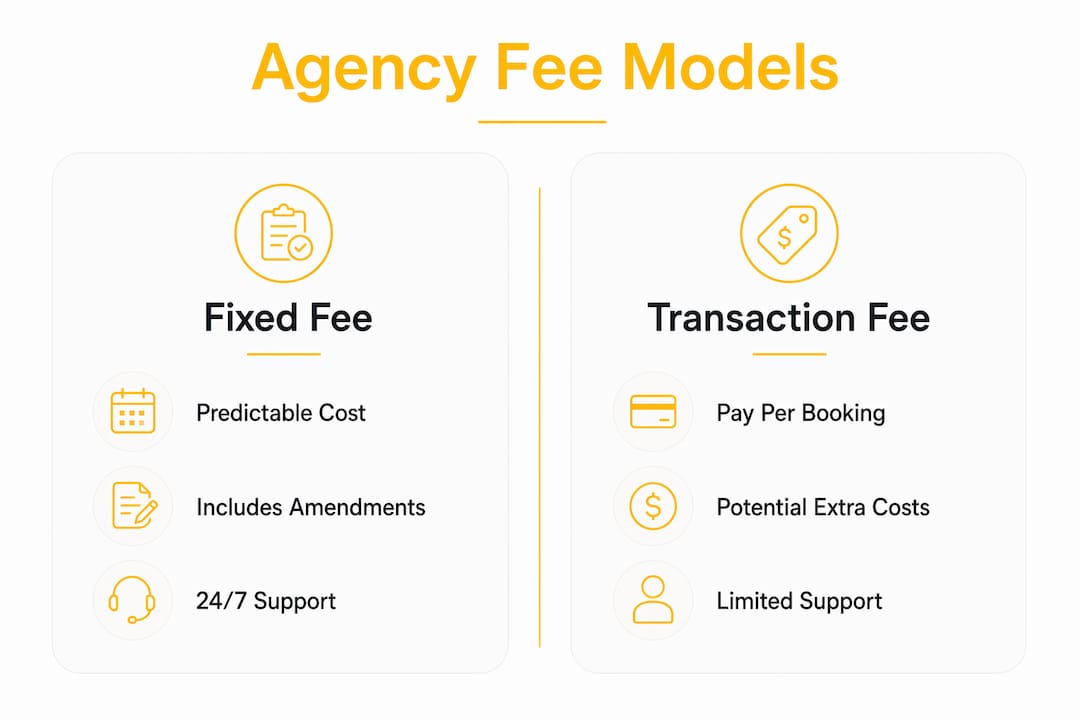
A fixed management fee model covers all bookings, amendments, and 24/7 support under one predictable cost. This aligns the agency’s incentives with the client’s. The agency has no reason to add unnecessary transactions or delay amendments. Transaction-based models, by contrast, can create friction when planners need to make changes, because every change generates a new fee.
| Fee model | Cost predictability | Amendment incentive | Support included |
|---|---|---|---|
| Fixed management fee | High | Agency favours efficiency | Yes, full 24/7 |
| Per-transaction fee | Low | Agency neutral or resistant | Often limited |
Pro Tip: When evaluating agencies, ask specifically whether amendments and cancellations are included in the management fee. Hidden per-change fees are the most common source of budget overruns in group travel.
Agencies also access preferred partner inventory that public booking platforms cannot reach. This includes negotiated group fares, priority seat allocations, and upgraded ground transport options. For event planners working with tight budgets, these exclusive rates frequently offset the agency’s management fee entirely.
The productivity argument is equally strong. When a travel coordinator for groups handles all logistics centrally, the event planning team focuses on programme content, speaker management, and attendee experience. The corporate outing transport guide for Toronto planners illustrates how centralizing ground transport alone can eliminate hours of back-and-forth coordination per event.
In what ways do agencies support event planners organizing group transit?
Event planners face a specific set of challenges that general travel management does not address. Groups arrive from multiple cities, follow different schedules, and need to reach the same venue within a narrow window. Agencies that specialise in travel agency group bookings build their workflows around exactly these constraints.
- Handling diverse traveller origins: Agencies map all departure points and build itineraries that converge at the destination without requiring planners to manually reconcile dozens of individual flights.
- Managing multi-leg trips: Multi-destination itineraries require a unified booking record. Without it, a delay on leg one creates a cascade of missed connections on legs two and three. Agencies maintain that unified record and act on it immediately when disruptions occur.
- Synchronizing hotel blocks with transport: Room blocks that do not align with arrival times create queues, frustrated attendees, and a poor first impression of the event. Agencies coordinate check-in windows with ground transfer schedules as a standard part of the planning process.
- Providing detailed budget reporting: Planners receive itemized cost reports covering flights, transfers, accommodation, and ancillary expenses. This level of budget tracking for groups supports post-event reconciliation and future planning.
- Freeing planners to focus on event content: The most underrated benefit of agency involvement is time. When logistics are handled by a specialist, the planning team directs its energy toward the event itself, not toward chasing flight confirmations.
- Applying group travel best practices: Experienced agencies use centralized digital itinerary tools to keep all attendees informed. Centralized digital itineraries reduce confusion and improve attendee satisfaction by giving every group member access to the same, current information.
The practical result is a smoother event from the moment attendees leave home to the moment they return. Agencies that specialise in event group transit understand that the transport experience shapes how attendees perceive the event itself.
Key takeaways
Travel agencies are the most effective partners for event planners managing group transit because they combine exclusive supplier access, fixed-cost transparency, and 24/7 disruption management into a single coordinated service.
| Point | Details |
|---|---|
| Agencies are orchestrators, not bookers | They coordinate flights, transfers, hotels, and contingencies as one unified system. |
| Group fares require specialist access | Discounted group rates and preferred inventory are unavailable on public booking platforms. |
| Fixed fees reduce budget risk | A fixed management fee covers amendments and support, preventing hidden cost overruns. |
| Real-time disruption response is critical | 24/7 dedicated support protects the entire group simultaneously, not traveller by traveller. |
| Centralized itineraries improve satisfaction | One digital source of truth for all group members reduces confusion and last-minute issues. |
Why I think most event planners underestimate the agency relationship
After working closely with event logistics for years, the pattern I see most often is this: planners bring in a travel agency too late. They handle the venue, the speakers, and the catering first, then treat transport as the final item on the list. That sequence creates the most expensive problems in group transit.
The agencies that deliver the best outcomes are the ones brought in at the brief stage, not the booking stage. When an agency understands the event’s objectives, the attendee profile, and the budget ceiling from the start, they build a transport plan that fits the event rather than one that accommodates whatever is left over. I have seen this difference play out repeatedly. Groups that integrated their agency early arrived on time, within budget, and without the frantic calls that characterize last-minute logistics.
The other observation I would offer is that the human element in agency work is genuinely irreplaceable. Technology can send alerts. Only an experienced travel coordinator for groups can call a hotel duty manager at midnight, negotiate a room block extension, and communicate a revised check-in plan to 80 attendees before breakfast. That is not a capability you can build internally without years of supplier relationships. It is exactly what a good agency brings on day one.
My advice: treat your agency as a strategic partner from the planning stage, not a vendor you activate at the end. The return on that relationship compounds with every event you run together.
— Firoz
Group transit in Toronto: how Torontobusrentals can help
Event planners organizing group transit in Toronto need ground transportation that matches the precision of a well-run agency programme.

Torontobusrentals provides motor coach solutions for corporate outings, conferences, and large events across the Greater Toronto Area. The fleet includes modern coaches with professional drivers, built for groups that need reliable, on-schedule transport. Whether you are coordinating airport transfers, venue shuttles, or multi-stop event routes, Torontobusrentals works alongside travel coordinators and event planners to keep every leg of the journey on time. Explore the full range of group transportation options to find the right vehicle for your next event.
FAQ
What is the role of travel agencies in group transit?
Travel agencies coordinate all elements of group transit, including flights, ground transfers, hotel blocks, and disruption response, as a single managed operation. Their role goes well beyond booking individual tickets.
When does group travel require a dedicated travel agency?
Group airfare contracts and discounted rates generally become accessible at 10 or more travellers, though complexity can arise with as few as five unique itineraries. At that threshold, agency involvement prevents costly coordination errors.
How do travel agencies handle disruptions during group travel?
Professional agencies provide 24/7/365 emergency support, proactively monitoring operational, weather, and geopolitical risks. When a disruption occurs, they rebook and communicate changes to all group members simultaneously.
What is a fixed management fee in group travel?
A fixed management fee covers all bookings, amendments, and support under one predictable cost. It aligns the agency’s incentives with the client’s goal of efficient, low-disruption travel rather than maximizing transaction volume.
How do travel agencies help event planners specifically?
Agencies handle diverse traveller origins, multi-leg itineraries, hotel block synchronization, and budget reporting, freeing event planners to focus on programme content rather than logistics coordination.
Recommended
- Group travel planning: your complete 2026 guide
- Group travel solutions explained: your 2026 planning guide
- Corporate outing transport guide for Toronto planners
- Top benefits of bus rentals for Toronto events in 2026