
Role of transportation in event planning: 2026 guide
TL;DR:
- Transportation logistics significantly impact attendee satisfaction and create first and last impressions. Proper planning, real-time management, and dedicated coordinators ensure smooth arrivals, departures, and brand perception. Integrating transport planning early and scaling strategies for event size prevents delays and enhances overall experience.
Transportation logistics is the backbone of event planning, determining whether attendees arrive on time, relaxed, and ready to engage. The role of transportation in event planning extends far beyond booking a few vehicles. It shapes the first and last impression every attendee carries away from your event. 52% of event planners rank transport and logistics above luxury accommodation in driving attendee satisfaction. That single figure reframes the entire planning conversation. Getting transport right is not a nice-to-have. It is the foundation every other element rests on.
How transportation logistics influence event flow and attendee satisfaction
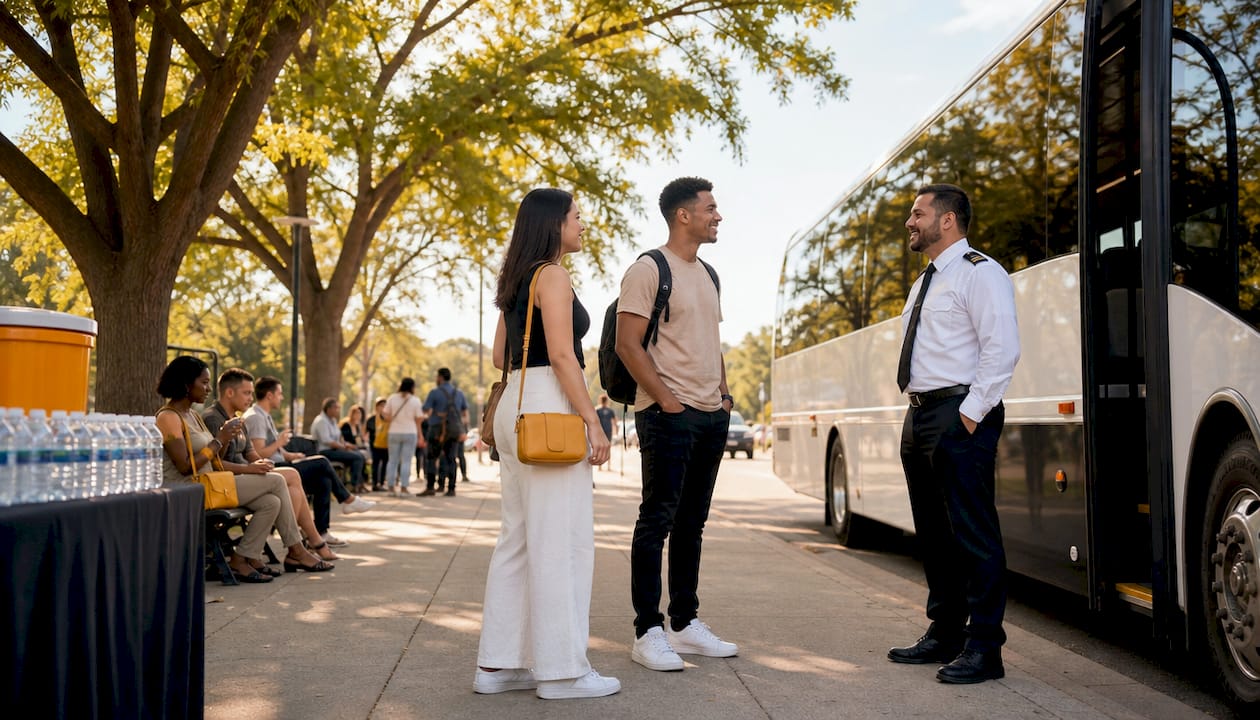
Transportation is the opening and closing act of the attendee experience. Overlooking granular details like loading zones and rush-hour traffic pinch points can damage an event’s reputation in a single afternoon. That is a hard truth most planners only learn once.
Poor transport creates a cascade of problems. A delayed shuttle means a delayed keynote. A delayed keynote means a compressed schedule. A compressed schedule means attendees leave feeling rushed rather than satisfied. The mood set by the first 30 minutes of an event rarely recovers.
Efficient transport logistics do the opposite. When arrivals and departures happen without noticeable difficulty, excellent transportation becomes invisible to guests. Attendees arrive relaxed and on time, which sets the tone for genuine engagement with your programme.
The effects of transport on brand reputation are equally concrete. Consider a corporate conference where delegates spend 90 minutes in traffic because no one mapped the venue’s loading zone capacity. That frustration attaches to the host organisation, not the traffic. Planners who treat transport as a logistics afterthought pay for it in post-event surveys.
Key ways transport directly shapes attendee satisfaction:
- Punctuality: Delayed vehicles push every session back and compress networking time.
- Comfort: Overcrowded or poorly maintained vehicles signal a lack of care before the event even begins.
- Stress reduction: Clear pick-up instructions and reliable vehicles remove a major source of attendee anxiety.
- Brand perception: Branded motorcoaches reinforce event identity and communicate professionalism from the moment delegates board.
- Accessibility: Vehicles equipped for attendees with mobility needs signal inclusion and prevent last-minute crises.
What are proven strategies for managing transportation logistics effectively?
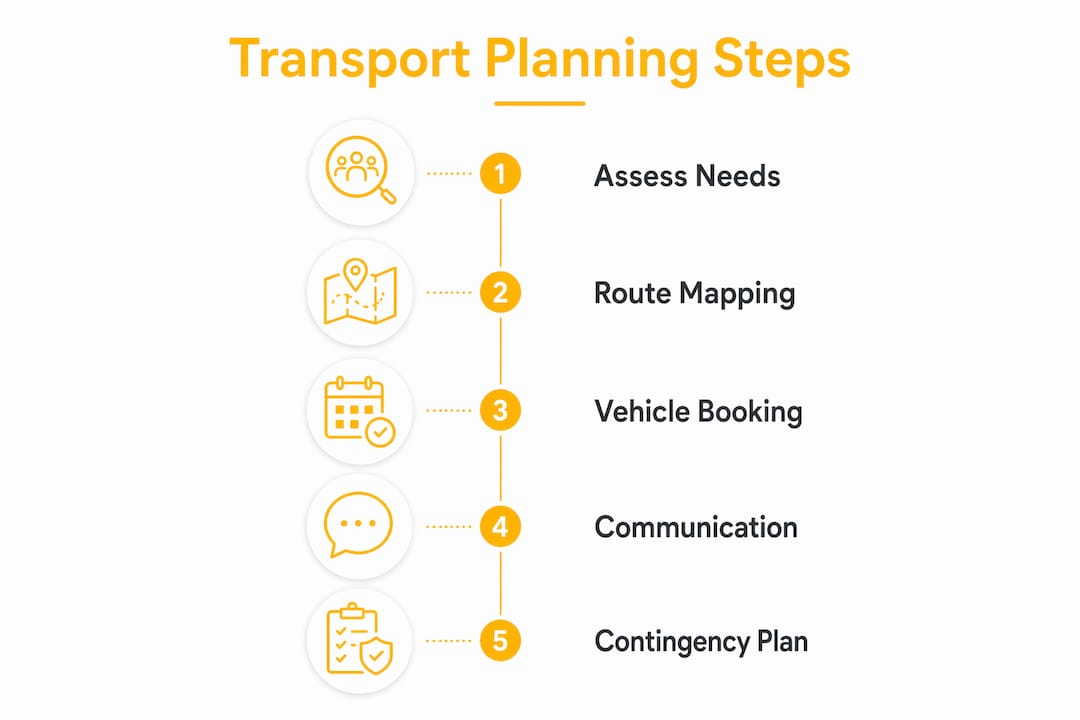
Professional transport management for events follows a set of industry-tested standards. Applying them consistently separates planners who deliver smooth events from those who spend the day firefighting.
Cluster airport arrivals into 30–60 minute windows. Grouping arrivals into defined windows reduces the number of vehicle trips, cuts costs, and prevents drivers from waiting indefinitely for staggered flights. Share arrival windows with delegates well in advance so they can book flights accordingly.
Build a 15–20 minute buffer into every departure. A 15–20 minute buffer absorbs minor delays without cascading into schedule failures. For airport-to-venue transfers specifically, build in at least 60 minutes to account for baggage claim and customs variability.
Distribute detailed manifests 24–48 hours before the event. Centralised tracking and pre-event manifests are critical to preventing communication failures. Every driver, coordinator, and venue contact should hold the same information at the same time.
Assign a dedicated on-site transportation coordinator. One coordinator per 50 guests is the recommended ratio for large events. This person monitors vehicle movement in real time, communicates with drivers, and resolves issues before attendees notice them.
Use real-time tracking tools. GPS-based vehicle tracking lets coordinators reroute drivers around accidents or road closures without disrupting the broader schedule. This is not optional for events with more than 100 attendees.
Map every loading zone before the event day. Walk the venue approach on a weekday at the same time your event will run. Identify where coaches can stage, where delegates will board, and where conflicts with public traffic will occur.
Pro Tip: Build a one-page transport brief for delegates that includes pick-up times, boarding locations, and a direct contact number for the on-site coordinator. Distribute it with your event confirmation email, not on the day itself.
For a thorough pre-event checklist covering routing, contingency planning, and vehicle coordination, the 2026 event transport checklist from Torontobusrentals is a practical starting point.
What challenges affect transportation in event planning?
The biggest challenge in event transport is unpredictability. Traffic, weather, mechanical failures, and flight delays do not respect your schedule. Planners who treat transportation as a dynamic system requiring real-time command handle these disruptions far better than those working from a static checklist.
Common challenges and how to address them:
- Traffic congestion: Pre-map two alternative routes for every transfer leg. Brief drivers on both options before departure, not after a jam appears.
- Weather disruptions: Add extra buffer time for winter events. In Toronto, a January evening can add 40 minutes to a 20-minute transfer. Plan accordingly.
- Mechanical failures: Contract with a provider that carries backup vehicles. A provider without a contingency fleet is a single point of failure.
- Flight delays: Monitor inbound flights in real time on event day. Adjust arrival windows and vehicle staging as delays are confirmed, not after delegates are standing at the kerb.
- Communication breakdowns: Communication failure is the main cause of transport crises. A single group chat connecting drivers, coordinators, and the event operations lead resolves most issues before they escalate.
Pro Tip: Designate one person as the sole point of contact between your event operations team and all drivers. Multiple people issuing instructions to drivers simultaneously creates confusion and contradictory routing decisions.
Local knowledge matters more than most planners realise. A driver who knows that a particular intersection backs up every Friday after 4:00 PM is worth more than a GPS app. Coordinate with local authorities for road closure information, particularly for large outdoor events or festivals. For VIP speakers and executives, airport transfer planning requires an additional layer of detail, including private staging areas and direct escort from arrivals.
How does transportation planning scale between small and large events?
Transport logistics do not scale linearly. A 50-person dinner and a 500-person conference share the same core principles but require completely different operational structures. The table below outlines the key differences.
| Factor | Small events (under 100 attendees) | Large events (100+ attendees) |
|---|---|---|
| Vehicle type | Minibuses, passenger vans | Full-size motorcoaches, multiple vehicles |
| Coordinator ratio | One coordinator for the full group | One coordinator per 50 guests |
| Scheduling model | Fixed departure times | Continuous loops and staggered departures |
| VIP transport | Shared vehicle with group | Separate dedicated vehicle |
| Communication | Single group message | Centralised tracking system with live updates |
| Contingency vehicles | One backup vehicle | Multiple backup vehicles staged on site |
Rigid fixed shuttle schedules often fail at large events because attendees do not move in uniform blocks. Continuous loops and staggered departures prevent boarding bottlenecks and reduce the frustration of waiting for a half-empty coach to fill before it departs.
VIP transport deserves a separate plan entirely. Executives, keynote speakers, and sponsors should never share a vehicle with general delegate shuttles. Their schedules are less predictable, their expectations are higher, and a delay affecting a keynote speaker has consequences that ripple through the entire programme.
Multi-day conferences typically rely on full-size motorcoaches for hotel-to-venue shuttles. Branded vehicles reinforce event identity and reduce the number of private cars on the road near the venue. For planners managing group transportation logistics for the first time, understanding vehicle capacity and loop frequency is the most common gap.
Accessibility planning is non-negotiable at any scale. Confirm that at least one vehicle in your fleet accommodates wheelchair users and that boarding areas are level and clearly marked. This is both a legal requirement and a basic standard of professional event management.
Key takeaways
Transportation logistics is the single most controllable factor in attendee satisfaction, and planners who treat it as a dynamic operational system consistently deliver better events.
| Point | Details |
|---|---|
| Transport shapes first impressions | Attendees form their opinion of your event before they enter the venue, based on how they arrived. |
| Buffer times prevent cascades | Build 15–20 minutes into every departure to absorb minor delays without disrupting the full schedule. |
| Communication failures cause crises | Distribute manifests 24–48 hours early and designate one point of contact between operations and drivers. |
| Scale changes the model | Large events require continuous loops, staggered departures, and one coordinator per 50 guests. |
| VIP transport needs a separate plan | Executives and speakers require dedicated vehicles and private staging, not shared shuttle queues. |
Why I think most planners underestimate transport until it’s too late
After working through dozens of events, the pattern I keep seeing is the same. Transport gets planned last and budgeted last. The venue, the catering, the AV setup all get locked in first. Then, two weeks out, someone asks how delegates are getting from the hotel to the venue, and the answer is usually “we’ll figure it out.”
That approach works until it doesn’t. And when it fails, it fails publicly, in front of every attendee, at the exact moment they are forming their first impression of your event.
The detail that catches most planners off guard is the loading zone. You can have the right number of vehicles, the right drivers, and the right schedule, and still create a 45-minute queue because no one confirmed where coaches are permitted to stage at the venue. That is a fixable problem. It just requires walking the site before event day.
My honest advice is to embed transport planning into the first planning meeting, not the last. Assign it a budget line, assign it an owner, and treat it with the same rigour you give to the programme itself. The events where transport is invisible to attendees are the ones where it was planned first, not last.
— Firoz
How Torontobusrentals supports event planners in Toronto

Torontobusrentals provides motorcoaches, minibuses, and group shuttle vehicles for events across Toronto, from corporate conferences to multi-day festivals. Every vehicle comes with a professional driver and the capacity planning support event organisers need to match fleet size to attendee numbers accurately.
For planners managing group shuttle services for the first time or scaling up from a previous event, Torontobusrentals offers direct booking support and local route knowledge that reduces the guesswork in vehicle staging and timing. The fleet includes options from 18-passenger minibuses to full-size 46-passenger coaches, giving planners the flexibility to match vehicle size to event scale. Explore group transportation solutions to find the right fit for your next event.
FAQ
What is the role of transportation in event planning?
Transportation logistics connect attendees to the venue reliably and on time, directly shaping their first impression and overall satisfaction. 52% of event planners rank transport above luxury accommodation in importance to event success.
How far in advance should event transport be planned?
Transport planning should begin at the first planning meeting, not in the final weeks before the event. Vehicle contracts, route mapping, and coordinator assignments all require lead time to execute properly.
What is the recommended buffer time for event vehicle departures?
The industry standard is a 15–20 minute buffer for every vehicle departure, with at least 60 minutes built into airport-to-venue transfers to account for baggage claim and flight variability.
How many transport coordinators does a large event need?
One on-site coordinator per 50 guests is the recommended ratio for large events. Each coordinator monitors vehicle movement, communicates with drivers, and resolves issues in real time.
Should VIP guests use the same shuttles as general attendees?
VIP speakers, executives, and sponsors should travel in dedicated vehicles with separate staging areas. Their schedules are less predictable, and a delay affecting a keynote speaker disrupts the entire event programme.
Recommended
- What is event transportation: a planner’s guide
- Sustainable transportation for events: a 2026 planner’s guide
- Event transportation checklist for planners: 2026 guide
- Defining event group transportation for planners