
Role of bus safety standards in Canadian schools
TL;DR:
- Canadian school bus safety standards ensure a high safety record through strict Federal, provincial, and industry collaboration. These regulations focus on crashworthiness, pedestrian safety, and visibility, with ongoing technological updates enhancing protection. The layered system relies on diligent operator practices and continuous improvement driven by safety data and technological advancements.
Canadian school buses carry millions of students every day, and the standards governing those vehicles are what make that possible with a safety record no other form of student transport can match. The role of bus safety standards in Canada is straightforward: they establish mandatory requirements for how school buses are designed, built, and operated, so that every child who boards one is protected whether the bus is moving or stopped at a loading zone.
Three pillars hold this system up. Transport Canada sets the federal manufacturing requirements under the Canadian Motor Vehicle Safety Standards (CMVSS). The Canadian Standards Association (CSA) D250 standard adds prescriptive body and chassis requirements that most provinces require for operational compliance. Provincial and territorial governments then enforce road rules, driver licensing, and maintenance policies on top of those federal foundations.
The core safety goals these standards pursue include:
- Crashworthiness: structural integrity that protects occupants during a collision
- Passenger protection: compartmentalization design with high-padded, energy-absorbing seats
- Pedestrian safety: stop signal arms, flashing lights, and perimeter visibility systems
- Traffic control: devices and rules that stop other motorists when children are loading or unloading
- Emergency egress: mandated exits, including side doors and roof hatches, sized and positioned for rapid evacuation
No single authority owns school bus safety in Canada. It is a shared responsibility, and that collaboration between federal regulators, provinces, school boards, and operators is precisely what gives the system its depth.
How CMVSS requirements protect school bus passengers
Canada applies over 40 CMVSS to the design and construction of school buses, covering crashworthiness, passenger and pedestrian safety, driver visibility, and the ability to control traffic. These standards apply at the manufacturing stage, meaning every new school bus sold in Canada must meet them before it ever reaches a school board.
The technical requirements are specific. CMVSS 222 governs seating and crash protection through compartmentalization: seats must have high backs, be padded with energy-absorbing material, and be spaced closely together so occupants are cushioned during a collision. If seat belts are installed, only three-point lap and shoulder belts are permitted. CMVSS 217 covers window retention and emergency exits, requiring a minimum number of exits, including a large rear door, side emergency exits, and a roof hatch, each sized and located to allow rapid evacuation.
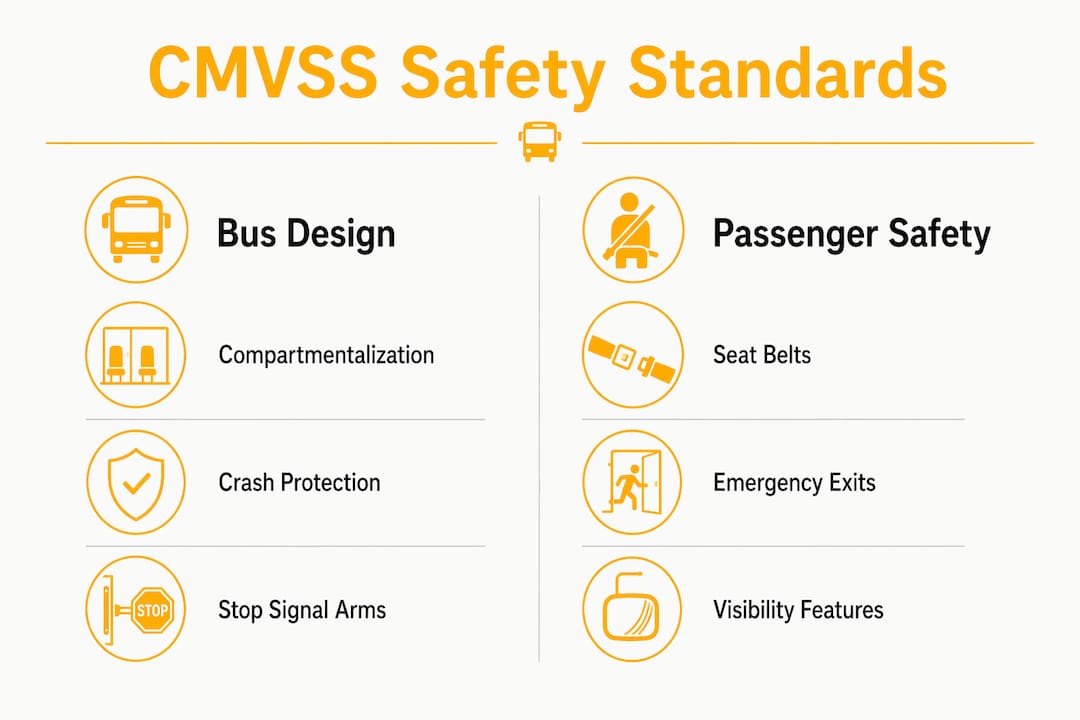
| CMVSS Standard | Safety Function |
|---|---|
| CMVSS 222 | Compartmentalization, seat crash protection, seat belt requirements |
| CMVSS 131 | Stop signal arm and pedestrian safety devices |
| CMVSS 108 | Flashing lighting systems for on-route stops |
| CMVSS 131 | Mirrors and visibility systems, including perimeter cameras |
| CMVSS 217 | Emergency exits, window retention and release |
| Fuel system standards | Crash-tested fuel integrity for gasoline, LPG, and CNG buses |
Stop signal arms fall under CMVSS 131. Every school bus must carry at least one, and it must deploy with flashing lights whenever the bus is stopped to pick up or drop off children. The lighting system under CMVSS 108 works alongside the arm to alert approaching drivers from both directions. Fuel system standards require crash testing of all school buses and set maximum leakage thresholds after impact, covering gasoline, liquid propane gas, and compressed natural gas configurations.
Multifunction School Activity Buses (MFSABs) meet the same compartmentalization and structural requirements as standard school buses, with two exceptions: they are not required to carry pedestrian safety devices (CMVSS 131) or the on-route flashing lighting system (CMVSS 108), because MFSABs are not used for regular on-route stops where children cross traffic.
What CSA D250 adds to the federal framework
The CSA D250 standard fills the gap between federal manufacturing requirements and the full construction picture for school bus bodies and chassis. Most provinces require that school buses be built to CSA D250, and the standard is developed jointly by Transport Canada, provincial governments, school bus operators, and manufacturers, so it reflects real-world operational needs alongside regulatory ones.
CSA D250:22 applies to all Type A1, A2, B, C, and D school buses, as well as MFSABs, manufactured on or after November 1, 2022. Its scope covers:
- Structural strength: body joint integrity, rollover protection, and chassis rigidity requirements that go beyond what CMVSS specifies
- Material standards: flammability limits and material specifications for interior and exterior components
- Body construction: prescriptive requirements for how the bus body is assembled, not just what performance it must achieve
- MFSAB-specific rules: CSA D250 requires, among other things, that MFSABs not be painted school bus yellow, distinguishing them visually from route buses
The committee structure behind CSA D250 is worth noting. Because it includes both government representatives and industry participants, updates to the standard tend to reflect practical manufacturing realities as well as emerging safety evidence. That process keeps the standard from becoming either a purely theoretical document or a purely industry-driven one.
Provincial authority over drivers, operations, and maintenance
Federal standards govern what gets built. Provinces and territories govern what happens once those buses are on the road. Provincial and territorial governments hold authority over driver training and licensing, operational safety policies, and vehicle maintenance requirements, and the specifics vary from one jurisdiction to another.
Key operational requirements that provinces typically mandate include:
- Driver qualifications: school bus drivers must hold a specific class of licence, pass medical assessments, and complete training programmes that go well beyond standard vehicle operation
- Maintenance schedules: buses undergo regular inspections, and provinces set the intervals and scope of those checks
- Seat belt policies: while Transport Canada defines the technical standards for seat belts if installed, provinces determine whether seat belt use is mandatory for passengers
- Aftermarket modifications: Transport Canada has no jurisdiction over retrofitting; provinces set the rules for adding or modifying equipment after a bus leaves the factory
This jurisdictional split means a school bus driver in Ontario and one in British Columbia may have trained under different programmes, even though the bus they drive meets identical federal construction standards. The variation is not a flaw in the system. It allows provinces to tailor operational rules to local road conditions, school board structures, and enforcement capacity.
Pro Tip: If you are a school administrator evaluating a transportation provider, ask specifically about driver training documentation and provincial licence class, not just whether the vehicles meet federal standards. The vehicle compliance is a given; the operational compliance is where providers differentiate themselves.
Common safety measures and rules for school buses across Canada
The safety measures mandated for Canadian school buses address two distinct risk zones: inside the bus during travel, and outside the bus during loading and unloading. Both matter, and the standards treat them differently.
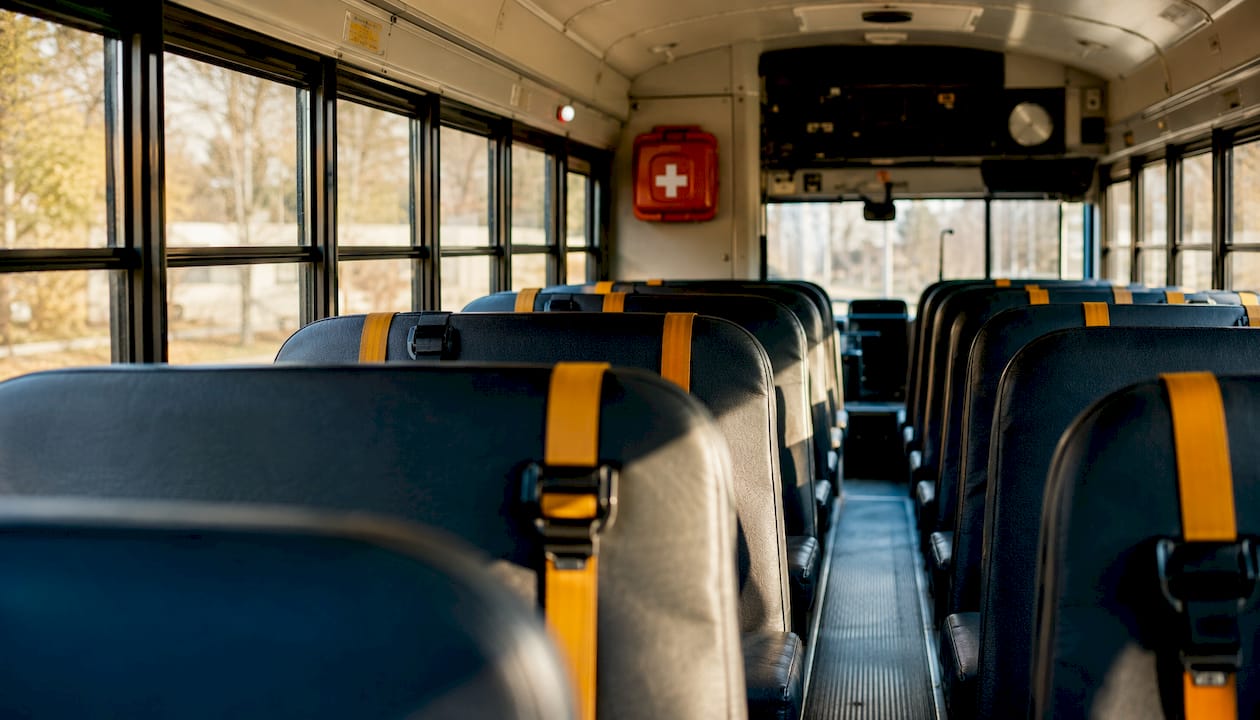
Inside the bus, compartmentalization does most of the work. High-backed, padded seats spaced closely together absorb crash energy and prevent occupants from being thrown into hard surfaces. Emergency exits, including the rear door, side exits, and roof hatch, give passengers multiple evacuation routes if the primary door is blocked.
Outside the bus, the risk picture is different. According to the Task Force on School Bus Safety, 79% of school-aged fatalities involving a school bus occur outside the vehicle, in or near loading zones. That finding drove the push for perimeter visibility systems and extended stop signal arms. Stop arms, flashing lights, and reflective materials on the bus body are all designed to make the loading zone as visible and controlled as possible for other road users.
Maintenance and inspection protocols sit alongside these active safety features. Provinces require periodic inspections covering brakes, lighting systems, emergency exits, and structural components. A bus that passes federal manufacturing standards at the factory must continue to meet those standards throughout its service life, and provincial inspection regimes are the mechanism that enforces that continuity.
How bus safety standards evolve and who drives the changes
School bus safety in Canada is a shared responsibility among Transport Canada, provincial and territorial governments, school boards, and bus operators, and that shared structure is also what drives the system forward. No single body can update standards unilaterally; changes require evidence, consultation, and consensus.
The Task Force on School Bus Safety, created in January 2019 by the Council of Ministers Responsible for Transportation and Highway Safety, reviewed safety data and existing technologies to identify improvements for both the interior and exterior of school buses. Its February 2020 report identified four priority technologies: infraction cameras, extended stop arms, exterior perimeter visibility systems, and automatic emergency braking.
New regulations published in the Canada Gazette now require all newly manufactured school buses to be equipped with exterior perimeter visibility systems. These systems use a series of cameras mounted around the bus to give drivers views of the danger zones that mirrors alone cannot cover, particularly the areas directly in front of and beside the bus where a child could be hidden from the driver’s line of sight. Infraction cameras, which capture licence plate information from vehicles that illegally pass a stopped bus, are voluntary at the federal level but may be required by individual provinces.
The evolution of these standards reflects a consistent principle: safety training for drivers and students is as critical as the hardware on the bus. Technical standards set the floor; human factors determine whether that floor is actually reached in daily operation. Continuous collaboration between manufacturers, operators, and policymakers keeps standards aligned with new safety challenges, including Vision Zero initiatives that several Canadian jurisdictions have adopted.
Key takeaways
Canada’s school bus safety system works because it layers federal manufacturing standards, provincial operational rules, and ongoing technological updates into a single integrated framework, with no gap between what a bus is built to and how it is operated.
| Point | Details |
|---|---|
| Federal manufacturing baseline | Over 40 CMVSS govern every new school bus built or imported in Canada. |
| CSA D250 fills the construction gap | Most provinces require CSA D250:22 for body and chassis compliance on buses built after November 2022. |
| Provinces control operations | Driver licensing, maintenance schedules, and road rules vary by jurisdiction under provincial authority. |
| Loading zones are the highest-risk area | 79% of school-aged bus-related fatalities occur outside the bus, near loading zones. |
| Technology is closing visibility gaps | New regulations mandate perimeter visibility camera systems on all newly manufactured school buses. |
Why compliance culture matters as much as the standards themselves
The gap between a well-written standard and a genuinely safe school bus is filled by the people who operate, maintain, and drive those vehicles every day. Canada’s regulatory framework is thorough. The CMVSS covers structural integrity, crash protection, and pedestrian safety. CSA D250 adds prescriptive construction requirements. Provinces layer on operational controls. What the regulations cannot mandate is the culture inside a transportation operation.
Professional operators who treat compliance as a minimum rather than a ceiling tend to produce better safety outcomes. That means going beyond the required inspection interval, investing in driver training that addresses student behaviour management alongside vehicle handling, and actively participating in the review processes that update standards over time. The student safety outcomes that Canadians rightly expect from school transportation depend on that operational commitment, not just the standards document.
There is also a tendency in public discussion to treat the federal and provincial frameworks as separate systems that occasionally overlap. They are not. They are deliberately layered. Transport Canada sets what the vehicle must be; provinces set how it must be used. When both layers function well, the result is a school bus that is structurally sound, operated by a qualified driver, maintained on schedule, and equipped with the technology to protect children in the loading zone. When either layer is weak, the other cannot fully compensate.
The ongoing push to mandate perimeter visibility systems is a good example of the system working as intended. Evidence showed that the loading zone was the most dangerous place for school-aged children near a bus. The Task Force identified the technology. Regulations followed. That cycle, from evidence to recommendation to mandate, is what keeps Canadian school bus safety genuinely current rather than frozen at the standards written a generation ago.
Recommended
- Role of buses in student safety: a 2026 guide
- Bus rental safety in Toronto: What event planners need to know
- Types of buses for schools: A guide for administrators
- Why reliable bus providers matter for group travel