
Reliable bus rentals in Toronto: essentials for safe group travel
TL;DR:
- Reliable bus rentals depend on verified safety documentation, including current CVOR certificates and comprehensive insurance coverage.
- Inspection discipline and thorough vendor evaluation are critical to prevent roadside failures and ensure smooth group trips.
Booking a bus for your group sounds straightforward until something goes wrong. Many event planners, school administrators, and corporate travel managers assume that any company with a website and a listed fleet has already been screened for safety and compliance. That assumption is dangerous. The difference between a smooth group trip and a roadside crisis often comes down to paperwork, process discipline, and the questions you asked before signing anything. This guide walks you through exactly what to look for, what to demand, and how to protect your group, your event, and your professional reputation.
Table of Contents
- Why documentation and safety records matter most
- Inspection discipline: the make-or-break for school and group trips
- Vendor selection: getting beyond the bus
- What most bus rental customers overlook
- The uncomfortable truth about bus rental reliability
- Take the next step: reliable group bus rentals in Toronto
- Frequently asked questions
Key Takeaways
| Point | Details |
|---|---|
| Verify all documentation | Always demand up-to-date CVOR, insurance, and maintenance records for any bus rental. |
| Prioritise inspection routines | Pre-trip and ongoing inspections directly affect rider safety and trip reliability. |
| Vet the vendor, not just the bus | Evaluate company credibility, transparency, and contract clarity to avoid surprises. |
| Don’t trust appearances alone | A clean bus is meaningless without inspection and compliance proof. |
Why documentation and safety records matter most
Reliability in bus rentals is not a feeling. It is a paper trail. Before a single passenger boards, you should be asking for specific documents that confirm the operator is legally compliant, financially protected, and operationally sound.
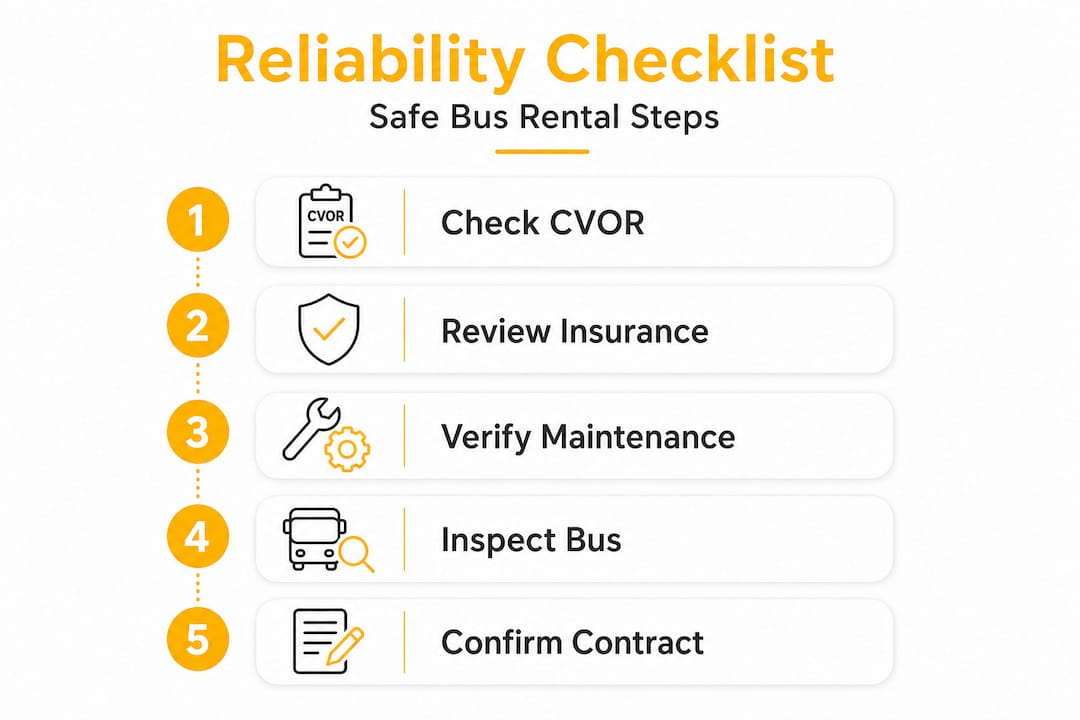
The most important document in Ontario is the CVOR certificate, which stands for Commercial Vehicle Operator’s Registration. Every commercial bus operator in the province is required to hold one. The CVOR tracks an operator’s safety history including collisions, inspections, and convictions. A poor CVOR record can result in suspension or cancellation of operating authority. You can verify CVOR status directly through Ontario’s Ministry of Transportation, and any reputable carrier should hand over their current certificate without hesitation.
Beyond the CVOR, insurance documentation is non-negotiable. Reputable carriers should carry at minimum:
- Commercial general liability insurance covering passenger incidents
- Automobile liability coverage at a minimum of $2 million (many corporate clients require $5 million)
- Non-owned vehicle coverage if the carrier subcontracts any trips
- Employer liability insurance if drivers are company employees
Ask for a certificate of insurance naming your organisation as an additional insured. This protects you in the event of a claim and confirms the policy is active, not lapsed.
Documented maintenance schedules round out the core trio. Ask specifically how often the fleet is serviced, who performs the maintenance, and whether records are kept on a per-vehicle basis. Operators who manage this rigorously will have logs available immediately. Those who hesitate or offer vague answers are telling you something important.
| Document | What to look for | Red flag |
|---|---|---|
| CVOR certificate | Current, satisfactory safety rating | Expired, conditional, or refused to share |
| Insurance certificate | $2M+ liability, active policy dates | Minimum coverage only or no certificate |
| Maintenance records | Per-vehicle logs, regular intervals | No documentation or verbal-only assurances |
| Driver abstracts | Clean records, current licences | Refusal to share or outdated credentials |
Understanding bus rental safety in Toronto means recognising that documentation is not bureaucratic overhead. It is your most concrete protection when something goes wrong, and your strongest signal of what kind of operator you are dealing with before anything goes wrong at all.
“A reliable bus rental starts with verifiable safety and compliance documentation. Ask the carrier for a current CVOR, confirm their insurance posture, and verify their maintenance and driver vetting process.”
Inspection discipline: the make-or-break for school and group trips
Documentation confirms past behaviour. Inspections confirm present readiness. These are two different things, and both matter enormously.
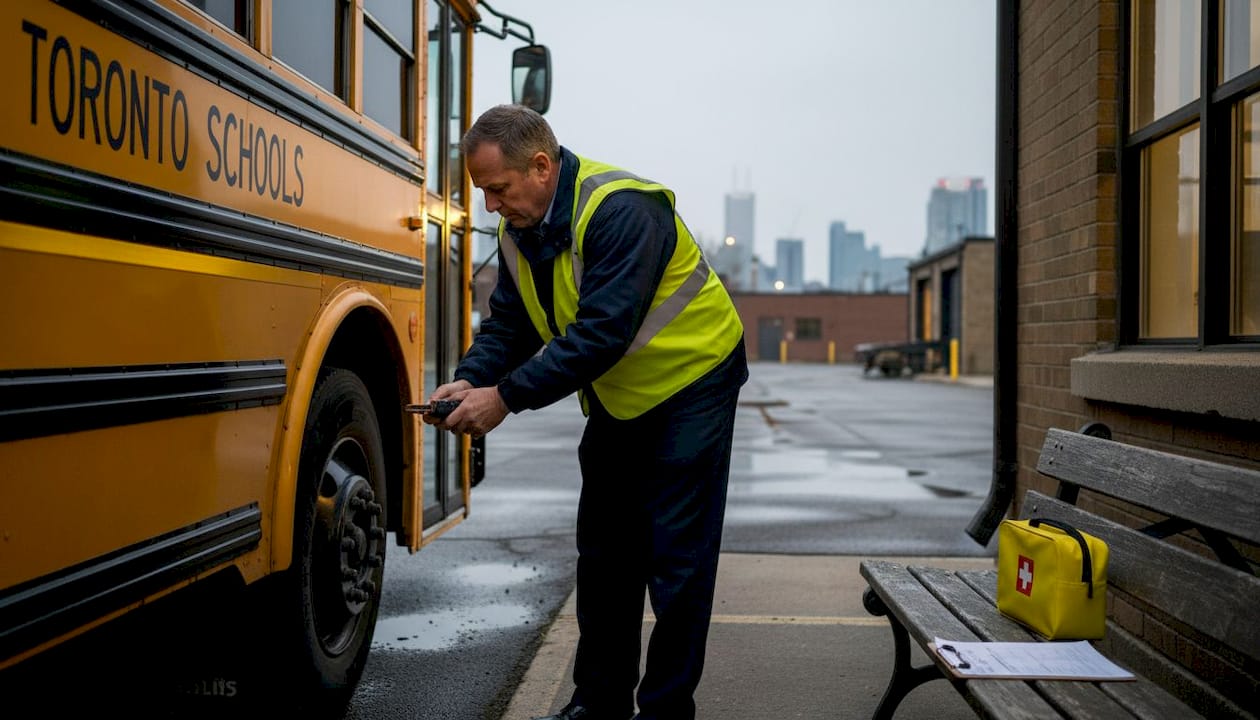
For school trips and youth group travel especially, inspection discipline is the single greatest predictor of whether a trip will go smoothly or end with a breakdown on the 401. A pre-trip inspection is not a casual walk around the vehicle. When done correctly, it is a structured, documented process that takes 20 to 30 minutes and covers dozens of specific components.
A proper pre-trip inspection should include the following steps in order:
- Engine compartment check: fluid levels, belts, hoses, battery connections, and coolant condition
- Tyre and wheel inspection: pressure, tread depth, lug nut torque, and visible damage
- Brake system review: air pressure readings, brake pad condition, and emergency brake function
- Lighting verification: headlights, brake lights, emergency flashers, and interior lighting
- Safety equipment inventory: first aid kit, fire extinguisher, emergency exits, and reflective triangles
- Interior passenger safety: seat belts, aisle clearance, handrails, and emergency door operation
- Driver’s documentation review: licence, trip manifest, and route confirmation
Each step should be recorded on a standardised form, signed by the driver, and retained in a trip file. If a provider cannot show you a sample of their inspection form or describe this process in detail, that is a serious warning sign.
Pro Tip: When vetting providers for school trips, ask to see a completed pre-trip inspection form from a recent trip. A quality operator will have them on file and won’t hesitate to share a redacted sample. If they fumble or change the subject, move on.
Ontario carriers must also comply with the Highway Traffic Act and NSC Standard 13 for vehicle inspection intervals. Roadside inspection failures don’t just delay your trip. They can trigger MTO audits and result in the carrier’s CVOR rating being downgraded, which affects their ability to operate.
The practical takeaway for safe school trip planning is this: ask about inspections the way you would ask about qualifications for any professional service. The answer tells you a great deal about the company’s overall operating culture. You can also review a full school trip bus rental guide to get a broader picture of what to plan for.
“For school trips specifically, reliability depends heavily on inspection discipline including pre-trip, routine, and documented inspections to prevent roadside failures and reduce liability exposure.”
Vendor selection: getting beyond the bus
The bus is just the vehicle. The vendor is the system that keeps it running, staffed, insured, and accountable. Many group travel planners make the mistake of evaluating only the physical fleet. A newer bus operated by a disorganised company is far riskier than an older vehicle from a disciplined, well-documented operator.
When evaluating vendors, think in terms of a structured RFP process. Even for a single trip, the habit of defining requirements in writing before speaking to a provider will save you time and protect you from misunderstandings.
Your vendor evaluation checklist should cover:
- Fleet size and age: a carrier with five or more vehicles is less likely to leave you stranded if one breaks down
- Accessibility features: lift-equipped vehicles, wide aisles, and accessible seating for groups with mobility needs
- Driver credentials: current commercial driver’s licence (Class B or higher), clean abstract, and first aid certification
- Communication protocols: who do you call if there is a problem en route, and how quickly do they respond
- Cancellation and rebooking policies: are these clearly written, or does the representative answer vaguely
| Evaluation category | Strong vendor | Weak vendor |
|---|---|---|
| Documentation | Provides immediately, without prompting | Delays, hesitates, or refuses |
| Fleet backup | Alternative vehicle available within hours | Single vehicle, no contingency |
| Accessibility | Lift-equipped options available | No accessible vehicles on roster |
| Contract clarity | Written, detailed, includes all terms | Verbal agreements, vague invoices |
| References | Provides contact details for past clients | No references available |
Understanding proper bus rental agreements is critical. A solid contract should specify the route, departure and arrival times, passenger count, pricing breakdown, driver identity, insurance coverage, and cancellation terms. Anything left to assumption is an opportunity for a dispute.
Pro Tip: Request a written quote that itemises every charge including fuel surcharges, wait time fees, and gratuity expectations. Then compare it line by line against what’s in the contract. Discrepancies at this stage almost always get worse once money is involved.
For school administrators in particular, choosing the right school bus rental goes beyond price comparison. Parent and board expectations around supervision ratios, communications, and safety standards mean you need a vendor who is genuinely accustomed to working with educational institutions.
What most bus rental customers overlook
Most people doing due diligence focus on what they can see: the bus photos, the website, the price quote. The factors most likely to cause problems are the ones you cannot see until you ask the right questions.
CVOR status is one of those invisible factors. In Ontario, carriers must renew their CVOR periodically. A carrier with a conditional or suspended CVOR may still appear to be operating, but they are doing so outside the bounds of their legal authority. Checking CVOR renewal status takes five minutes and can eliminate a non-compliant provider before any money changes hands.
Another widely overlooked issue is what we call “looks good, no proof.” A polished bus with vinyl graphics and a cheerful website tells you almost nothing about the company’s maintenance habits or inspection rigour. The risk is not theoretical. A bus that passed a visual inspection but had unrecorded brake wear is a bus that may fail on a highway on-ramp.
Questions most customers never ask but absolutely should:
- Who performs your vehicle maintenance, and where are records stored?
- What happens if the assigned driver calls in sick the morning of our trip?
- Can you show me your driver screening and training process?
- What is your on-road emergency protocol and who is the point of contact?
- Have you had any MTO roadside inspection failures in the past 24 months?
Pro Tip: Ask directly whether the company has received any MTO out-of-service orders in the past two years. A reputable carrier will answer honestly. One that deflects or claims they “don’t keep track” likely lacks the organisational culture needed for safe group transport.
Maintenance culture is also something worth probing. Reliable providers schedule inspections proactively rather than reactively. They don’t wait for warning lights. They don’t defer oil changes because a trip came up. This discipline is what keeps a fleet reliable at 6:00 a.m. on a Monday when your school group is loading.
For those planning ahead, this school bus rental Toronto guide provides a thorough look at what questions to ask and what to prioritise at each stage of the booking process.
The uncomfortable truth about bus rental reliability
Here is something the industry rarely says plainly: most reliability failures in bus rentals are not caused by bad luck. They are caused by skipped steps on both sides of the transaction.
Operators who rush pre-trip inspections, defer maintenance, or keep their CVOR paperwork out of date do not usually fail dramatically on the first trip. They fail gradually, and then suddenly. The breakdown in the middle of your corporate outing or the delayed school trip did not happen that morning. It was months in the making, baked into a culture of cutting corners that you could have detected in the vetting process.
The equally uncomfortable truth for planners and administrators: many of those corners get cut because customers allow it. When you accept a verbal quote, skip asking for insurance certificates, or choose the cheapest bid without asking a single question about compliance, you are signalling to the market that these things don’t matter. They do matter.
Insisting on proof at every step is not being difficult. It is being a professional who understands that group transportation carries real responsibility. When forty students or sixty conference attendees board a vehicle you arranged, their safety is connected to how thoroughly you did your homework.
Bus rental safety best practices are not complicated, but they do require consistency. The organisations that never have bad experiences are not lucky. They have built a reliable process around vendor selection, documentation review, and contract clarity. That process is learnable, repeatable, and worth every minute it takes.
Take the next step: reliable group bus rentals in Toronto
You now have a concrete framework for evaluating any bus rental provider in Toronto before you commit to a booking. The next move is applying it to a provider who is already prepared to meet that standard.

At Toronto Bus Rentals, we understand what thorough planners are looking for because we’ve built our operations to support that standard. Whether you’re exploring the advantages of charter buses for your next corporate event, ready to walk through the steps to rent a bus for an upcoming outing, or comparing options for Toronto school bus rentals, our team is ready to answer every question on your checklist. Reach out to start a transparent, documented conversation about your group’s needs.
Frequently asked questions
What documents should I always request from a bus rental provider in Ontario?
Always ask for a current CVOR certificate, proof of commercial liability insurance, and documented vehicle maintenance records before confirming any booking.
How can I check if a bus company’s CVOR is up to date?
You can request the certificate directly from the carrier, or confirm CVOR status through Ontario’s Ministry of Transportation resources.
What’s the risk of skipping pre-trip inspections?
Skipping pre-trip inspections increases risk of mechanical failure, roadside breakdowns, and significant liability exposure, particularly on school and youth group trips.
Why is a written contract important for bus rentals?
A written contract clarifies all terms including routes, payment, insurance responsibilities, and cancellation policies, reducing the risk of disputes or last-minute surprises.
What’s a hidden sign that a bus rental isn’t as reliable as it seems?
If a provider hesitates to share inspection records or insurance details, treat it as a warning, even if the vehicles appear clean and well-maintained.
Recommended
- Bus rentals for Toronto events: Cost, comfort, reliability
- Why rent buses in Toronto for smoother group travel
- Why bus rentals are essential for Toronto events: Cost, ease, safety
- Bus rental safety tips for Toronto events and group travel