
Master the bus rental booking process for group events
TL;DR:
- Booking group buses in Toronto involves a complex, multi-step process requiring approvals, policy compliance, and timely communication. Schools demand the earliest planning, often needing superintendent approval months in advance, while corporate groups benefit from structured timelines; neglecting these processes can cause costly delays. The primary causes of trip delays are internal approval bottlenecks, not vehicle availability, highlighting the importance of proactive internal planning and clear documentation.
Booking a bus for a group event in Toronto sounds straightforward until you actually try to do it. Most event planners, school staff, and corporate coordinators assume it’s a simple call-and-confirm process, only to discover layers of approvals, policy requirements, and timing constraints they never anticipated. Miss one step and you could find yourself facing a cancelled field trip, a delayed corporate outing, or a frustrated group of travellers with nowhere to go. This guide walks you through every stage of the group bus rental booking process, from first inquiry to final confirmation, so you can plan with confidence and avoid the setbacks that trip up so many first-time group organisers in Toronto.
Table of Contents
- Understanding the group bus rental booking process
- Essential policies and timing: What schools and organisations must know
- Common mistakes to avoid in the bus rental booking process
- Streamlining your booking: Tools and tips for efficient group travel planning
- A surprising truth: Why most delays in bus rentals are about approval, not availability
- Next steps: Take the stress out of your Toronto bus rental
- Frequently asked questions
Key Takeaways
| Point | Details |
|---|---|
| Start early | Begin the booking process as soon as possible to avoid policy delays and bus shortages. |
| Check approvals | Always verify and obtain required school or organisational permissions before finalising any booking. |
| Follow a checklist | Using a step-by-step checklist keeps your group rental on track and prevents vital details from slipping through the cracks. |
| Know common pitfalls | Avoid last-minute surprises by understanding and addressing the most frequent mistakes discussed in the guide. |
Understanding the group bus rental booking process
The booking process for group bus rentals is not a single transaction. It’s a sequence of coordinated steps that involve your organisation, the rental provider, and sometimes a third-party authority like a school board. Understanding this sequence from the start saves you from scrambling at the last minute.
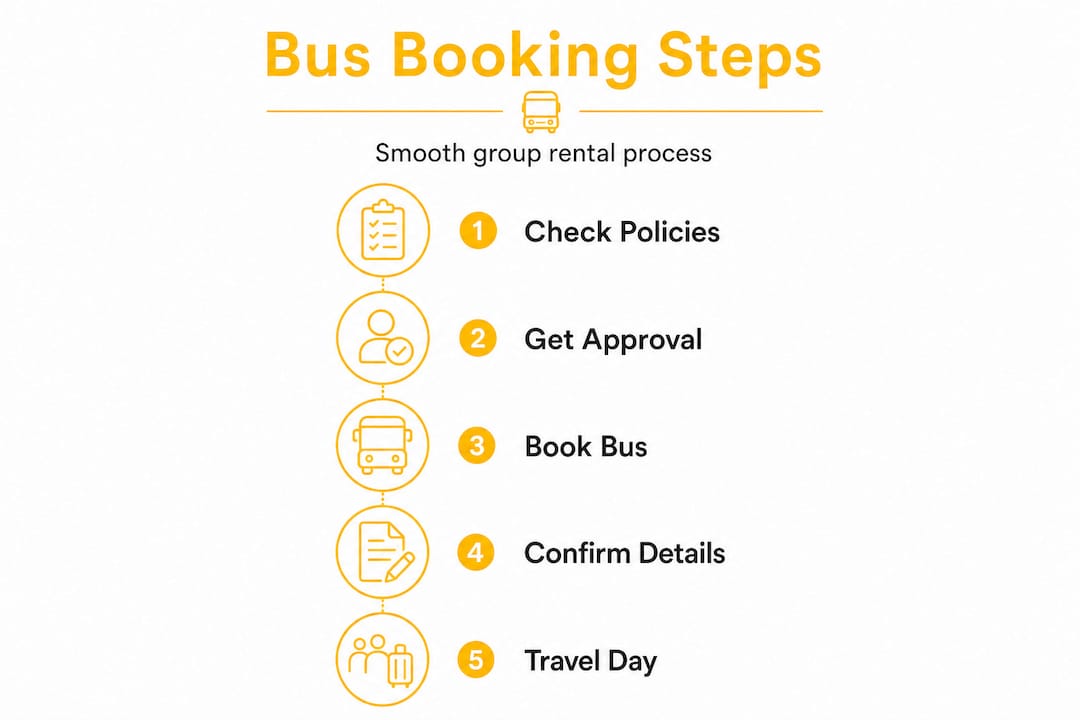
Here’s what the standard process looks like:
- Identify your group’s needs: Number of passengers, destination, date, and any accessibility or comfort requirements.
- Request a quote: Contact the rental provider with your trip details to receive pricing options based on vehicle type and duration.
- Review vehicle options: Choose between full-size motor coaches, minibuses, or school-style buses based on group size and trip distance.
- Check internal approval requirements: Schools, government bodies, and some corporations need sign-off before any booking is confirmed.
- Submit your booking request: Complete the reservation form and provide all required documentation.
- Review and sign the rental agreement: Understand cancellation policies, liability terms, and driver responsibilities.
- Confirm and pay the deposit: Secure the vehicle with a deposit, typically within a defined period after signing.
- Final confirmation: Receive written confirmation of your pick-up location, drop-off point, timing, and driver contact details.
The process varies depending on who is doing the booking. Schools face the most complex path, while private corporate clients often move faster. Here’s a side-by-side look:
| Factor | Schools | Corporate clients | Community groups |
|---|---|---|---|
| Approval required | Board-level and principal | Internal manager sign-off | Organisation leadership |
| Typical lead time needed | 4 to 6 weeks minimum | 2 to 4 weeks | 2 to 3 weeks |
| Policy documentation | Excursion policy compliance | Company travel policy | Variable |
| Contract complexity | High | Medium to high | Low to medium |
| Insurance verification | Often mandatory | Recommended | Recommended |
For anyone new to chartering buses for Toronto events, the table above makes one thing clear: not all group bookings are equal. Schools carry the most administrative weight, and that weight has a direct impact on how early you need to start.
Renting buses in Toronto also requires an understanding of local regulations. Drivers must be properly licenced, vehicles must meet provincial safety standards, and any contract you sign should reflect those standards clearly.
Notably, booking for school trips may require advance superintendent approval depending on the destination and whether it appears in the school board’s approved excursion directory. This is one of the most commonly overlooked requirements in the entire process.
Essential policies and timing: What schools and organisations must know
Now that you know the basic process, let’s dig into the specific approval steps and timing issues that can make or break your group trip, especially for schools and large organisations.
School boards in Ontario operate under structured excursion policies. The Toronto District School Board, for instance, maintains a directory of pre-approved trip destinations. Any trip outside that directory requires a higher level of approval, and that process takes time. School trips can be subject to additional board-level excursion policy requirements, including advance superintendent approval that must be secured well before any transportation is confirmed.
Here are the key timing milestones for school trip planning:
- Eight weeks out: Identify the destination and confirm whether it appears in the school board’s approved excursion directory.
- Six weeks out: If superintendent approval is needed, submit the request with full trip details, including transportation arrangements.
- Four weeks out: Receive superintendent sign-off and begin formal communications with the bus rental provider.
- Three weeks out: Review and sign the rental agreement. Pay the deposit.
- Two weeks out: Distribute consent forms to students and families.
- One week out: Confirm all trip logistics with the rental provider, including exact pick-up times and passenger count.
- Two days out: Final check-in call with the driver or dispatch team to confirm everything is on track.
“Schools are often well-organised in the classroom but underestimate the administrative complexity of off-campus trips. Starting the bus booking process eight weeks out isn’t excessive. For non-directory destinations, it may be the bare minimum.”
For corporate clients, the process is generally more flexible but still benefits from a structured approach. Many companies have internal procurement policies that require competitive quotes, department head approval, or even legal review of transportation contracts. The smart move is to check your organisation’s travel policy before making any commitments to a rental provider.
| Group type | Minimum recommended lead time | Key policy risk |
|---|---|---|
| School (directory trip) | 3 to 4 weeks | Principal approval missed |
| School (non-directory trip) | 6 to 8 weeks | Superintendent sign-off missed |
| Corporate outing | 2 to 4 weeks | Procurement policy bypassed |
| Community/non-profit | 2 to 3 weeks | Budget or leadership approval |
Your school trip bus rental guide resources can help you map out these timelines clearly, but the most valuable thing any school coordinator can do is build the approval process into the trip planning calendar from day one, not as an afterthought.
Pro Tip: When booking buses early for popular dates like June grad season or spring field trip month in Toronto, availability shrinks fast. Securing your vehicle while your approvals are in progress (rather than waiting for approvals to finalise before reaching out to a rental company) keeps you ahead of demand. Just be transparent with your provider about your approval timeline.
The essential bus rental tips that protect school groups always circle back to one theme: preparation beats reaction every time.
Common mistakes to avoid in the bus rental booking process
Understanding the rules helps, but many groups still fall into avoidable traps. Here’s how to sidestep the common ones.
Skipping the policy check entirely. This is the single most costly mistake school and organisational planners make. Non-directory school trips sometimes proceed without required superintendent approval, resulting in outright policy violations that can force last-minute cancellations. Beyond the inconvenience, it can also put teachers and administrators in a professionally compromised position.
Underestimating lead time. Many planners operate on the assumption that a bus can be booked the week before a trip. In reality, popular dates in Toronto fill up quickly, and the administrative pipeline for schools and large organisations often takes longer than expected. A rushed booking increases the risk of getting the wrong vehicle, missing important contractual details, or simply not finding a bus at all.
Common booking mistakes to watch for include:
- Failing to confirm the exact passenger count before requesting a quote (under-booking leads to unsafe overcrowding; over-booking wastes money)
- Not reading the cancellation and refund policy before signing the agreement
- Assuming verbal confirmation counts as a secured booking
- Overlooking accessibility needs until after the vehicle is confirmed
- Ignoring the importance of a written itinerary shared with the driver in advance
- Booking based solely on the lowest price without verifying the provider’s safety record or licensing
Focusing only on cost. Budget is always a factor, but prioritising price over reliability is a trap. A provider with a marginally lower quote but no track record with school or corporate groups may create more stress than savings. Confirm that the company is fully licenced, carries appropriate insurance, and employs drivers with the correct credentials for your trip type.
Pro Tip: Before finalising any bus rental agreements in Toronto, ask for the rental provider’s safety record, driver credentials, and proof of insurance in writing. A reputable provider will supply these without hesitation.
Failing to lock in logistics in writing. Pick-up time, drop-off address, luggage storage, and emergency contact numbers should all be confirmed in the contract or a follow-up written communication. Verbal agreements create confusion on the day of travel.
The most efficient school bus booking processes treat every booking like a project with deliverables, deadlines, and a paper trail.
Streamlining your booking: Tools and tips for efficient group travel planning
Armed with insights on what not to do, let’s see how you can turn a complex process into a smooth, predictable system for your group.

Even with principal-level approval, board-level permissions may still be required, making advanced planning not just helpful but essential for school groups. The good news is that with the right systems in place, the entire process becomes repeatable and far less stressful.
Here is a proven step-by-step planning approach for group travel coordinators:
- Create a master trip checklist for your organisation that covers every approval stage, key contacts, and deadline dates. Adapt it for school trips, corporate outings, and community events separately.
- Set calendar reminders at eight, six, four, two, and one week markers before your travel date. Each reminder should correspond to a specific action item from your checklist.
- Designate a single point of contact within your organisation for all communications with the bus rental provider. This prevents miscommunication and ensures consistency.
- Use a shared document or project management tool to track approval status in real time, so every stakeholder knows where things stand without requiring constant update emails.
- Confirm your group size at least two weeks out and update the rental provider immediately if numbers change significantly. This can affect vehicle type and pricing.
- Request a written trip confirmation from the rental provider at least five business days before travel and review every detail for accuracy.
- Brief your group on travel day logistics at least one week before departure: meeting time, location, what to bring, and what to expect from the journey.
Pro Tip: Streamlining bus rental bookings becomes much easier when you treat each trip as a repeatable template. After your first well-documented booking, you’ll have a framework that your entire team can follow for every future group event.
Tools worth using include shared calendar platforms for deadline tracking, digital signature tools for rental agreements, and group messaging apps for keeping your travellers informed. These aren’t just conveniences. They’re the difference between a smooth departure and a chaotic morning scramble.
A surprising truth: Why most delays in bus rentals are about approval, not availability
All these steps add up, but here’s the lesson our team has learned after years of working with Toronto group planners: the buses are almost never the problem.
You might expect that the hardest part of arranging group transportation would be finding an available vehicle on your preferred date. In reality, experienced rental providers typically have fleet options across multiple vehicle sizes and configurations. The bottleneck that actually derails trips is almost always internal to the organisation planning the event.
We’ve seen this pattern consistently. A school coordinator reaches out with a confirmed travel date, only to realise two weeks later that they never submitted for advance superintendent approval. The bus was ready. The driver was scheduled. But the trip couldn’t proceed without that sign-off, and there wasn’t enough time left to obtain it through proper channels.
The same pattern appears in corporate settings. A manager books a vehicle for a team outing, assuming department approval is automatic, only to find that the finance team requires procurement sign-off for any service contract above a certain dollar threshold. The approval takes longer than expected. The trip is delayed or rescheduled entirely.
The lesson isn’t that approval processes are obstacles. They exist for important safety and accountability reasons, especially for school groups. The lesson is that approval processes deserve as much attention and planning effort as the transportation itself. Our recommendation to every group planner: treat your internal approval chain as the critical path. Everything else, including the charter bus safety for school events, vehicle selection, and logistics, can be organised around a confirmed approval timeline.
The planners who never have delays aren’t necessarily the most experienced. They’re the ones who learned early that getting the right signatures on time matters more than anything else in the whole process.
Next steps: Take the stress out of your Toronto bus rental
If you’re ready to simplify your next group event, here’s how you can get a jump start:
Planning a group trip in Toronto doesn’t have to feel like navigating a bureaucratic maze. With the right rental partner, you gain not just a vehicle but a team that understands the specific requirements of school outings, corporate travel, and community events. Toronto Bus Rentals offers a fleet built for every group size, from intimate minibus options for smaller departments to full-size coaches for large school excursions.

Whether you’re coordinating a class trip, an annual corporate outing, or a community event, the right vehicle and the right support make all the difference. Explore school bus rentals in Toronto for supervised school excursions, browse minibus options for groups for smaller gatherings, or review our full range of group transportations and shuttle services to match your specific travel needs. Reach out today and let’s build a booking plan that works with your timeline, not against it.
Frequently asked questions
How far in advance should I book a bus for a school trip in Toronto?
School trips require superintendent approval at least one month in advance for destinations outside the approved directory, so plan to start the full process at least six to eight weeks before your travel date.
What happens if I skip policy approvals when booking buses?
Skipping required approvals can result in policy violations that force cancellations, even if the bus is fully confirmed and the driver is ready to go.
Are policy rules different for corporate or private events?
Corporate and private groups follow different internal policies but may still encounter company procurement protocols or venue-specific requirements that need sign-off before travel is confirmed.
What if our trip needs last-minute changes after booking?
Contact the bus rental company and your organisation’s approval authority immediately, since changes to destination, timing, or passenger numbers may still require formal clearance to remain compliant with your organisation’s policies.
Recommended
- Top benefits of bus rentals for Toronto events in 2026
- Group Transportations & Shuttle Services | Toronto Bus Rentals
- How to streamline your Toronto bus rental booking
- 7 Essential Bus Rental Tips for Successful Events