
How to schedule bus pickup for groups and events
TL;DR:
- Scheduling a bus pickup requires confirming passenger count, precise location, and advance booking details. Clear communication and proper clustering of stops ensure timely pickups and reduce delays. Proper planning, coordinating early, and providing exact instructions prevent no-shows and logistical issues.
Scheduling a bus pickup is the process of reserving a specific time, location, and vehicle for transporting a group from a defined starting point to a destination. Done correctly, it removes the guesswork from group travel and keeps everyone moving on time. The key variables are passenger count, precise pickup location, advance booking window, and clear communication with your transportation provider. Whether you are coordinating a corporate outing, a school trip, or a wedding shuttle, the same core process applies. Get these details right before you confirm anything, and the rest of the logistics fall into place.
What do you need before scheduling a bus pickup?
Three pieces of information are non-negotiable before you contact any provider: your confirmed passenger count, a precise pickup address, and the names or contact details of a point person at the pickup location. Without these, no provider can give you an accurate quote or assign a vehicle.

Passenger count determines vehicle size. A group of 18 fits a minibus rental, while a group of 46 requires a full coach bus. Getting this wrong means rebooking, which costs time and often money.
Pickup windows are a standard part of bus scheduling that many organisers overlook. Standard pickup windows range from 15 to 20 minutes to accommodate traffic and boarding variability. In complex urban areas, that window can extend beyond 30 minutes. Build this buffer into your event timeline from the start.
Advance booking timelines vary significantly by service type. Some services require 1 to 14 days notice for reservations, and school transportation changes can need up to 10 business days for processing. For large group events in Toronto, booking at least two weeks out is the standard practice. Last-minute requests risk unavailability, especially during peak seasons.
Here is a quick reference for what to prepare before booking:
| Requirement | Why it matters |
|---|---|
| Confirmed passenger count | Determines vehicle size and cost |
| Precise pickup address (geocoded) | Enables accurate routing and timing |
| Event date and departure time | Locks in availability and scheduling |
| Point-of-contact name and phone | Allows driver to reach someone on the day |
| Ticket or credential requirements | Prevents denied boarding at secured locations |
Pro Tip: Collect passenger counts at least 72 hours before your booking deadline. Last-minute additions are the single most common reason groups end up with the wrong vehicle size.
How to schedule a bus pickup step by step
The bus reservation process follows a consistent sequence regardless of the provider or event type. Following it in order prevents the most common errors.
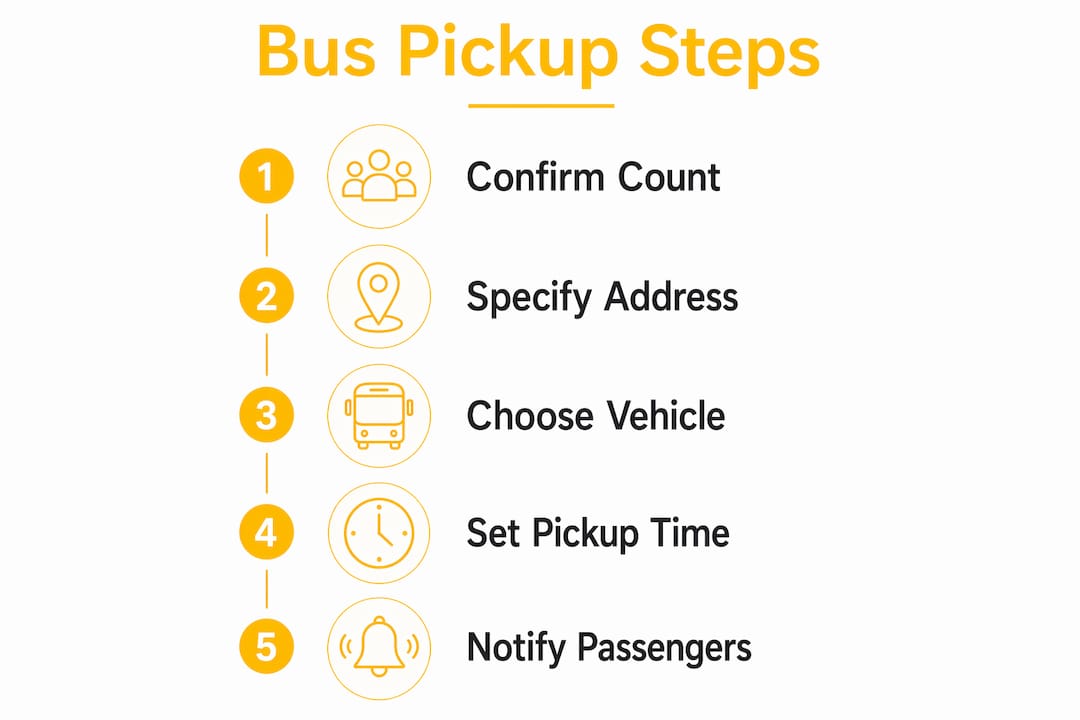
Confirm your group details. Lock in passenger count, pickup address, destination, and event time before making any calls or filling out any online forms. Vague information at this stage causes delays later.
Choose your booking channel. Most providers accept reservations by phone, online form, or email. Some transit reservations are taken on a first-called, first-served basis during specified office hours on weekdays only. For private charter services like Torontobusrentals, online booking requests are available any time.
Submit your pickup details. Provide the full civic address, not a landmark or a general area. Accurate, geocoded addresses enable efficient routing and clustering of passengers. Vague landmarks decrease scheduling efficiency and may cause delays.
Receive and review your confirmation. Exact pickup points in charter services may be finalised only after booking. Rely on the confirmation details you receive, not a general map or an assumed location. Read the confirmation carefully and flag any discrepancies immediately.
Distribute pickup instructions to passengers. Send the confirmed address, pickup time, and any ticketing requirements to every passenger at least 24 hours before departure. Include a contact number for the day-of driver or dispatcher.
Confirm again the day before. A brief confirmation call or message to your provider the day before the event catches any last-minute changes before they become problems.
Pro Tip: When sending pickup instructions to passengers, include a photo of the exact boarding location if possible. A street-level image eliminates confusion at busy venues, transit hubs, or multi-entrance buildings.
Common challenges and how to avoid no-shows or delays
No-shows are the most disruptive problem in group bus scheduling. They delay departure, frustrate other passengers, and can cause a driver to leave without the missing person.
Drivers typically wait no more than 3 minutes at stops to stay on schedule. That is not a policy choice. It is a scheduling necessity. A driver who waits longer at one stop creates a cascade of late arrivals at every subsequent stop.
The root cause of most no-shows is not forgetfulness. It is poor visibility. Bus drivers cannot leave their vehicles to search inside buildings, so passengers must be visible and waiting outside at the pickup point. No-show rates increase when passengers wait in lobbies, behind glass doors, or in areas the driver cannot see from the road.
“Being ready means waiting where the driver can see you. No-shows often occur not because passengers are absent, but because they are waiting in the wrong place.”
Here is how to prevent the most common boarding problems:
- Arrive 10–15 minutes early. Passengers should arrive at their designated pickup location 10–15 minutes before the scheduled time. This accounts for the driver arriving at the early end of the pickup window.
- Wait outside and stay visible. Standing at the kerb or in a clearly marked area prevents missed pickups.
- Have tickets or credentials ready. Having tickets or QR codes ready before bus arrival speeds up boarding and prevents delays. At airports or cruise terminals, check-in with agents or ticket presentation may be required before boarding.
- Assign a group leader. One person should be responsible for confirming all passengers are present before the bus arrives.
- Share the driver’s contact number. If a passenger is running late, they need a direct line to the driver or dispatcher, not just the booking office.
Pro Tip: For events with 20 or more passengers, send a reminder message two hours before pickup. Include the exact address, the driver’s phone number, and a clear instruction to wait outside. This single step cuts no-show rates significantly.
How to optimise bus pickup scheduling for group events
Group event scheduling adds a layer of complexity that single-stop pickups do not have. When passengers are spread across multiple locations, route order and timing become critical.
Clustering passengers by proximity is the most effective way to reduce total travel time. Scheduling is similar to solving a routing problem. Grouping pickup points by proximity boosts efficiency and reduces the total distance the vehicle travels. The practical result is that passengers at nearby addresses should be assigned to the same pickup window, not scattered across the schedule.
The table below shows the difference between an unoptimised and an optimised approach to multi-stop pickup scheduling:
| Approach | Method | Outcome |
|---|---|---|
| Unoptimised | Stops assigned in booking order | Longer routes, higher fuel cost, late arrivals |
| Optimised | Stops clustered by geographic proximity | Shorter routes, on-time arrivals, lower cost |
| Precise addressing | Full civic address with unit number | Accurate routing, no driver confusion |
| Landmark-based | “Near the mall” or “by the park” | Routing errors, delays, missed pickups |
Timing coordination requires accounting for traffic variability, not just distance. A pickup scheduled for 8:00 AM on a Friday in downtown Toronto faces very different conditions than the same route at 10:00 AM on a Saturday. Build a 15-minute buffer into your schedule for each stop in high-traffic corridors.
For school and sports group travel, the advance booking process follows the same clustering logic. Assign students or athletes to pickup points based on their home neighbourhood, not their registration order.
Pro Tip: Use Google Maps or a similar mapping tool to plot all your pickup addresses before finalising the route order. Drag the stops into geographic clusters and share the proposed order with your provider. Most providers will adopt a logical route sequence if you present one.
Key takeaways
Scheduling a bus pickup requires confirmed passenger details, a precise pickup address, adequate advance notice, and clear communication with both the provider and every passenger.
| Point | Details |
|---|---|
| Book with enough lead time | Some services require 1–14 days notice; book at least two weeks out for group events. |
| Use precise addresses | Geocoded civic addresses prevent routing errors and delays at pickup. |
| Passengers must be visible | Drivers wait no more than 3 minutes; passengers must wait outside in a visible location. |
| Cluster stops by proximity | Grouping nearby passengers into the same pickup window reduces travel time and cost. |
| Confirm and communicate | Send pickup details to all passengers at least 24 hours before departure. |
What I have learned from watching group pickups go wrong
Every organiser I have spoken with who had a bad pickup experience shares one thing in common: they assumed passengers would figure it out. They sent a calendar invite with a general address and called it done. The driver arrived, waited three minutes, and left. Two people were standing inside the lobby. One was in the parking garage. Nobody had the driver’s number.
The uncomfortable truth about bus pickup scheduling is that the logistics are simple. The communication is where it falls apart. Organisers spend hours on the venue, the catering, and the programme. They spend ten minutes on transportation instructions. That imbalance shows up on the day.
What actually works is treating the pickup briefing like a boarding pass. Every passenger needs to know the exact address, the exact time to be standing outside, and who to call if something goes wrong. That is three pieces of information. It takes five minutes to write and two minutes to send. The groups that do this consistently have smooth pickups. The ones that skip it do not.
For multi-stop events, I have seen organisers save significant time by presenting a pre-clustered route to their provider rather than leaving the stop order to chance. Providers appreciate it, and the route ends up tighter. The group transportation logistics involved are not complicated once you see the pattern. Plan early, communicate clearly, and never assume a passenger knows where to stand.
— Firoz
Torontobusrentals: group pickup scheduling made straightforward
Planning a group pickup in Toronto requires a provider that confirms details clearly and keeps schedules tight. Torontobusrentals works with event organisers, schools, sports teams, and corporate groups to set up pickups that run on time.

The booking process covers vehicle selection, pickup address confirmation, and passenger capacity in one request. For school groups, the Toronto school bus rental options cover groups of varying sizes with professional drivers who know Toronto routes. For corporate and event groups, the group shuttle services page outlines available vehicles and scheduling options. Reach out to Torontobusrentals to confirm availability and get your pickup details locked in well before your event date.
FAQ
How far in advance should I book a bus pickup?
Some services require 1 to 14 days notice, and school transport changes can take up to 10 business days. For group events, booking at least two weeks in advance is the safest approach.
What happens if a passenger misses the bus?
Drivers typically wait no more than 3 minutes at each stop to stay on schedule. If a passenger misses the pickup, they should contact the dispatcher directly to arrange an alternative.
Why do I need a precise address instead of a landmark?
Accurate, geocoded addresses enable efficient routing and reduce delays. Vague landmarks like “near the park” create confusion for drivers and slow down the entire schedule.
Do passengers need tickets or credentials to board?
At secured locations such as airports or cruise terminals, ticket presentation or agent check-in is often required before boarding. Always confirm credential requirements with your provider when booking.
Where should passengers wait for the bus?
Passengers must wait outside in a visible location at the confirmed pickup point. Drivers cannot leave their vehicles to search inside buildings, so standing at the kerb or a clearly marked area is the only reliable way to avoid a missed pickup.
Recommended
- 7 Essential Bus Rental Tips for Successful Events
- Top benefits of bus rentals for Toronto events in 2026
- Master the bus rental booking process for group events
- Booking buses for schools 2026: the complete planning guide