
How to plan group transportation for events
TL;DR:
- Getting group transportation right is an essential yet underrated aspect of successful event planning that directly impacts guest experience and organizer reputation.
- It requires early planning, detailed documentation, clear communication, and contingency measures to ensure punctuality and safety.
Getting group transportation right is one of the most underrated challenges in event planning. When you’re coordinating a corporate outing, a school trip, or a wedding, how to plan group transportation becomes the difference between a polished experience and a stressful one. Missed pickups, confused attendees, and last-minute vehicle shortages do not just inconvenience guests. They reflect directly on you as the organiser. This guide walks through every stage of the process, from assessing your needs and building a timeline to managing the day itself and learning from each event.
Table of Contents
- Key takeaways
- How to plan group transportation needs and vehicle selection
- Building a realistic transportation timeline
- Coordinating communication on the day
- Common challenges and how to handle them
- Evaluating and improving your process
- My perspective on getting group transport right
- Reliable group transport for Toronto events
- FAQ
Key takeaways
| Point | Details |
|---|---|
| Start planning 30 to 90 days out | Early booking secures the right vehicles and experienced drivers, especially during busy seasons. |
| Build a detailed group snapshot | Document headcount, luggage, accessibility needs, and itinerary before requesting quotes. |
| Assign a coordinator and backup | One point of contact reduces conflicting messages and improves real-time problem solving. |
| Add buffer time to every schedule | Allow extra time for baggage, restrooms, and traffic to avoid missed rides and delays. |
| Collect feedback after every event | Post-event data on timing, satisfaction, and cost helps you improve future transport plans. |
How to plan group transportation needs and vehicle selection
Before you contact a single provider or compare prices, you need a clear picture of your group. This means more than just a headcount. A useful group snapshot includes headcount, flight details or arrival windows, luggage volume, and any special accessibility requirements. Providers use this to quote accurately, and you use it to size vehicles correctly.
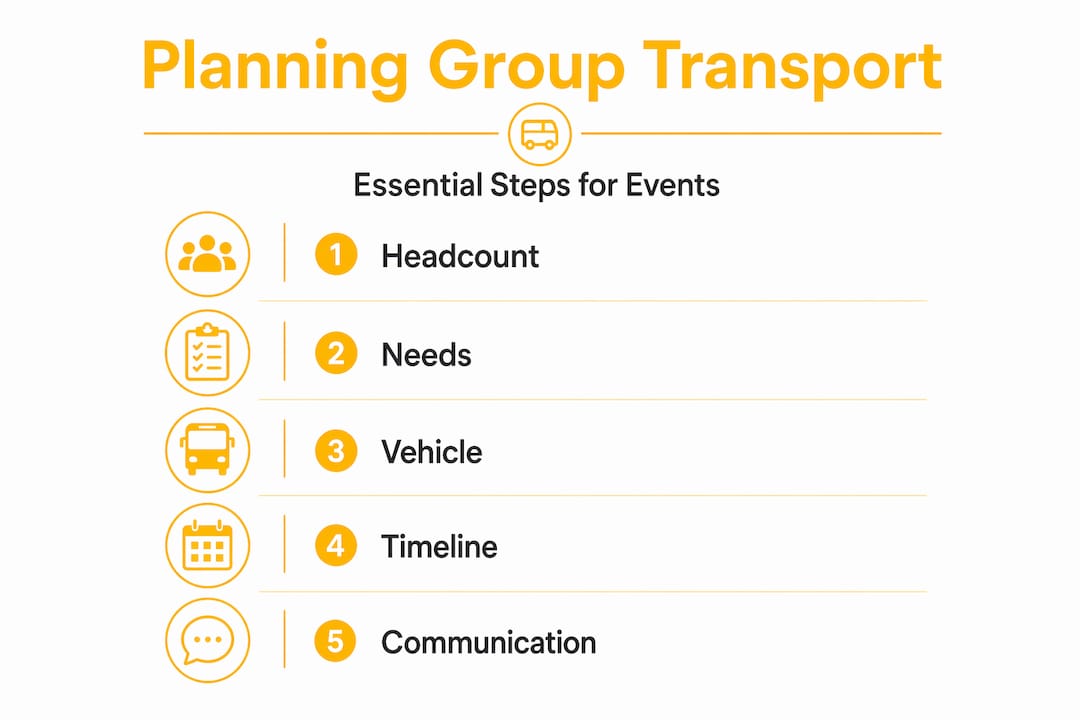
Group size is the most obvious factor, but comfort and trip type matter just as much. A 45-person corporate group heading to a formal dinner needs something very different from a 20-person student group going on a day trip. Below is a practical comparison to help you match your needs to the right vehicle type.
| Vehicle type | Capacity | Best use case | Pros | Cons |
|---|---|---|---|---|
| Minibus (15 to 20 passengers) | 15 to 20 | Small corporate groups, wedding parties | Easy to park, cost-effective | Limited luggage space |
| Midsize coach (30 to 35 passengers) | 30 to 35 | School trips, mid-size events | Good balance of space and manoeuvrability | Fewer amenities than full coaches |
| Full motor coach (46 to 55 passengers) | 46 to 55 | Large conferences, multi-stop corporate tours | Maximum comfort, onboard amenities | Higher cost, needs more space to operate |
| Shuttle bus | 24 to 30 | Airport transfers, conference shuttles | Frequent runs, flexible routing | Not ideal for long distances |
When in doubt, size up rather than down. A vehicle that is slightly too large is far less disruptive than one that cannot accommodate all your guests. Also, account for luggage. A group of 30 with large suitcases may fill a coach designed for 40 when baggage is factored in. For more on matching vehicle types to specific group profiles, the group transportation solutions by size resource breaks it down clearly.
Pro Tip: Always ask your provider about luggage bays and overhead storage before confirming a booking. Some vehicles carry passengers comfortably but have limited cargo capacity.
Building a realistic transportation timeline
The single biggest mistake event organisers make is starting too late. Begin planning 30 to 90 days in advance to secure your preferred vehicles and avoid last-minute scrambling. During peak wedding season or major conference periods in Toronto, quality vehicles with experienced drivers book out quickly.
Here is a step-by-step timeline framework to guide your planning:
- 60 to 90 days out: Confirm your event date, expected headcount, and route. Begin requesting quotes from providers.
- 45 to 60 days out: Finalise your vehicle selection and sign a written agreement. Confirm cancellation and change policies in writing.
- 30 days out: Build your full itinerary with pickup locations, drop-off points, and estimated travel times for each leg.
- 14 days out: Share the itinerary with all attendees. Include meeting points, arrival windows, and a contact number for the day.
- 2 to 3 days out: Send a reminder to all attendees with final logistics. Conduct a driver briefing at least 24 to 48 hours before the event.
- Day of: Assign your on-site coordinator and backup. Confirm vehicle arrival times and have a contingency plan ready.
One often-overlooked element is the buffer. Scheduling pick-ups exactly at flight landing times causes stress and missed rides. Build in at least 30 to 45 minutes after expected arrival times to account for baggage claim, restroom stops, and stragglers. The same logic applies to any multi-stop event route.
Contingency planning deserves its own row in your plan. Identify backup vehicles in advance, map alternate routes for your primary legs, and know who to call if something falls through. A written plan held by your coordinator is worth far more than a mental note.

Pro Tip: Prepare a short SMS or messaging template for each stage of the journey (departing, en route, arrived) and send it out before event day so attendees know exactly what to expect and when.
Coordinating communication on the day
The best transport plan can fall apart without tight communication on event day. Setting up a centralised command centre with live tracking and designated contacts is what separates smooth events from chaotic ones. This does not need to be high-tech. A group messaging app, a shared itinerary document, and two charged phones in the right hands will accomplish most of what you need.
Here are the tools and practices that make real-time coordination work:
- Group messaging apps such as WhatsApp or Signal for attendee updates. Keep a separate group for coordinator-to-driver communication.
- GPS tracking shared with your coordinator so vehicle locations are visible in real time.
- Live flight tracking tools for events involving airport pickups. Delays cascade quickly, and knowing about them early gives you time to adjust.
- A printed manifest for each driver that lists passenger names, pickup locations, and special requirements.
- On-site meet-and-greet coordinators at major pickup points, especially for large groups or multi-location events.
Assign one coordinator and a backup with clear communication devices and the authority to make real-time decisions. Having a single point of contact eliminates the confusion that happens when multiple people start giving instructions to drivers. One point of contact reduces conflicting messages and keeps problem-solving focused.
Driver briefings 24 to 48 hours before the event are not optional. Cover the full route, parking arrangements, attendee special needs, and your communication protocol. A driver who knows the plan in advance is a partner. One who is briefed in the parking lot is a liability.
Pro Tip: Share a one-page summary document with each driver that includes the day’s itinerary, key contact numbers, and a note on any guests with accessibility requirements. Keep a digital copy on your phone.
Common challenges and how to handle them
Even well-organised events hit snags. Knowing the most common problems in advance puts you ahead of them.
- Late arrivals: Staggered pickups and a firm departure window communicated to all guests reduce waiting. For serial late arrivals, a “wheels rolling at X time” policy works well.
- Miscommunication: Written confirmation of pickup plans, including meeting locations and delay protocols, removes ambiguity for both attendees and drivers.
- Vehicle shortages: Always confirm backup vehicle availability in your written agreement. Know what your provider’s contingency process is before the day arrives.
- Accessibility issues: Identify mobility requirements during initial planning, not on the day. Confirm that vehicles have the appropriate ramps, lifts, or seating configurations well in advance.
- Safety and compliance concerns: Verify operating authority, insurance, and driver background checks as part of your vendor selection process. These are not details to take on trust.
A calm coordinator is the greatest asset you have in a transport crisis. Passengers take their cues from the people running the event. If you project control and communicate clearly, even a 40-minute delay can feel managed rather than chaotic.
Keep written agreements that specify what happens in the event of cancellation, late arrival by the provider, or force majeure circumstances. Oral agreements are worth nothing when a vehicle does not show up.
Evaluating and improving your process
The work does not end when the last guest reaches their destination. Post-event review is where serious event organisers improve their approach to organising group transport.
- Gather attendee feedback through a short post-event survey. Ask specifically about pickup experience, vehicle comfort, communication clarity, and any pain points.
- Debrief with your drivers and coordinators. They will have ground-level observations that no survey captures.
- Review on-time performance. Compare scheduled departure and arrival times to actual times. Identify which legs had delays and why.
- Reconcile your transport budget. Track actual spend against estimates. Note where costs exceeded projections and whether those overruns were avoidable.
- Assess sustainability. Consolidating vehicles and maximising occupancy reduces environmental impact and cost. Look at whether your vehicle selection was optimally efficient.
Document everything and store it alongside your event files. Next time you are planning transportation for a large group of similar size, you will have a real baseline to work from rather than starting from scratch.
My perspective on getting group transport right
I have seen a lot of event organisers treat transportation as an afterthought. The venue gets months of attention, the catering gets multiple tastings, and the transport gets a call three weeks out. That is where the problems start.
In my experience, the events that run smoothly are the ones where transportation was treated as a core part of the guest experience. Getting someone safely, comfortably, and on time to your event is not a background task. It is the first and last impression many of your guests will have.
What surprises most new planners is how much of transport management is about communication, not logistics. The vehicle either fits your group or it does not. The route is what it is. But how you communicate the plan, how you handle a delay, and how calm your coordinator stays under pressure? Those are the variables that determine whether your event is remembered fondly or not.
Technology is genuinely useful here, but it amplifies human decisions rather than replacing them. GPS tracking is only valuable if someone is watching it. A group messaging channel only works if someone is sending updates. Build your human system first, then layer the tools on top.
My advice to anyone new to planning group transport: write everything down, assign clear ownership for every task, and add more buffer time than you think you need. You will almost always use it.
— Firoz
Reliable group transport for Toronto events

Planning a corporate outing, wedding, school trip, or conference in the Greater Toronto Area? Torontobusrentals offers a fleet ranging from 18-passenger minibuses to 46-passenger motor coaches suited for every group size and event type. Each booking comes with professional, licensed drivers and vehicles maintained to the highest safety standards.
Whether you need a single shuttle run or a full multi-day transport programme, the team at Torontobusrentals works with event planners directly to tailor itineraries, confirm contingency plans, and keep your guests moving on schedule. Reach out through torontobusrentals.ca to get a customised quote for your next event.
FAQ
How far in advance should I book group transportation?
Book at least 30 to 90 days before your event to secure the right vehicle and an experienced driver. During peak seasons, popular vehicle types can book out well in advance.
How do I choose the right vehicle size for my group?
Start with your confirmed headcount and factor in luggage volume and any accessibility requirements. When in doubt, book a slightly larger vehicle to avoid comfort issues on the day.
What should a group transportation plan include?
A solid plan covers your full itinerary with pickup and drop-off times, driver briefing notes, attendee communication templates, backup vehicle arrangements, and written confirmation of all logistics with your provider.
How do I handle delays or no-shows on event day?
Set a firm departure window communicated to all guests in advance, use live tracking to monitor vehicle locations, and have a backup coordinator available to manage real-time issues. Pre-planned delay protocols reduce panic and keep things moving.
How can I improve group transport for future events?
Collect feedback from attendees and drivers immediately after the event, review on-time performance against your schedule, and document what worked and what did not. Use that information to refine your approach for the next event.
Recommended
- Group transportation logistics explained for event planners
- Group transportation explained: efficient solutions for Toronto events
- Examples of group transportation solutions by size
- 7 Essential Bus Rental Tips for Successful Events