
How to choose safe bus rentals in Toronto for events
TL;DR:
- Verify a bus company’s safety rating and CVOR certification through official Ontario government sources.
- Conduct thorough vehicle inspections and confirm compliance with safety features and maintenance records.
- Ensure drivers have proper licenses, training, and insurance coverage to guarantee group safety.
Picture this: your corporate outing is hours away, 45 colleagues are waiting, and you discover the bus company you hired has a conditional safety rating and an unverified driver. The entire event, and your professional reputation, is suddenly at risk. Choosing a charter bus in Toronto is not simply about finding the lowest quote. It is about systematically confirming that every layer of the operation, from the vehicle to the driver to the insurer, meets Ontario’s standards. In this guide, you will learn the exact checks that separate reliable, safe providers from the ones that look polished online but fall short where it counts.
Table of Contents
- Verify safety credentials with official checks
- Inspect vehicle safety features and maintenance
- Assess driver qualifications and company insurance
- Balance user reviews with official safety data
- Why safety checks aren’t just a box-ticking exercise
- Safe group transportation solutions for Toronto events
- Frequently asked questions
Key Takeaways
| Point | Details |
|---|---|
| Always confirm credentials | Request the operator’s CVOR documentation and review their public safety rating through the Ontario Ministry of Transportation. |
| Inspect bus safety features | Ensure every bus has required safety gear, current inspection certificates, and accessible emergency equipment. |
| Driver and insurance verification | Check that each driver has the proper licensing, background checks, and that the company carries appropriate insurance coverage. |
| Use reviews and data together | Cross-reference customer feedback on trusted platforms with official safety data for the best choice. |
Verify safety credentials with official checks
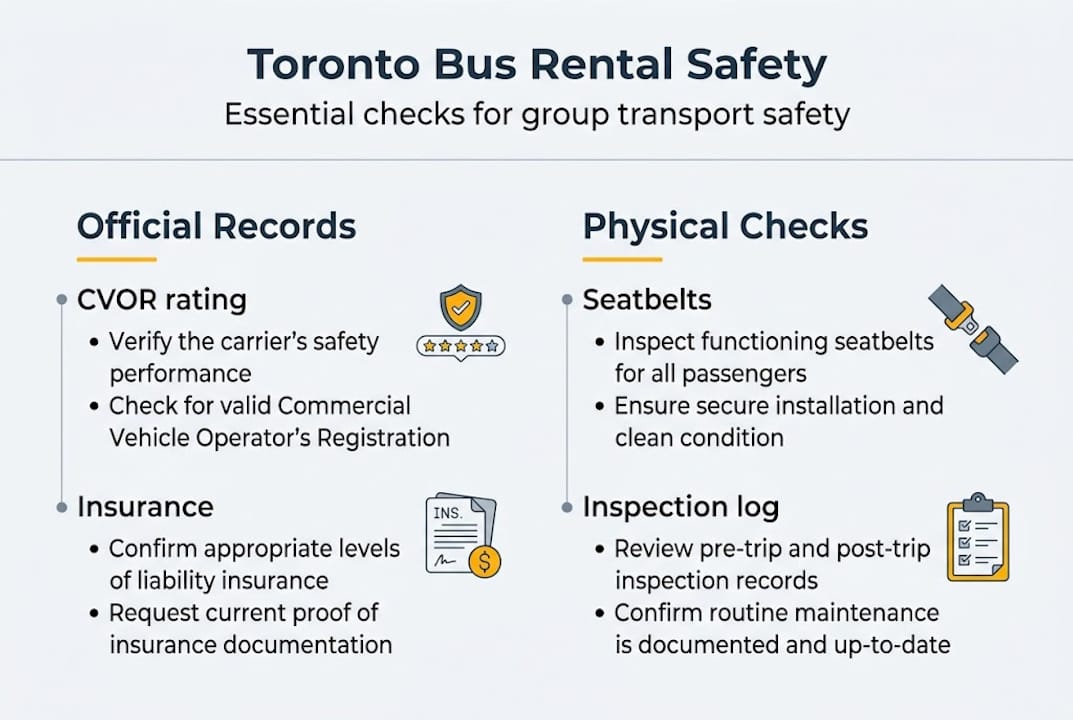
The first thing any event planner should do before booking is confirm that the bus company holds a valid CVOR certificate. CVOR stands for Commercial Vehicle Operators Registration, and in Ontario, every carrier operating a commercial vehicle must maintain one. This is not optional. It is a legal requirement, and it tells you far more than any marketing brochure ever will.
You can verify a company’s CVOR registration and check its public safety rating directly through the Ontario Ministry of Transportation portal. The rating system uses four classifications: Excellent, Satisfactory, Conditional, and Unsatisfactory. Booking a carrier with an Unsatisfactory rating is a serious risk you should never take, and avoiding Unsatisfactory carriers is considered a baseline requirement by transportation safety experts.
Here is what each rating broadly means in practice:
- Excellent: The operator has a strong compliance history with minimal violations.
- Satisfactory: The operator meets requirements with acceptable performance.
- Conditional: The operator has notable violations and is subject to increased monitoring.
- Unsatisfactory: The operator has serious compliance failures and should be avoided entirely.
The table below shows how official ratings compare to what companies often claim in their own marketing:
| Indicator | Official CVOR record | Company marketing |
|---|---|---|
| Source of data | Ontario government portal | Self-reported |
| Verification | Independently audited | No third-party check |
| Includes violations | Yes, last 24 months | Rarely disclosed |
| Reliability | High | Low to moderate |
Pro Tip: Always review the last 24 months of violations on the CVOR record, not just the overall rating. A company could hold a Satisfactory rating while showing a recent spike in violations that signals a declining operation.
For event planners who want to explore Toronto coach bus alternatives or understand the advantages of charter buses before making a final call, reviewing CVOR data alongside fleet options gives you the full picture.
Inspect vehicle safety features and maintenance
Once credentials check out, turn your attention to the physical bus. A valid CVOR tells you about the company’s compliance history, but a direct vehicle inspection tells you about the specific coach your group will be riding in. These are two separate checks, and both matter.

Ontario safety inspections require that new charter buses carry seatbelts, and this is mandatory under Ontario law, not a bonus feature. Emergency exits, fire extinguishers, and ADA-compliant features such as wheelchair lifts must also meet regulatory standards. Always ask to see the most recent inspection certificate before signing anything.
Here is a step-by-step approach for your own pre-boarding walk-around:
- Check that seatbelts are present and functional at every seat.
- Locate all emergency exits and confirm they open from both inside and outside.
- Verify the fire extinguisher is mounted, accessible, and within its inspection date.
- Ask about wheelchair lift functionality if your group includes passengers with mobility needs.
- Request the latest periodic inspection certificate and maintenance log.
- Look for visible damage to tyres, lights, and windows.
“New buses in Ontario must be equipped with seatbelts as required by provincial regulations. If a charter bus lacks them, it is not road-legal for passenger use.”
Ontario regulations mandate monthly safety inspections by the Toronto Public Vehicle Safety Branch for certain vehicle classes, as well as semi-annual inspections and preventative maintenance schedules. Reputable operators maintain these records and share them willingly.
| Inspection type | Frequency | Who oversees it |
|---|---|---|
| Periodic safety inspection | Monthly (select vehicles) | Toronto Public Vehicle Safety Branch |
| Semi-annual inspection | Twice per year | Ontario MTO |
| Preventative maintenance | Ongoing | Operator responsibility |
Pro Tip: If a company hesitates to show you its maintenance logs or inspection certificates, that hesitation is itself a red flag. Transparent operators are proud of their safety record.
For more context on renting for safer group travel, or to review a practical bus safety checklist before your next trip, these resources can guide your preparation.
Assess driver qualifications and company insurance
The vehicle can be perfect and the CVOR rating Excellent, but if the driver is not properly licensed, trained, and screened, your group’s safety is still at risk. This section of your due diligence is just as critical as the hardware check.
Drivers operating charter buses in Ontario must hold the appropriate commercial licence, which could be a Class B, C, D, E, or F depending on the vehicle type and passenger capacity. Beyond the licence, look for evidence of defensive driving training, a background check, a clean driving record, and compliance with Ontario’s hours-of-service rules. Fatigued driving is one of the top causes of preventable accidents.
Here is what to confirm with any prospective provider:
- Valid commercial driver’s licence (appropriate class for vehicle)
- Documented defensive driving and passenger safety training
- Criminal background check on file
- Clean abstract with no serious convictions
- Written policy on zero tolerance for drugs and alcohol
- Compliance with hours-of-service regulations to prevent fatigue
On the insurance side, request proof of commercial liability coverage of at least $2 million before you sign the contract. This is the standard minimum for Toronto charter bus rentals. Some higher-risk events or larger groups may warrant even more coverage. Never assume insurance is in place without seeing the certificate.
Pro Tip: Ask for the insurance certificate directly from the broker or carrier, not just a scanned copy from the company. This eliminates the risk of receiving an outdated or altered document.
For detailed planning on private bus transportation for corporate or special events, knowing the driver and insurance standards ahead of time saves you from last-minute surprises.
Balance user reviews with official safety data
With the formal checks completed, add one more layer of validation: what other clients have actually experienced. Online reviews are not a replacement for government data, but they often surface patterns that official records do not capture, such as chronic lateness, poor communication, or unprofessional driver behaviour.
Look for reviews on established platforms. For example, Ontario charter bus ratings on TripAdvisor show significant variation between operators, with some services like Royal Charter scoring a perfect 5.0, while others receive mixed feedback. Similarly, Coach Canada’s Trustpilot reviews reveal a gap between company-reported reliability and real passenger experiences.
Here is what to look for when scanning reviews:
- Consistency: Are complaints isolated incidents or recurring themes?
- Response to complaints: Does the company reply professionally and resolve issues?
- Specifics: Are safety concerns mentioned directly (driver behaviour, vehicle condition)?
- Recency: Focus on reviews from the past 12 months, not older testimonials.
Pro Tip: Always put more weight on government CVOR data than on five-star reviews for your final safety decision. A company can coach clients to leave positive reviews, but it cannot hide violations from the MTO portal.
Review platforms work best when used alongside official records. A company with glowing reviews but a Conditional CVOR rating should raise immediate questions. Use reviews to assess service quality and experience, and use group travel benefits resources to understand what a well-run operation actually looks and feels like. You might also find it helpful to compare bus amenities for events across providers once you have narrowed your shortlist on safety grounds.
Why safety checks aren’t just a box-ticking exercise
Here is the uncomfortable truth that many experienced event planners eventually learn the hard way: familiarity breeds complacency. When you have used the same bus company three times without incident, the fourth booking often skips the CVOR check. That is precisely when things go wrong.
The good news is that charter buses are statistically the safest form of road transport, with motorcoach crashes accounting for less than 0.1% of all highway fatalities. But that statistic assumes diligent operators. It does not protect you from the carrier who lets maintenance slide or the driver whose abstract you never checked.
Real incidents involving group transportation rarely make headlines because they involve non-fatal near-misses, late arrivals due to mechanical failure, or clients stranded when an operator loses their operating licence mid-season. The legal and reputational exposure for the planner who booked the service is very real in those moments. Most of these situations are entirely preventable at the research stage, before a single deposit is paid. A complete guide to special event transportation can help you build a repeatable screening process you use for every booking, not just the high-profile ones.
Safe group transportation solutions for Toronto events
Going through every one of these checks on your own takes time, but working with a provider that has already done the work internally makes the entire process seamless. At Toronto Bus Rentals, our fleet is maintained to Ontario standards, our drivers are fully credentialled, and our insurance documentation is always ready to share before you sign.

Whether you are planning a corporate outing, a wedding, a school trip, or a large group tour, you deserve a partner who takes safety as seriously as you do. Explore the advantages of charter buses for your next event, follow our guide to renting for corporate outings, or visit Toronto Bus Rentals directly to start your booking with confidence.
Frequently asked questions
What is the minimum insurance coverage recommended for Toronto bus rentals?
At least $2 million in liability is the standard minimum for commercial charter bus operations in Toronto. Higher-risk events or larger groups may require additional coverage.
How do I check a bus company’s safety rating in Ontario?
You can look up CVOR safety ratings through the Ontario Ministry of Transportation’s public portal. Search by company name or carrier number for an up-to-date record.
What are must-have safety features for modern charter buses?
Seatbelts, clearly marked emergency exits, fire extinguishers, and a current safety inspection certificate are all non-negotiable for any reputable Ontario charter bus operator.
What makes charter buses safer than other forms of group transport?
Motorcoach crashes represent less than 0.1% of highway fatalities, making charter buses statistically the safest option for road-based group travel when operators maintain proper standards.
Recommended
- Why rent buses in Toronto for smoother group travel
- Master bus rentals for seamless event transport in Toronto
- Guide to Chartering Buses for Toronto Events
- What Is Bus Rental and Why It Matters in Toronto