
How to choose a motor coach for group events
TL;DR:
- Choosing the right motor coach involves matching vehicle class, capacity, and amenities to your group’s specific transportation needs.
- Safety regulations require drivers to hold a CDL-P endorsement, and upcoming standards like anti-ejection glazing should influence vendor selection.
Choosing the right motor coach is a step-by-step process of matching vehicle class, capacity, safety compliance, and amenities to your group’s specific transportation goals. For event planners and group coordinators in Toronto, the decision directly shapes passenger comfort, schedule reliability, and your liability exposure. The wrong coach leaves guests cramped or stranded. The right one makes the entire event feel polished and professional. This guide covers every factor you need to evaluate, from vehicle classifications and FMCSA-regulated driver requirements to amenity priorities and rental cost structures.
How to choose a motor coach: the key decision factors
The term “motor coach” refers specifically to a full-sized, over-the-road passenger bus built for long-distance or charter travel, distinct from transit buses or shuttle vans. In event transportation, the phrase is sometimes used loosely, so it helps to know the recognised industry term is motorcoach (one word), and that the category sits above minibuses and well above standard shuttle vehicles in both capacity and comfort.
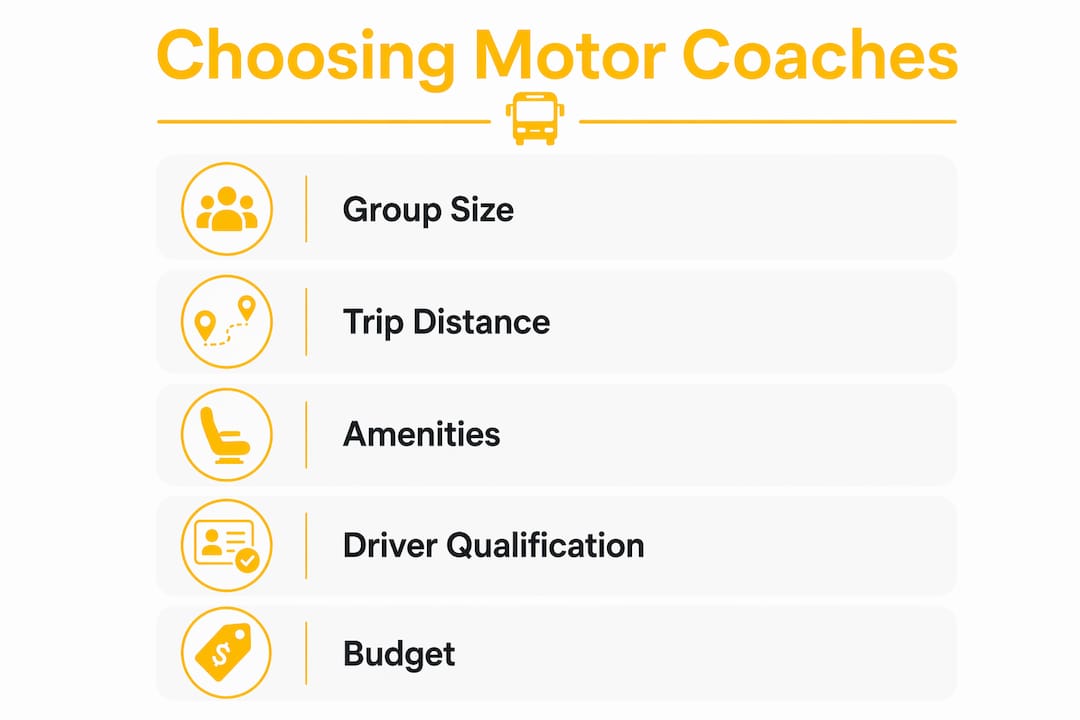
The core decision factors are group size, trip distance, required amenities, driver qualifications, and budget. Each factor narrows your options in a predictable sequence. Start with group size because it eliminates entire vehicle classes immediately. Then layer in trip distance, which determines how much comfort and lavatory access matter. Finally, weigh amenities against budget to land on the right specification.
Understanding the benefits of hiring a motor coach for your event before you start comparing options saves significant time during vendor conversations.
What are the main types of motor coaches and how do they differ?
Motor coaches are broadly categorised into three classes, each suited to different group sizes and event contexts.
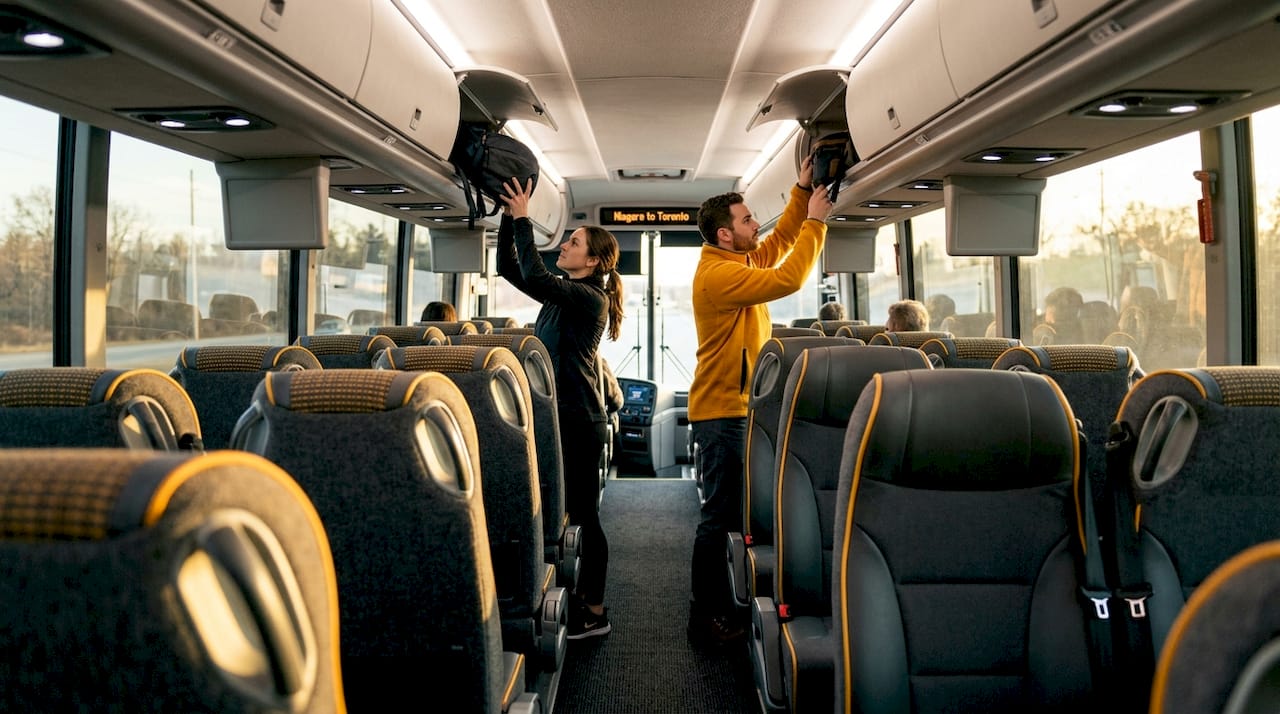
Class A motorhomes are large, bus-shaped vehicles ranging from 21 to 45 feet, built on commercial truck or bus chassis with spacious interiors. In event transportation, the full-sized Class A motorcoach is the standard workhorse, seating 47 to 57 passengers with overhead luggage bins, lavatories, and climate control. These are the coaches you book for corporate retreats, multi-day tours, and airport transfers for large delegations.
Class B motorhomes are compact camper-van configurations suitable for small groups of up to four passengers. In a group travel context, the Class B equivalent is the minivan or small sprinter, appropriate only for VIP transfers or intimate team outings where a full coach would be excessive.
Class C motorhomes are mid-sized vehicles that balance size and amenities between Class A and B, accommodating around eight passengers. The event-transportation equivalent is the minibus, which seats 14 to 24 passengers and suits smaller corporate groups, wedding parties, or school excursions.
| Vehicle class | Typical seating | Best suited for | Key amenities |
|---|---|---|---|
| Full-sized motorcoach (Class A) | 47 to 57 passengers | Large corporate events, multi-day tours | Lavatory, Wi-Fi, reclining seats, overhead bins |
| Minibus (Class C equivalent) | 14 to 24 passengers | Wedding shuttles, small team outings | Climate control, USB charging, luggage space |
| Sprinter/van (Class B equivalent) | 8 to 14 passengers | VIP transfers, airport runs | Flexible seating, basic climate control |
If you are unsure whether a charter coach or a shuttle better fits your event, the charter bus vs shuttle bus guide for Toronto planners breaks down the distinction clearly.
What safety regulations and driver qualifications affect motor coach selection?
Safety compliance is not optional, and it directly affects which vehicles and operators you can legally use. Drivers of motorcoaches designed to carry 16 or more passengers must hold a Commercial Driver’s Licence (CDL) with a Passenger (P) endorsement under federal rules. That endorsement requires passing specialised passenger-safety knowledge and skills tests, not just a standard driving exam. When you evaluate operators, ask specifically for proof of CDL-P credentials for every driver assigned to your event.
Hours of Service rules add another layer of compliance. Passenger bus drivers are limited to 10 hours of driving after 8 consecutive hours off duty, and cannot remain on duty beyond the 15th hour, including all breaks and non-driving time. For multi-day events or long-distance charters, this means you may need two drivers or carefully structured rest stops built into your itinerary.
Looking ahead, FMVSS No. 217a mandates anti-ejection glazing on motorcoach windows starting October 30, 2027. The glazing must remain bonded during crash impacts to reduce occupant ejections. Choosing operators who are already sourcing compliant vehicles in 2026 puts you ahead of the compliance curve and reduces your liability exposure as an event organiser.
Pro Tip: Ask every operator for their FMCSA operating authority number and run it through the FMCSA Safety and Fitness Electronic Records (SAFER) system before signing any contract. This takes under two minutes and confirms the company is legally authorised to carry passengers.
Choosing motor coaches that comply with current and upcoming safety regulations not only protects passengers but also reduces liability risk for event planners.
How to match motor coach options to specific event types and group sizes
The selection process becomes much cleaner when you map vehicle type to event context rather than treating every booking as the same problem. Here is a numbered framework that works across event categories:
- Confirm your passenger count. Include staff, vendors, and any guests with mobility aids. A group of 45 adults with luggage often needs a 57-seat coach, not a 47-seater, because luggage bin capacity becomes the limiting factor.
- Assess trip length and routing. Trips under 90 minutes in the Greater Toronto Area can use a minibus comfortably. Trips exceeding three hours call for a full motorcoach with a lavatory and reclining seats.
- Identify mobility and accessibility needs. Federal accessibility requirements apply to commercial carriers. Confirm that the vehicle has a lift or ramp if any passengers use wheelchairs.
- Match comfort expectations to the event type. A corporate client entertaining senior executives expects leather seating and Wi-Fi. A school field trip prioritises safety features and cost efficiency over luxury.
- Account for luggage and equipment. Conferences with trade show materials, sports teams with gear, and wedding parties with floral arrangements all require undercoach storage beyond standard passenger luggage.
For Toronto-specific scenarios, a corporate outing to Niagara-on-the-Lake for 40 guests calls for a full motorcoach with Wi-Fi and a lavatory. A wedding shuttle moving 20 guests between a downtown hotel and a venue in the Distillery District suits a minibus perfectly. A VIP airport transfer for six executives fits a sprinter or luxury van. Matching the vehicle to the scenario prevents both overspending and under-delivering.
What amenities and features should you prioritise in a motor coach?
Amenities drive passenger satisfaction more than any other single factor after safety. The features worth prioritising depend on trip length and group profile, but several are non-negotiable for most event contexts.
- Reclining seats with armrests: Standard on full motorcoaches, but confirm seat pitch (the distance between rows) for longer trips. Tight pitch on a three-hour ride generates complaints.
- Onboard lavatory: Required for any trip exceeding 90 minutes. Confirm it is serviced and stocked before departure.
- Wi-Fi connectivity: Corporate groups and conference attendees expect it. Verify actual bandwidth, not just the presence of a router.
- Climate control with individual vents: Group comfort varies widely. Individual vent control prevents the perennial “too hot/too cold” conflict.
- USB and power outlets: Increasingly standard, but not universal. Confirm outlet placement per seat row.
- Entertainment screens: Useful for tours with commentary, team-building content, or long transfers. Not necessary for short urban hops.
The must-have motor coach amenities resource from Torontobusrentals covers each feature in detail with guidance on when each one justifies the added cost.
Pro Tip: For luxury events, request a vehicle inspection photo or walkthrough video before confirming the booking. Seat condition, cleanliness, and screen functionality are difficult to verify from a spec sheet alone.
The decision between luxury and standard coaches is not always about budget. Sometimes it is about brand perception. A luxury vs. standard bus comparison for Toronto planners outlines exactly when the upgrade pays for itself in client satisfaction.
How to evaluate rental costs and vendor reliability
Event planners almost always rent rather than purchase motorcoaches, which means vendor evaluation is as important as vehicle selection. The cost structure for motorcoach rentals includes several components that are not always visible in the initial quote.
| Cost component | What to confirm |
|---|---|
| Base hourly or daily rate | Minimum hours, overtime rate after the base period |
| Fuel surcharge | Whether it is included or billed separately at trip end |
| Driver gratuity | Industry standard is 15 to 20 percent; confirm if it is included |
| Deadhead mileage | Charges for the driver travelling to and from your pickup point |
| Insurance certificate | Confirm the operator carries commercial passenger liability coverage |
| Cancellation terms | Refund policy and notice period required |
When comparing vendors, ask these questions directly:
- How old is the specific vehicle assigned to my event?
- Who is the assigned driver and what is their CDL-P status?
- What is your contingency plan if the vehicle breaks down on the day?
- Can I inspect the vehicle before the event date?
Vendors who hesitate on any of these questions are signalling operational gaps. Reliable operators answer them without friction because they have documented processes for each scenario.
Key takeaways
Selecting the right motorcoach requires matching vehicle class and capacity to your group size, confirming CDL-P driver credentials and Hours of Service compliance, and prioritising amenities based on trip length and group profile.
| Point | Details |
|---|---|
| Match vehicle class to group size | Full motorcoaches seat 47 to 57; minibuses suit groups of 14 to 24 passengers. |
| Verify driver credentials | CDL with Passenger endorsement is federally required for coaches carrying 16 or more passengers. |
| Plan for upcoming safety standards | FMVSS No. 217a anti-ejection glazing takes effect October 2027; choose compliant operators now. |
| Prioritise amenities by trip length | Lavatories and reclining seats matter on trips over 90 minutes; Wi-Fi matters for corporate groups. |
| Audit rental costs fully | Fuel surcharges, deadhead mileage, and driver gratuity can add 25 to 40 percent above the base rate. |
What I have learned from coordinating group transportation in Toronto
Most planners underestimate how much the operator matters compared to the vehicle. I have seen pristine coaches arrive with drivers who did not know the route and had no contingency plan for traffic on the Gardiner Expressway. The vehicle was flawless. The experience was not.
The single most useful thing you can do before signing a contract is ask for references from events of similar size and type. Not general testimonials. Specific references from a corporate outing or a wedding where something went wrong and the operator handled it well. Every experienced operator has a story like that. If they cannot produce one, they have not been doing this long enough.
On budget negotiations: operators have more flexibility on multi-day bookings and weekday events than on Saturday evenings in peak season. If your event date is flexible, moving it by one day can reduce your quote by a meaningful amount. That is not widely advertised, but it is consistently true.
Finally, confirm the driver’s Hours of Service schedule in writing before the event. For a full-day corporate outing with an evening gala, you may be pushing the 15-hour on-duty limit without realising it. Building a driver change or a scheduled rest stop into the itinerary is far less disruptive than discovering the issue at 10 p.m. in a parking lot.
— Firoz
Plan your Toronto group event with Torontobusrentals

Torontobusrentals operates a fleet of modern motorcoaches and minibuses across Toronto, serving corporate outings, weddings, school trips, and group tours. Every vehicle in the fleet is maintained to current federal safety standards, and all drivers hold valid CDL-P credentials. Whether you need a group travel solution in Toronto for 20 guests or a full motorcoach for 55, the team handles routing, compliance documentation, and day-of logistics. For corporate planners specifically, the Toronto corporate outing transport options page outlines fleet options matched to event size and experience level. Contact Torontobusrentals directly to request a quote and confirm vehicle availability for your event date.
FAQ
What is the difference between a motor coach and a charter bus?
A motorcoach and a charter bus refer to the same category of full-sized, over-the-road passenger vehicle. The term “charter” describes the booking arrangement, while “motorcoach” describes the vehicle class.
How many passengers does a standard motor coach hold?
A standard full-sized motorcoach seats between 47 and 57 passengers, depending on the configuration and whether a lavatory is installed at the rear.
What licence does a motor coach driver need in Canada?
Motor coach drivers carrying 16 or more passengers require a Commercial Driver’s Licence (CDL) with a Passenger (P) endorsement, which includes specialised passenger-safety testing beyond a standard CDL.
How far in advance should I book a motor coach for an event?
For peak-season events in Toronto, particularly on weekends between May and October, booking 6 to 8 weeks in advance is standard practice. Last-minute bookings within two weeks risk limited vehicle availability.
What hidden costs should I watch for in a motor coach rental quote?
Fuel surcharges, deadhead mileage, driver gratuity, and overtime rates are the most common costs absent from base quotes. Always request a fully itemised quote before signing a rental agreement.
Recommended
- Top benefits of hiring a motor coach for your Toronto event
- Must-have motor coach amenities for group travel
- Bus rental checklist for events: guide for Toronto planners