
How to assess bus rental quality: a planner’s guide
TL;DR:
- Verifying safety compliance, driver credentials, vehicle condition, clear pricing, and reliable contracts ensures high-quality bus rental. Focusing on safety documentation and operator reputation is essential before comparing costs. Early booking and thorough due diligence prevent liability risks and guarantee dependable group transportation.
Assessing bus rental quality means verifying safety compliance, driver credentials, vehicle condition, transparent pricing, and reliable service agreements before you sign anything. For event planners and group travel coordinators in Toronto, a poor choice here does not just inconvenience guests. It creates liability. The industry term for this process is charter bus service evaluation, and it covers everything from FMCSA safety ratings to contract contingency clauses. This guide walks you through every criterion that separates a dependable operator from one that looks fine on paper but fails on the day.
How to assess bus rental quality: the core criteria
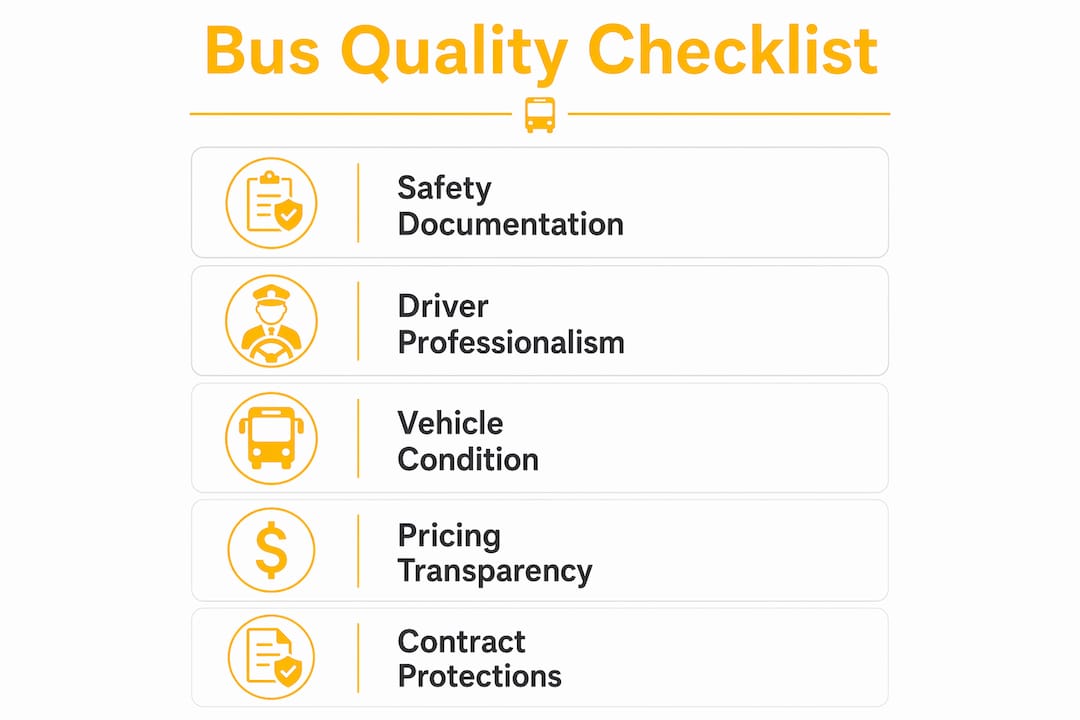
Bus rental quality is defined by five measurable pillars: safety compliance, driver professionalism, vehicle condition, pricing transparency, and contractual reliability. Each one is verifiable before you commit. The mistake most planners make is treating price as the primary filter and treating everything else as secondary. That approach reverses the correct order of evaluation.

The bus rental quality checklist used by experienced coordinators starts with safety documentation, not quotes. Once you confirm a provider meets baseline standards, pricing becomes a meaningful comparison. Without that baseline, you are comparing numbers that may not reflect the same level of service at all.
What safety and compliance factors determine bus rental quality?
Safety compliance is the non-negotiable foundation of any bus rental service evaluation. A provider that cannot produce documentation on demand is not a provider worth considering.
The key compliance factors to verify are:
- Mandatory safety inspections. Charter buses require inspections every 6 to 10 weeks. Ask for the most recent inspection report and confirm the date. A reputable operator keeps these on file and shares them without hesitation.
- USDOT and FMCSA safety ratings. The FMCSA SAFER system assigns ratings of satisfactory, conditional, or unsatisfactory. Satisfactory is the only acceptable rating. Conditional means deficiencies exist. Unsatisfactory means the carrier should not be operating. Cross-referencing FMCSA SAFER ratings with recent independent reviews gives you both the official record and the current operational reality.
- Driver qualifications. Every driver must hold a Commercial Driver’s Licence (CDL) with a passenger endorsement. Background checks and drug and alcohol testing are standard requirements for reputable operators. Ask specifically whether these are conducted at hiring and on an ongoing basis.
- Insurance coverage. Hire and reward insurance is the specific policy type required for passenger-carrying vehicles. Confirm the coverage amount and ask for a certificate of insurance. General liability alone is not sufficient.
- Local licensing and permits. In Ontario, operators must hold the appropriate operating authority. Confirm the provider is licenced to operate in your specific travel corridor, particularly for cross-border or multi-city routes.
Pro Tip: Ask the provider to email you their most recent inspection certificate and insurance certificate before the call ends. A quality operator sends these within 24 hours. Delays or deflection on this request are a red flag.
How do driver professionalism and experience affect your trip?
The driver is the single human variable that most directly shapes your group’s experience. Vehicle quality and pricing matter, but a poorly prepared or unprofessional driver can undermine both.
When evaluating driver quality, focus on these areas:
- Event-specific experience. A driver experienced with corporate groups handles a different dynamic than one accustomed to school trips or stadium runs. Ask the provider whether their drivers have handled your event type before and how recently.
- Punctuality and communication. Professional, prompt communication from the company itself is a reliable indicator of how their drivers perform on the day. If the office takes three days to return a quote, the driver is unlikely to arrive 15 minutes early.
- Vetting and ongoing training. Ask whether drivers complete refresher training annually and whether the company conducts internal performance reviews. The best operators treat driver development as a continuous process, not a one-time hiring check.
- Route and venue familiarity. A driver who knows the venue, the loading zones, and the traffic patterns around a Toronto event centre is worth more than one who relies entirely on GPS. Ask whether the assigned driver has served your destination before.
- Discretion and professionalism. For corporate events and weddings, discretion matters. Confirm that drivers are briefed on client expectations and that the company has a code of conduct for passenger interactions.
Understanding group transportation logistics in advance helps you ask sharper questions about driver assignments and route planning during the evaluation process.
What vehicle features and maintenance practices signal high quality?
Vehicle condition is one of the most visible quality indicators, and it is also one of the easiest to fake in marketing photos. Request a physical inspection or ask for dated photographs of the specific vehicle assigned to your booking.
| Feature | What to look for | Why it matters |
|---|---|---|
| Air conditioning | Confirm it is functional, not just present | Passenger comfort on summer event days |
| Wi-Fi and power outlets | Ask for speed and reliability, not just availability | Corporate and long-distance groups rely on connectivity |
| Restroom availability | Confirm for trips over two hours | Reduces stops and keeps schedules on track |
| Accessibility features | Wheelchair lifts, step height, aisle width | Legal requirement for accessible group travel |
| Vehicle age and presentation | Ask for the model year and inspect interior cleanliness | Older vehicles carry higher mechanical risk |
Maintenance schedules are as important as the vehicle itself. A newer bus with a poor maintenance record is riskier than a well-maintained older coach. Ask for the maintenance log or at minimum a written confirmation of the last service date. For specialised needs like sports crew transport, luxury bus features such as extra luggage capacity and reclining seating become relevant criteria.
Pro Tip: Ask the provider which specific vehicle will be assigned to your booking, not just the vehicle category. Operators who cannot confirm the exact vehicle until the day of departure are managing a fleet with availability problems.
For groups with specific comfort requirements, reviewing motor coach amenities before your evaluation call helps you ask the right questions about what is standard versus what costs extra.
How to evaluate pricing transparency and contractual protections
Charter bus hourly rates in metropolitan areas range from $125 to $250 depending on bus type, season, and mileage. That range is wide enough to make direct comparisons meaningless without a fully itemised quote.
A reliable quote must break out the following:
- Base hourly or daily rate
- Fuel surcharges and how they are calculated
- Toll and parking fees
- Driver gratuity (whether included or expected separately)
- Overtime rates if the trip runs long
- Cancellation fees and the timeline that triggers them
Booking directly with the operator rather than through a third-party broker removes the markup layer and gives you a direct line to the person responsible for your trip. Brokers add a fee and often reduce your ability to hold anyone accountable when something goes wrong.
Contracts are the backbone of reliability in group transportation. The contract must include contingency clauses covering breakdowns, driver illness, and explicit refund terms. Vague language like “we will do our best to resolve issues” is not a contingency plan. A quality contract specifies the replacement vehicle standard and the maximum response time if a substitution is needed. Review bus rental agreements carefully before signing, and never accept a verbal assurance in place of written terms.
Prioritising price over safety creates liability risks tied to poor compliance, inadequate insurance, and deferred maintenance. The cheapest quote on the market is almost always cheap for a reason.
Which questions should event planners ask bus rental companies?
The quality of a provider’s answers tells you as much as the answers themselves. A company that hesitates, deflects, or gives vague responses to direct questions is showing you exactly how they will handle problems on the day of your event.
Use this question set as your bus rental quality checklist during provider calls:
- What is your current USDOT safety rating, and can you provide your FMCSA carrier number for verification?
- When was your last vehicle inspection, and can you share the report for the specific bus assigned to our booking?
- What CDL endorsements do your drivers hold, and how recently were background and drug testing completed?
- Do you carry hire and reward insurance, and what is the coverage limit per passenger?
- What does your cancellation policy specify, and at what point does the fee structure change?
- If the assigned vehicle breaks down en route, what is your guaranteed replacement timeline and vehicle standard?
- Do you book directly or through brokers, and who is our primary contact if an issue arises during the trip?
- Can you provide three references from events similar to ours in the past 12 months?
Booking 6 to 9 months in advance for peak season events secures both availability and better pricing. Asking these questions early in that window gives you time to compare providers without pressure.
Key takeaways
Reliable bus rental quality comes down to verifiable safety compliance, professional drivers, well-maintained vehicles, itemised pricing, and contracts with specific contingency guarantees.
| Point | Details |
|---|---|
| Safety documentation first | Request inspection reports and insurance certificates before comparing prices. |
| Driver vetting matters | Confirm CDL endorsements, background checks, and event-specific experience for every booking. |
| Itemise every quote | Fuel, tolls, gratuity, and overtime must appear in writing before you sign. |
| Contracts need specifics | Contingency clauses must name replacement vehicle standards and response timelines, not vague promises. |
| Book early | Securing a provider 6 to 9 months out protects availability and gives leverage in negotiations. |
What I have learned about cutting corners on bus rentals
I have seen planners lose deposits, scramble for last-minute replacements, and face genuinely unsafe situations because they treated bus rental as a commodity purchase. The pattern is consistent: the decision came down to price, the contract was thin, and the first real test of the relationship was a problem on the day of the event.
The uncomfortable truth is that a low quote almost always signals something missing. It might be insurance coverage that does not fully protect passengers. It might be a maintenance schedule that skips the 6 to 10 week inspection window. It might be a driver who has not been vetted beyond a basic licence check. None of these gaps are visible in the quote. They only appear when something goes wrong.
What actually works is treating the evaluation process as due diligence, not comparison shopping. Use the FMCSA SAFER system to verify the carrier number. Read the contract before you are excited about the price. Ask for references from events that match yours in size and type. The providers who welcome these questions are the ones worth booking.
One more thing: confirm every detail in writing, including the specific vehicle, the driver’s name, and the pickup time, at least two weeks before the event. Verbal confirmations disappear. Written ones do not.
— Firoz
How Torontobusrentals supports planners in securing quality transport
Torontobusrentals operates with the exact criteria this article describes: documented safety compliance, professionally vetted drivers, well-maintained modern coaches, and transparent pricing with no hidden fees. Every booking comes with a clear contract that specifies contingency terms, not vague reassurances.

Whether you are coordinating a corporate outing, a wedding, a school trip, or a large group event in Toronto, Torontobusrentals offers group transportation solutions scaled to your group size and event type. The fleet covers everything from minibuses to full-size motor coaches, with amenities confirmed at the time of booking. For planners who want to understand the full scope of what is available, the motor coach options for Toronto groups page outlines fleet specifications, capacity, and booking details in one place.
FAQ
What is the most important factor when evaluating bus rental quality?
Safety compliance is the primary criterion. Verify the operator’s FMCSA safety rating, request current inspection certificates, and confirm hire and reward insurance coverage before reviewing pricing.
How do I verify a bus company’s safety record?
Use the FMCSA SAFER system to look up the carrier’s USDOT number and safety rating. Supplement that with recent independent customer reviews to get a current picture of operational quality.
What should a bus rental contract always include?
A reliable contract must specify contingency clauses for breakdowns and driver illness, replacement vehicle standards and timelines, cancellation fees, and explicit refund terms. Vague language in any of these areas is a warning sign.
Is it better to book directly with a bus operator or through a broker?
Booking directly with the operator removes markup fees, reduces communication gaps, and gives you a clear line of accountability if issues arise during the trip.
How far in advance should I book a charter bus for an event?
Book 6 to 9 months ahead for peak season events to secure availability and better rates. For festivals or stadium events, a minimum of 7 to 12 weeks is the standard recommendation.
Recommended
- Bus rental checklist for events: guide for Toronto planners
- Master bus rental agreements for Toronto group travel
- Top benefits of bus rentals for Toronto events in 2026
- Estimate bus rental costs in Toronto: step-by-step