
Group travel planning: your complete 2026 guide
TL;DR:
- Effective group travel planning involves a phased approach with clear decision stages, a designated manager, and deadlines to prevent chaos. It emphasizes locking in dates early using a three-step process, setting a budget based on the lowest comfort level, and balancing structured and unstructured time to reduce fatigue. Separating social and logistics channels, booking transportation early, and establishing a strict process lead to smoother trips with higher participation.
Group travel planning is the methodical coordination of multiple travellers’ schedules, budgets, destinations, and logistics to create a smooth, enjoyable trip for everyone involved. Done well, it prevents the chaos that derails so many group trips. Nearly 40% of group trips face significant disruptions due to poor planning and communication. That number drops sharply when planners follow a structured, phased approach. The key is separating decisions into stages, assigning clear roles, and using the right tools at each step. Torontobusrentals works with group planners daily and sees the same avoidable mistakes repeat across corporate outings, family reunions, and school trips alike.
What does effective group travel planning actually require?
Effective group travel planning requires three things: a defined process, a single person managing it, and decisions made in the right order. Most planners skip straight to debating destinations before anyone has agreed on dates or budget. Trying to decide “when,” “where,” and “how” simultaneously is the leading cause of decision paralysis in group trips. Separating those decisions into phases is called progressive scheduling, and it is the single most reliable fix.

Progressive scheduling works by decoupling decisions. You collect rough availability first, then propose specific travel windows, then lock dates with majority support. Each phase has a deadline. Without deadlines, groups loop endlessly. The planner’s job is not to make everyone happy. It is to keep the process moving.
How do you lock in dates without endless back-and-forth?
Date coordination is the hardest part of planning group trips, and the reason most trips stall before they start. The fix is a three-step progressive approach.
- Collect rough availability. Ask every member to share two or three date windows that work for them. Use a shared calendar tool or a simple poll. Give a response deadline of five to seven days.
- Propose a specific travel window. Identify the window with the most overlap and propose it as the default. Do not ask for consensus. Ask for objections.
- Lock the dates with majority support. Majority-based decisions prevent stagnation and keep the trip moving forward. Unanimity is not the goal. Progress is.
Once dates are locked, book flights early. International trips benefit from booking flights 8–12 weeks in advance for better pricing and seat availability. That window also gives members enough time to arrange leave from work or school.
Pro Tip: Separate availability from commitment. Ask “Can you travel these dates?” before asking “Will you commit?” Mixing those two questions in one message causes confusion and delays.
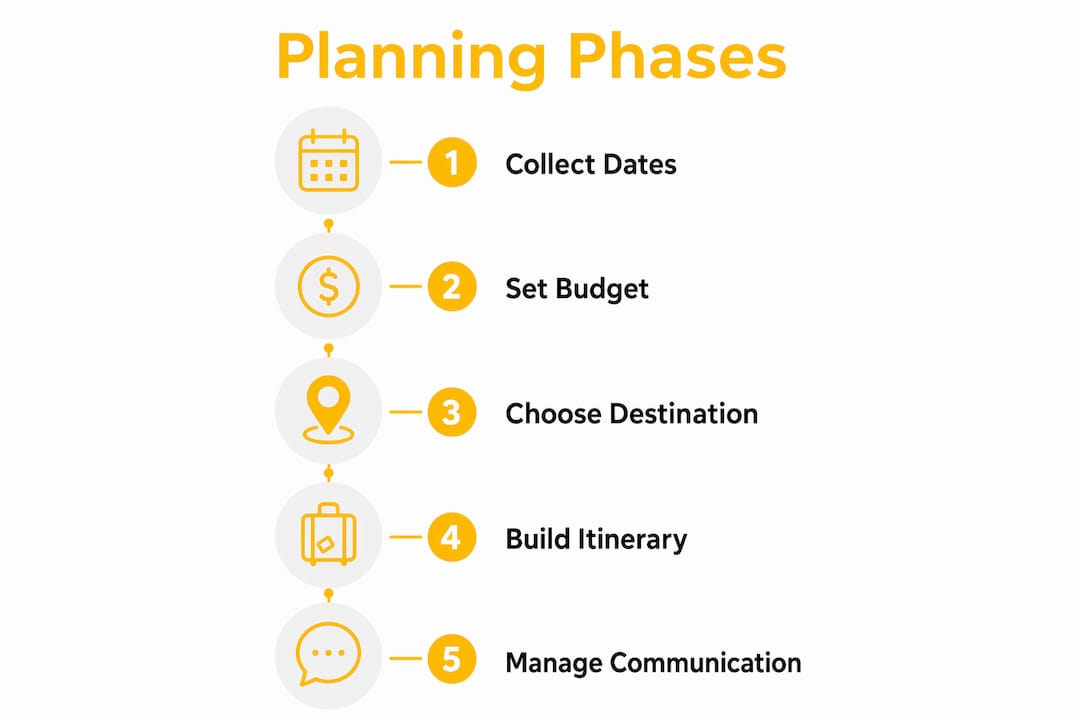
Giving each phase a firm response deadline is not aggressive. It is a courtesy to everyone in the group. People respond faster when they know a decision will be made with or without their input.
How do you set a group travel budget that works for everyone?
Budget conversations are uncomfortable, but skipping them early causes far more damage later. The right time to discuss money is immediately after locking dates, before any bookings are made.
The most effective approach is to set the budget ceiling at the lowest comfortable spend among all members. Budgeting based on the lowest maximum spend prevents exclusion and removes financial pressure from members with tighter limits. Members who want to spend more can upgrade individually, such as booking a private room instead of a shared one, without affecting the group’s baseline plan.
Common budgeting pitfalls to avoid:
- Assuming everyone has the same financial comfort. Ask directly and privately if needed.
- Leaving budget conversations until after destination voting. Destination choice drives cost. Sequence matters.
- Underestimating shared costs. Transportation, group meals, and activity fees add up faster than most groups expect.
- Ignoring contingency funds. A small buffer per person covers unexpected costs without drama.
Pro Tip: Have one person collect budget ranges anonymously before the group discussion. Knowing the range in advance prevents anyone from feeling singled out or pressured during the conversation.
Transparent money conversations at the start prevent last-minute dropouts. A member who quietly cannot afford the trip will often cancel close to departure, which disrupts bookings and morale for everyone else.
How do you choose a destination and build a flexible itinerary?
Destination selection works best as a structured, three-step process rather than an open-ended group debate.
First, collect suggestions from all members. Second, filter those suggestions against the agreed budget and travel dates. Third, narrow the list to three viable options and vote. A three-option shortlist forces real choices and prevents the sprawling debates that come from a list of ten destinations.
Building the group travel itinerary
Once the destination is confirmed, the 70/30 rule is the most reliable framework for building a group travel itinerary. Plan 70% of each day with structured activities and leave 30% unstructured. That unstructured time lets members rest, explore independently, or simply decompress. Groups that over-schedule every hour experience travel fatigue quickly, and fatigue creates conflict.
| Itinerary type | Structure level | Best for |
|---|---|---|
| Fully structured | 100% planned | School trips, corporate programmes |
| 70/30 balanced | 70% planned, 30% free | Family reunions, friend groups |
| Loosely structured | 50% or less planned | Small groups with shared interests |
Pro Tip: Build at least one full rest day into any trip longer than five days. Groups rarely regret it, and it gives the itinerary room to absorb delays or spontaneous detours.
Hybrid itinerary building works well for diverse groups. Start with an AI-generated itinerary as a draft, then refine it collaboratively using a shared document or planning platform. This approach gives the group a concrete starting point instead of a blank page, which dramatically reduces the time spent debating options.
What technology and communication strategies work best for group trips?
The biggest communication mistake in travel planning for groups is using a single chat thread for everything. Social conversation buries logistics. A poll about dinner preferences disappears under memes and reactions, and members miss deadlines they never saw.
The fix is channel segmentation. Keep two separate spaces:
- A social chat for casual conversation, excitement, and general discussion.
- A dedicated planning space for polls, deadlines, confirmations, and logistics documents.
This separation keeps critical information visible and reduces the chance of members missing key decisions. Segmenting communication channels is one of the most consistently recommended practices in group trip coordination.
Technology works best in a hybrid workflow. Use an AI planning tool to generate a draft itinerary quickly, then move that draft into a collaborative document where members can comment and suggest changes. Hybrid AI and collaborative editing workflows reduce planning time significantly compared to building everything from scratch in a group chat.
Pro Tip: Assign one person as the process manager, not the decision-maker. Their job is to post deadlines, collect responses, and break ties. Deadlines function as mercy, not authority. They free the group from endless deliberation.
Role clarity prevents planning fatigue. When everyone knows who is managing each piece, such as flights, accommodation, or activities, the workload distributes and no single person burns out.
How do you coordinate group transportation without last-minute chaos?
Transportation is the logistical backbone of any group trip. It is also the element most often left until too late. Poor transport coordination is a direct contributor to the disruption rate that affects so many group trips.
Effective group transportation logistics planning covers several key areas:
- Book early. For coach buses and minibuses, booking 6–8 weeks ahead secures availability and often better rates. For international trips, align transport booking with the 8–12 week flight booking window.
- Match vehicle size to group size. A 20-passenger minibus suits a mid-sized group. A full motor coach handles 40 or more travellers comfortably. Matching transport to group size prevents both overcrowding and wasted spend.
- Consolidate arrival and departure times. Staggered arrivals create coordination problems. Where possible, arrange shared pickups and a single departure time.
- Document all transport details in one place. Vehicle type, pickup location, departure time, driver contact, and confirmation number should live in a single shared document accessible to all members.
| Transport element | Key action | Timing |
|---|---|---|
| Vehicle booking | Confirm size and type | 6–8 weeks before departure |
| Pickup logistics | Set single pickup point | 2–3 weeks before departure |
| Driver contact info | Share with all members | 1 week before departure |
| Confirmation documents | Distribute to group | 48–72 hours before departure |
Pro Tip: Pin the transport document in your dedicated planning channel. Members should never need to ask for pickup times or driver contacts in the days before departure.
Torontobusrentals provides group transport solutions for Toronto-based trips ranging from corporate outings to school excursions, with vehicles sized to match groups of all sizes. Booking transport through a single provider simplifies coordination and removes the risk of mismatched vehicles or last-minute cancellations.
Key takeaways
Effective group travel planning depends on separating decisions into phases, setting a budget ceiling at the lowest comfortable spend, and keeping logistics communication in a dedicated channel away from social chatter.
| Point | Details |
|---|---|
| Progressive scheduling | Lock dates before discussing destinations or budget to avoid decision paralysis. |
| Budget ceiling rule | Set the group budget at the lowest comfortable spend and allow individual upgrades. |
| 70/30 itinerary rule | Plan 70% of each day and leave 30% unstructured to reduce travel fatigue. |
| Channel segmentation | Keep social chats separate from logistics to prevent missed deadlines. |
| Early transport booking | Book group vehicles 6–8 weeks out to secure availability and manage costs. |
What I’ve learned from watching group trips succeed and fail
I’ve seen groups of 30 people plan a flawless week-long trip with a shared spreadsheet and a single WhatsApp rule: no logistics in the main chat. I’ve also seen groups of eight spend three months debating a long weekend and never leave. The difference is almost never budget or destination. It is process.
The most common mistake is treating the planner role as a democratic facilitator. The planner is not there to achieve consensus. They are there to manage a process that produces decisions. Good planning leads to 70–80% of original invitees actually participating, which means some people will drop out regardless. Accept that early and plan for it.
Decision paralysis is real, and it feeds on open-ended questions. “Where do you want to go?” produces 12 answers. “Which of these three destinations do you prefer?” produces a decision. The planner’s job is to convert open questions into structured choices. That single shift changes everything.
I also think the 70/30 rule is underused. Most groups either over-plan every hour or leave everything vague. The 30% unstructured time is not laziness. It is the part of the trip people remember most. Give the group room to breathe, and the structured parts land better.
Finally, group travel advice from experienced trip coordinators consistently points to one truth: the planner who sets deadlines and sticks to them is not being difficult. They are the reason the trip happens at all.
— Firoz
Torontobusrentals: group transportation for Toronto trips
Planning a group trip in or out of Toronto means transportation is one of your biggest logistical decisions. Getting it wrong affects every other part of the trip.

Torontobusrentals offers a fleet of motor coaches, minibuses, and shuttle vehicles sized for groups of all types, from corporate teams to school groups and family reunions. Professional drivers, confirmed pickup logistics, and vehicles matched to your group size remove the coordination stress that derails so many trips. For groups looking to maximise travel efficiency with a motor coach in Toronto, Torontobusrentals handles the transport so you can focus on the rest of the plan. Contact the team directly to confirm availability and get a quote for your group’s dates.
FAQ
What is group travel planning?
Group travel planning is the coordinated organisation of schedules, budgets, destinations, and logistics for multiple travellers. It relies on progressive scheduling and clear role assignment to keep decisions moving forward.
How far in advance should you plan a group trip?
For international trips, start planning at least 3–4 months ahead and book flights 8–12 weeks before departure. Domestic trips with large groups benefit from at least 6–8 weeks of lead time.
How do you stop group travel decisions from stalling?
Narrow destination choices to three options and use a majority vote. Consensus does not require unanimity. Majority-based decisions prevent stagnation and keep the planning process on schedule.
What is the 70/30 rule for group itineraries?
The 70/30 rule means planning 70% of each day with structured activities and leaving 30% unstructured. This reduces travel fatigue and gives group members time to rest or explore independently.
How many people from the original group will actually go?
Realistically, 70–80% of original invitees end up participating in a well-planned group trip. Expect some dropouts and build your bookings around a confirmed headcount rather than the initial interest list.
Recommended
- Wedding travel safety tips: a practical guide for 2026
- Top benefits of bus rentals for Toronto events in 2026
- School trip transportation explained: a 2026 guide