
Group transportation logistics explained for event planners
TL;DR:
- Most event planners overlook transportation, risking delays and damaging first impressions. Proper group transit involves vehicle selection, route planning, scheduling, and contingency measures to ensure on-time arrivals. Treat transportation as an integrated part of event logistics, utilizing early booking, clear communication, and technology for seamless execution.
Most event planners spend months perfecting the programme, venue, and catering, then treat transportation as a last-minute detail. That’s where things unravel. Group transportation logistics explained properly isn’t just about booking a bus. It’s a multi-layered process covering vehicle selection, route planning, scheduling, communication, and contingency management. When any of those layers fails, attendees arrive late, groups split, and your event’s first impression is damaged before anyone walks through the door. This guide gives you the frameworks, strategies, and insider knowledge to get every person where they need to be, on time.
Table of Contents
- Key takeaways
- What group transportation logistics actually involves
- Choosing the right vehicle for your event
- Best practices for managing group transport
- Technology that supports group logistics
- Handling complex scenarios and special needs
- What I’ve learned from years in group transport
- Plan your next group move with Torontobusrentals
- FAQ
Key takeaways
| Point | Details |
|---|---|
| Plan transport early | Book group vehicles 2 to 3 months ahead to secure availability and competitive pricing during peak seasons. |
| Match vehicle to group size | Selecting the right vehicle type prevents split groups, delays, and unnecessary attendee frustration. |
| Use curb time buffers | Building a 20 to 30 minute buffer before boarding absorbs human factor delays and keeps schedules intact. |
| Consolidate routes | Fewer vehicles covering shared routes reduces costs and emissions without compromising attendee comfort. |
| Leverage technology | Real-time tracking and group messaging tools allow coordinators to respond to disruptions before they cascade. |
What group transportation logistics actually involves
People often conflate transportation with logistics. They’re related but not the same. Transportation is the physical movement of people from point A to point B. Logistics is the planning, coordination, and management system that makes that movement work at scale, on time, and under real-world conditions.
When you’re moving a group of 50 or 500 people, planning as an integrated process rather than a checklist item is what separates events that flow from events that fracture.
The major components of group transportation logistics include:
- Vehicle selection: Matching the right vehicle type and capacity to your group size and event context.
- Route planning: Identifying the most efficient paths between multiple pickup and drop-off locations.
- Scheduling: Sequencing departures, arrivals, and transfers so no one waits unnecessarily and no vehicle sits idle.
- Communication: Keeping attendees, drivers, and coordinators aligned before and during the event.
- Contingency planning: Building backup options for delays, no-shows, mechanical issues, or last-minute changes.
One concept experienced coordinators rely on is “curb time.” Rather than scheduling a bus to depart exactly when your programme says it should, you build a 20 to 30 minute buffer before the actual departure to absorb the human factor. People need bathroom breaks. Luggage takes longer than expected. Someone always runs back to their room.
Pro Tip: Communicate the curb time to attendees as the actual departure time. If the bus truly leaves at 9:00 AM, tell attendees to be at the kerb by 8:30 AM. This simple reframing eliminates cascading delays without requiring anyone to change their behaviour.
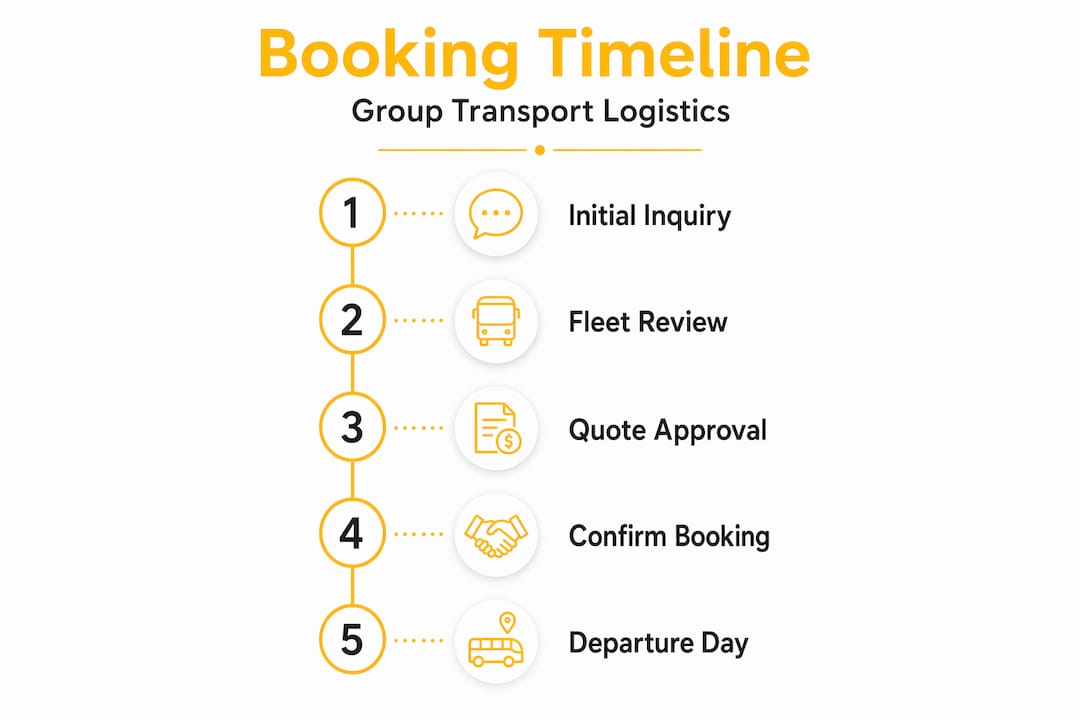
Booking timelines matter enormously here. Group transportation booked 2 to 3 months in advance secures better fleet availability and pricing, especially during Toronto’s busy conference and event seasons. Waiting until six weeks out often means accepting whatever is left, at whatever price the provider names.
Choosing the right vehicle for your event
Not all group transport needs the same solution. A corporate site visit with 12 executives requires a different vehicle than a 300-person festival shuttle. Matching vehicle type to the group size and occasion is one of the highest-leverage decisions you’ll make in the entire logistics process.

Here’s a practical comparison to guide your selection:
| Vehicle type | Capacity | Best for | Key considerations |
|---|---|---|---|
| Sedan or SUV | 2 to 6 | VIP transfers, executive arrivals | High comfort, low capacity, premium cost per person |
| Minibus | 12 to 20 | Small corporate groups, wedding parties | Flexible, easy to park, moderate cost |
| Shuttle bus | 20 to 35 | Airport transfers, hotel-to-venue loops | Cost-effective for recurring routes, good frequency |
| Full-size coach | 40 to 56 | Large conferences, tours, sports groups | Best per-person value, luggage space, highway comfort |
| Double-decker or articulated | 60 to 80+ | Festivals, mass arrivals | High capacity, route-specific, requires specialist operators |
When choosing between private charters and scheduled or shared services, think about schedule control. Private charters move on your timeline, not a fixed route. That matters enormously for corporate events with tight agendas or weddings where the programme depends on everyone arriving together.
For efficient group travel options at the coach scale, the per-person cost drops significantly compared to sedans or rideshares, while the experience for attendees is consistent and predictable.
A few factors that trip planners up in vehicle selection:
- Underestimating luggage volume, especially for multi-day events or airport transfers.
- Forgetting accessibility requirements until it’s too late to source an ADA-compliant vehicle.
- Choosing a vehicle that technically fits the headcount but leaves no room for bags, equipment, or comfort on longer drives.
Best practices for managing group transport
Great execution comes down to systems, not luck. The following numbered approach gives you a repeatable framework for planning group transportation regardless of event type or scale.
Consolidate routes first. Before booking anything, map all pickup locations and identify where you can combine stops. Consolidating routes reduces the number of vehicles needed, cuts costs, and lowers your event’s environmental footprint.
Designate a transport coordinator. One person, ideally on-site, should own all transport communications. This person liaises with drivers, fields attendee questions, and makes real-time decisions when plans change.
Build communication protocols in advance. Attendees should receive transport details at least 48 hours before the event. Include pickup location, departure time (the curb time), what to bring, and who to contact if they’re running late.
Create contingency plans for every segment. What happens if the inbound flight is delayed by two hours? What if a coach has a mechanical issue 20 minutes from the venue? Having a backup provider or a pre-negotiated standby vehicle is not paranoia. It’s professional planning.
Split costs transparently. When splitting transportation costs across a group, divide shared costs equally and assign premium options individually. This avoids disputes and keeps the budget clear.
Debrief after every event. Log what went wrong, what ran late, and what attendees said about the transport experience. This data improves your next event’s logistics from the first planning call.
Pro Tip: For corporate events, assign a named driver contact to each vehicle and include that driver’s first name and mobile number in the attendee communication. Knowing who to call reduces anxiety and eliminates the bottleneck of routing all queries through a central coordinator.
Professional group transport providers bring chauffeur training, fleet maintenance programmes, and built-in contingency experience that rideshare apps simply cannot replicate at group scale.
Technology that supports group logistics
The right technology doesn’t replace good planning. It amplifies it. For coordinators managing logistics for large groups, here are the tools that make the biggest difference:
- Real-time flight tracking: Tools like FlightAware or integrated airport data feeds let you adjust ground transport pickup times based on actual arrival data rather than scheduled times.
- Live traffic monitoring: Platforms like Waze or Google Maps (used actively by drivers and coordinators) allow rerouting before delays become visible to attendees.
- Group messaging apps: Centralised communication tools like WhatsApp groups, Slack channels, or dedicated event apps keep all transport updates in one place and reduce the noise of individual queries.
- Centralised booking platforms: For multi-vehicle events, platforms that show all bookings, driver assignments, and vehicle statuses on a single dashboard dramatically reduce coordination errors.
- SMS broadcast tools: A simple mass-text to attendees (“Your coach departs in 15 minutes from the north entrance”) reduces stragglers and last-minute scrambles.
The goal of all these tools is simple: faster awareness of problems means faster solutions. A 10-minute delay caught early stays a 10-minute delay. Caught late, it becomes a 45-minute cascading problem across three vehicles and two venues.
Handling complex scenarios and special needs
Not every event fits a neat single-pickup model. Multi-location conferences, airport hotel shuttles with staggered arrival windows, and events with VIP guests or attendees requiring accessibility support all demand a more sophisticated approach.
| Scenario | Challenge | Recommended strategy |
|---|---|---|
| Staggered airport arrivals | Multiple flights landing 30 to 90 minutes apart | Use a shuttle loop with fixed departure windows rather than waiting for full capacity |
| Multi-venue event | Attendees moving between two or three locations at different times | Assign dedicated vehicles per route leg with clear digital signage at each location |
| VIP transfers | High-touch service expectations with precise timing | Separate dedicated sedan or minibus with named driver and direct contact protocol |
| Accessibility requirements | Wheelchair access, ramp vehicles, extended boarding time | Book ADA-compliant vehicles first; these have the least fleet availability |
| Large equipment transport | Band gear, exhibition materials, product displays | Confirm vehicle cargo specifications before booking; add a dedicated cargo vehicle if needed |
Complex multi-location events benefit significantly from working with providers who know local traffic patterns, venue access restrictions, and parking constraints. A Toronto-based provider, for example, understands the difference between a Bay Street hotel with underground access and a Distillery District venue where coach parking requires coordination with building management.
Backup vehicles should be pre-arranged, not an afterthought. Experienced local providers can have a standby vehicle in position within 20 to 30 minutes if their fleet and dispatch system support it.
What I’ve learned from years in group transport
After working across corporate conferences, large-scale festivals, and high-stakes wedding logistics, the lesson that stands out most clearly is this: the groups that experience the smoothest transport days are never the ones with the most vehicles. They’re the ones whose planners treated transportation as part of the event narrative rather than a separate operational problem.
I’ve watched beautifully planned corporate retreats lose credibility the moment 40 executives stood in a hotel driveway for 25 minutes because nobody confirmed a curb-side location with building management. The bus was there. The driver was professional. The failure was in a detail that had nothing to do with the vehicle.
The human elements are almost always where things go wrong. A missed confirmation email. An attendee who didn’t read the pickup instructions. A driver who was given the venue name but not the specific entrance. These are not logistics failures. They’re communication failures. And they’re preventable.
My honest advice: spend 20% more time on your communication plan than you think you need to. Write the attendee instructions as if you’re explaining them to someone who has never been to your city. Include photos of the exact pickup location if you can. Repeat the key details in at least two formats.
Integrating transport into the event experience rather than treating it as a utility also changes the attendee’s relationship with travel time. A branded coach with WiFi and a welcoming driver is part of your event. A confusing rideshare scramble is a stressor before your event even begins.
— Firoz
Plan your next group move with Torontobusrentals
If this guide has clarified the depth that goes into managing group travel effectively, the next step is pairing that knowledge with a provider who can execute it.

Torontobusrentals offers a modern fleet of motor coaches, shuttle buses, and minibuses sized for everything from intimate corporate teams to large conference groups across the Greater Toronto Area. With charter bus advantages that include professional drivers, real-time coordination support, and flexible itinerary options, Torontobusrentals is built for planners who can’t afford a logistics gap on event day. Explore group transport options or reach out directly to discuss your event’s specific requirements and get a quote tailored to your timeline.
FAQ
What does group transportation logistics mean?
Group transportation logistics refers to the full process of planning, coordinating, and executing travel for multiple people as a unit. It covers vehicle selection, route planning, scheduling, communication, and contingency management for events of any size.
How far in advance should I book group transport?
Booking 2 to 3 months ahead is the standard best practice, especially for peak seasons. Leaving it to the last six weeks often means limited fleet availability and higher pricing.
What is curb time in group transport planning?
Curb time is a buffer period, typically 20 to 30 minutes, built before a scheduled departure to absorb delays from late arrivals, luggage loading, and other human factor disruptions. Communicating curb time to attendees as the official departure time prevents cascading delays.
When should I choose a private charter over a shuttle service?
Choose a private charter when your event schedule requires precise departure control and you can’t afford to wait for a vehicle to complete another loop. Shuttle services work well for recurring routes with flexible timing, such as hotel-to-venue loops throughout a conference day.
How do I handle accessibility needs in group transport?
Book ADA-compliant vehicles first, as they have the lowest fleet availability. Confirm ramp access, boarding time allowances, and seating configurations well in advance, and brief your transport coordinator on each attendee’s specific needs before departure day.
Recommended
- Group transportation explained: efficient solutions for Toronto events
- How bus rentals streamline event logistics in Toronto
- Why book a bus for conferences: a smarter group travel solution