
Fleet types explained for Canadian businesses
TL;DR:
- A fleet is a group of vehicles operated under common management or ownership for business purposes, meeting specific Canada-wide thresholds.
- Understanding fleet classification helps organizations optimize insurance, costs, and compliance, especially regarding the five-vehicle Ontario threshold.
A fleet is any group of vehicles operated under common ownership or common management for business, commercial, or public purposes. In practical terms, most Canadian insurers and regulators use a threshold of a minimum number of vehicles typically required before a group is treated as a fleet for insurance and administrative purposes. Three classification lenses matter most: vehicle class (light, medium, or heavy, based on gross vehicle weight rating), operational function (passenger, cargo, service, or specialised), and ownership model (owned, leased, rented, or managed).
Who needs to understand fleet classification?
- Event planners and corporate travel managers deciding whether to own coaches or rent charter buses for recurring group transport
- Logistics and delivery managers choosing between light cargo vans and heavy-duty tractor-trailers
- Municipal and government procurement leads managing mixed fleets across departments
- Small business owners figuring out whether five company vehicles trigger fleet insurance obligations under FSRA guidance
The immediate next step for most operators: confirm with your broker whether your vehicles meet the five-vehicle threshold and whether common management (not just common ownership) applies to your situation.
Table of Contents
- What counts as a fleet in Canada?
- How are fleets classified by vehicle class?
- What are the main functional fleet types?
- Which ownership model fits your operation?
- Why do businesses operate fleets?
- What does a fleet actually cost? Total cost of ownership
- How do you manage a fleet effectively?
- Should you own a fleet or use alternatives?
- Canada-specific insurance and regulatory considerations
- Industry-specific fleet types in Canada
- Environmental and regulatory considerations for Canadian fleets
- Emerging fleet types: EVs, autonomous vehicles, and what comes next
- Key takeaways
- What fleet operators consistently get wrong
- Group passenger transport in Toronto without the fleet overhead
- Useful sources
What counts as a fleet in Canada?
The distinction between “a bunch of company vehicles” and a legally recognised fleet matters more than most operators realise, especially at renewal time.
FSRA/FSCO guidance sets out three conditions that must all be satisfied for a group of vehicles to qualify as a fleet in Ontario: at least five vehicles, common ownership or common management, and use for business, commercial, or public purposes. All three must be met simultaneously. A sole proprietor with four delivery vans and one personal car does not automatically qualify. A property management company that controls ten vehicles across three subsidiary companies may qualify under common management even without common ownership.
Fleet definition under Ontario insurance guidance: A fleet requires a minimum number of vehicles under common ownership or common management, used for business, commercial, or public purposes. Meeting all three conditions unlocks fleet insurance contracts, which are exempt from certain rate and classification approval processes that apply to individual commercial auto policies.
The practical difference between owning vehicles and exercising operational control is significant. A company that leases ten vans and manages driver scheduling, maintenance, and insurance centrally satisfies the “common management” test. A group of independent contractors who happen to use the same brand livery does not.
Pro Tip: Document your centralised management practices in writing: a shared maintenance log, a driver training register, and a single insurance contact. Insurers look for evidence of operational control, not just a list of vehicle VINs.
Fleet insurance, once you qualify, bundles all vehicles under one policy and typically simplifies administration compared with maintaining separate commercial auto policies for each vehicle. BrokerLink’s fleet insurance guidance notes that insurers often require evidence of driver training programmes and risk management practices before offering fleet rates, so documentation matters from day one.
How are fleets classified by vehicle class?
Vehicles are grouped into Classes 1 through 8 based on gross vehicle weight rating (GVWR), then summarised into three broad tiers. GVWR is the maximum operating weight a vehicle is designed to handle, and it determines payload capacity, routing restrictions, and driver licensing requirements.
- Light-duty (Classes 1–3): Up to approximately 6,350 kg GVWR. Sedans, pickup trucks, cargo vans, and minivans. Standard Class G licence in Ontario is typically sufficient.
- Medium-duty (Classes 4–6): Roughly 6,350–11,793 kg GVWR. Step vans, larger cargo trucks, minibuses, and some school buses. May require a Class F or D licence depending on passenger capacity.
- Heavy-duty (Classes 7–8): Above 11,793 kg GVWR. Full-size coach buses, tractor-trailers, and heavy construction equipment carriers. Class 7 and 8 vehicles typically require a commercial driver licence equivalent, such as Ontario’s Class A or D.
Weight-class categorisations directly affect operational decisions including which routes a vehicle can serve, payload limits, and bridge weight restrictions on Canadian highways.
| Vehicle class | Typical vehicles | Canadian licence note |
|---|---|---|
| 1–3 (light-duty) | Sedans, cargo vans, pickup trucks | Class G (Ontario) typically sufficient |
| 4–6 (medium-duty) | Step vans, minibuses, school buses | Class F or D depending on passenger load |
| 7–8 (heavy-duty) | Coach buses, tractor-trailers | Class A or D (Ontario); commercial licence required |
What are the main functional fleet types?
Classification by function cuts across vehicle classes and tells you far more about day-to-day operations than weight alone. A Class 6 vehicle could be a minibus carrying school children or a refrigerated delivery truck; the compliance obligations, maintenance cadence, and safety priorities are completely different.
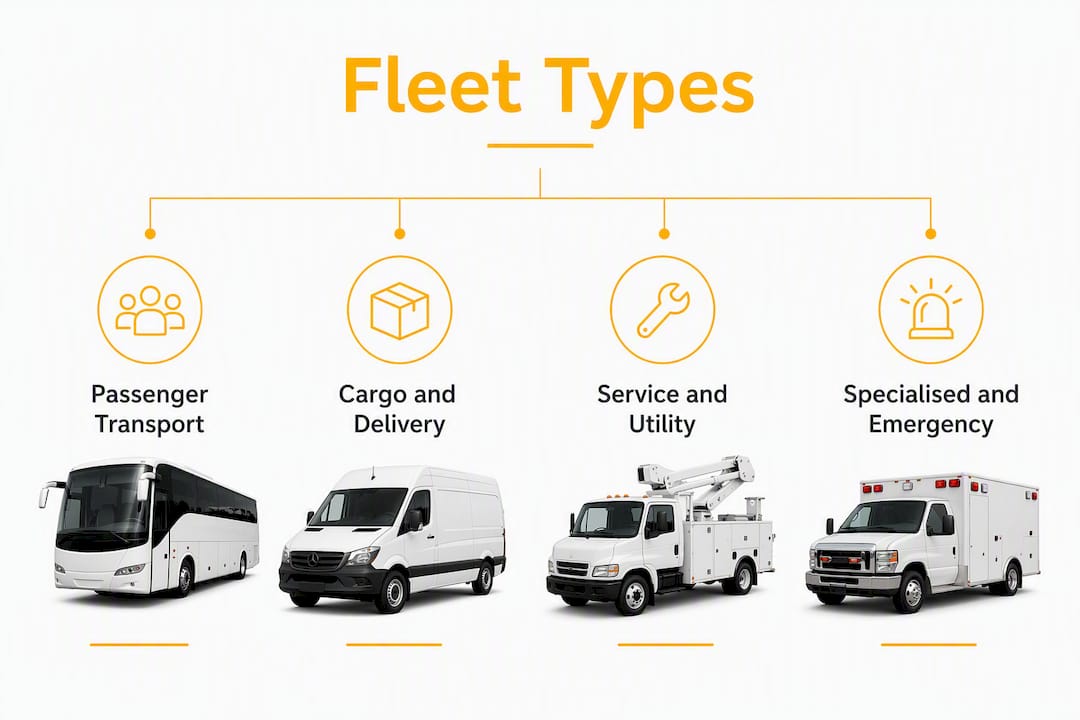
Passenger transport fleets
Corporate shuttles, charter coaches, minibuses, school buses, and airport transfer vehicles fall here. Safety and traceability are the primary differentiators. Professional passenger operators face higher compliance expectations than typical corporate car fleets: accessibility standards, driver screening, trip logging, and in many provinces, specific operating licences. Coach buses and minibuses used for events or school transport must meet federal and provincial safety standards that go well beyond what applies to a company sedan.

Cargo and delivery fleets
Last-mile delivery vans, freight trucks, and refrigerated units. The priority here is payload optimisation and route efficiency. Telematics for fuel monitoring and route density analysis pays off quickly at scale. Maintenance intervals are typically shorter than for passenger vehicles because of higher daily mileage and load stress.
Service and utility fleets
Utility bucket trucks, inspection vehicles, mobile repair units, and field service vans. These fleets often carry specialised equipment rather than cargo or passengers. Downtime costs are high because a broken-down service vehicle means a missed appointment, not just a delayed shipment.

Specialised and emergency fleets
Refrigerated transport, ambulances, fire apparatus, and hazmat vehicles. Regulatory requirements are the most demanding of any category. Maintenance records, equipment certifications, and driver qualifications are subject to audit.
Pro Tip: If your fleet mixes passenger and cargo duties in the same vehicles, classify each vehicle by its primary use for insurance purposes and document the secondary use separately. Misclassifying a minibus as a cargo van to save on premiums is a coverage gap waiting to happen.
Hybrid situations are common. A construction company might run light-duty crew-cab pickups (passenger function) alongside heavy equipment transporters (cargo/specialised). Each vehicle should be classified individually, not by the company’s dominant activity.
Which ownership model fits your operation?
Fleet ownership is not binary. Most Canadian organisations use a mix of models depending on vehicle type, usage frequency, and capital strategy.
- Owned outright: Full control, full depreciation, full maintenance responsibility. Best for branded vehicles used daily (coach buses, marked service vans) where appearance and availability are non-negotiable.
- Finance lease: You carry the asset on your balance sheet and own the vehicle at the end of the term. Lower upfront cost than purchase; you bear residual value risk.
- Operating lease: Off-balance-sheet in many accounting treatments; the lessor carries residual value risk. Predictable monthly costs, but you return the vehicle at term end with no equity.
- Full-service management: A third party handles maintenance, licensing, fuel cards, and sometimes driver management. Higher per-vehicle cost, but administrative overhead drops sharply.
- Short-term rental: No capital commitment, no maintenance obligation. The right answer for seasonal peaks, project-specific needs, or testing a new vehicle type before committing.
- Reimbursement or allowance programmes: Employees use personal vehicles and claim a per-kilometre rate. Works for occasional travel but offers no operational control, no branding, and no telematics data.
When each model fits:
- Owned or finance lease: high-frequency use, strong brand identity, vehicles used more than 200 days per year
- Operating lease: predictable replacement cycles, preference for off-balance-sheet treatment
- Full-service management: large fleets where internal maintenance capacity is limited
- Short-term rental: occasional or specialised needs where fleet bloat is a real risk
- Reimbursement: low-frequency employee travel with no specialised equipment needs
Pro Tip: Fleet management is as much about operational control as asset ownership. Before committing to purchase, model the total cost of a three-year operating lease against outright ownership including depreciation, insurance, and maintenance. The lease often wins for vehicles under 80,000 km per year.
Why do businesses operate fleets?
The short answer: reliability, cost control at scale, and operational necessity. A single company vehicle is a convenience; a managed fleet is infrastructure.
- Guaranteed availability: Owned or leased vehicles are available when you need them, not when a rental agency has inventory.
- Cost control: Fleet insurance, bulk fuel purchasing, and centralised maintenance contracts reduce per-vehicle costs compared with individual policies and ad hoc repairs.
- Brand consistency: Marked vehicles are rolling advertising. A coach bus with your logo arriving at a corporate event makes a different impression than a mixed fleet of unmarked rentals.
- Regulatory or contractual requirements: School transport contracts, government service agreements, and healthcare patient transport often require the operator to own or control specific vehicles.
- Telematics and data: A managed fleet generates route data, fuel consumption figures, and driver behaviour metrics that inform procurement, safety training, and route optimisation. You cannot get that from a reimbursement programme.
For event planners specifically, the calculus often tips toward renting charter buses rather than owning passenger vehicles: no depreciation, no off-season storage costs, and access to the right vehicle size for each event.
What does a fleet actually cost? Total cost of ownership
Acquisition price is the number most operators fixate on. It is rarely the biggest cost over a vehicle’s life.
Major cost components for any fleet:
- Acquisition or lease payments: The visible cost. For heavy-duty coaches, this is significant; for light-duty vans, less so.
- Depreciation: Light-duty vehicles lose roughly 15–20% of value in year one. Heavy-duty commercial vehicles depreciate more slowly but carry higher absolute values.
- Financing charges: Interest on purchase loans or implicit financing cost in lease structures.
- Insurance: Fleet policies reduce per-vehicle premiums, but total premium scales with fleet size, vehicle class, and claims history.
- Fuel or energy: Typically the largest ongoing operating cost for high-mileage fleets.
- Preventive maintenance and repairs: Scheduled oil changes, brake inspections, tyre rotations, and unscheduled repairs.
- Tyres: Often underestimated. Heavy-duty vehicles go through tyres quickly under load.
- Licensing and registration: Annual fees vary by province and vehicle class.
- Parking and storage: Particularly relevant in Toronto and other dense urban markets.
- Administration: Driver records, compliance filings, telematics subscriptions, and fleet management software.
A rough illustration for a five-vehicle light-duty fleet in Ontario:
These are illustrative ranges based on typical Ontario commercial vehicle operating costs; your actual figures will vary by vehicle type, mileage, and insurer.
Pro Tip: Idle vehicles are not free. A van sitting unused still accumulates insurance, depreciation, and storage costs. If any vehicle in your fleet runs fewer than 100 days per year, model the cost of renting that vehicle type on demand versus keeping it on your books. Fleet bloat is one of the most common and correctable cost problems in small fleets.
EV transition adds complexity: upfront acquisition costs are higher, but fuel and maintenance savings are real over a five-year horizon. Charging infrastructure investment is a separate capital line that most TCO models undercount.
How do you manage a fleet effectively?
Fleet management is not a single activity. It is a cluster of disciplines that, done well, keep vehicles on the road, drivers safe, and costs predictable.
Core activities:
- Preventive maintenance scheduling (oil, brakes, tyres, fluid checks at manufacturer-specified intervals)
- Incident reporting and claims management
- Driver licence verification and abstract checks (annual minimum for commercial drivers)
- Fuel card management and consumption tracking
- Parts procurement and vendor relationships
Technology categories to consider:
- Telematics (GPS and fuel monitoring): Real-time location, route history, idling reports, and fuel consumption data. Tools like Geotab (a Canadian company) and Samsara are widely used in Canadian fleets.
- Maintenance management systems: Track service history, schedule upcoming work, and flag vehicles approaching inspection deadlines.
- Compliance and e-log tools: Electronic logging devices (ELDs) are mandatory for federally regulated commercial carriers in Canada under Transport Canada rules.
- Scheduling and dispatch software: Particularly relevant for passenger and delivery fleets where route optimisation reduces fuel cost and driver hours.
Initial fleet-management programme checklist:
- Assign a single fleet administrator or manager with clear authority
- Create a vehicle file for each unit (registration, insurance, service history, driver assignment)
- Set a preventive maintenance schedule based on manufacturer specs and actual mileage
- Establish a driver onboarding process including licence verification and safety orientation
- Choose a telematics platform and define the data points you will actually act on
- Review fleet composition annually against utilisation data
Should you own a fleet or use alternatives?
The decision is not permanent, and most organisations revisit it as their needs change.
Indicators that an in-house fleet makes sense:
- Vehicles are in use more than 200 days per year
- You need specialised equipment or branded livery that rental fleets cannot provide
- Regulatory or contractual obligations require you to control specific vehicles
- Your volume is high enough that fleet insurance rates beat individual commercial auto premiums
- You have the internal capacity to manage maintenance, compliance, and driver records
Indicators that rentals, outsourcing, or reimbursement fit better:
- Demand is seasonal or project-specific
- Vehicle type varies significantly by job (no single vehicle serves all needs)
- You are below the five-vehicle threshold and cannot access fleet insurance rates
- Administrative overhead of fleet management exceeds the cost savings
Example scenarios:
- An event planner who books group transport six times per year has no business owning a coach bus. Renting charter buses eliminates depreciation, storage, driver payroll, and licensing obligations entirely.
- A logistics firm running 15 delivery vans on daily routes should own or long-term lease: the utilisation rate justifies the capital commitment and the fleet insurance savings are real.
- A construction company needing a specialised crane truck twice a year should rent. Owning a low-utilisation specialised vehicle is a textbook case of fleet bloat.
The trigger point for switching from occasional rentals to an in-house fleet is typically when rental costs exceed the annualised TCO of ownership for the same vehicle type, adjusted for the administrative burden of fleet management.
Canada-specific insurance and regulatory considerations
Fleet insurance in Canada is regulated provincially, which means the rules in Ontario differ from those in Alberta or British Columbia. The FSRA/FSCO framework is Ontario-specific; operators in other provinces should confirm equivalent thresholds with their provincial regulator.
Ontario fleet insurance threshold: Under FSRA/FSCO guidance, a fleet requires at least five vehicles under common ownership or common management, used for business, commercial, or public purposes. Fleet contracts meeting this definition are exempt from certain rate and classification approval processes that apply to individual commercial auto policies, which is why the threshold matters administratively, not just for premium purposes.
Practical questions to ask your broker:
- Does our vehicle mix (passenger plus cargo) qualify under a single fleet policy, or do we need separate commercial auto endorsements?
- What documentation do you need to confirm common management (maintenance logs, driver registers, centralised billing)?
- How does provincial variability affect coverage if our vehicles operate across provincial borders?
One important distinction: a fleet insurance policy and a commercial auto policy are not the same product. Fleet policies typically offer broader administrative flexibility and may include blanket coverage for newly acquired vehicles up to a defined limit. Commercial auto policies cover individual vehicles and require each addition to be endorsed separately.
Pro Tip: When your fleet mixes vehicle classes (say, light-duty sedans alongside a heavy-duty coach bus), confirm with your broker whether all vehicles can sit under one fleet policy or whether the heavy-duty units require a separate commercial vehicle endorsement. Mixing vehicle types without explicit confirmation is a common coverage gap.
Industry-specific fleet types in Canada
Canada’s economic geography shapes fleet composition in ways that differ from the United States or Europe. A few sectors worth understanding:
Construction and resource extraction: Heavy-duty fleets dominate, with Class 7–8 equipment transporters, crew-cab pickups, and specialised vehicles for remote site access. Northern operations add cold-weather requirements (block heaters, arctic-rated tyres) that affect both vehicle spec and maintenance schedules.
Healthcare and patient transport: Non-emergency medical transport (NEMT) fleets typically use accessible minivans and minibuses configured for wheelchair users. Provincial health authorities in Ontario, Alberta, and British Columbia each have specific vehicle and driver certification requirements for NEMT operators.
Logistics and last-mile delivery: The growth of e-commerce has pushed Canadian logistics operators toward larger light-duty and medium-duty van fleets concentrated in urban centres. Toronto, Vancouver, and Montreal are the primary density markets. Route optimisation and telematics adoption are highest in this sector.
Government and municipal fleets: Among the most complex to manage: mixed vehicle types, strict procurement rules, public accountability requirements, and long replacement cycles. Many municipalities publish fleet replacement schedules and sustainability targets publicly.
Education: School bus fleets in Canada are subject to provincial school bus regulations that specify vehicle colour, lighting, safety equipment, and driver certification. These are among the most tightly regulated passenger fleets in the country.
Environmental and regulatory considerations for Canadian fleets
Canada’s federal and provincial governments have introduced several programmes that directly affect fleet classification and procurement decisions.
Transport Canada’s Canadian Environmental Protection Act and associated regulations set emissions standards for new vehicles sold in Canada, largely aligned with U.S. EPA standards. For fleet operators, this means the vehicles available for purchase already meet baseline emissions requirements; the active decision is whether to accelerate toward zero-emission vehicles (ZEVs) ahead of regulatory timelines.
The federal government’s ZEV mandate requires that a growing percentage of new light-duty vehicle sales be zero-emission by 2035. Fleet operators replacing light-duty vehicles should factor this into their replacement cycle planning now, not at the next renewal.
Several provinces offer incentive programmes for fleet EV adoption. British Columbia’s CleanBC programme and Quebec’s Roulez vert programme both include commercial vehicle incentives. Ontario’s programmes have varied; confirm current availability with the provincial ministry before budgeting.
Green fleet initiatives from the federal government, including Natural Resources Canada’s Fleet Intelligence programme, provide benchmarking tools and guidance for federal and broader public-sector fleet operators. Private-sector operators can use the same frameworks for internal sustainability reporting.
From a classification standpoint, EVs fit within the existing Class 1–8 framework based on GVWR, not powertrain. A Class 3 electric cargo van is still a Class 3 vehicle for licensing and routing purposes. The operational difference is charging infrastructure planning, which adds a facility cost that diesel fleets do not carry.
Emerging fleet types: EVs, autonomous vehicles, and what comes next
Electric vehicle fleets are no longer experimental in Canada. Canada Post, municipal transit authorities, and several large logistics operators have deployed EV fleets at scale. The classification framework does not change: an electric Class 6 step van is still a medium-duty vehicle. What changes is the total cost of ownership model, the maintenance profile (fewer moving parts, no oil changes, but high-voltage battery service requirements), and the infrastructure dependency.
Autonomous and semi-autonomous vehicles are further from widespread commercial deployment in Canada than vendor timelines have historically suggested. Level 2 and Level 3 driver-assistance systems (adaptive cruise control, lane-keeping, automatic emergency braking) are now standard on many new commercial vehicles and affect insurance underwriting and driver training requirements. Fully autonomous commercial fleets operating without a human driver remain in pilot phases in controlled environments.
For fleet classification purposes, autonomy level does not change a vehicle’s class or functional category. A Level 4 autonomous delivery van is still a light-duty cargo vehicle. The operational and insurance implications are significant, but the classification framework is stable.
Hydrogen fuel cell vehicles are entering Canadian fleet consideration, particularly for heavy-duty applications where battery weight and range limitations are most constraining. Several Class 8 hydrogen truck pilots are underway in Canada. At this stage, hydrogen vehicles are a procurement option for forward-looking heavy-duty fleet operators, not a mainstream replacement cycle decision.
Key takeaways
Canadian fleet operators who understand classification, ownership trade-offs, and the FSRA five-vehicle threshold are better positioned to control costs, maintain compliance, and choose the right vehicle program for their needs.
| Point | Details |
|---|---|
| Five-vehicle threshold | Ontario’s FSRA/FSCO guidance requires at least five vehicles under common ownership or management to qualify for fleet insurance. |
| Three classification lenses | Every fleet can be mapped by vehicle class (light/medium/heavy), function (passenger/cargo/service/specialised), and ownership model. |
| TCO beats sticker price | Fuel, insurance, depreciation, and admin typically exceed acquisition cost over a vehicle’s life; model all components before committing. |
| Rentals beat ownership for low utilisation | Vehicles used fewer than 200 days per year often cost less to rent on demand than to own, insure, and maintain year-round. |
| Torontobusrentals for passenger transport | For Toronto-based event and group transport needs, Torontobusrentals offers coach buses, minibuses, and sprinter vans as a rental alternative to owning a passenger fleet. |
What fleet operators consistently get wrong
The most common mistake is not misclassifying vehicles. It is over-fleeting: buying or leasing more vehicles than the operation actually needs because “we might need them” feels safer than modelling utilisation honestly.
The second mistake is treating fleet insurance as a formality. Operators who mix vehicle types (a minibus alongside cargo vans) without confirming that all units sit under the same policy often discover the gap at claim time. The FSRA framework is clear on the threshold, but it does not automatically resolve coverage questions for mixed-use fleets. That requires an explicit conversation with your broker, documented in writing.
Telematics data is the third missed opportunity. Most operators who install GPS tracking use it for one thing: locating vehicles. The fuel consumption data, idling reports, and driver behaviour scores that the same system generates go unreviewed. A right-sizing review using actual utilisation data from telematics often reveals two or three vehicles that could be removed from the fleet without affecting operations, which immediately reduces insurance, maintenance, and depreciation costs.
The practical fix for all three: run a utilisation audit before your next renewal. Pull mileage and active-use days for every vehicle. Any unit below 100 active days per year deserves a hard look. Document your centralised management practices. And read your fleet policy carefully enough to know exactly which vehicles are covered for which uses.
Group passenger transport in Toronto without the fleet overhead
For organisations that need reliable, professional passenger transport in Toronto but have no interest in owning, insuring, and managing a fleet of coaches, Torontobusrentals offers a direct alternative.

The fleet includes large coach buses, minibuses, school buses, and sprinter vans, all with professional drivers, for corporate events, school trips, sports team travel, weddings, airport shuttles, and multi-day tours. You get the right vehicle size for each booking, no depreciation, no off-season storage, and no driver payroll obligations. For event planners and corporate travel managers who book group transport a handful of times per year, this is almost always cheaper than owning equivalent vehicles when you run the full cost comparison.
Torontobusrentals handles passenger transport only: coach buses, minibuses, and vans for group travel. Cargo fleets, refrigerated transport, and heavy-duty commercial vehicles are outside this scope.
Request a quote or check availability for your next Toronto group transport booking.
Useful sources
The following sources informed the Canadian regulatory and operational guidance in this article. Confirm provincial variations with your broker and local regulator before making fleet insurance or procurement decisions.
- FSRA/FSCO bulletin on fleet definition: The primary Ontario source for the five-vehicle fleet threshold and the common ownership/common management test. Essential reading before any fleet insurance conversation.
- BrokerLink: Fleet insurance requirements: Practical explanation of what Canadian insurers look for when underwriting fleet policies, including documentation and risk management requirements.
- Government Fleet Fundamentals: Vehicle Classes 1–8: The standard reference for GVWR-based vehicle classification used across North American fleet operations.
- Work Truck Online: Fleet 101, vehicle classes and uses: Operational guidance on how weight class affects routing, payload, and driver qualification decisions.
- Penske: Commercial truck classes explained: Useful reference for driver licensing implications by vehicle class, particularly for Class 7 and 8 operations.
- SeeWorld GPS: What is a commercial vehicle: Covers functional fleet classification and the higher compliance expectations for passenger transport operators.
- Torontobusrentals: Group transportation for events and travel: Practical guidance for Toronto-based planners evaluating charter bus rental versus owning passenger vehicles.
Reminder: Fleet insurance rules vary by province. Ontario’s FSRA framework is the reference used throughout this article. Operators in Alberta, British Columbia, Quebec, and other provinces should confirm equivalent thresholds and documentation requirements with their provincial regulator and insurance broker.
Recommended
- Types of buses for schools: A guide for administrators
- Corporate Shuttle Services – Why They Matter in Toronto
- Choose the best transport types for Toronto corporate outings