
Field trip transportation workflow: a 2026 planning guide
TL;DR:
- A field trip transportation workflow is a structured process that ensures safe, compliant, and efficient group travel planning from approvals to post-trip review. Proper planning and documentation help prevent risks, improve safety, and promote clear communication among administrators, staff, and parents.
A field trip transportation workflow is the systematic process of organising safe, compliant, and efficient transport for educational and group outings, covering every step from initial approvals through to post-trip review. Without a defined workflow, even short school outings carry real risk: missed approvals, unassigned supervision, and last-minute vehicle gaps. Educators and event planners who treat student transport planning as a structured process, rather than a checklist of tasks, consistently produce safer and smoother trips. This guide covers the core components, step-by-step logistics, safety protocols, and practical tools that make the difference between a stressful outing and a well-run one.
What makes up an effective field trip transportation workflow?

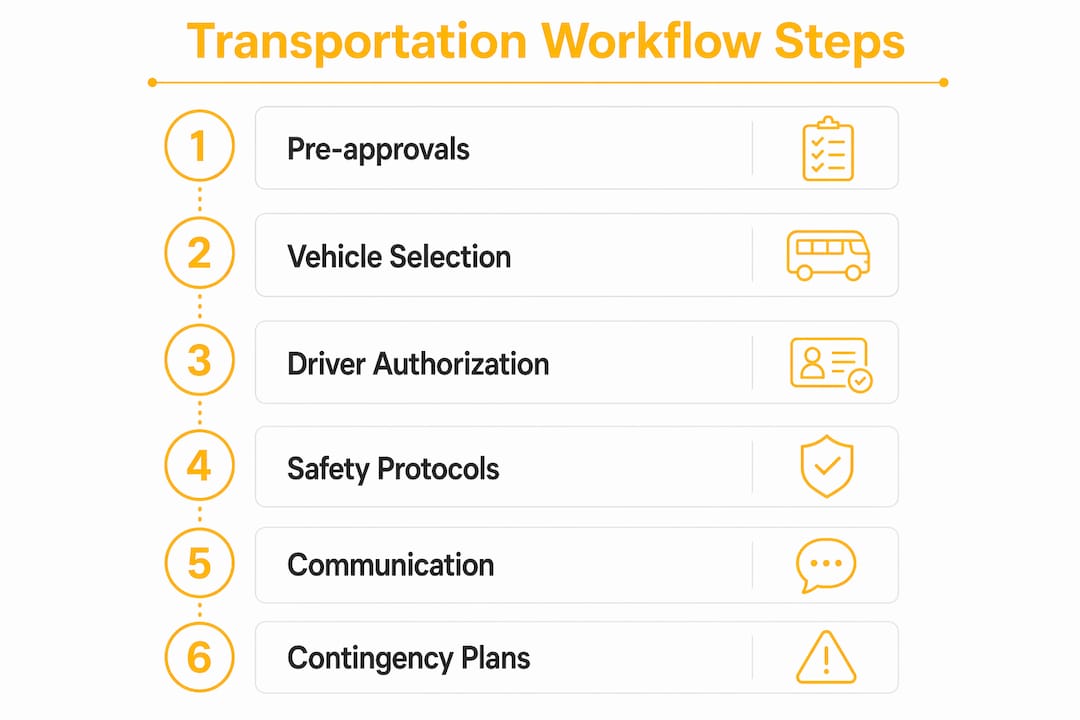
A field trip transportation workflow has six core components: pre-trip approvals, vehicle selection, driver authorisation, scheduling, communication protocols, and safety documentation. Each component depends on the others. A vehicle booked without confirmed driver authorisation, for example, creates a liability gap that no amount of last-minute coordination can close.
Centralising vehicle use policies reduces liability claims by standardising driver authorisation and emergency protocols. Institutions that implement these centralised policies see measurably better safety outcomes. That finding points to a clear principle: consistency in process produces consistency in safety.
The table below summarises each component and its function within the workflow.
| Component | Function |
|---|---|
| Pre-trip approvals | Confirms administrative, board, and parental consent before any booking proceeds |
| Vehicle selection | Matches group size, accessibility needs, and route requirements to the right vehicle |
| Driver authorisation | Verifies licencing, criminal record checks, and emergency training for all drivers |
| Scheduling | Sets departure, arrival, and return times with buffer windows built in |
| Communication protocols | Defines who contacts parents, drivers, and administrators at each stage |
| Safety documentation | Compiles risk assessments, emergency plans, insurance, and supervision ratios |
Coordination between school boards, administrators, and transport providers sits at the centre of this structure. The school board sets the policy framework. Administrators execute it. The transport provider delivers the vehicle and driver. When all three operate from the same documented plan, the workflow holds together under pressure.
Pro Tip: Align your workflow documentation with your school board’s existing risk management standards before you book anything. Approval timelines shrink significantly when your paperwork already matches the format reviewers expect.
How do you plan transportation logistics step by step?
Thorough educational trip logistics planning begins far earlier than most planners expect. Comprehensive educational travel programmes typically begin planning 12–18 months in advance to secure approvals and maintain cost stability. That timeline is not excessive. It reflects the number of sequential approvals, bookings, and communications that must happen before a single student boards a vehicle.
The following steps cover the full planning arc from destination approval to vehicle confirmation.
Confirm destination and educational purpose. Get written approval from the school principal or event director before any other planning begins. This approval anchors every subsequent decision.
Submit a risk assessment to the school board. Documentation quality directly affects approval chances. Include emergency plans, insurance coverage, and supervision ratios at this stage.
Determine group size and vehicle requirements. Groups of 30 or fewer allow for more effective supervision and participation. Larger groups may require multiple vehicles and additional assigned staff.
Select and book the vehicle. Match the vehicle to the group size, route distance, and any accessibility requirements. Confirm driver authorisation at the time of booking, not after.
Plan the route and identify contingencies. Map the primary route and at least one alternate. Identify rest stops, muster points, and the nearest medical facilities along the way.
Distribute parent consent forms and trip information. Transparent communication with parents about safety, budget, and itinerary increases enrolment success. Include payment schedules, cancellation policies, and a sample itinerary.
Confirm all bookings and documentation 72 hours before departure. Call the transport provider, verify driver details, and confirm pickup times. Do not assume a booking made weeks earlier is still accurate.
Conduct a pre-departure briefing with all supervising staff. Assign specific roles for boarding, headcounts, and emergency response before the day of travel.
Pro Tip: Book your vehicle at least eight weeks before the trip date for local outings, and earlier for multi-day or out-of-province travel. Availability for accessible vehicles and larger coaches fills up quickly, especially in spring and autumn.
What safety measures and communication strategies belong in the workflow?
Safety in school outing transportation is not a single checklist item. It is a set of layered protocols that run from the moment a trip is approved to the moment every student is back in the building.
School Trip Preparedness plans focus on informed parent consent with high-visibility communication. These plans include risk identification, mitigation methods, and clear information for parents at every stage. The goal is not just legal compliance. It is community trust.
Loading and unloading require the same attention as any other safety event. Assigning staff to oversee boarding and providing parents with GPS coordinates for muster points improves both trip safety and parental confidence. A headcount at every boarding and unloading point is non-negotiable.
Informed consent grounded in high-visibility communication is central to gaining administrative approval and community trust. When parents understand the risk management plan, they become partners in the process rather than sources of last-minute concern.
The following communication practices belong in every workflow:
- Send a written trip overview to parents at least three weeks before departure, including the vehicle type, driver information, and emergency contact numbers.
- Establish a single point of contact for parent inquiries on the day of travel.
- Share GPS tracking access with parents where the transport provider supports it.
- Brief all supervising staff on emergency protocols the day before departure.
- Confirm return times with parents by text or email on the morning of the trip.
How do you troubleshoot common challenges in transportation workflows?
Even well-planned trips encounter problems. The difference between a minor disruption and a full breakdown is whether the workflow includes a recovery plan.
The table below outlines the most common challenges and the recommended response approach for each.
| Challenge | Reactive approach | Proactive approach |
|---|---|---|
| Vehicle no-show or breakdown | Call provider for emergency replacement; activate backup vehicle contact | Book with a provider that holds a confirmed backup fleet |
| Driver unavailable day-of | Request substitute driver from provider; verify authorisation immediately | Confirm driver details 48 hours before departure |
| Delayed departure | Notify parents via group message; adjust itinerary to protect return time | Build a 30-minute buffer into the departure schedule |
| Headcount discrepancy | Stop boarding; recount against the attendance list before proceeding | Assign two staff to every boarding and unloading point |
| Route closure or detour | Use pre-mapped alternate route; notify destination of revised arrival time | Map two route options during the planning phase |
Flexibility in booking matters more than most planners realise. A transport provider that can confirm a backup vehicle within two hours is worth more than a marginally lower quote from one that cannot. When reviewing group transportation logistics options, ask directly about contingency capacity before signing any agreement.
Clear role assignments prevent most communication failures during a disruption. Every staff member on the trip should know their specific responsibility before the vehicle leaves the school. When roles are ambiguous, decisions stall at exactly the moment speed matters most.
What tools support managing transportation workflows efficiently?
Technology does not replace good planning, but it does make consistent execution far easier. The right tools reduce manual errors, speed up approvals, and keep all stakeholders informed in real time.
Centralised scheduling and workflow software automates approvals, enhances communication, and tracks transportation status in real time. That capability removes the back-and-forth email chains that slow down approvals and create version-control problems with documents.
| Tool category | Key capabilities | Best used for |
|---|---|---|
| Trip management platforms | Approval workflows, document storage, itinerary building | Multi-stop or multi-day educational travel |
| Communication apps | Group messaging, real-time updates, parent notifications | Day-of coordination and emergency alerts |
| GPS tracking tools | Live vehicle location, muster point sharing, ETA updates | Boarding management and parent communication |
| Scheduling software | Driver assignment, vehicle availability, route optimisation | Fleet coordination for large school boards |
| Digital consent systems | Electronic signatures, form distribution, record keeping | Replacing paper consent forms at scale |
The most practical approach for most schools is to start with one tool that solves the biggest pain point, typically document management or parent communication, and build from there. Trying to implement five new systems before a single trip creates more friction than it removes.
Pro Tip: Choose tools that integrate with your school’s existing administration system, such as your student information platform. Integration means data flows automatically rather than being re-entered manually, which is where most errors occur.
For event planners coordinating group outings outside a school setting, the school event transport guide for administrators offers a practical framework that translates well to corporate and community group contexts.
Key takeaways
A well-executed field trip transportation workflow requires early planning, centralised documentation, layered safety protocols, and clear role assignments at every stage.
| Point | Details |
|---|---|
| Start planning early | Begin the workflow 12–18 months before departure for complex trips to secure approvals and stable pricing. |
| Centralise documentation | Consolidate risk assessments, driver authorisations, and consent forms in one accessible location. |
| Treat boarding as a safety event | Assign dedicated staff to every boarding and unloading point and conduct headcounts each time. |
| Build in contingencies | Map alternate routes and confirm backup vehicle availability before the trip date. |
| Communicate proactively | Send parents written trip details at least three weeks out and confirm return times on the day of travel. |
What I’ve learned about workflow planning that most guides skip
The biggest failure point in school outing transportation is not the vehicle or the route. It is the assumption that everyone involved shares the same understanding of who is responsible for what. I have seen well-funded, carefully planned trips fall apart at the boarding stage because two staff members each assumed the other was doing the headcount.
The fix is not more documentation. It is a five-minute verbal briefing the morning of the trip where every person states their specific role out loud. That single practice eliminates more day-of confusion than any checklist ever will.
There is also a tendency among planners to treat the transport provider as a vendor rather than a partner. The best outcomes I have observed come from planners who call the provider two days before departure, not to confirm the booking, but to ask whether the driver has any questions about the route or the group. That conversation surfaces problems early, when they are still easy to solve.
The other thing most guides underestimate is the value of a post-trip debrief. Fifteen minutes after every outing to document what went wrong, what was unclear, and what took longer than expected builds a workflow that genuinely improves over time. Without that feedback loop, you are planning every trip from scratch.
— Firoz
How Torontobusrentals supports field trip and group travel planning
Planning a field trip or group outing in Toronto means coordinating a lot of moving parts. Torontobusrentals makes the vehicle side of that process straightforward, with a fleet that covers groups of all sizes and trips of all types.

From minibus rentals for smaller groups to full-size motor coaches for larger school outings, Torontobusrentals provides professional drivers, safety-compliant vehicles, and responsive booking support. The team works with educators and event planners to confirm vehicle availability, discuss route requirements, and accommodate accessibility needs before the booking is finalised. For planners who want to compare group transport options by size before committing, Torontobusrentals offers clear guidance on matching the right vehicle to the right trip. Reach out directly to discuss your next outing.
FAQ
What is a field trip transportation workflow?
A field trip transportation workflow is the structured process of planning, approving, booking, and executing transport for educational or group outings. It covers vehicle selection, driver authorisation, safety documentation, and communication protocols from start to finish.
How far in advance should you book transportation for a school trip?
Comprehensive educational travel programmes typically begin planning 12–18 months before departure for complex trips. For local day trips, booking at least eight weeks in advance is the recommended minimum to secure the right vehicle and driver.
What documents are required for school trip transportation approval?
Most school boards require a risk assessment, emergency response plan, insurance confirmation, and supervision ratios before approving a trip. Documentation quality directly affects approval timelines and safety evaluations.
How should loading and unloading be managed on a field trip?
Loading and unloading should be treated as managed safety events with assigned staff, accurate headcounts at every point, and GPS muster point information shared with parents. Assigning two staff members to each boarding location removes ambiguity about responsibility.
What is the best way to communicate with parents during a field trip?
Send a written trip overview at least three weeks before departure, establish a single parent contact on the day of travel, and confirm return times by text or email on the morning of the trip. Where the transport provider supports it, share live GPS tracking access with parents.
Recommended
- School trip transportation explained: a 2026 guide
- Role of transportation for educational outings: 2026 guide
- Booking buses for schools 2026: the complete planning guide