
Festival shuttle service coordination: a Canadian planner’s guide
Festival shuttle service coordination is the strategic organisation of shuttle routes, vehicle staging, departure schedules, and real-time driver communication to move attendees safely and efficiently at festivals. Done well, it prevents the traffic gridlock that turns a great event into a logistical nightmare. Done poorly, it creates the kind of chaos that ends up in post-event reviews and municipal complaints.
The core elements every Canadian event organiser needs to manage:
- Demand mapping: estimating shuttle capacity from attendance projections before booking a single vehicle
- Entry point and access route mapping: identifying every gate, road, and staging zone by vehicle type
- Regulatory compliance: securing Traffic Management Plan approvals from local road authorities and police
- Real-time driver communication: using GPS fleet tracking to monitor and redirect vehicles during the event
- Staggered scheduling: building departure windows that spread traffic load rather than releasing it all at once
- Contingency planning: pre-built protocols for vehicle breakdowns, demand surges, and weather disruptions
Torontobusrentals operates as a trusted provider in Canadian event transportation planning, offering modern motor coaches, professional drivers, and the local knowledge that makes compliance with Ontario’s regulatory requirements far less daunting.
Table of Contents
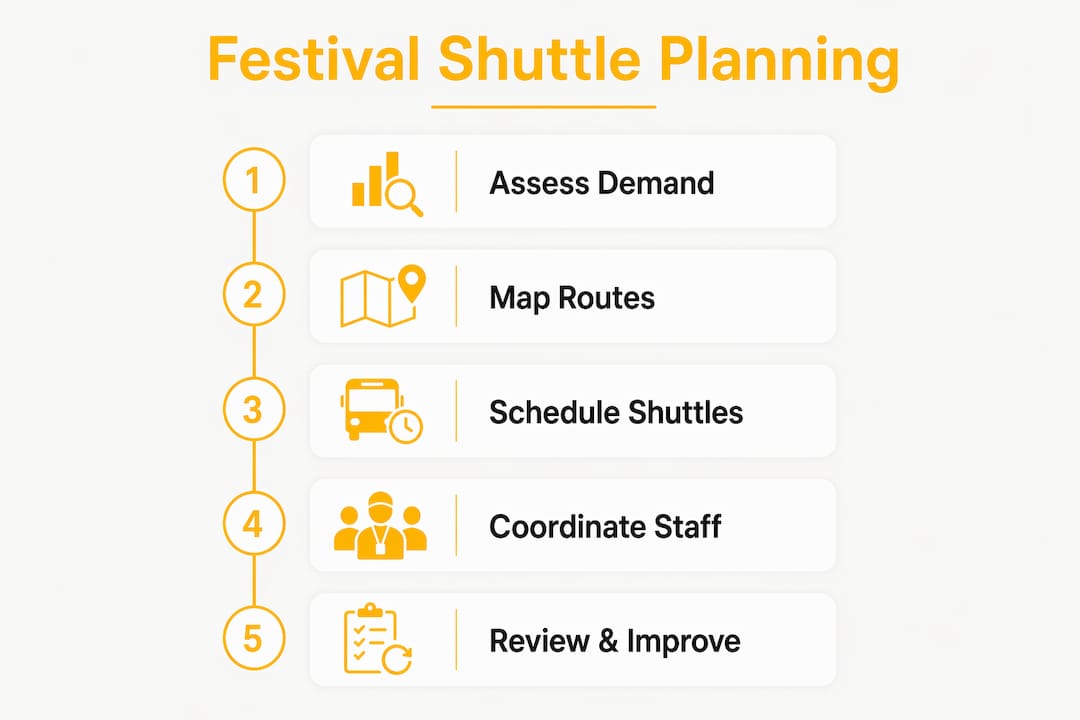
- How to plan your festival shuttle service coordination before event day
- What good on-the-ground shuttle execution actually looks like
- Post-event review: how to make the next festival run better
- Canadian regulations every festival shuttle planner needs to know
- Torontobusrentals: festival shuttle solutions built for Canadian events
- Key takeaways
How to plan your festival shuttle service coordination before event day
Pre-event planning is where shuttle operations are won or lost. Pre-event dispatch planning months in advance is critical to successful shuttle service; reactive management on event day is almost always the result of skipping this stage.
- Conduct demand mapping early. Estimate shuttle capacity by cross-referencing ticket sales, parking supply, and transit access. A festival drawing 10,000 attendees with limited on-site parking will need a fundamentally different shuttle volume than one with a large surface lot.
- Map every entry point and access route. Identify all vehicle gates, pedestrian entry points, and internal circulation paths. Staging areas must be designated by bus type with separate loading and offloading zones to optimise traffic flow and safety.
- Engage local authorities at least 8–12 months out. British Columbia’s Major Planned Events Guidelines recommend contacting local authorities a minimum of 8–12 months before the event date to confirm permitting, insurance requirements, and which municipal departments need to be involved.
- Hire a professional transportation planner. For major Ontario events, professional transportation planners are strongly recommended to complete traffic impact studies, develop shuttle schedules, and establish offsite parking plans that comply with municipal bylaws.
- Vet shuttle service providers on safety and accessibility. Confirm that providers carry appropriate commercial vehicle insurance, maintain accessible vehicles for attendees with mobility needs, and have documented experience with festival-scale operations.
- Build contingency scenarios into the plan. Account for vehicle breakdowns, late arrivals, and demand spikes. A backup vehicle on standby and a clear escalation protocol are not luxuries at a large festival.
- Communicate shuttle details to attendees before the event. Clear communication via website, email, and on-site signage is critical to preventing unsafe parking behaviour and ensuring attendees actually use the shuttle system you have built.
Pro Tip: Build your shuttle schedule around boarding and ticketing processing times, not just vehicle capacity. Processing times for boarding significantly impact traffic flow and can cause congestion extending well beyond the venue perimeter.
What good on-the-ground shuttle execution actually looks like
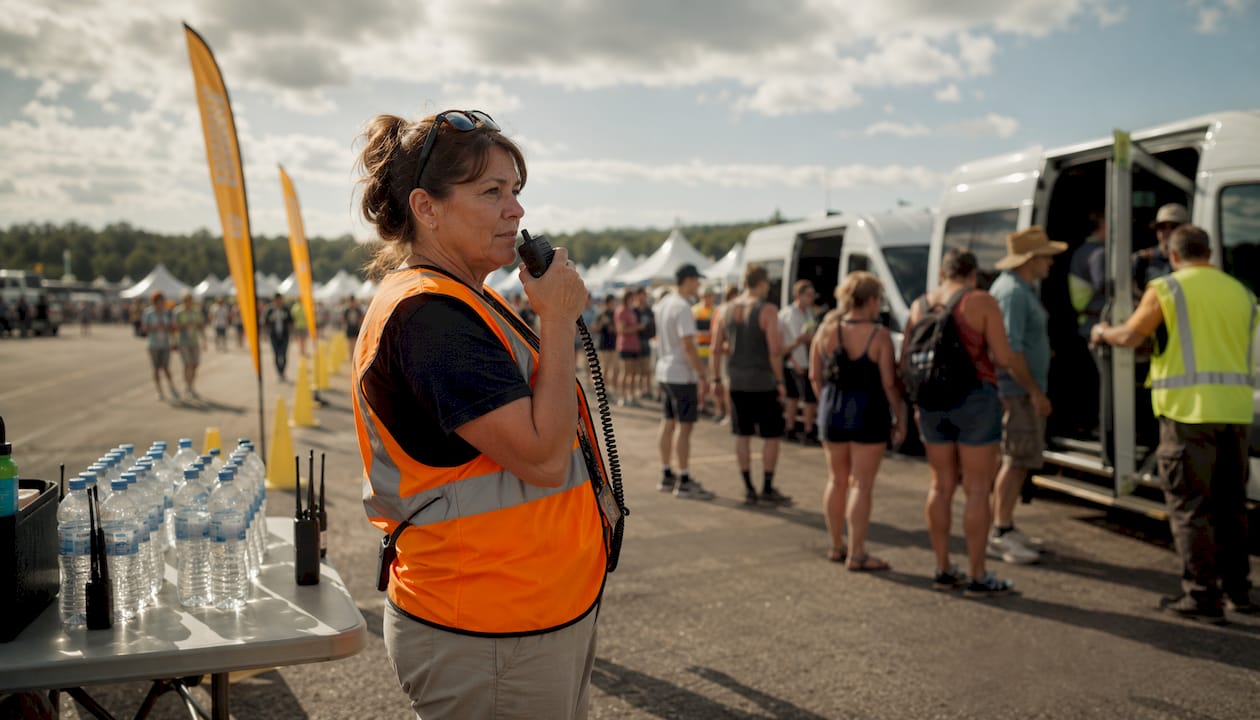
Planning sets the conditions; execution determines the outcome. The gap between a smooth festival transport operation and a congested mess usually comes down to how well the team manages the three distinct transport phases: ingress, egress, and mid-event transitions.
Effective shuttle management depends on treating ingress, egress, and keynote transitions as separate transport events with predictable demand surges. Ignoring these phases and treating the day as one continuous flow leads to massive congestion instead of phased traffic movement.
- Deploy real-time fleet tracking from the first vehicle movement. GPS tracking and dynamic redeployment tools reduce shuttle wait times significantly. Configurable alerts for queue depth, ETA variance, and vehicle idle time let dispatchers act before a problem compounds.
- Treat each transport phase as its own operational event. Ingress, egress, and mid-event performer or headliner transitions each generate predictable surges. Pre-assign vehicles and staging positions to each phase rather than improvising.
- Use dynamic zone redeployment when demand shifts. If one pickup zone backs up while another sits idle, move vehicles. A dispatcher with live fleet visibility can make that call in minutes; one working from a static schedule cannot.
- Coordinate pedestrian and vehicle safety zones explicitly. Separate foot traffic from bus movements with physical barriers and clear wayfinding. High-visibility staff at every loading zone reduce confusion and near-miss incidents.
- Schedule staggered departure windows for egress. Releasing all shuttles simultaneously at event end creates the same congestion you were trying to avoid. Stagger departures by zone, section, or ticket tier.
- Station staff at every loading and queuing area. Signage alone is not enough. A staff member at each shuttle stop who can answer questions, manage queues, and radio dispatch when a vehicle is delayed prevents small delays from cascading.
- Maintain a live communication loop with event stakeholders. Dispatch, venue operations, security, and local police need a shared channel. Problems that stay siloed get resolved slowly; problems that surface immediately get resolved fast.
Pro Tip: Assign a dedicated shuttle liaison to each major entry and exit point. This person’s only job is to monitor queue length, communicate with dispatch, and flag when a zone needs an additional vehicle. It sounds simple, but most operations that fail on event day skipped this role.
Post-event review: how to make the next festival run better
The festival ends, the last shuttle departs, and most teams exhale and move on. The ones who run consistently smooth operations do something different: they debrief while the details are still fresh.
- Plan staggered final departures in advance. The post-event egress is the highest-risk period for congestion. A pre-built staggered departure schedule, communicated to drivers before the event ends, prevents the mass exodus scenario.
- Coordinate final shuttle loads carefully. Confirm that all designated pickup zones are cleared before releasing vehicles. A missed zone at midnight creates a stranded-attendee situation that generates complaints and, in some cases, safety incidents.
- Conduct a structured post-event review within 48 hours. Analyse shuttle wait times, vehicle utilisation rates, and any incident logs while the operational team’s memory is accurate. Waiting a week means losing the granular detail that drives real improvement.
- Update demand maps and staging plans based on actual data. What the model predicted and what actually happened are rarely identical. Adjust capacity estimates, zone assignments, and redeployment thresholds for the next event.
- Document everything for regulatory compliance. Traffic Management Plan performance, incident reports, and communication logs may be required by municipal authorities or insurers. Comprehensive documentation protects the organiser and demonstrates good faith.
- Collect passenger feedback on accessibility and experience. Attendees with mobility needs often encounter friction that operations staff never see. A short post-event survey surfacing accessibility gaps is one of the most cost-effective improvements available.
- Formalise lessons learned into updated protocols. A debrief that produces a verbal consensus but no written update is a debrief that will not change anything. Revised protocols, updated checklists, and amended staging plans are the actual deliverable.
Canadian regulations every festival shuttle planner needs to know
Canada’s regulatory environment for festival transport is specific, and the consequences of getting it wrong range from permit revocations to legal liability. This is not an area where general knowledge from other markets transfers reliably.
- Traffic Management Plans are mandatory for large events. Large-scale event transportation management in Canada requires a formal Traffic Management Plan approved by local road authorities and police. Plans must address impacts on local, county, and provincial roads and receive host community approval before the event proceeds.
- Only police or fire officials can legally direct road traffic in Ontario. Only authorised personnel such as police or fire officials can legally direct road traffic in Ontario; event organisers must budget for paid duty police to manage shuttle egress safely and legally. Non-compliance creates both legal exposure and genuine safety risk.
- Link your traffic, parking, and shuttle plans together. These are not separate documents. Processing times for boarding and ticketing affect road congestion beyond the venue boundary, and incorporating shuttle and parking processing times into a unified plan prevents overflow queues from spilling onto local roads.
- Apply Transportation Demand Management principles. TDM analysis of attendee travel patterns helps design shuttle routes, schedules, and communication plans that reduce congestion and support sustainable travel. Treating transportation as a core event strategy rather than a logistical afterthought reduces attendee confusion and stress.
- Confirm permit and insurance requirements early. Festival-specific shuttle operations typically require commercial general liability insurance, vehicle-specific coverage, and event permits from the host municipality. Requirements vary by province and municipality; confirm them with the relevant authority, not from a generic checklist.
- Build accessibility compliance into every shuttle plan. The Accessibility for Ontarians with Disabilities Act (AODA) sets requirements for accessible transportation at public events. Accessible vehicles, boarding assistance, and clear communication of accessibility options are not optional for Ontario festivals.
Treating transportation as a core event strategy with TDM reduces attendee confusion and stress while supporting sustainable travel — and it is the single clearest differentiator between festivals that run smoothly and those that generate post-event complaints about getting in and out.
Torontobusrentals brings local expertise in Ontario’s regulatory requirements to every engagement, helping festival organisers navigate permit processes, staging logistics, and compliance requirements without starting from scratch.

Torontobusrentals: festival shuttle solutions built for Canadian events
For festival organisers who have read this far, the planning complexity is clear. Torontobusrentals gives you a concrete shortcut: a fleet of modern motor coaches and minibuses, professional drivers with event experience, and a team that understands Ontario’s regulatory requirements from the inside.

Where generic rental providers hand you a vehicle and a driver, Torontobusrentals brings the operational knowledge that makes festival transport logistics work at scale. Whether you need a single 47-passenger coach for a satellite parking shuttle or a mixed fleet of 18-passenger minibuses for multi-zone operations, the fleet scales to your event’s actual demand. Vehicles are accessible, maintained to commercial safety standards, and operated by drivers who know Toronto’s road network.
Get a quote for your festival shuttle programme at torontobusrentals.ca and lock in your vehicles before the peak season fills the calendar.
Key takeaways
Effective festival shuttle service coordination requires unified planning across demand mapping, regulatory compliance, real-time operations, and post-event review — skipping any one of these phases creates the conditions for the others to fail.
| Point | Details |
|---|---|
| Start planning well before event day | Contact local authorities and confirm permitting, insurance, and municipal requirements well before event day. |
| Designate staging zones by vehicle type | Separate loading and offloading zones by bus type to prevent mixed traffic congestion and improve turnaround times. |
| Budget for paid duty police in Ontario | Only police or fire officials can legally direct road traffic; this cost must be in every Ontario festival shuttle budget. |
| Treat ingress and egress as separate events | Managing each transport phase independently prevents the demand surges that cause congestion at festival entry and exit points. |
| Torontobusrentals for Canadian festival transport | Torontobusrentals offers a scalable fleet of motor coaches and minibuses with local regulatory knowledge for Ontario festival operations. |
Recommended
- How to set up event shuttle service: Toronto guide
- Shuttle Service: Enhancing Corporate Events in Toronto
- Master the Wedding Shuttle Booking Process in Toronto
- Event Shuttle Services: 50% Lower Costs with Motor Coaches