
Event transportation planning basics: a planner’s guide
TL;DR:
- Proper event transportation planning includes forecasting attendee demand, selecting appropriate vehicles, and building detailed communication and contingency plans.
- Start early and coordinate with experienced partners to ensure smooth arrivals, departures, and parking, avoiding costly last-minute errors.
Event transportation planning is the organised process of coordinating vehicles, routes, schedules, and attendee communication to move groups safely and on time for any event. Done well, it shapes the first and last impression every attendee takes away. Done poorly, it creates delays, frustration, and costs that compound quickly. This guide covers the event transportation planning basics every coordinator needs, from demand forecasting and vehicle selection through to contingency protocols and on-site execution. Whether you are organising a corporate conference, a gala, or a multi-day convention, the fundamentals apply the same way.
What are the fundamental components of event transportation planning?
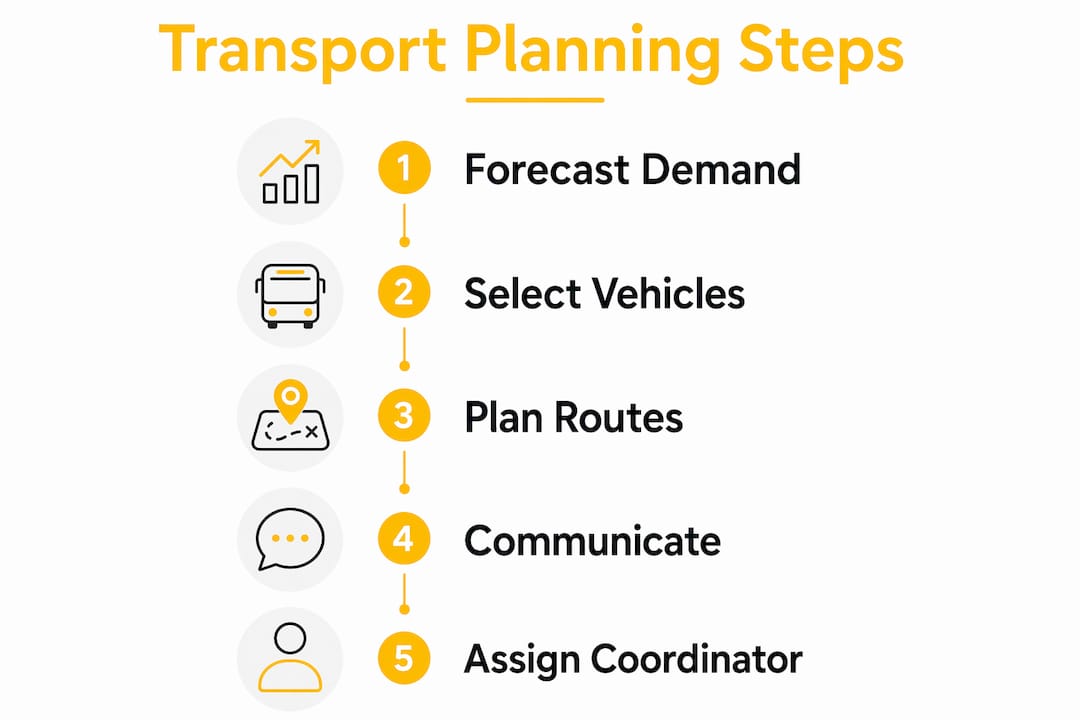
Event transportation planning rests on five core components: demand forecasting, vehicle selection, route and schedule design, attendee communication, and coordination staffing. Miss any one of them and the others start to fail.

Demand forecasting means estimating how many people need transport, when they will arrive, and in what waves. A 500-person conference does not produce 500 simultaneous arrivals. Attendees cluster around registration windows, keynote start times, and meal breaks. Mapping those waves tells you how many vehicles you need at each interval, not just in total.
Vehicle selection follows directly from demand data. A group of 15 fits a minibus. A group of 50 needs a full motor coach. Mixing vehicle sizes across different arrival waves is often more cost-effective than running one large vehicle at low capacity all day. Torontobusrentals offers a range from minibuses to full-size motor coaches, which gives planners the flexibility to match capacity to actual demand rather than guessing high.
Route and schedule design covers shuttle loops, pickup sequences, and traffic pattern analysis. A shuttle loop that works at 10:00 AM may fail at 5:00 PM when arterial roads near a venue back up. Build your schedule around real traffic data, not ideal conditions.
- Identify all pickup and drop-off locations before finalising any route
- Calculate realistic travel times using peak-hour traffic data
- Build a minimum 15-minute buffer between shuttle cycles
- Assign a zone captain to each major pickup point
- Confirm vehicle staging areas with the venue operations team
Attendee communication is the component planners most often underestimate. Pre-event communication such as sending arrival maps and shuttle details via email and text reduces last-minute confusion and prevents missed pickups. Send details at least 48 hours before the event, then again the morning of.
Pro Tip: Assign a shuttle coordinator and a named backup before the event date. A dedicated coordinator with a backup is the single most reliable way to manage delays and keep group travel calm.
How should planners coordinate group transportation for airport transfers?
Airport transfers are the highest-risk segment of any group transportation logistics plan. Flight delays, baggage claim times, and terminal navigation all introduce variability that a rigid schedule cannot absorb.
The first step is collecting accurate travel data. Request flight numbers, arrival terminals, and estimated baggage claim times from every attendee. Group arrivals by terminal and time window. Attendees arriving within 30 minutes of each other at the same terminal can share a vehicle. Those arriving hours apart need separate arrangements.
- Collect all flight details at least two weeks before the event
- Group arrivals by terminal and 30-minute windows
- Build realistic pickup plans with time buffers for flight delays, baggage claim, and terminal navigation
- Choose a single, clearly described meeting point inside or just outside each terminal
- Assign one coordinator per terminal group, with a mobile number shared with all travellers in that group
- Define a simple delay rule: if a flight is delayed beyond 60 minutes, the vehicle waits or a replacement is dispatched
- Confirm the plan in writing with the transport provider 48 hours before the first pickup
Single-pickup plans work well when most of the group arrives within a two-hour window. Multiple-pickup plans are necessary when arrivals span a full day. The cost difference between the two is real, but so is the operational complexity of running multiple vehicles across overlapping time slots.
Pro Tip: Never list a curbside lane as your meeting point. Curbside lanes at major airports cycle vehicles every few minutes. Choose a fixed interior landmark, like a specific baggage carousel or a named coffee shop, and include a photo of it in your pre-event communication.
Departure coordination follows the same logic in reverse. Collect checkout times and flight departure windows. Stagger shuttle departures so vehicles are not all loading at once. Build in extra time for guests who need to check luggage or clear security.
What are the best practices for managing event parking and shuttle services?
On-site parking and shuttle services are not separate problems. They are one system, and they need to be planned together. On-site parking does not eliminate the need for shuttles. Shuttles manage peak arrival and departure waves and protect priority stalls for VIP and accessible guests.
Zone-based parking allocation
A layered parking approach reduces congestion and improves throughput. The Mississauga Convention Centre, which manages 700 on-site spots for events exceeding 2,200 guests, uses colour-coded zones with prioritised accessible and VIP areas and timed exhibitor windows. That structure prevents the most common failure mode: general attendees filling accessible stalls because no one directed them elsewhere.
| Zone type | Priority level | Access timing |
|---|---|---|
| Accessible parking | Highest | Open at all times |
| VIP and speaker parking | High | Reserved until 30 min before doors |
| Exhibitor and vendor parking | Medium | Timed windows, pre-event only |
| General attendee self-park | Standard | Opens with general admission |
| Overflow with shuttle link | Lowest | Activated at capacity threshold |
Signage, lighting, and staffed decision points
Signage fails when it assumes guests know where they are going. Place directional signs at every point where a guest could make a wrong turn, not just at the entrance. Effective event parking logistics include detailed arrival maps, cone placement, marshals at key intersections, and portable LED towers for low-light safety.
- Post signs at the venue entrance, each zone boundary, and the shuttle boarding area
- Use consistent colours that match your zone map
- Staff every major decision point during peak ingress and egress
- Test the full pedestrian path from the furthest parking zone to the venue entrance before the event
Matching shuttle cadence to demand peaks
Run shuttles more frequently during the 30 minutes before doors open and the 30 minutes after the event ends. Those two windows generate the highest demand. Outside those peaks, reduce frequency to avoid running near-empty vehicles. Matching attendee arrival demand waves with available parking and shuttle capacity prevents bottlenecks and keeps the flow moving.
How can planners build contingency plans for event day?
Contingency planning is not pessimism. It is the part of the event transportation workflow that separates experienced coordinators from first-timers. Every event day produces at least one thing that does not go as planned.
Weather is the most predictable source of disruption for fall and winter events in Canada. Rain slows pedestrian movement and increases vehicle loading times. Snow and ice affect road conditions and shuttle schedules. Build weather contingencies into your plan before the event date, not during it.
- Identify an indoor holding area near each shuttle boarding point
- Add 10 minutes to shuttle cycle times for any forecast of rain or snow
- Confirm that your transport provider has winter-rated vehicles and trained drivers
- Have a backup vehicle on standby for events over 200 guests
Radios with labelled channels are the most reliable tool for on-site communication. The Mississauga Convention Centre assigns separate radio channels to the Parking Lead, Zone Captains, and Shuttle Coordinators so each team can communicate without cluttering a single channel. That structure lets teams adapt quickly during peak ingress and egress without confusion.
Post-event review is the step most planners skip. Document what worked, what failed, and what surprised you. That record becomes the foundation for your next event’s transport plan. Last-minute transportation arrangements increase costs by 30–50% and introduce operational difficulties that affect event success. Early planning, informed by past events, is the most direct way to avoid those costs.
Pro Tip: Run a full walkthrough of your transport plan with all coordinators the day before the event. Walk the shuttle route, test the radios, and confirm every staging area. Problems found the day before cost nothing to fix. Problems found on event day cost everything.
Key takeaways
Effective event transportation planning requires coordinating demand forecasting, vehicle selection, clear communication, and contingency protocols before the first guest arrives.
| Point | Details |
|---|---|
| Start with demand forecasting | Map attendee arrival waves before selecting vehicle types or quantities. |
| Assign coordinators early | Name a primary coordinator and a backup for every pickup zone and airport transfer. |
| Use zone-based parking | Colour-coded zones with priority stalls prevent congestion and protect accessible spaces. |
| Communicate before the event | Send arrival maps and shuttle details at least 48 hours in advance to reduce confusion. |
| Build contingency time in | Add buffer time for weather, delays, and peak ingress waves to every schedule. |
Why transport planning deserves a seat at the planning table from day one
Transport is the first thing attendees experience and the last thing they remember. I have seen beautifully produced events lose their reputation because guests waited 45 minutes for a shuttle in the rain. The programme was excellent. The catering was excellent. None of that mattered by the time people got home.
The most common mistake I see is treating transport as a vendor booking rather than a planning discipline. Coordinators finalise the venue, the catering, and the AV, and then call a transport provider two weeks out. At that point, the best vehicles are already booked, the route has not been tested, and there is no time to build a proper communication plan. Transport planning is a core part of event quality that directly shapes attendee first impressions and overall satisfaction. It belongs in the first planning meeting, not the last.
The second mistake is underestimating the value of a professional transport partner. A provider who has worked events at your venue before knows where the staging areas are, which exits back up at 5:00 PM, and how to handle a 200-person egress in 20 minutes. That knowledge is not in any checklist. You get it by working with people who have done it before. For Toronto events, Torontobusrentals brings exactly that kind of operational experience to the table, and that is worth more than the lowest quote.
Plan the transport early. Test it. Communicate it clearly. The attendees who never think about how they got there are the ones whose transport was planned properly.
— Firoz
How Torontobusrentals supports event planners with group transport
Planning group transportation for a large event takes more than booking a vehicle. It takes a partner who understands event logistics, attendee volumes, and the difference between a shuttle that runs and a shuttle that runs well.

Torontobusrentals works with event planners across Toronto on corporate shuttles, conference transfers, gala transport, and multi-stop group routes. The fleet covers everything from 18-passenger minibuses for smaller groups to full-size motor coaches for large events, with professional drivers who know the city’s traffic patterns. Routes are customisable, schedules are built around your event timeline, and the team is available to consult before you finalise your plan. Reach out to Torontobusrentals to confirm availability and get a quote matched to your event’s specific needs.
FAQ
What is event shuttle planning?
Event shuttle planning is the process of designing, scheduling, and operating vehicle routes that move attendees between designated locations such as hotels, airports, and venues during an event. It includes vehicle selection, timing, communication, and on-site coordination.
How early should I start planning event transportation?
Start planning event transportation as soon as the venue and event date are confirmed. Last-minute arrangements increase costs by 30–50% and limit vehicle availability, so early booking is the most direct way to control both budget and logistics.
How do I manage airport pickups for a large group?
Collect all flight details at least two weeks before the event, group arrivals by terminal and time window, and assign a dedicated coordinator to each pickup group. Define a fixed meeting point and a clear delay protocol before the first flight lands.
Do I need shuttles if the venue has its own parking?
Yes. On-site parking does not eliminate the need for shuttles because shuttles manage peak arrival waves and protect accessible and VIP stalls from general use. Even venues with large lots benefit from shuttle overflow capacity during high-demand windows.
What is the most important element of an event transportation workflow?
Clear communication is the most important element. Sending arrival maps, shuttle schedules, and meeting point details to attendees before the event reduces confusion, prevents missed pickups, and keeps the entire event transportation workflow running on time.
Recommended
- What is event transportation: a planner’s guide
- Event transportation checklist for planners: 2026 guide
- Role of transportation in event planning: 2026 guide
- Streamline your Toronto wedding transport workflow in 2026