
Event transportation checklist for planners: 2026 guide
TL;DR:
- An event transportation checklist is essential for organizing participant travel across all stages, from demand mapping to post-event review. Proper planning with a detailed, dependency-based approach reduces on-site surprises, crowding, and logistical failures during large events. Continuous communication, contingency measures, and timely evaluations are critical for safe and efficient shuttle operations.
An event transportation checklist is a structured set of tasks that organises every stage of participant travel, from pre-event demand mapping through to post-event review. Without one, even well-funded events suffer the same failures: late shuttles, crowded pickup zones, and guests stranded at the wrong entrance. The industry term for this discipline is event transportation logistics, and the checklist is its operational backbone. This guide walks you through each phase, drawing on 2026 dispatch protocols and real-world scheduling tactics so your next event runs without the scramble.
1. What belongs on your event transportation checklist
The most effective event transportation checklist covers six distinct phases: pre-event planning, vehicle selection, route analysis, scheduling, on-site coordination, and contingency management. Each phase depends on the one before it. Skipping demand mapping, for instance, makes vehicle selection a guess. Skipping route analysis makes scheduling fiction. Think of the checklist not as a to-do list but as a dependency chain where every confirmed item unlocks the next decision.
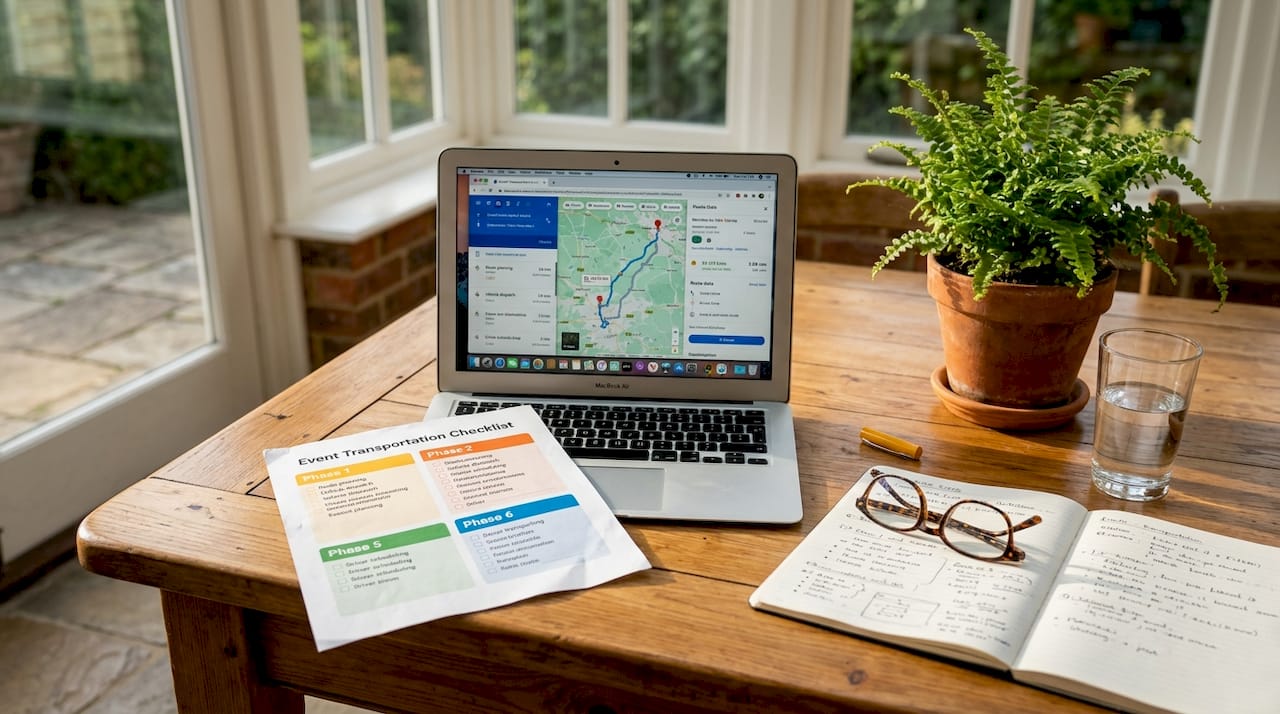
The complete event transportation planning process begins with accurate data: guest counts, venue access constraints, and session timing. From that data, you build every other decision. Planners who start with the checklist and work backwards from event day consistently report fewer on-site surprises than those who build plans forward from a booking confirmation.
2. Critical pre-event tasks: demand mapping and staging
Demand mapping and staging completed 48 hours before the event is the single most impactful step in the entire logistics process. A pre-event dispatch checklist includes demand mapping, surge vulnerability identification, headway compression plans, reserve vehicle confirmation, and central staging position setup. This means you are not just counting buses. You are identifying which 90-minute windows will overwhelm your current vehicle count and pre-positioning reserves before the pressure hits.
Here is what your 48-hour pre-event checklist should confirm:
- Guest count with buffer. Lock in your confirmed attendee number and add 10 to 15 per cent for late registrations, plus-ones, and no-show reversals.
- Pickup and drop-off point documentation. Every collection and delivery point must be documented with precise coordinates and shared with drivers and dispatchers.
- Peak demand windows. Identify the 30-minute windows around session starts and event close when passenger volume spikes.
- Surge vulnerability assessment. Flag any single-point-of-failure routes or venues with narrow access lanes.
- Reserve vehicle confirmation. At least one reserve unit should be staged within 20 minutes of the primary pickup zone.
- Central staging position. Confirm where your lead vehicle and dispatch coordinator will be physically located.
- Driver and dispatcher briefing schedule. Set a confirmed time for the pre-event briefing, not a standing assumption that everyone knows the plan.
Pro Tip: Producing your demand map and staging plan 48 hours out allows dispatchers to compress shuttle wait times without adding vehicles on event day. This is the most cost-efficient adjustment available to any planner.
3. How to choose the right vehicles and routes
Vehicle selection is a function of four variables: passenger capacity, accessibility requirements, luggage volume, and journey comfort expectations. Selecting the right vehicle size with features like climate control, luggage space, and accessibility significantly enhances both passenger comfort and operational efficiency. For corporate events and premium weddings, luxury motor coaches with professional drivers add measurable value that guests notice and remember.
| Event type | Recommended vehicle | Key consideration |
|---|---|---|
| Corporate conference (50 to 150 guests) | 47 to 55-passenger motor coach | Climate control, Wi-Fi, luggage bays |
| Wedding or gala (20 to 40 guests) | Minibus or luxury coach | Comfort, aesthetics, punctuality |
| Large festival or trade show (150+ guests) | Multiple full-size coaches | Frequency, staging space, accessibility |
| School or community event | School bus or standard coach | Safety certification, cost efficiency |
Route analysis is equally non-negotiable. Access routes must be agreed on with venue security and traffic control prior to event day. This is not a courtesy call. Venues with shared parking, loading docks, or narrow laneways can physically block your operation if access is not pre-cleared. Confirm loading zone dimensions, turning radii for large coaches, and any time restrictions on vehicle access.
- Analyse journey duration under peak traffic conditions, not average conditions.
- Identify alternate routes for each primary route in case of road closures.
- Confirm whether the venue has a dedicated bus bay or whether vehicles must queue on a public road.
- Check local authority requirements for oversized vehicles on event-adjacent streets.
Pro Tip: Run your route in a vehicle of the same class as your event fleet during the same time of day, at least one week before the event. GPS estimates do not account for school zones, construction, or event-adjacent congestion from parallel activities.
4. Scheduling and coordination strategies for smooth transport
Matching shuttle timing to event session timing rather than to clock time is the correction most planners learn the hard way. A shuttle scheduled to depart at 9:00 a.m. fails when the session it serves ends at 8:55 a.m. and boarding takes seven minutes. Scheduling mismatches between event agenda time and real-world boarding dynamics are the leading cause of crowding at pickup zones. Build boarding time, access buffer, and a two-minute safety margin into every departure window.
Here is a practical coordination sequence for event day:
- Stagger arrival windows. Divide guests into arrival groups by zone or ticket tier and assign each group a 15-minute arrival window. This prevents simultaneous demand at a single pickup point.
- Assign zone supervisors. Each major pickup or drop-off location needs one named person with radio or phone contact to the central dispatcher.
- Define escalation protocols. If a vehicle is more than 10 minutes late, the zone supervisor contacts dispatch. If dispatch cannot resolve within five minutes, the reserve vehicle is activated.
- Conduct driver briefings. Every driver receives a printed route sheet, a contact list, and a verbal briefing covering the event schedule, expected passenger volumes, and the escalation protocol.
- Deploy real-time GPS tracking. Use a GPS dashboard so your dispatcher can see all vehicles simultaneously and redirect before a delay becomes a queue.
- Set alert thresholds. Programme alerts for queue depths exceeding 30 passengers or vehicle idle times exceeding eight minutes at a staging point.
- Use passenger communication tools. QR codes at pickup points linking to a live ETA page, or a simple SMS update system, reduce passenger anxiety and prevent people from abandoning the shuttle for rideshares.
Continuous status updates between drivers, dispatch, and venue teams are what keep a transport plan adaptable when real conditions diverge from the plan. And they always diverge.
5. Contingency and safety measures every checklist must include
Backup planning is not pessimism. It is the difference between a minor delay and a reputational incident. Checklist adherence and attention control during operational handoffs are critical. Distractions during shift changes or vehicle handoffs are a documented source of safety failures across transportation sectors.
Your contingency and safety checklist should cover:
- Backup vehicles. Confirm at least one reserve vehicle is available and positioned within 20 minutes of the primary staging area.
- Alternate routes. Every primary route has a documented alternate, shared with all drivers before the event.
- Driver qualification verification. Confirm valid commercial licences, current medical certificates, and event-specific briefing completion for every driver.
- Vehicle maintenance sign-off. Each vehicle receives a pre-event mechanical check covering tyres, brakes, lights, and fuel level.
- Emergency contact documentation. Every driver carries a laminated card with venue security, local emergency services, and the event’s lead coordinator contact numbers.
- On-site signage. Physical signs at every pickup and drop-off point with route information and a contact number. This is the most frequently overlooked item on any event logistics checklist.
“Most operational failures in event transportation are not vehicle failures. They are communication failures. The checklist exists to make communication a system, not an assumption.”
Post-event review closes the loop. Within 48 hours of the event, collect debrief notes from zone supervisors and drivers, review GPS logs for idle time anomalies, and document every deviation from the original plan. This data becomes the foundation of your next event’s demand map.
Key takeaways
A well-executed event transportation checklist depends on demand mapping completed 48 hours out, schedule alignment with session timing, and a communication system that connects drivers, dispatchers, and zone supervisors in real time.
| Point | Details |
|---|---|
| Start with demand mapping | Produce a staging plan 48 hours out to identify surge windows and pre-position reserves. |
| Align schedules to sessions | Match shuttle departure times to actual session end times, not clock time, to prevent crowding. |
| Verify vehicles and routes | Confirm access agreements with venue security and run routes under peak traffic conditions. |
| Build in contingency | Stage a reserve vehicle within 20 minutes and document alternate routes for every primary route. |
| Close with a post-event review | Debrief within 48 hours using GPS logs and supervisor notes to improve the next event’s plan. |
What I have learned from managing event transport
The checklist items that planners skip most often are the ones that hurt most on event day. In my experience, the two most neglected steps are on-site signage and the post-event review. Planners invest heavily in vehicle booking and route planning, then place a single handwritten sign at a pickup zone and wonder why guests call the venue asking where the shuttle is. Physical, weather-resistant signage with clear route information and a contact number is not optional. It is the last line of communication when every digital tool fails.
The post-event review is equally undervalued. Most teams debrief verbally, if at all, and the institutional knowledge from that event evaporates before the next booking. GPS logs tell you exactly where vehicles idled too long. Zone supervisor notes tell you which pickup points were understaffed. That data, captured within 48 hours, turns one event’s problems into the next event’s solutions.
The other lesson I keep returning to is this: checklist adherence during handoffs is where safety incidents originate. When a driver change happens mid-event without a proper briefing, the incoming driver is operating on assumptions. The checklist removes the assumption. It is not bureaucracy. It is the mechanism that keeps a complex, moving operation predictable under pressure.
— Firoz
Plan your next event with Torontobusrentals
Torontobusrentals provides a full fleet of vehicles for events across Toronto, from minibuses for intimate corporate gatherings to large motor coaches for group travel at conferences, weddings, and festivals. Every booking includes professional drivers, pre-event route confirmation, and flexible scheduling to match your event programme. If you are coordinating a large group, the 47-passenger school bus rental is a practical, cost-efficient option for high-volume shuttle runs. Torontobusrentals works directly with event coordinators to align vehicle deployment with your specific agenda timing, pickup zones, and contingency requirements. Contact the team to discuss your event’s transport needs and receive a tailored quote.
FAQ
What is an event transportation checklist?
An event transportation checklist is a structured list of tasks covering pre-event demand mapping, vehicle selection, route confirmation, scheduling, on-site coordination, and contingency planning. It serves as the operational framework for organising reliable participant travel at any event scale.
How far in advance should I start planning event transport?
Begin your demand mapping and staging plan at least 48 hours before the event, with vehicle bookings and route agreements confirmed several weeks out. The Dispatcher Playbook 2026 identifies the 48-hour window as the critical threshold for compressing shuttle wait times without adding vehicles.
How do I prevent crowding at shuttle pickup zones?
Stagger arrival windows by dividing guests into groups with assigned 15-minute boarding slots, and align shuttle departures with actual session end times rather than scheduled clock times. Zone supervisors with clear escalation protocols further reduce bottlenecks.
What vehicles work best for large event shuttle services?
For groups of 50 to 150 guests, a 47 to 55-passenger motor coach with climate control and luggage bays is the standard choice. Larger events with 150 or more guests require multiple coaches operating on staggered frequencies from a central staging point.
What safety items must appear on an event transport checklist?
Driver licence and medical certificate verification, pre-event vehicle mechanical checks, documented alternate routes, reserve vehicle staging, and emergency contact cards for every driver are the non-negotiable safety items on any event logistics checklist.
Recommended
- What is event transportation: a planner’s guide
- Bus rental checklist for events: guide for Toronto planners
- 7 Essential Bus Rental Tips for Successful Events
- Defining event group transportation for planners