
Essential bus rental tips for safe Toronto school trips
TL;DR:
- Organizing school bus trips requires strict compliance with Ontario safety regulations and detailed paperwork.
- Choice between yellow school buses and charter coaches depends on trip distance, comfort needs, and budget.
- Early booking, thorough planning, and working with experienced providers ensure safe, smooth, and enjoyable trips.
Organising bus transportation for a Toronto school field trip sounds straightforward until you realise how many layers are involved. You need to satisfy Ontario safety regulations, align with TDSB or TCDSB policies, account for group size and accessibility needs, and still keep costs manageable. Get one piece wrong and the whole trip is at risk before the students even board. This guide walks you through the key regulations, bus options, planning checklists, and booking strategies that experienced Toronto school administrators rely on to keep every excursion safe, smooth, and stress-free.
Table of Contents
- Know the regulations: Safety standards and paperwork
- Understand your bus options: Comparing school buses and charter buses
- Plan the perfect trip: Choosing the right bus for your needs
- Booking and logistics: Timing, communication, and day-of strategies
- Our perspective: What most planners overlook about school trip buses
- Trust Toronto specialists for your next school trip
- Frequently asked questions
Key Takeaways
| Point | Details |
|---|---|
| Follow regulations | Using CSA-compliant buses and approved documentation ensures a legally sound, safe school trip. |
| Match trip needs | Choose the bus type based on group size, accessibility needs, and journey length for a comfortable experience. |
| Book early | Secure your preferred bus and avoid last-minute stress by booking transportation 2–4 weeks in advance. |
| Double-check details | Confirm all logistics with your provider and prepare a day-of checklist for smooth operations. |
Know the regulations: Safety standards and paperwork
Before you contact a single bus company, you need to understand what Ontario law actually requires. This is not optional background knowledge; it is the foundation every school trip is built on.
Ontario’s rules for student transportation are specific. CSA Standard D250 governs bus manufacturing and equipment, covering overhead signal lights, stop arm devices, and reflective sheeting. Any bus carrying students must meet these standards. This applies whether you are using a yellow school bus or a charter coach. Compliance is not negotiable.
Beyond the vehicle itself, your school board has its own documentation requirements. The TDSB and TCDSB require permission forms, defined supervision ratios (one adult per ten students for elementary trips), written safety plans, and curriculum alignment for every excursion. They also require schools to use contracted carriers through the Toronto Student Transportation Group, which pre-screens providers for compliance.
Here is a quick summary of the paperwork you will need before departure:
- Signed parent or guardian permission forms for every student
- A written safety plan covering emergency procedures and communication protocols
- Supervision assignments with clearly defined adult-to-student ratios
- Curriculum justification linking the trip to learning outcomes
- Confirmation that your carrier is approved through the Toronto Student Transportation Group
For trips involving students with special needs, requirements go further. Accessible vehicles, securement devices, and individualised support plans must all be documented and confirmed in advance. Overnight trips also require explicit board-level approval and a higher supervision ratio.
“Paperwork is not bureaucracy for its own sake. It is the safety net that protects students, teachers, and the school board when something unexpected happens.”
Pro Tip: Download the TDSB transportation procedures document and keep it on file. Cross-reference your checklist against it before every trip, not just the first one. Reviewing our bus rental safety guide can also help you identify gaps before they become problems.
With regulations and paperwork forming the foundation, it is important to understand your transportation options.
Understand your bus options: Comparing school buses and charter buses
Not all buses are created equal, and the right choice depends heavily on your trip’s specific needs. The two main options for Toronto school trips are traditional yellow school buses and charter coaches. Each has genuine strengths and real limitations.
Yellow school buses are the default for most board-organised excursions. They are cost-effective, widely available through contracted carriers, and already meet CSA D250 standards. For short local trips, like a morning visit to a Toronto museum and back, they are often the most practical choice. The trade-off is comfort. No air conditioning in warmer months, no onboard restrooms, and limited luggage storage can make longer journeys genuinely uncomfortable for students.
Charter buses are a different experience entirely. Charter buses offer seatbelts, air conditioning, onboard restrooms, ample storage, and WiFi, making them a smart upgrade for longer or multi-day trips. Students arrive at the destination more comfortable and more focused. For overnight excursions or trips exceeding two hours each way, the added cost is often worth it.
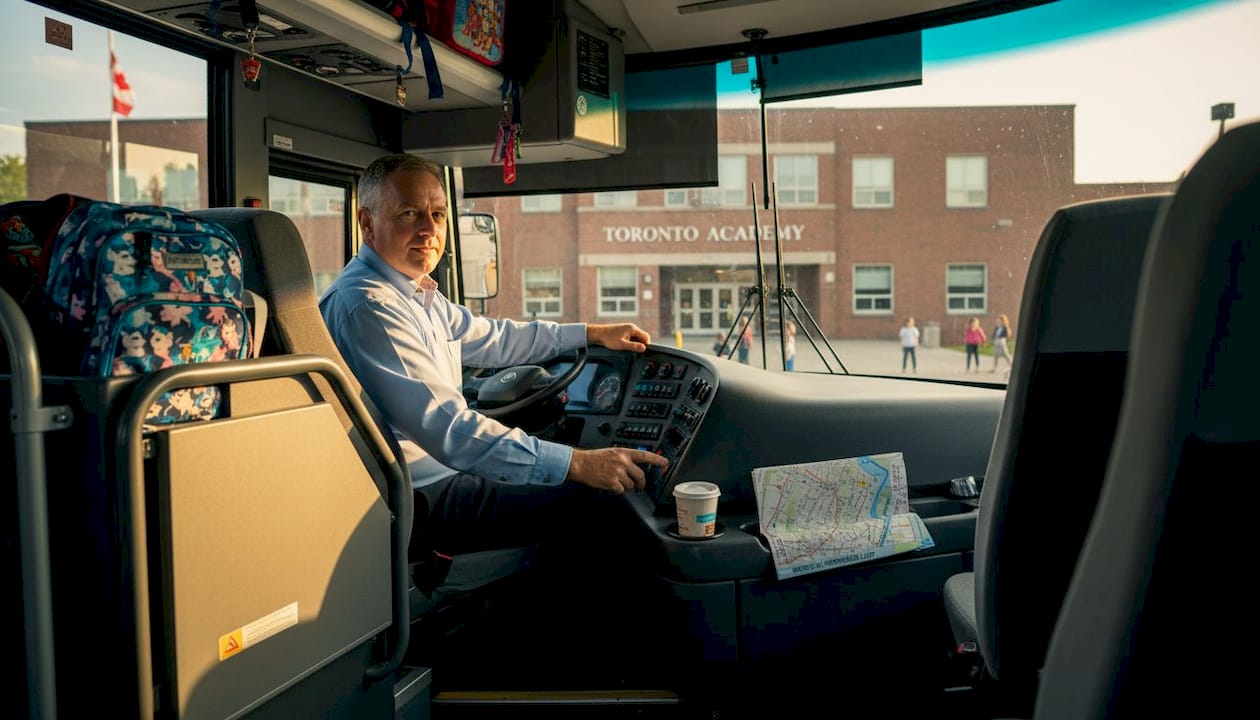
| Feature | Yellow school bus | Charter bus |
|---|---|---|
| Cost | Lower | Moderate to higher |
| Air conditioning | Rarely | Standard |
| Seatbelts | Compartmentalised seating | Yes |
| Onboard restroom | No | Yes |
| WiFi | No | Often included |
| Luggage storage | Minimal | Generous |
| Accessibility options | Limited | Available on request |
For accessible transportation, both options can be configured with ramps and wheelchair securement, but you must request this explicitly and confirm compliance with CSA standards. Do not assume a bus is accessible; verify it in writing.
Pro Tip: If your group is under 20 students, consider a minibus. It is more manoeuvrable in Toronto traffic and often more cost-effective than a full-size coach for smaller groups. Browse school bus rentals and charter bus examples to compare what fits your group size and budget. You can also explore the benefits of charter buses if you are weighing the upgrade.
Now that you are aware of how each provider differs, the next step is to decide which bus best fits your specific trip’s requirements.
Plan the perfect trip: Choosing the right bus for your needs
Matching the right bus to your trip is part logistics, part advocacy for your students. Here is how to approach it systematically.
Start with these five questions before contacting any provider:
- How many students and adults are travelling? Always include chaperones in your headcount.
- How long is the journey each way? Trips over 90 minutes warrant comfort features like restrooms and AC.
- Are any students using wheelchairs or requiring other mobility support? Special needs students require CSA-compliant accessible buses with wheelchair securement and individualised plans.
- Does the trip involve overnight stays or travel outside the GTA? Board approval and higher supervision ratios apply.
- What is your confirmed budget per student, including transportation?
For small groups of 15 or fewer, a minibus for small groups is often the most cost-effective and practical solution in Toronto’s dense urban environment.
Here is a general guide to typical pricing and capacity in 2026:
| Bus type | Typical capacity | Estimated daily rate |
|---|---|---|
| Minibus | 14 to 24 passengers | $350 to $550 |
| School bus (standard) | 48 to 72 passengers | $400 to $650 |
| Charter coach | 47 to 56 passengers | $700 to $1,200 |
| Accessible coach | Varies | $800 to $1,400 |
Rates are approximate and vary by provider, distance, and season.
When evaluating providers, always ask for proof of insurance, a current operating licence, and driver credentials. Reputable companies will share this without hesitation. If a provider is reluctant to provide documentation, that is a clear signal to look elsewhere. Checking online reviews and asking for references from other Toronto schools adds another layer of confidence.
Selecting the ideal bus is just part of the planning. Attention to timely booking and logistics helps ensure a stress-free trip.
Booking and logistics: Timing, communication, and day-of strategies
Even the best bus choice falls apart with poor booking and communication. This section covers the practical steps that separate smooth trips from chaotic ones.
Book early. Toronto’s field trip season peaks in May and June, and quality buses fill up fast. Aim to secure your vehicle at least two to four weeks before your trip date. For popular destinations or large groups, six weeks is safer. TDSB and TCDSB require contracted carriers and full documentation, so early booking also gives you time to confirm compliance before the deadline.
When you confirm your booking, get the following in writing:
- Confirmed pickup and drop-off times and locations
- Driver’s name, contact number, and licence details
- Vehicle make, model, and capacity
- Emergency contact number for the company’s dispatch
- Confirmation of any accessibility equipment requested
- Cancellation and refund policy
Pro Tip: Create a shared digital folder with all trip documents: permission forms, safety plans, driver details, and emergency contacts. Every supervising adult should have access before departure day. Review our school bus booking timing resource for a practical timeline you can follow.
On the day of the trip, run through a quick checklist before students board:
- All permission forms collected and accounted for
- First aid kit and emergency supplies on the bus
- Supervision assignments confirmed with all chaperones
- Students briefed on bus behaviour expectations
- Driver has the confirmed route and destination address
The most common booking mistakes are leaving it too late, failing to confirm accessibility requirements in advance, and not having a backup contact if the driver is unreachable. Avoid all three with a simple pre-trip protocol.
Having walked through booking logistics, let us step back and consider a holistic perspective for consistently safe, enjoyable school trips.
Our perspective: What most planners overlook about school trip buses
After supporting dozens of Toronto school trips, we have noticed a consistent pattern: administrators focus intensely on the destination and the curriculum tie-in, but treat the bus as an afterthought. It rarely is.
The best buses book up in April for May and June trips. By the time some schools start calling, the most comfortable, accessible, and well-maintained coaches are already gone. What is left is often fine, but it is not what your students deserve.
Comfort and accessibility are also underestimated in their impact on the actual learning experience. A two-hour ride in a hot, cramped bus does not set students up for engaged participation when they arrive. The trip begins the moment they board.
The schools that consistently run the smoothest excursions ask more questions upfront. They confirm driver experience with student groups, request the specific vehicle they will receive (not just a category), and have a contingency plan if something changes last minute. Our expert tips for bus safety cover exactly this kind of proactive planning. Treat the bus as part of the educational experience, not just a way to get there.
Trust Toronto specialists for your next school trip
Putting these tips into action is much easier when you have an experienced local partner alongside you. At Toronto Bus Rentals, we work directly with schools to match the right vehicle to every trip, whether that is a compact minibus for a small class or a fully accessible coach for a larger group.
Our fleet meets CSA safety standards, and our team understands TDSB and TCDSB documentation requirements inside and out. We help you navigate the paperwork quickly so you can focus on the students. Explore the advantages of charter buses for your next outing, browse our Toronto school bus rentals, or download our bus rental checklist to start planning with confidence today.
Frequently asked questions
What documents are required for a Toronto school trip by bus?
Schools need signed permission forms, a written safety plan, and supervision assignments that align with board protocols. The TDSB and TCDSB require use of contracted carriers and full documentation for all student excursions.
How far in advance should we book a school bus rental in Toronto?
Book at least two to four weeks before your trip date, and up to six weeks ahead during peak spring season to secure your preferred vehicle and confirm all compliance requirements.
Are charter buses allowed for school trips in Ontario?
Yes, charter buses may be used provided they meet the required safety standards and are operated by an approved provider. Ontario school buses must comply with CSA Standard D250 for manufacturing and equipment.
What accessibility features should we ask about when renting a school bus?
Confirm whether the bus has a wheelchair ramp, securement devices, and CSA-compliant accessible seating. Special needs students require accessible, CSA-compliant buses with proper wheelchair securement systems.
Is WiFi or air conditioning standard on school trip buses?
Yellow school buses typically do not include these features, but charter coaches usually do. Charter buses offer air conditioning, WiFi, restrooms, and storage, making them the better choice for longer or multi-day trips.
Recommended
- School Trip Bus Rental Guide for Safe Group Travel
- School Bus Rental Toronto 2026: Book 2-4 Weeks Early for Best Rates
- School bus rental in Toronto: how to choose the right option
- Why rent buses in Toronto for smoother group travel