
Event Planners: Cut CO2 to 30 g/km With Eco Friendly Group Transport
For most group trips, a full motorcoach or shared bus is the lowest-carbon, most practical way to move people from one place to another. That verdict holds only when occupancy is high and the vehicle runs on a reasonably clean fuel or power source. Get those two variables right, and the logistics tactics below turn a good instinct into measurable emissions savings.
TL;DR:
- Full buses running on cleaner fuel sources significantly reduce emissions per passenger, especially when occupancy is high.
- Occupancy rate is the key factor; a nearly empty coach can emit more per rider than a well-filled car or train.
- Medium-distance trips under a few hundred kilometers benefit most from full coaches, particularly electric buses on cleaner grids.
- Effective planning—such as matching vehicle size to passenger count and consolidating trips—greatly enhances environmental savings.
- Improving logistics, fleet modernization, and maximizing fill rates outweigh technology upgrades alone in reducing group travel emissions.
Table of Contents
- Why motorcoaches and buses cut group travel emissions
- Buses, cars, trains and planes: what fits your trip
- How to plan group transport that actually lowers emissions
- The practical case beyond the environment
- What a well-run coach operation looks like day to day
- What happens before the bus ever picks anyone up
- Policies and incentives shaping greener group transport
- Getting a group to actually choose the bus
- Real-world examples of group transport done right
- What actually matters here, and what gets overstated
- How to book an eco-friendly charter for your next group trip
- Sources
Why motorcoaches and buses cut group travel emissions
The math behind eco-friendly group transport comes down to one number: emissions per passenger, not emissions per vehicle. A bus burns more fuel than a sedan, but it carries far more people, and that ratio is what determines the real environmental cost of the trip.
A fully loaded motorcoach can bring CO2 down to below roughly 30 grams per passenger-kilometre. A low-occupancy private car, by contrast, typically runs somewhere between 120 and 150 grams per passenger-kilometre, according to the MIT Climate portal.
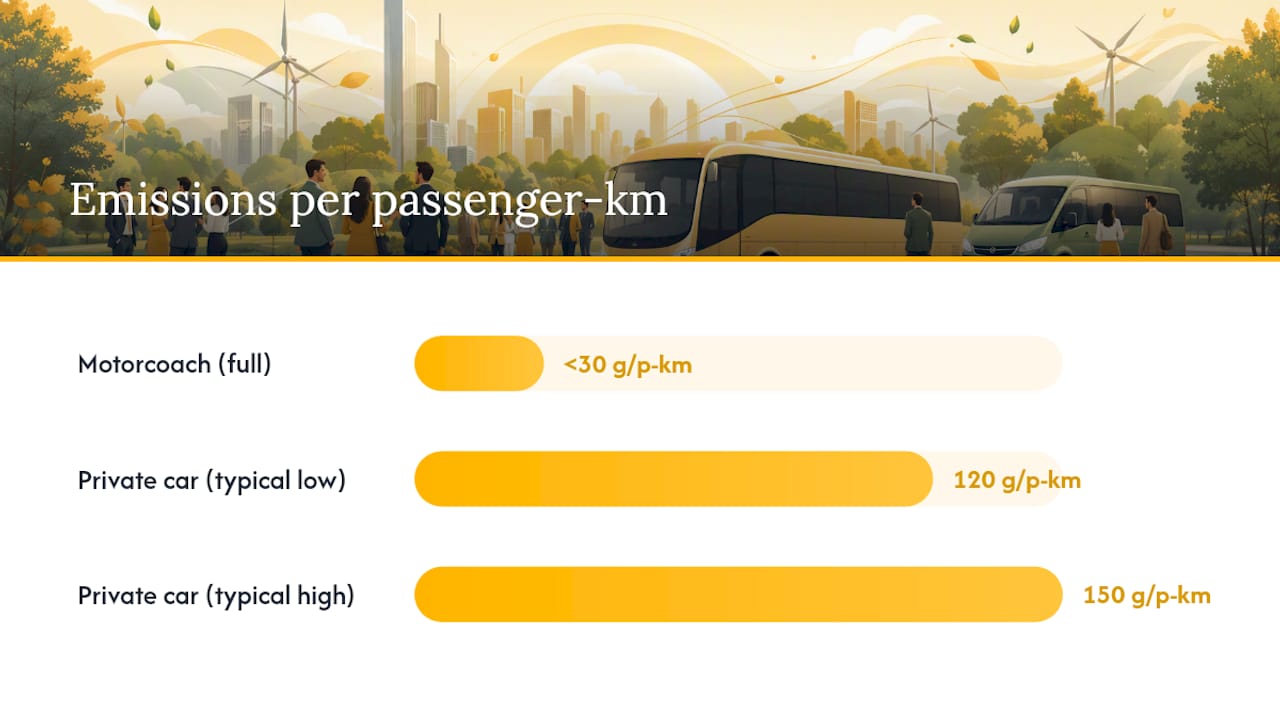
Broader industry analysis backs the same pattern from a different angle. A comprehensive energy-use review from the American Bus Association Foundation found motorcoaches use less energy and generate lower CO2 per passenger-mile than nearly every other common travel mode, averaged across typical trips.
Pro Tip: An empty seat is wasted efficiency. The environmental case for a bus only holds up if the bus is actually full, so treat occupancy as your first planning metric, not an afterthought.
A few things pull those averages in either direction:
- Route terrain, traffic congestion, and idling time all affect real fuel burn.
- Older diesel engines pollute more than post-2010 fleets with modern emission controls.
- A nearly empty coach can, per rider, pollute more than a packed sedan.
- Regional electricity mix matters if the vehicle is electric rather than diesel.
None of this changes the conclusion. It just means the number on paper and the number on the road can differ depending on who is actually in the seats.
Buses, cars, trains and planes: what fits your trip
Choosing the right mode for sustainable group travel depends less on ideology and more on trip length, group size, and how many seats you can realistically fill.
Private cars make sense for two or three people going somewhere transit cannot reach. Beyond that, occupancy drops and per-person emissions climb fast. A car with one or two riders is almost always the worst option on the table for a group of any real size.
Trains are strong performers on electrified routes with high ridership, since rail spreads energy use across hundreds of passengers at once. They are less practical for door-to-door group logistics, especially with luggage, sports equipment, or accessibility needs.
Planes only make environmental and practical sense once distance rules out ground travel entirely. Short-haul flights carry a disproportionate carbon cost relative to distance covered.
Shared rides and ride-hailing work for small clusters but scale poorly. Ten separate cars moving fifteen people is a worse outcome than one coach moving the same fifteen.
Where does that leave motorcoaches? A McMaster University simulation study found the environmental edge of buses over cars depends heavily on operating conditions and the carbon intensity of the power source. Electrified buses running on a cleaner grid can beat diesel coaches by a wide margin, but a diesel coach at high occupancy still usually beats a fleet of half-empty cars. For medium-distance group trips under a few hundred kilometres, a full coach is typically the safest bet for balancing emissions against real-world flexibility.
How to plan group transport that actually lowers emissions
Booking a bus does not automatically make a trip green. The planning decisions around it do most of the work.
- Estimate real occupancy before choosing a vehicle size. A 46-passenger coach carrying 18 people defeats the purpose. Match vehicle capacity to your actual headcount, not your hoped-for one.
- Cluster pickup and drop-off points. Fewer stops spread across a tighter geographic radius means less idling, shorter routes, and higher fill rates per trip.
- Ask providers directly about emission standards. Fleet age, engine type, and whether low-emission or hybrid options exist all affect the trip’s footprint.
- Design return legs to avoid empty mileage. A coach that drives back empty after dropping off one group has effectively doubled its per-passenger emissions for that day.
- Consolidate multiple small groups onto shared vehicles where schedules allow. Two departments booking separate minibuses for the same event is less efficient than one shared coach.
Before requesting a quote, collect passenger count including staff, luggage volume, accessibility requirements, and your full timetable. Providers can match vehicle size accurately only when they have those specifics up front, which avoids the common trap of overprovisioning a bigger vehicle “just in case.” Toronto Bus Rentals’ group transportation logistics guidance walks through this kind of route and vehicle planning in more detail.
Pro Tip: When comparing quotes, ask each provider for their typical load factor on similar trips. A provider who tracks this number is usually the one running a tighter, more fuel-efficient operation.
The practical case beyond the environment
Lower emissions rarely stand alone as the reason a group switches to shared transport. Cost, convenience, and comfort usually seal the decision.
- Cost per person drops sharply when one coach fare replaces a dozen individual trips, parking fees, and mileage reimbursements.
- Congestion and parking demand shrink at the destination. A single coach can replace roughly 30 to 55 private cars, depending on coach size and typical car occupancy.
- Comfort and amenities like climate control, onboard restrooms, and reclining seats increase rider acceptance of shared transport over driving separately.
- Fewer vehicles on the road at pickup and drop-off means faster loading and less chaos at event entrances.
Every one of these practical wins ties directly back to the same root cause as the emissions savings: fewer vehicles, fuller ones, moving more efficiently.
What a well-run coach operation looks like day to day
Emissions savings on paper only show up on the road if the operator runs a tight ship. That means scheduling drivers and vehicles to minimize dead mileage, pairing outbound and return bookings where trip windows allow, and keeping fleet maintenance current so engines run at their designed efficiency rather than degrading quietly over years of use.
Fleet modernization plays a real role here. Motorcoach engines built after roughly 2007 to 2010 carry substantially lower particulate matter and NOx output than older units, a shift documented across the Canadian coach industry. A provider running newer coaches with a disciplined dispatch process is doing more for a trip’s footprint than any single routing decision a planner makes.
There is a regulatory layer to this too. Canadian motorcoach drivers operate under hours-of-service rules that cap driving time and mandate rest periods, so a tight itinerary needs to be checked against those limits before it is booked, not after. Toronto Bus Rentals’ resource on why sustainability matters in bus rentals covers more of this operational side for planners building out a full itinerary.
What happens before the bus ever picks anyone up
Tailpipe emissions only tell part of the story. Every vehicle, whether it is a diesel coach, an electric minibus, or a private car, carries a manufacturing footprint before it ever moves a single passenger, and a disposal footprint once it is retired.
Steel, aluminum, and battery production (where relevant) all draw on mining, smelting, and manufacturing processes that release greenhouse gases well before a vehicle reaches the road. A larger coach requires more raw material per unit than a sedan, but it also serves far more passenger-trips over its operating life, which spreads that manufacturing footprint thin. A coach running for fifteen years and tens of thousands of trips amortizes its production impact across a huge number of riders, in a way a car replaced every five to seven years never quite matches.
Electric buses complicate this picture. Battery production carries a heavier upfront manufacturing footprint than a diesel engine, which means the lifecycle advantage of an electric coach depends on how long it stays in service and how clean the electricity grid is where it charges. On a grid still leaning on fossil generation, an electric bus’s manufacturing debt takes longer to pay off in emissions terms.
End-of-life matters too. Steel and aluminum bus components are highly recyclable, while battery packs require dedicated recycling infrastructure that is still maturing in most regions. None of this erases the per-trip advantage of a full coach over a fleet of half-empty cars, but it is worth knowing that the “greenest” choice on paper can shift depending on how long a vehicle stays in service and what happens to it afterward.

Policies and incentives shaping greener group transport
Governments and industry bodies have started building the case for shared transport into policy, not just marketing copy. Public-health and environmental groups have pushed for electrification of transit fleets for years, flagging both the health benefits of cutting local pollutants and the practical hurdles of getting there, a tension the American Lung Association has documented in its own policy work.
At a practical level, incentives for eco-conscious transport choices tend to show up in a few recurring forms: grants or rebates for fleet operators upgrading to lower-emission engines, procurement rules that favour newer emission-compliant vehicles for institutional bookings, and, in some regions, preferential access lanes or reduced tolls for high-occupancy vehicles. None of these incentives change what a planner needs to do on the ground. A school, company, or event organizer booking a coach still benefits most from asking directly whether a provider’s fleet meets current emission standards, since that single question does more to lower a trip’s footprint than any broader policy shift the planner has no control over.
The direction of travel is clear even where the pace varies. Fleet operators face growing pressure, regulatory and reputational, to modernize, and that pressure is what has already driven the particulate and NOx reductions documented across the Canadian motorcoach industry since the late 2000s.
Getting a group to actually choose the bus
The greenest transport option on paper does nothing if nobody books it. Getting a group of thirty coworkers or two hundred wedding guests to choose the shared coach over individual cars is a behavioural problem as much as a logistical one.
Convenience usually beats altruism as a motivator. Framing a shared coach as “no parking hassle, no designated driver, drinks allowed” tends to land better than framing it as “lower carbon footprint.” A look at convenience priorities in business travel makes a similar point: travellers consistently rank ease and predictability above almost every other factor, environmental impact included, when choosing how to get somewhere.
Default options matter more than persuasive arguments. If the coach is booked automatically and attendees have to opt out rather than opt in, uptake climbs sharply. The same logic applies to timing: publishing pickup times and locations early, and making them more convenient than driving oneself, removes the friction that pushes people back toward their own cars.
Social proof helps too. When organizers publicize how many attendees are already booked onto the shared coach, latecomers are more likely to join rather than arrange separate transport. None of these tactics require lecturing a group about emissions. They just make the low-carbon option the easiest one.
Real-world examples of group transport done right
Large recurring events offer the clearest evidence that shared transport works at scale. Music festivals and major sporting events that mandate or heavily incentivize shuttle buses from designated lots routinely report far less local traffic congestion and parking strain than events that leave attendees to drive individually, a pattern operators and municipalities cite repeatedly when justifying continued investment in shuttle infrastructure.
School boards offer a smaller but equally telling case. A school running a single chartered coach for a field trip that would otherwise involve a dozen parent-driven cars consolidates dozens of trips into one, cutting both emissions and the chaos of staggered pickup times at the destination.
Corporate retreats show a similar pattern on the business side. Companies that book one or two coaches for staff travel to an offsite location consistently report smoother arrivals, fewer late stragglers, and simpler expense reporting compared with reimbursing individual mileage claims. The environmental benefit rides alongside a purely administrative one, which is often the argument that actually gets budget approval.
What actually matters here, and what gets overstated
The conventional advice on eco-friendly group transport spends too much time comparing vehicle types and not enough time on occupancy. A brand-new electric minibus running at a third capacity is not a green choice. A ten-year-old diesel coach running full is doing more good per passenger than most planners give it credit for.
Where I think the industry oversells itself is in treating vehicle technology as the whole answer. Electrification matters, and it will matter more as grids get cleaner, but it is a slower lever than logistics. A planner can fix occupancy this week. Nobody is upgrading a national electricity grid on a school trip’s timeline.
If you take one thing from this, prioritize fill rate over fleet type. Ask providers about their vehicles, absolutely, but ask harder questions about routing, consolidation, and whether your headcount actually justifies the vehicle you’re about to book. That single decision moves the needle more than almost anything else on this list.
— Firoz
How to book an eco-friendly charter for your next group trip
Once you know roughly how many people you’re moving, booking the right coach is mostly a matter of giving Torontobusrentals the right numbers up front. That means passenger count, luggage volume, accessibility needs, pickup and drop-off points, and your full itinerary timing, including any return leg.

Vehicle size should match headcount, not ambition. A group of 15 to 18 fits comfortably in a minibus, groups between roughly 22 and 46 passengers are the sweet spot for a standard coach like the 46-passenger coach for corporate events, and larger school or institutional groups over 47 riders are better served by a dedicated 47-passenger school bus rental. Booking too large a vehicle for your group defeats the per-passenger efficiency this whole approach depends on, so match the size honestly rather than padding for comfort.
A modern Toronto fleet with professional drivers and full itinerary planning support helps ensure vehicle-matching and route logistics that lower a trip’s footprint are handled before the coach ever leaves the lot. Start by requesting a quote through the group transportation and shuttle services page, and have your passenger count and schedule ready when you do.
Sources
- MIT Climate portal — public transportation explainer
- Motorcoach Canada — coaches and the environment
- American Bus Association Foundation — Energy use and emissions (updated 2023 analysis)
- MASc thesis — passenger-transport environmental impact simulation (McMaster University)
Recommended
- Why sustainability matters in bus rentals for events
- Sustainable transportation for events: a 2026 planner’s guide
- Why choose group transport for events and travel
- Defining event group transportation for planners