
Defining point-to-point transportation for Toronto event planners
Point-to-point transportation is a private, direct service that moves your entire group from one specific location to a single destination, with no intermediate stops. The vehicle is exclusive to your group, the route is fixed to your itinerary, and the clock runs on your schedule, not a shared timetable. For event planners in Toronto, that distinction matters the moment you are coordinating 40 wedding guests from a hotel to a venue, or moving a corporate team from Union Station to a conference centre in Mississauga.
The core elements that define the service:
- Direct routing: one origin, one destination, no detours or shared pickups
- Private vehicle use: the coach, minibus, or sprinter van is booked exclusively for your group
- No intermediate stops: passengers board together and arrive together
- Door-to-door efficiency: pickup and drop-off happen at the exact addresses you specify
Torontobusrentals operates this model across Toronto and the surrounding region, working within Canadian federal and provincial safety standards for commercial passenger carriers. A practical technique that experienced planners use from the start: designate a single day-of contact who communicates directly with the driver and dispatcher.
Table of Contents
- What does point-to-point service actually look like on event day?
- How does point-to-point differ from shuttles and scheduled loops?
- When is point-to-point the right call for Toronto events?
- What operational details do you need to confirm before booking?
- What drives the cost of a point-to-point charter quote?
- Your step-by-step booking checklist
- What should you expect from a professional Toronto charter operator?
- What does a point-to-point charter typically cost in Toronto?
- How long does the booking process take?
- Key takeaways
- The detail most planners overlook
- How Torontobusrentals handles point-to-point bookings in Toronto
- Useful sources
What does point-to-point service actually look like on event day?
Picture a wedding at a venue in Niagara-on-the-Lake. Sixty guests are staying at a downtown Toronto hotel. A motor coach pulls up to the hotel entrance at the agreed time, the group boards, and the driver heads directly to the venue. No stops at a second hotel, no detour through a pickup loop. Guests arrive together, on time, and the vehicle waits or returns on a schedule you set in advance.
Corporate planners use the same model for single-venue conferences. One pickup at the office, one drop-off at the event site. The driver stages the vehicle at the designated loading zone, handles any luggage, and the group walks straight in. For airport-to-hotel transfers tied to a single flight block, a sprinter van or minibus meets the group at arrivals and delivers them directly to the property. Sports teams travelling to a stadium in Hamilton or Ottawa get the same treatment: board at the facility, arrive at the arena, no shared routing with another team or event.
On the day itself, watch for three practical cues: the vehicle should be staged and ready at least 15 minutes before departure, the driver should have a written briefing with your contact’s number and the exact drop-off address, and luggage loading should be accounted for in your departure buffer.

How does point-to-point differ from shuttles and scheduled loops?
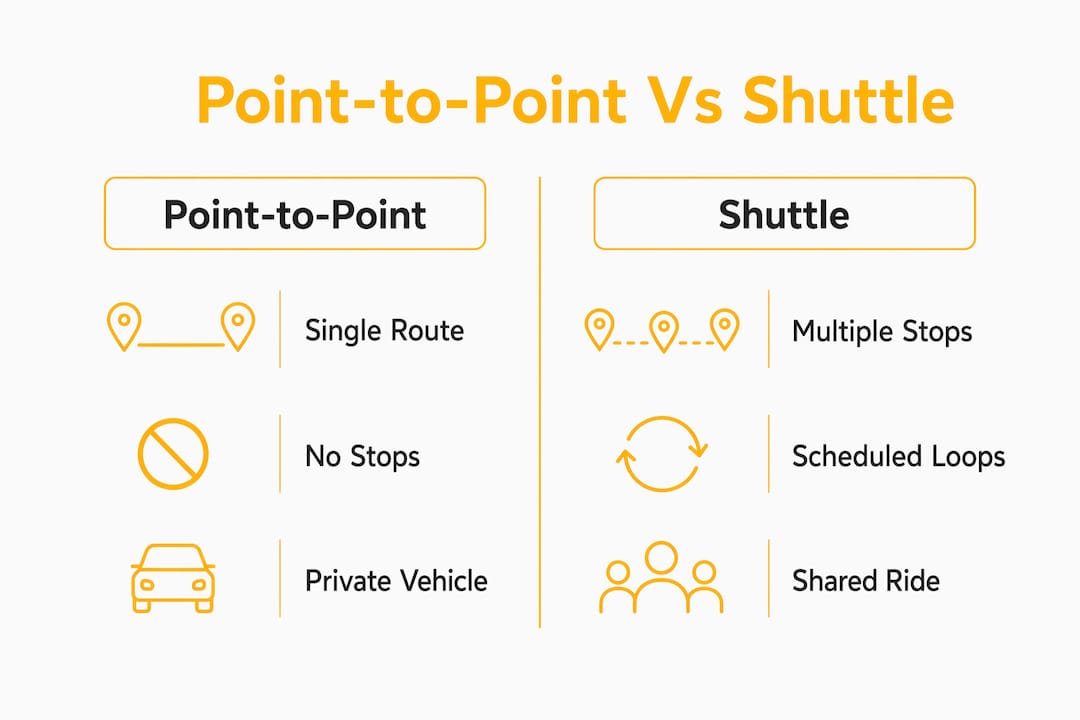
The distinction is straightforward once you see it from a routing perspective. Shuttles operate on fixed routes with multiple stops, cycling through a loop to move people in batches. Point-to-point service is exclusive and built entirely around your itinerary.
Point-to-point vs. shuttle vs. scheduled loop at a glance:
- Route flexibility: point-to-point is fully custom; shuttles follow a fixed stop sequence; loops repeat a circuit
- Scheduling: point-to-point departs when your group is ready; shuttles run on a timetable regardless of your event flow
- Travel time: point-to-point trips are faster because there are no intermediate pickups or drop-offs
- Cost per person: shared shuttles cost less per head for short, repeated trips; an exclusive charter costs more because the vehicle is yours alone
- Capacity: a single coach handles large groups in one vehicle; shuttle loops often require smaller vehicles making multiple runs
When to choose each model:
- Choose point-to-point when your group travels together, timing is tight, and privacy matters
- Choose a shared shuttle when attendees arrive in waves and a continuous loop is more practical than a single departure
- Choose a scheduled loop for multi-venue festivals or conferences where guests move between several locations throughout the day
For a deeper look at how these models compare for corporate outings, the transport types guide on the Torontobusrentals site breaks down the decision by event type.
When is point-to-point the right call for Toronto events?
Toronto’s traffic, limited curbside access, and venue-specific loading rules make point-to-point particularly attractive for time-sensitive events. Specific use cases where it tends to be the strongest fit:
- Weddings: guests travel as a single group from hotel to ceremony or reception; timing is fixed and late arrivals are not an option
- Single-venue corporate conferences: one pickup location, one drop-off, no coordination overhead for multiple stops
- Airport transfers tied to a single flight block: the group clears customs together and moves directly to the hotel or event site
- Sports team transit: a sports team charter to a single stadium keeps the group together and eliminates the logistics of coordinating individual travel
Point-to-point is likely not the best fit when arrivals are staggered over several hours, when guests are coming from multiple locations across the city, or when a multi-venue festival requires continuous circulation. In those cases, a shuttle loop or a combination of vehicle types usually serves the group better.
What operational details do you need to confirm before booking?
Getting an accurate quote and a smooth day-of experience depends on the specifics you provide upfront. Work through this list before you contact a provider:
- Exact pickup and drop-off addresses, including building entrance or loading dock details
- Departure time and required arrival time, with buffer minutes built in for Toronto traffic
- Load and unload allowances, particularly if guests have luggage, equipment, or mobility aids
- Accessible vehicle requirements, including lift-equipped coaches or low-floor minibuses
- Driver credentials, including a valid Commercial Vehicle Operator’s Registration (CVOR) for the carrier and a Class B or Class C licence for the driver, as required under Ontario regulations
- Insurance coverage, including third-party liability minimums for commercial passenger carriers in Ontario
- Permits and loading zone access, especially for venues in downtown Toronto where curbside staging requires advance coordination with venue operations or the City
Share detailed itineraries with the provider, including exact coordinates, expected load times, and any permit requirements, to avoid surprises on the day.
What drives the cost of a point-to-point charter quote?
Providers typically calculate charges using a combination of factors. Understanding them helps you request comparable quotes and spot where costs can shift.
- Vehicle class and capacity: a sprinter van for 12 passengers costs less than a full-size coach for 55
- Hourly vs. mileage billing: most providers charge by a combination of hourly rates and distance; confirm which method applies to your trip
- Driver wait time: if the vehicle idles at a venue for three hours, that time is usually billable
- Deadhead distance: the return trip to base without passengers is often added to the total; ask upfront
- Amenities and extras: Wi-Fi, climate control, luggage bays, and accessible equipment can affect the rate
Shuttle models tend to be more cost-effective for short, repeated trips; an exclusive charter costs more because the vehicle is reserved entirely for your group. When comparing quotes, use identical inputs: same origin and destination, same passenger count, same amenities, and the same departure and return times.
Pro Tip: Model two scenarios side by side: an hourly shuttle block versus a single coach day rate. For groups over 30 travelling together, the exclusive coach often reaches a lower per-person cost than running multiple shuttle loops.
Your step-by-step booking checklist
| Stage | Task |
|---|---|
| Pre-booking | Confirm guest count, exact pickup/drop addresses, accessibility needs, and preferred vehicle class |
| Pre-booking | Set a provisional schedule with buffer time for Toronto traffic and venue load/unload |
| Booking | Review deposit terms, contract cancellation policy, and insurance or waiver requirements |
| Booking | Designate a single day-of contact and share their number with the provider in writing |
| Booking | Confirm a contingency plan for delays (traffic, late guests, venue access changes) |
| Day-of | Brief the marshal or lead organiser on vehicle staging location and driver contact details |
| Day-of | Confirm driver has written itinerary with exact addresses and your contact’s number |
| Post-trip | Reconcile any wait-time or additional charges against the original quote |
The Torontobusrentals event transportation checklist covers pre-booking through post-trip reconciliation in a format you can hand directly to an operations colleague.
What should you expect from a professional Toronto charter operator?
A reputable local operator will offer a fleet that covers the main vehicle classes relevant to point-to-point bookings:
- Full-size motor coaches (46–55 passengers): best for large single-group transfers; charter buses provide fully flexible routes and door-to-door service for private group travel
- Minibuses (18–30 passengers): practical for mid-size corporate or wedding groups; smaller executive vehicles are cost-efficient for small groups and shorter distances
- Sprinter vans (10–14 passengers): ideal for airport transfers or VIP executive runs
On the safety side, confirm that the carrier holds a valid CVOR, that drivers carry the appropriate Ontario licence class, and that the company maintains commercial liability insurance meeting provincial minimums. A professional operator will also provide a clear booking process: written confirmation, a named dispatcher contact, and a communication protocol for day-of changes.
Pro Tip: Ask the provider whether their drivers receive a written briefing sheet for each trip. Operators who do this consistently are the ones who handle last-minute venue changes without losing time.
What does a point-to-point charter typically cost in Toronto?
Exact pricing varies by vehicle class, distance, and duration, but the ranges below reflect what Toronto-area planners generally encounter. A sprinter van for an airport-to-hotel transfer of short duration typically falls in the low cost range for the trip. A minibus for a wedding guest transfer of similar duration typically costs a moderate amount. A full-size coach for a half-day corporate event, including driver wait time, generally costs a higher amount depending on distance and amenities.
These are illustrative ranges, not fixed prices. Your actual quote will shift based on deadhead distance, wait time, and any permit or parking costs the provider incurs. The most reliable way to budget is to request quotes with identical inputs from at least two providers and compare line by line.
How long does the booking process take?
For straightforward point-to-point bookings, most Toronto operators can confirm availability and issue a quote within 24–48 hours of receiving your full itinerary details. Contract signing and deposit payment typically follow within a few business days. For large events or peak dates (June through September weddings, major conference weeks), plan for a minimum of four to six weeks of lead time. Cross-border trips to the United States require additional documentation under federal regulations, which can extend the confirmation timeline by one to two weeks.
A realistic planning window from first inquiry to signed contract is two to four weeks for standard bookings, and six to eight weeks for complex or multi-vehicle arrangements.
Key takeaways
Point-to-point transportation is the right choice for Toronto event planners when the group travels together, timing is fixed, and a direct, private route is worth the premium over a shared shuttle model.
| Point | Details |
|---|---|
| Core definition | One origin, one destination, private vehicle, no intermediate stops. |
| Best use cases | Weddings, single-venue conferences, airport transfers, and sports team transit. |
| Cost drivers | Vehicle class, hourly or mileage billing, driver wait time, and deadhead distance all affect the final quote. |
| Booking lead time | Allow two to four weeks for standard bookings; six to eight weeks for peak dates or cross-border trips. |
| Torontobusrentals | Offers motor coaches, minibuses, and sprinter vans for point-to-point charters across Toronto, with a clear booking process and local operational knowledge. |
The detail most planners overlook
The biggest gap between a smooth point-to-point transfer and a chaotic one is almost never the vehicle. It is the communication structure on the day. Planners spend weeks confirming guest counts and vehicle classes, then show up without a single person designated to talk to the driver. When the venue shifts the loading zone at the last minute, or a guest is running 20 minutes late, the absence of a single day-of contact creates a decision vacuum that costs time nobody has.
The other thing planners consistently underestimate is Toronto’s curbside reality. Loading zones at downtown hotels and conference venues are often shared, time-limited, or require advance coordination with building operations. Confirming staging access with the venue before the event, not the morning of, is the difference between a vehicle that pulls up cleanly and one that circles the block while guests stand on the sidewalk.
Point-to-point is genuinely the most efficient model for a group that travels together. But efficiency only materialises when the logistics are locked in before the day starts.
How Torontobusrentals handles point-to-point bookings in Toronto
Group travel that runs on a fixed schedule, with a single pickup and a single destination, is exactly what Torontobusrentals is built for. The fleet covers the full range of point-to-point needs: full-size motor coaches for large corporate or wedding groups, minibuses for mid-size transfers, and sprinter vans for airport runs and executive pickups. Every booking comes with a professional driver, a confirmed itinerary, and a dispatcher you can reach on the day.

Getting a firm quote starts with three pieces of information: your pickup address, your drop-off address, and your passenger count. From there, the team can recommend the right vehicle class and walk you through pricing, including any wait time or permit considerations for your specific venue. For planners who want to see the full range of group transportation options before committing, the Torontobusrentals site has vehicle-specific pages and logistics guides built for exactly this stage of planning. Request your quote at torontobusrentals.ca and have your itinerary details ready to get a price that reflects your actual event.
Useful sources
- Shuttle Service vs. Point-to-Point Service in Transportation: covers the core distinctions between shared shuttle models and exclusive point-to-point charters, including cost and time trade-offs
- Shuttle Bus vs Charter Bus: Key Differences Explained: explains route flexibility and scheduling differences between shuttle and charter services
- Plush Transportation: Shuttle vs. Bus Rental Costs: breaks down pricing structures including hourly rates, mileage, and vehicle class cost comparisons
- Group Transportation Solutions for Events and Team Travel: practical operational guidance on day-of coordination, single-contact protocols, and itinerary sharing
- Torontobusrentals: Group Transportation Logistics Explained: operational templates and logistics workflows for Toronto event planners
- Torontobusrentals: Event Transportation Checklist: pre-booking through post-trip checklist in a format planners can use directly
Recommended
- Defining event group transportation for planners
- Role of transportation in event planning: 2026 guide
- Smart transportation ideas for Toronto corporate events