
Defining event group transportation for planners
TL;DR:
- Event group transportation involves careful planning of logistics, vehicle selection, and attendee experience, not just booking seats. Choosing the appropriate vehicle type and early booking, along with detailed route and manifest management, ensures smooth, punctual group movement for events. Proper planning minimizes delays and enhances guest satisfaction, differentiating a flawless event from a logistical nightmare.
Most event planners assume that arranging group transportation is simply a matter of calling a vehicle provider and booking seats. The reality of defining event group transportation is far more layered. It touches on logistics strategy, attendee experience, vehicle selection, regulatory considerations, and budget planning. Get it wrong, and you create bottlenecks, frustrated guests, and reputational damage. Get it right, and transportation becomes an invisible part of a flawless event. This guide breaks down exactly what event group transportation means, what it involves, and how to plan it properly.
Table of Contents
- Key takeaways
- Defining event group transportation: what it actually means
- Vehicle types and what they are suited for
- Planning considerations and logistics
- Charter services vs. public and shuttle transport
- Choosing the right transportation for your event
- My take on where planners go wrong
- Plan your Toronto event transport with Torontobusrentals
- FAQ
Key takeaways
| Point | Details |
|---|---|
| More than vehicle booking | Defining event group transportation means aligning logistics, schedules, and attendee needs, not just reserving seats. |
| Match vehicles to event type | Vehicle selection should reflect group size, event style, and desired onboard atmosphere. |
| Book well in advance | Small events need two to four weeks’ notice; large conferences require one to three months for guaranteed availability. |
| Know the charter vs. public distinction | Private charter services for exclusive attendee groups must use non-federal funding under FTA guidelines. |
| Logistics detail determines success | Manifest management, staggered departures, and on-site coordination are the difference between smooth flow and chaos. |
Defining event group transportation: what it actually means
At its core, event group transportation is the coordinated movement of a defined group of people to, from, or between event locations, using vehicles arranged specifically for that purpose. It is not the same as individual travel or public transit use. The distinction matters because event group transport is organised around a shared itinerary, a specific attendee profile, and an event programme with fixed timing requirements.
The services that fall under this definition include:
- Private charter coaches for full group movements between venues, hotels, and airports
- Event shuttle transportation running continuous loops between a central hub and the event site
- Executive transfers for VIP guests, speakers, or executives needing private vehicle arrangements
- Multi-stop itinerary services for tours, team-building outings, or progressive events
- Airport meet-and-greet transfers for delegates arriving from out of town
Several factors determine what group transportation for an event actually requires. Group size is the most obvious. An intimate corporate dinner for 20 people calls for a minibus or two executive vehicles. A national conference drawing 800 delegates calls for a co-ordinated fleet. Event type shapes the experience expectations: a wedding party wants a different atmosphere than a corporate delegation. Itinerary complexity matters too. A single venue event is straightforward. A multi-stop gala or a sports event with staggered arrivals demands a layered logistics plan.
The role of group transportation within overall event logistics transport is to remove travel friction for attendees. When it is done well, guests arrive on time, relaxed, and ready. When it is poorly planned, late arrivals and confusion undermine the entire event experience before it has even started.
Vehicle types and what they are suited for
Planners who approach group transport with a one-size-fits-all mindset routinely choose the wrong vehicle. Understanding the options is the foundation of smart selection.
| Vehicle type | Typical capacity | Best suited for | Key features |
|---|---|---|---|
| Limousine | 6 to 10 passengers | Weddings, VIP transfers, formal galas | High-end interior, privacy, prestige |
| Party bus | 15 to 40 passengers | Social events, bachelorette parties, milestone birthdays | Entertainment system, standing room, social atmosphere |
| Minibus | 14 to 28 passengers | Corporate outings, airport transfers, smaller conferences | Practical, comfortable, efficient |
| Executive shuttle | 20 to 35 passengers | Conferences, trade shows, corporate events | Professional interior, reliable scheduling |
| Motor coach | 40 to 55 passengers | Large conferences, weddings, group tours, sports teams | Maximum capacity, luggage storage, long-distance comfort |
Vehicle choice directly impacts the guest experience and how well it fits the event’s style. A limousine signals prestige and exclusivity. A party bus creates a social, celebratory atmosphere while in transit. An executive shuttle signals professionalism and efficiency, which is exactly what a corporate audience expects.

Beyond atmosphere, consider practical factors. Does your itinerary involve multiple stops? A motor coach with luggage capacity handles overnight conference trips differently than a shuttle running a fixed loop. Does the group value privacy, or will they benefit from socialising en route? How long is the journey? For rides exceeding 90 minutes, passenger comfort and amenities matter far more.
Professional chauffeurs contribute significantly to the premium experience. Managing route planning, timing, and passenger co-ordination are not just logistical tasks. They reduce travel stress, particularly for guests unfamiliar with the city.
Pro Tip: For corporate events where multiple vehicle types are in use simultaneously, assign a single point of contact at the venue who liaises with all drivers. This prevents the confusion that happens when drivers communicate with different organisers at once.
Planning considerations and logistics
Solid group travel co-ordination rests on four pillars: timing, route design, manifest management, and communication. Planners who address all four systematically avoid the most common operational failures.
Book early. Advance booking of two to four weeks suits small to midsize events. For large conferences, book one to three months out to guarantee availability and lock in pricing. Last-minute bookings restrict your vehicle choices and often increase costs.
Design the route before confirming the provider. Map every stop, including hotel pick-ups, the venue, any mid-event transfers, and the return journey. Share this with your provider before signing a contract. Surprises about route complexity after booking create delays and cost overruns.
Build and share a manifest. A passenger manifest is a list of guests assigned to each vehicle and departure time. Effective planning with manifest management aligns schedules and reduces delays. Update it as your guest list changes and share the final version with drivers at least 24 hours before the event.
Use staggered departures to manage guest flow. Deploying coordinators at a 1:50 guest ratio with vehicle staging and manifest tracking has been shown to significantly reduce congestion at large-scale conferences and galas. If you cannot afford dedicated staff, designate a volunteer or assistant for each vehicle.
Build contingency into every schedule. Traffic delays, late arrivals, and last-minute changes are predictable in the sense that something will always shift. Add 15 to 20 minutes of buffer at key points in the itinerary, particularly around peak urban travel times.
Confirm communication protocols with the provider. Know which number to call if a vehicle is late. Clarify who communicates with guests about delays. Establish whether real-time tracking is available for your vehicles so you can monitor progress from your event command point.
Pro Tip: Confirm driver mobile numbers directly and save them to your phone before the event. When something goes wrong on the day, you need to reach the driver immediately, not navigate a phone menu at a dispatch centre.
Charter services vs. public and shuttle transport
One of the most misunderstood distinctions in group transport planning is the difference between private charter services and public or subsidised shuttle services. Getting this wrong has both legal and financial consequences.
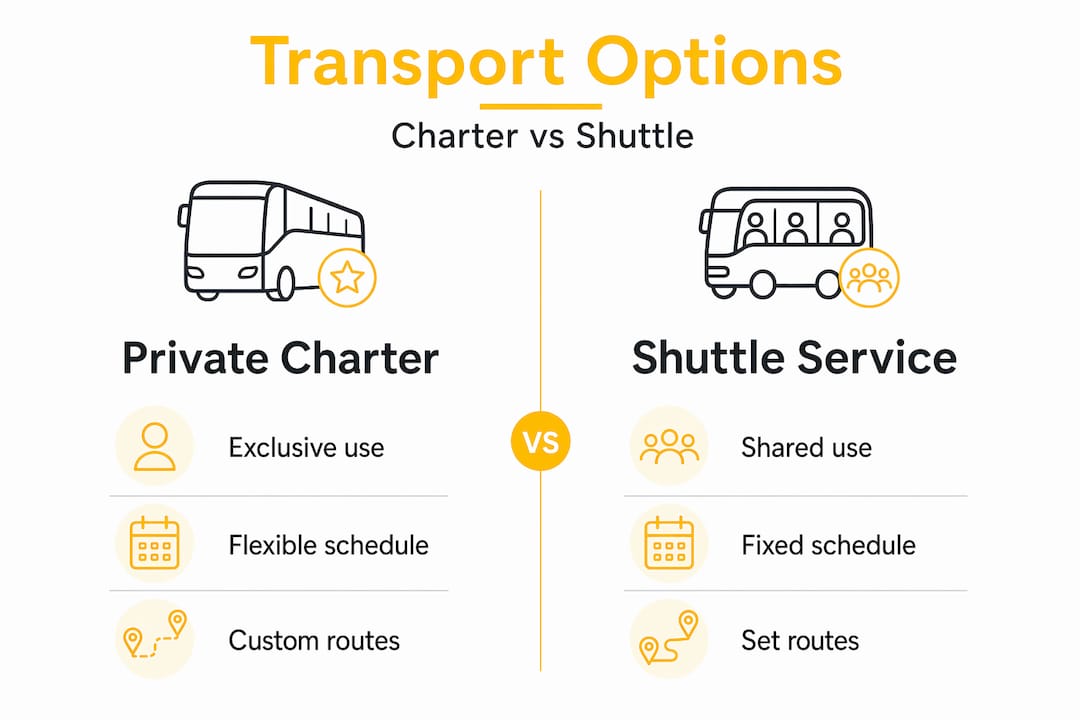
Charter service is transportation provided at the request of a third party for exclusive use, at a negotiated price, and not part of a regular scheduled service. This definition has regulatory consequences in Canada and the United States.
| Service type | Exclusive use | Funding source | Schedule type | Typical use case |
|---|---|---|---|---|
| Private charter | Yes | Private only | Negotiated, on-demand | Corporate events, weddings, private groups |
| Public transit | No | Federal or public | Fixed, scheduled | General public movement to large events |
| Event shuttle | Varies | Private or public | Fixed loop or on-demand | Conference attendees, venue-to-hotel loops |
Exclusive shuttle services for ticket holders, athletes, or media are classified as private charter services and must use non-federal funding. This matters to planners working with organisations that receive public grants or transit partnerships. Using public transit funding to operate what is effectively a private attendee shuttle creates a compliance problem.
For most corporate, social, or special event planners, private charter is the default and the correct choice. It gives you control over scheduling, routing, and exclusivity. Public transit partnerships are more relevant for mass public events such as music festivals or sports games where moving general audiences is the goal rather than managing a defined attendee list.
When evaluating whether to use private charter or shuttle services, ask two questions: Is the use of the transport restricted to a defined list of people? And is the funding source entirely private? If both answers are yes, you are dealing with a private charter and should plan and contract accordingly.
Choosing the right transportation for your event
The best group transportation options are not always the most expensive. They are the ones that match your event’s specific profile. Here is a practical framework to apply before you contact any provider:
- Define your group size precisely. Know the minimum and maximum headcount you expect, not an estimate. Undersizing vehicles is the most common and most preventable mistake in group transport planning.
- Map the full itinerary. List every location, transfer time, and stop in sequence. Your provider needs this to quote accurately and plan driver assignments.
- Identify your audience’s expectations. Corporate executives have different expectations than a 30-person birthday group. The vehicle and service style should reflect your attendees’ norms, not just your budget.
- Ask every provider the right questions. How far in advance do you confirm drivers? What is your contingency plan if a vehicle breaks down? Do you provide on-site co-ordinators for large groups? What does your manifest process look like?
- Account for the full cost picture. Gratuity, fuel surcharges, parking at the venue, and overtime fees for events running long are frequently omitted from initial quotes. Confirm the all-in price before signing.
- Use a bus rental checklist specific to events. A structured checklist prevents the oversight of important details under the time pressure of event planning.
The payoff for getting transportation right is measurable. Attendees who arrive on time, in comfort, and without stress are in the right frame of mind for engagement. Transportation that is poorly planned leaves a lasting negative impression, often remembered long after other event details have faded.
My take on where planners go wrong
I have seen event transportation treated as an afterthought too many times. Planners invest months in venue selection, catering, and programme design, then try to sort transport in the final two weeks. The result is predictable: limited vehicle availability, no time to build a proper manifest, and zero contingency planning.
What I have found consistently is that transportation satisfaction is a proxy for overall event satisfaction. When guests are waiting 40 minutes for a shuttle that was not properly staged, no keynote speaker or dinner menu recovers that impression. The dissatisfaction is disproportionate to the cause.
The other mistake I see regularly is underestimating the value of a good driver. Not just someone with a licence, but a professional who knows the city, anticipates traffic, and communicates proactively. For events in a dense urban environment like Toronto, the difference between a great driver and an average one can be 20 minutes and a lot of stress.
My honest advice: treat transportation as a guest experience element, not just a logistics line item. Budget for it properly, plan it early, and choose your provider based on their co-ordination process, not just their per-hour rate.
— Firoz
Plan your Toronto event transport with Torontobusrentals

Torontobusrentals works with event planners across Toronto to match the right vehicles and service structure to the specific demands of each event. Whether you are co-ordinating corporate group transport for a downtown conference, arranging shuttle loops for a gala, or managing fleet logistics for a multi-day convention, the team at Torontobusrentals has the fleet and the planning expertise to support you.
From 18-passenger minibuses to 55-seat motor coaches, every vehicle comes with a professional driver and a service standard built around punctuality and attendee comfort. Explore options for maximising group travel efficiency and see how working with a local Toronto provider simplifies the logistics from first booking to final drop-off. Contact Torontobusrentals early in your planning cycle to get accurate availability and pricing for your event.
FAQ
What does event group transportation include?
Event group transportation covers all co-ordinated vehicle services arranged for a defined group of attendees, including charters, shuttles, executive transfers, and multi-stop itinerary services tied to an event programme.
How far in advance should I book group transportation?
Small to midsize events need two to four weeks of advance notice. Larger conferences and multi-vehicle events should be booked one to three months ahead to confirm availability and pricing.
What is the difference between a private charter and a public shuttle service?
A private charter provides exclusive transport for a defined group at a negotiated price and must be funded privately. Public shuttle services use scheduled routes and may use public or federal funding for general audience movement.
Which vehicle type works best for corporate events?
Executive shuttles and motor coaches suit large corporate conferences, while minibuses work well for smaller team outings or airport transfers. The right choice depends on group size, itinerary complexity, and the level of professional atmosphere required.
How do I avoid congestion at large group pick-ups and drop-offs?
Use staggered departure times, assign an on-site co-ordinator for every 50 guests, and share a confirmed passenger manifest with drivers before the event. These three steps resolve the majority of bottleneck issues at large-scale events.
Recommended
- What is event transportation: a planner’s guide
- Group transportation explained: efficient solutions for Toronto events
- Group transportation logistics explained for event planners
- Why book a bus for conferences: a smarter group travel solution