
Corporate transportation trends 2026: what leaders must know
TL;DR:
- In 2026, corporate transportation is driven by data management, sustainability regulations, and employee wellbeing. Companies increasingly integrate technology and compliance to optimize costs, reduce emissions, and enhance employee performance. Pre-booked group shuttles offer significant savings and reliability, positioning transport as a strategic asset rather than a cost.
Corporate transportation trends in 2026 are defined by three forces reshaping how companies move people: data-driven fleet management, binding sustainability regulations, and the measurable impact of travel quality on employee productivity. The corporate employee transportation market grew from $38.46 billion in 2025 to $41.7 billion in 2026, an 8.4% year-over-year increase. That growth reflects return-to-office mandates, tightening duty-of-care obligations, and a fundamental reclassification of transport from a cost line to a strategic asset. For corporate decision-makers and event planners in Toronto and beyond, the window to act on these shifts is now.
What are the corporate transportation trends shaping 2026?
Business mobility in 2026 is no longer a procurement afterthought. Three converging forces are driving the change: artificial intelligence applied to scheduling and disruption management, mandatory Scope 3 emissions reporting under the EU CSRD Omnibus package, and quantified employee wellbeing metrics that now sit on board-level dashboards. Each force independently demands a policy response. Together, they require a complete rethink of how corporate transport programmes are designed, procured, and measured. Companies that treat these trends as isolated compliance tasks will spend more and deliver less than those that integrate them into a single transport strategy.
How is technology changing corporate transport logistics?
Technology is the most immediate driver of efficiency gains in group transportation trends for 2026. The shift is not simply about adding apps. It is about treating your entire transport programme as a data system first, and a vehicle fleet second.

AI scheduling and predictive rebooking
By 2025, 80% of business travellers used generative AI in travel planning to manage bookings and handle disruptions. That adoption rate means AI-assisted scheduling is now a baseline expectation, not a differentiator. Predictive rebooking tools analyse flight delays, traffic data, and calendar changes to reroute ground transport before a problem becomes a crisis. The practical gain for event planners is fewer last-minute scrambles and lower rescheduling costs.
Real-time route analytics and fleet integration
Smart route optimisation platforms pull live traffic feeds, office occupancy data, and shift patterns to assign the right vehicle size to each run. This eliminates the common waste of sending a 46-passenger coach for a group of twelve. Integrated data platforms that connect employee schedules, real-time fleet positions, and compliance requirements deliver the strongest return on investment by automating both reporting and operations.
Key technology capabilities worth prioritising in 2026:
- AI-powered disruption alerts that trigger automatic rebooking without manual intervention
- HR and finance system integration to automate duty-of-care records and expense reconciliation
- Passenger app interfaces that give employees real-time vehicle tracking and boarding notifications
- Capacity analytics dashboards that flag underutilised routes and recommend consolidation
Pro Tip: Before selecting a fleet management platform, confirm it exports Scope 3 emissions data in a format compatible with your sustainability reporting framework. Retrofitting this capability after procurement is expensive and time-consuming.
Why is sustainability now a board-level transport issue?
Sustainability compliance has moved corporate transportation procurement from the facilities manager’s desk to the executive suite. The trigger is regulatory, not voluntary.
Mandatory Scope 3 emissions reporting now includes employee commuting under the EU CSRD Omnibus package, effective 2026. Large enterprises must report verified carbon intensity data per passenger-kilometre for ground transport. That requirement means your transport provider’s emissions data is now a compliance input, not a marketing claim. Choosing a provider that cannot supply verified figures creates a reporting gap that auditors will flag.
The operational implications are significant:
- Verified emissions data per trip must be collected and stored, not estimated
- Electric and low-emission vehicle fleets are now preferred over conventional diesel coaches for compliance reasons, not just brand positioning
- Outsourced transport services with documented environmental credentials reduce the internal burden of data collection
- Procurement criteria must now include carbon intensity benchmarks alongside price and reliability scores
Sustainability compliance has pushed transport procurement to senior executives, increasing demand for eco-friendly fleets and verified emissions data. This is a structural shift. The companies best positioned for 2026 are those that have already built emissions tracking into their transport contracts rather than scrambling to add it at year-end reporting time.
Does pre-booked group transport actually save money?
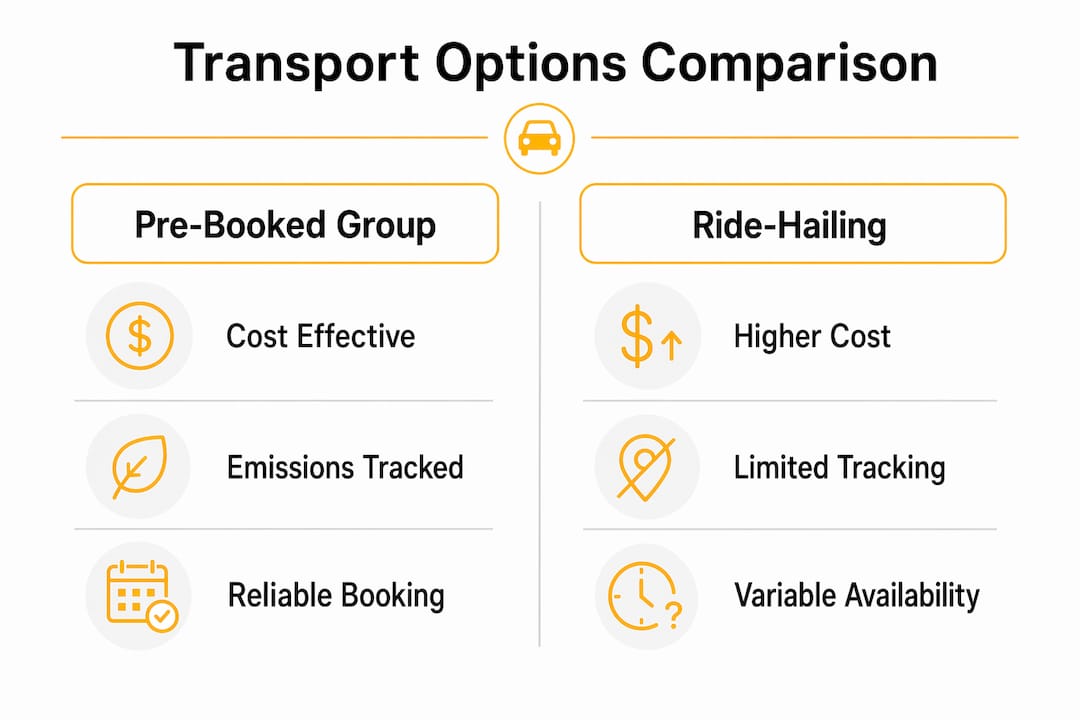
The cost argument for coordinated group transport is straightforward and well-supported by data. Switching from multiple ride-hailing vehicles to a single pre-booked group shuttle reduces costs by up to 60% per person for corporate teams. A group of six using ride-share apps typically pays $180–$300 total. The same group in a pre-booked shuttle pays $300–$600 total, or $25–$50 per person. The per-person saving is substantial, and it compounds across a full year of corporate travel.
Comparing your main transport options
| Transport Mode | Cost for 6 People | Comfort Level | Emissions Tracking | Booking Reliability |
|---|---|---|---|---|
| Ride-hailing apps | $180–$300 | Variable | None | Low |
| Chauffeur SUVs | $400–$700 | High | Partial | Medium |
| Pre-booked group shuttle | $300–$600 total | High | Full | High |
| Motor coach (larger groups) | Best per-person rate | Premium | Full | Highest |
The table makes the case clearly. Pre-booked group options win on cost per person, emissions documentation, and booking reliability. Chauffeur SUVs remain appropriate for executive travel where individual comfort and discretion are priorities. Ride-hailing apps are the worst performer on every metric that matters for corporate compliance and cost control.
Standardising transport pre-booking at least 24–72 hours in advance reduces logistical risk and delivers cost stability. Last-minute bookings carry hidden costs that affect both reliability and rider experience, particularly in regional markets like Toronto where peak-hour demand can spike unpredictably.
Pro Tip: Build a 48-hour booking window into your corporate travel policy as a hard rule, not a guideline. Exceptions should require manager approval. This single policy change typically reduces transport overspend by a measurable margin within one quarter.
For Toronto-based planners, corporate shuttle services that offer fixed-rate pre-booking eliminate the price volatility that makes ride-hailing budgets unreliable.
How does transport quality affect employee productivity?
The link between ground transport quality and employee performance is now quantified, not assumed. Travellers who arrive stressed perform worse in meetings and incur higher rescheduling and turnover costs. That makes the quality of the journey a direct input to business outcomes, not a perk.
Wellbeing has evolved into a measurable KPI affecting retention and productivity, making transport quality a board-level concern. The practical implication is that a premium motor coach with Wi-Fi, comfortable seating, and a professional driver is not a discretionary upgrade. It is a productivity investment with a calculable return.
The strategic case for premium ground transport in 2026 rests on four measurable outcomes:
- Reduced pre-meeting stress translates directly to better decision-making and meeting performance
- Lower turnover costs when employees associate their employer with a high standard of care
- Duty-of-care compliance is easier to document when transport is managed through a single professional provider
- Safety perception scores improve when employees travel in vetted, professionally driven vehicles rather than unvetted ride-hailing cars
Corporate transportation has shifted from a discretionary expense to a strategic lever for productivity, environmental compliance, and duty of care. Premium pre-booked services consistently outperform taxis and ride-shares on the KPIs that now matter to corporate travel managers. For event planners specifically, the transport experience for guests sets the tone for the entire event before anyone walks through the door.
Key takeaways
The most effective corporate transportation strategy in 2026 integrates data systems, sustainability compliance, and employee wellbeing into a single managed programme rather than treating each as a separate initiative.
| Point | Details |
|---|---|
| Market growth signals urgency | The corporate transport market reached $41.7B in 2026, reflecting rising strategic importance. |
| Sustainability is now mandatory | EU CSRD Omnibus requires verified Scope 3 emissions data per passenger-kilometre from transport providers. |
| Group shuttles cut costs by up to 60% | Pre-booked group transport reduces per-person costs significantly compared to ride-hailing apps. |
| Pre-book 24–72 hours ahead | Standardising advance booking eliminates last-minute price spikes and improves service reliability. |
| Transport quality is a productivity KPI | Employees who arrive in comfort perform better, reducing rescheduling and turnover costs. |
The case for treating transport as infrastructure, not logistics
By Firoz
After working closely with corporate event planners and travel managers across Toronto, the pattern I see most often is this: companies invest heavily in the event itself and treat the transport as an afterthought. That approach is increasingly costly in 2026, and not just financially.
The organisations getting the most value from their transport programmes are the ones that have stopped thinking about vehicles and started thinking about data flows. They know their per-trip emissions figures. They have pre-booking policies written into travel expense guidelines. They measure whether employees arrive on time and in good condition. That is not over-engineering. That is what compliance and duty-of-care now require.
The sustainability angle is the one I find most underestimated. Many planners I speak with assume Scope 3 reporting applies only to flights. It does not. Employee commuting and ground transport are explicitly included under the EU CSRD Omnibus framework, and similar requirements are moving through Canadian regulatory discussions. If your transport provider cannot give you verified carbon intensity data per trip, you have a compliance gap that will become a problem at your next sustainability audit.
My honest recommendation: standardise your pre-booking window, choose providers who supply emissions documentation, and stop treating a quality motor coach as a luxury. The productivity and retention numbers make the investment straightforward to justify to any CFO.
— Firoz
Plan your next corporate event transport with Torontobusrentals
Corporate decision-makers and event planners in Toronto need transport solutions that deliver on cost, compliance, and comfort without the complexity of managing multiple vendors. Torontobusrentals provides professionally driven motor coaches and group shuttle services sized for every corporate event, from executive off-sites to large-scale staff gatherings.

Every vehicle in the Torontobusrentals fleet comes with a professional driver, fixed-rate pre-booking, and the reliability your duty-of-care obligations demand. Whether you need a group shuttle for your next event or a full motor coach for a larger gathering, the fleet covers groups of all sizes. Explore the motor coach options for corporate groups and get a quote that fits your 2026 transport budget.
FAQ
What is driving corporate transportation market growth in 2026?
The corporate employee transportation market reached $41.7 billion in 2026, driven by return-to-office mandates, rising duty-of-care standards, and new sustainability reporting requirements. A projected CAGR of 7.9% through 2030 confirms this is a sustained structural trend, not a short-term spike.
How much can pre-booked group shuttles save compared to ride-hailing?
Switching from ride-hailing apps to a pre-booked group shuttle reduces per-person costs by up to 60% for corporate teams. A group of six pays $25–$50 per person in a shuttle versus $30–$50 each in separate ride-hailing vehicles, with better reliability and emissions documentation included.
What does scope 3 emissions reporting mean for corporate transport?
Under the EU CSRD Omnibus package effective 2026, large enterprises must report verified carbon intensity data per passenger-kilometre for employee ground transport. This means your transport provider must supply documented emissions figures, not estimates, or your sustainability report will have a compliance gap.
How far in advance should corporate transport be booked?
Booking corporate transport 24–72 hours in advance is the standard that delivers cost stability and service reliability. Last-minute bookings carry hidden costs and increase the risk of vehicle unavailability, particularly during peak periods in high-demand markets like Toronto.
Why is employee wellbeing considered a transport KPI in 2026?
Employees who arrive at meetings stressed from poor transport perform worse and generate higher rescheduling and turnover costs. Wellbeing is now tracked as a measurable KPI by leading corporate travel programmes, making ground transport quality a direct input to productivity and retention metrics.
Recommended
- Choose the best transport types for Toronto corporate outings
- Master the role of buses in corporate travel for Toronto events
- Group transportation explained: efficient solutions for Toronto events
- Corporate outing transport guide for Toronto planners