
Children on wedding buses: what parents need to know
TL;DR:
- Children traveling on wedding buses in Canada require proper restraints, depending on bus type and provincial rules.
- Parents should confirm seat and anchor point availability, provide accurate child information early, and follow day-of supervision steps for safety.
Children may travel on chartered wedding buses in Canada, but safe carriage depends on three things: the bus type, the provincial rules that apply where your wedding is held, and whether an appropriate child restraint is available and properly secured. Before you confirm any booking, take these immediate steps:
- Confirm the bus type and whether forward-facing seats with three-point belts or lower/tether anchor points are available.
- Ask the operator directly whether they permit children and whether they can accommodate or help secure a car seat.
- Plan a dedicated child restraint for any child under approximately 18 kg (roughly 4½ years old), as Transport Canada recommends these children use an appropriate child seat rather than relying on compartmentalization alone.
- Contact the operator with exact child ages and weights at the time of inquiry, not the day before the event.
The Canadian Paediatric Society reinforces that child restraints save lives and that the right seat for a child’s size matters more than convenience. Torontobusrentals works with parents to confirm anchor availability and seating assignments before any wedding booking is finalised.
Table of Contents
- Who decides car-seat rules in Canada, and what do parents need to know?
- How does the bus type change the safety picture for your child?
- What should you ask the bus company before you book?
- Day-of steps to keep children safe and comfortable
- Province-by-province notes: how do you check the exact rule?
- How many people fit on a wedding bus, and do children count?
- When a bus is not the right option: backup plans to consider
- How Torontobusrentals handles child passengers
- Key takeaways
- What operators see most often, and how to avoid it
- Torontobusrentals makes child-safe wedding transport straightforward
- Useful sources for parents and planners
Who decides car-seat rules in Canada, and what do parents need to know?
The regulatory chain in Canada has two levels, and understanding both saves you from a nasty surprise on the wedding day.
Transport Canada sets the technical vehicle safety standards: what equipment buses must be built with, how compartmentalization must perform, and when anchor points are required. Provinces and territories then decide when and how child restraints must actually be used in non-private vehicles, including hired coaches and party buses. Operators layer their own policies on top of that. So the answer to “does my child need a car seat on this bus?” runs through three filters, not one.
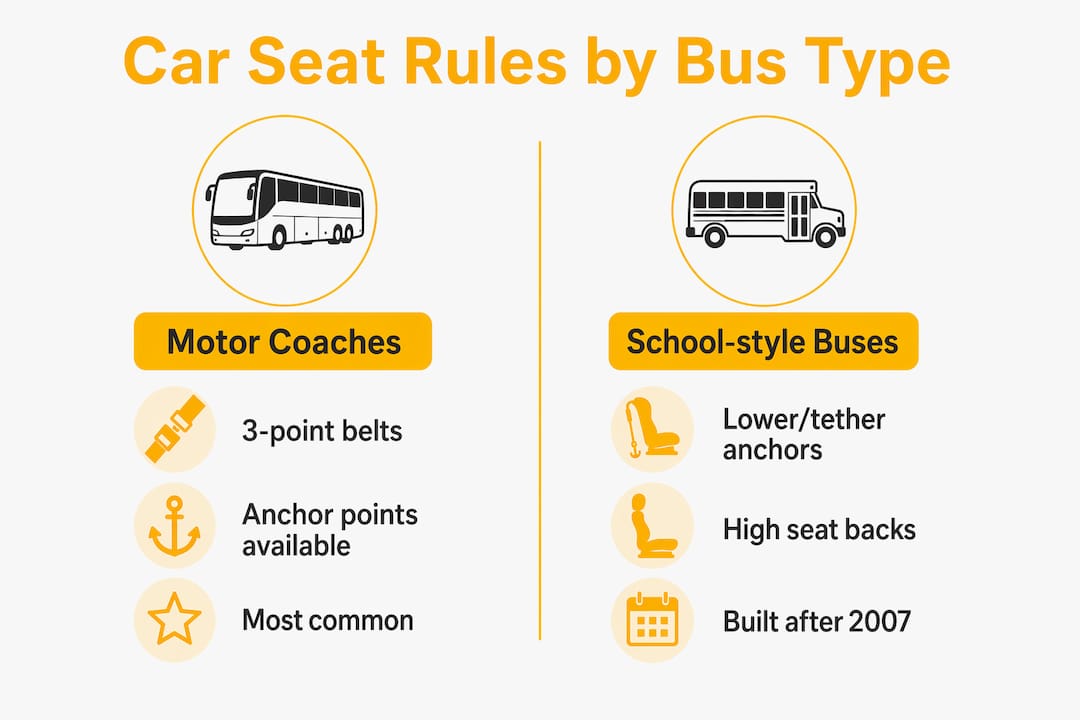
The core safety concept here is compartmentalization. Newer school-style buses are built with high-padded seat backs spaced closely together, designed to absorb crash energy and protect occupants without seat belts. Transport Canada confirms this works well for many school-age children, but not for the smallest ones. A child under about 18 kg has a head-to-body ratio that compartmentalization cannot adequately protect; the energy distribution in a crash simply does not work the same way. That is why Transport Canada specifically recommends a standard child restraint for children in that weight range, even on a bus.
On seat belts specifically, Transport Canada’s position is that belts can add protection when installed and used correctly, but it leaves the decision on installation and use rules to provinces and operators. This means a motor coach hired in Ontario may have three-point belts at every seat, while a school-style bus hired in another province may have only lap belts at anchor-equipped positions.
Statistic to keep in mind: Transport Canada data shows that fewer than 0.02% of all Canadian road deaths involve a school-bus occupant, making buses statistically among the safest ways to move children. That figure does not eliminate the small-child caveat, but it does put the overall risk in perspective.
Three parties share responsibility on the day: the operator confirms anchor availability and assigns appropriate seats; the driver checks that restraints are secured before departure; and the parent or chaperone brings a certified car seat and installs it correctly. None of those three can substitute for the other two.
Pro Tip: Get any special arrangement in writing. If an operator verbally confirms anchor availability, follow up with an email that restates what was agreed. A written record protects everyone if the vehicle changes or a staff member is different on the day.
How does the bus type change the safety picture for your child?
Not all wedding buses are built the same, and the differences matter directly for kids seating on wedding buses.
Motor coaches
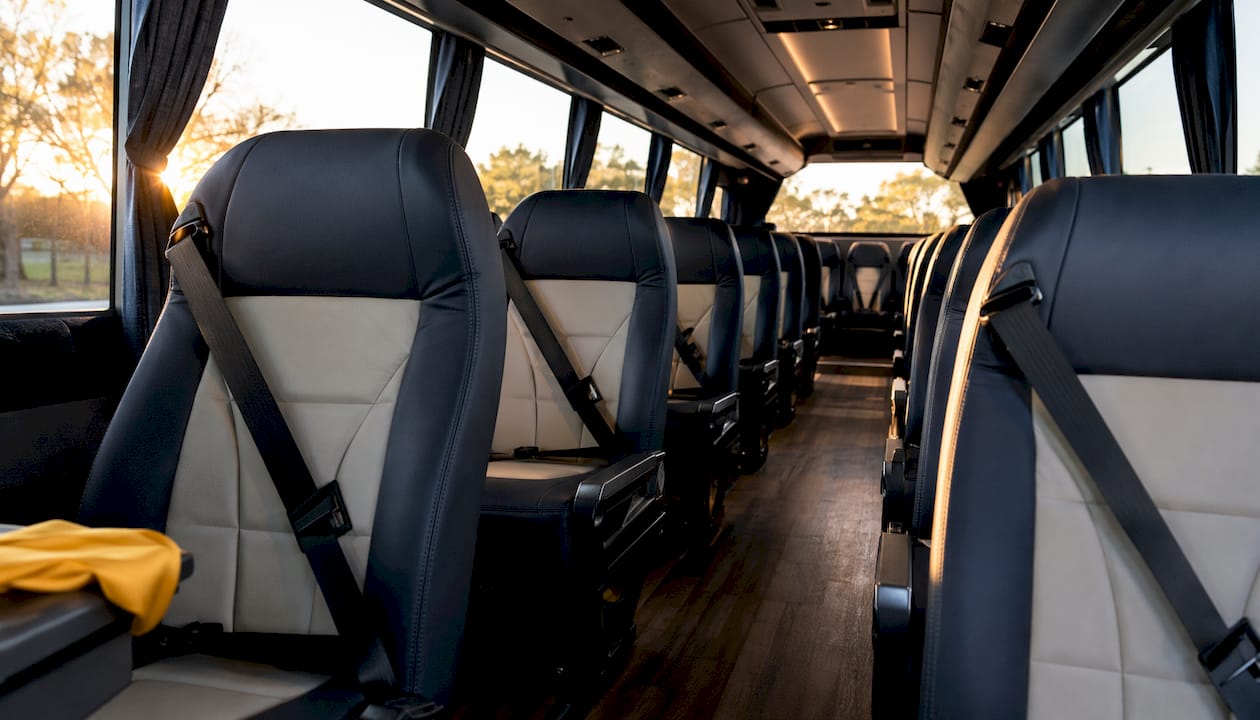
Motor coaches are the most common choice for wedding shuttles. Most modern coaches come with three-point lap-and-shoulder belts at every seat, and newer builds often include lower and tether anchor points at designated positions. This makes them the most straightforward option for parents who need to install a car seat. Confirm the specific seat number with the anchor point before the day, because not every seat in a coach will have anchors even if the vehicle has some. Typical capacity runs within a mid-range suitable for medium-sized groups. For a closer look at what a modern coach offers families, the motor coach amenities page covers the key features.
School-style buses
School buses built after April 1, 2007 are required by Transport Canada to include a minimum number of lower and tether anchorages based on seating capacity: two anchor positions for buses with 24 or fewer seats, four for buses with 25–65 seats, and eight for buses with 66 or more seats. Compartmentalization protects older children well, but the anchor positions matter for children under 18 kg. Torontobusrentals’s school bus rental option is worth discussing with the booking team if your group includes young children who need dedicated restraints.
Perimeter-seating and party buses
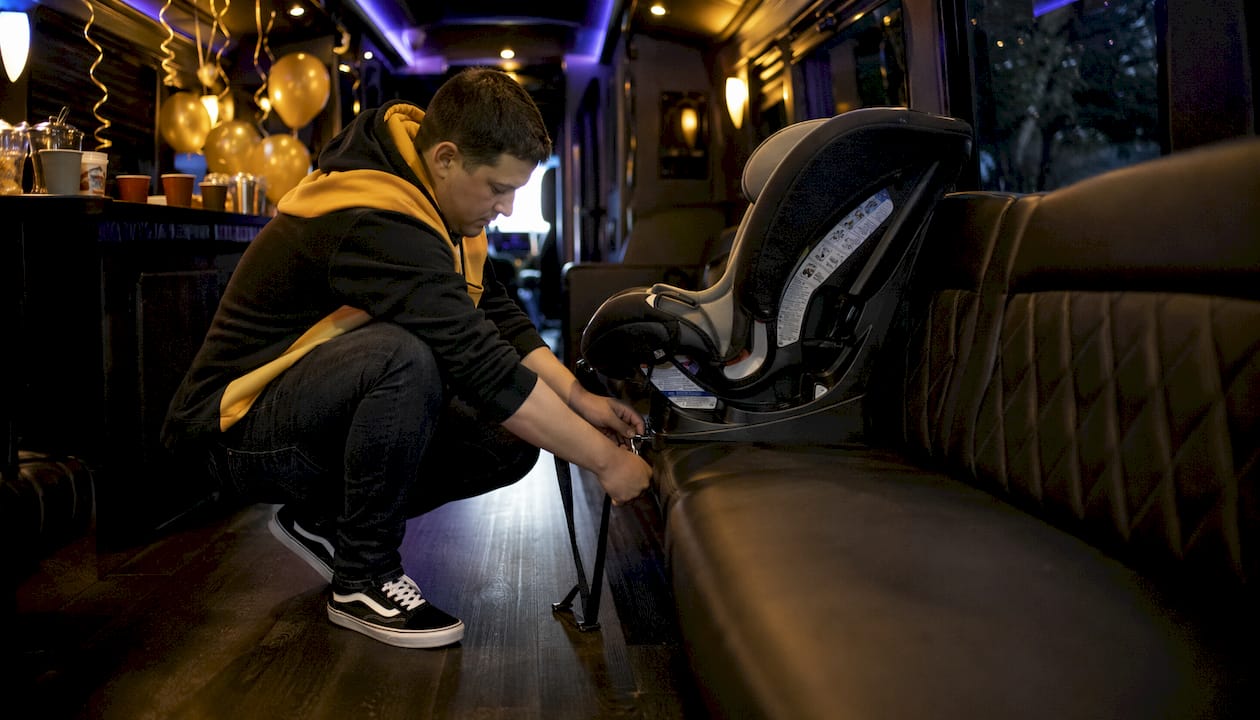
Perimeter buses, where seats line the sides and rear of the vehicle rather than facing forward, present the most complex situation for child-friendly wedding transportation. Passengers face sideways or backward, which changes how crash forces act on a small body. In British Columbia, provincial regulations require trained safety monitors and signed parental consent for any unaccompanied minor on a perimeter-seating vehicle. Other provinces have not yet codified identical rules, but the underlying safety concern applies everywhere. If your wedding bus has perimeter seating, confirm with the operator whether a trained safety monitor will be present and whether a parental consent form is required.
Quick comparison:
- Motor coach: Forward-facing seats, three-point belts common, anchor points at designated seats, capacity roughly 40–56.
- School-style bus: Compartmentalized seating, anchor points required in newer builds, capacity varies widely.
- Perimeter/party bus: Sideways or rear-facing seats, stricter rules for minors in BC, safety monitor may be required, capacity varies.
Pro Tip: Bring your own certified car seat and call the operator at least two weeks out to confirm the exact seat number with compatible anchors. A seat that fits your child at home may not clip into every anchor configuration on a coach.
What should you ask the bus company before you book?
Raising the right questions early is what separates a smooth wedding day from a last-minute scramble. Charter operators consistently advise that special needs, including children and restraint requirements, should be communicated at the first inquiry, not the day before.
Questions to ask before confirming
- What vehicle type will be assigned to this booking, and does it have forward-facing seats with three-point belts?
- Are lower and tether anchor points available, and at which specific seat numbers?
- Will a staff member assist with car-seat installation, or is that the parent’s responsibility?
- Does the operator supply booster seats, and is there an additional fee?
- What is the operator’s written child-passenger policy?
- Does the operator’s insurance cover minors as passengers, and are there any liability exclusions?
- Is a trained safety monitor required or available for this vehicle type?
- What are the emergency procedures if a child is injured or becomes ill during the trip?
- What is the final passenger list deadline, and how should children be listed?
Red flags that should make you pause
- The operator cannot confirm whether anchor points exist on the specific vehicle.
- There is no written child-passenger policy, only a verbal assurance.
- A perimeter-seating bus is proposed for a group that includes unaccompanied minors, with no mention of a safety monitor.
- The operator discourages you from bringing your own certified car seat.
Many motor coach operators do not supply child safety seats, so parents should plan to bring their own and verify compatibility in advance. Request written confirmation of every special arrangement, and note the final passenger list deadline in your planning calendar. Operators typically require a final accurate count at least 48 hours before the event for seat assignment and emergency planning.
Operators may also require parental consent letters and government-issued ID for minors travelling without both parents or as unaccompanied passengers on certain vehicle types, so ask about documentation requirements when you book.
Day-of steps to keep children safe and comfortable
Confirm seating assignments and anchor points before anyone boards. That single step prevents the most common day-of problem: discovering the anchor seat was reassigned or the car seat does not fit the belt configuration.
Before boarding
- Arrive at the bus 15–20 minutes early to inspect anchor points and install car seats.
- Have a trained adult install and check each car seat; a tight, non-wobbling fit is the standard.
- Brief chaperones on their assigned children and confirm each chaperone has the child’s emergency contact information.
- Keep a small kit accessible: first aid supplies, any medication (with consent forms), motion-sickness remedies, and a copy of signed consent forms if required.
During the ride
- Seat children under 18 kg in their installed restraints for the entire trip, no exceptions.
- For children prone to motion sickness, choose forward-facing seats in the middle of the bus, away from the rear axle. Light snacks, water, and a sick bag in the seat pocket go a long way.
- Assign a chaperone to every group of four to six children, not one adult for the whole bus.
- Keep aisles clear of bags and toys that could become hazards in a sudden stop.
Boarding and deboarding
- Supervise children on stairs and at the curb; never let a child step off before an adult is positioned below.
- Brief children before the trip on seat-belt rules and staying seated while the bus is moving.
- Do a headcount before departure and again after each stop.
Parent packing checklist
- Certified car seat or booster seat appropriate for the child’s weight and height.
- Harness and any additional locking clips required for the seat model.
- Extra clothing and a comfort item for long rides.
- Motion-sickness remedies (consult your child’s doctor in advance).
- Signed parental consent form and government-issued ID if the operator requires them.
Province-by-province notes: how do you check the exact rule?
Provinces and territories, not the federal government, decide when child restraints must be used in non-private hired vehicles. Retrofitting rules and anchor requirements also vary by region, so the rule in Ontario may differ from the rule in Alberta or British Columbia.
| Province / Territory | Who to contact | Perimeter bus safety monitor required? | Notes on anchors / installation |
|---|---|---|---|
| British Columbia | BC Passenger Transportation Board | Yes, for unaccompanied minors | Consent form required; monitor must have criminal record check and first-aid training |
| Ontario | Ministry of Transportation Ontario | Not provincially mandated for all bus types | Confirm with operator; motor coaches commonly have three-point belts |
| Alberta | Alberta Transportation | Not provincially mandated for all bus types | Check operator policy; newer school buses have anchors per federal standard |
| Quebec | Société de l’assurance automobile du Québec (SAAQ) | Not provincially mandated for all bus types | Verify child-restraint use rules for hired vehicles directly with SAAQ |
| Other provinces / territories | Provincial motor vehicle or transportation authority | Varies | Contact provincial authority directly for hired-vehicle child-restraint rules |
British Columbia is the most explicit: under BC Order in Council 647/2018, perimeter-seating bus operators must obtain written parental consent for every unaccompanied minor and provide at least one safety monitor for up to 15 minor passengers, with additional monitors required as numbers rise. The safety monitor must be at least 25 years old, employed by the operator, hold a criminal record check, and have completed first-aid and CPR training. That is a high bar, and it is worth asking any BC operator to show proof of compliance before you sign a contract.
Pro Tip: Before finalising your booking, visit the motor vehicle or passenger transportation authority website for the province where your wedding is held. Ask the operator for proof of their commercial operating licence and, where required, documentation of safety-monitor training. A reputable operator will provide both without hesitation.
How many people fit on a wedding bus, and do children count?
Children count as passengers for seating and capacity purposes. Every seat a child occupies is a seat an adult cannot use, so plan your numbers accordingly.
Typical capacity ranges to work with when planning family-friendly wedding transport:
- Minibus: roughly 12–30 passengers, easier for smaller family groups and simpler car-seat installation logistics.
- Single-decker coach: roughly 40–56 passengers, the most common wedding shuttle choice.
- Larger or double-decker coach: roughly 56–72 passengers, suited to large wedding parties.
These are planning ranges; confirm exact capacity with the operator for the specific vehicle assigned to your booking. For a breakdown of vehicle sizes and what fits in each, the group transportation solutions by size page gives a practical reference.
When children under 18 kg are in the group, reserve anchor-equipped seats specifically for them and factor in the extra space a rear-facing or convertible car seat takes up. A car seat in a coach seat effectively occupies that seat fully, so a family of two adults and one infant in a car seat needs three seats, not two. Allow extra boarding time as well; installing a car seat correctly takes five to ten minutes, and rushing it is how mistakes happen.
When a bus is not the right option: backup plans to consider
Sometimes the safest answer is a different vehicle altogether. If an operator cannot confirm anchor availability for a child under 18 kg, or if the only available vehicle has perimeter seating with no safety monitor, a backup plan protects everyone.
Practical alternatives:
- Staggered family car travel: families with infants drive themselves or carpool, with mileage reimbursement offered by the couple as a courtesy.
- Taxi or ride-hail for families with infants: a private vehicle allows the parent to use their own car seat without any compatibility questions.
- Smaller charter van or minibus: a minibus rental with forward-facing seats and standard seat belts can be easier to work with for car-seat installation than a large coach.
- Dedicated chaperone vehicle: assign a trusted adult with a suitable vehicle to travel with families who have very young children, keeping them off the main shuttle entirely.
Backup plan template:
- Who will drive or arrange the alternative transport?
- What are the departure and arrival time windows to align with the main shuttle?
- Who is the contact person for coordination on the day?
- How will reimbursement or cost-sharing be handled?
- Confirm the change in writing with the original operator if it affects the passenger count or contract.
Always confirm that any alternative arrangement carries appropriate insurance coverage, and document the change so the original operator can update their passenger list and emergency contact records.
How Torontobusrentals handles child passengers
Torontobusrentals operates a fleet that covers the main vehicle types parents ask about: motor coaches, minibuses, and school-style buses, all driven by professionally licenced commercial drivers. When a booking involves children, the process starts at the inquiry stage, not the day before.
What parents can expect when booking with Torontobusrentals:
- Provide child ages and weights at the time of inquiry so the team can confirm anchor-seat availability on the specific vehicle.
- Receive written confirmation of anchor positions and seat assignments before the booking is finalised.
- Request optional safety-monitor staffing or chaperone support for groups with multiple young children.
- Review the operator’s insurance coverage and written child-passenger policy as part of the booking documentation.
- Submit a final passenger list, including all children, at least 48 hours before the event for seat assignment and emergency planning.
Torontobusrentals drivers hold commercial licences and the fleet undergoes routine safety inspections. The bus rental safety guide for event planners covers the safety standards parents and planners should expect from any Toronto-area operator.
For parents who want to confirm child-safety arrangements before signing anything, contact the Torontobusrentals booking team with your child count, ages, weights, and route details. The team will confirm anchor availability, suggest the most appropriate vehicle from the fleet, and provide written documentation of all special arrangements.
Key takeaways
Safe children’s accommodation on wedding buses in Canada requires confirming bus type, anchor availability, and provincial rules before booking, then following a clear day-of installation and supervision plan.
| Point | Details |
|---|---|
| Confirm anchors before booking | Ask the operator for the specific seat numbers with lower and tether anchor points on the assigned vehicle. |
| Car seats for children under 18 kg | Transport Canada recommends a dedicated child restraint for children under approximately 18 kg; compartmentalization alone is not sufficient for this group. |
| Provincial rules vary | British Columbia mandates safety monitors and parental consent for minors on perimeter-seating buses; check your province’s authority for hired-vehicle rules. |
| Children count toward capacity | Every child occupies a seat; reserve anchor-equipped positions and allow extra boarding time for car-seat installation. |
| Torontobusrentals booking process | Provide child ages and weights at inquiry to receive written confirmation of anchor availability and seat assignments. |
What operators see most often, and how to avoid it
The most common issue, from an operator’s standpoint, is late notice about children and car seats. A family calls two days before a wedding to mention they have a two-year-old who needs an anchor seat, and the vehicle assigned to the booking does not have one at the position they want. By that point, swapping vehicles is expensive and sometimes impossible.
The fix is straightforward: raise child-restraint needs at the first conversation, not the last. When parents specify exact ages and weights during the initial inquiry, the booking team can reserve an anchor-equipped seat, confirm compatibility with the car seat model if the parent shares it, and assign a staff member to assist with installation on the day. Emergency contact procedures, including what happens if a child becomes ill mid-route, should also be confirmed in writing at booking. None of this is complicated, but it only works if the information arrives early enough to act on it.
Torontobusrentals makes child-safe wedding transport straightforward
Planning family-friendly wedding transport does not have to mean a stack of unanswered questions about anchors and provincial rules. Torontobusrentals offers motor coaches, minibuses, and school-style buses with professional drivers, and the booking team handles child-safety checks as part of every wedding inquiry.

Share your child count, ages, weights, and route when you request a quote. The team will confirm anchor-seat availability on the specific vehicle, provide written documentation of all arrangements, and suggest the right vehicle size for your group. For groups with very young children, optional safety-monitor staffing is available on request. Contact Torontobusrentals to request a child-safety check with your quote and get written confirmation before your wedding day arrives.
Useful sources for parents and planners
- Transport Canada, child seats on school buses (Q&A): tc.canada.ca/en/child-seats-school-buses-questions-answers — explains the 18 kg threshold and compartmentalization limits.
- Transport Canada, seat belts on school buses: tc.canada.ca/en/road-transportation/school-bus-safety/seat-belts-school-buses — covers provincial authority over belt installation and use.
- Transport Canada, child seats on school buses (publication): tc.canada.ca/en/road-transportation/publications/child-seats-school-buses — anchor requirements by bus size and the school-bus safety statistics.
- BC Passenger Transportation Board, perimeter seating bus safety monitors: ptboard.bc.ca/psb-safety-monitors — BC-specific rules for safety monitors and parental consent.
- Canadian Paediatric Society: cps.ca — health and safety guidance on child restraints by age and weight.
- Torontobusrentals booking and safety information: torontobusrentals.ca — fleet options, anchor-seat availability, and wedding transport inquiries.
Recommended
- 7 Essential Bus Rental Options for Weddings in Toronto
- How buses enhance wedding planning in Toronto 2026
- How to coordinate guest transport for your wedding
- Wedding travel safety tips: a practical guide for 2026