
Why charter buses are essential for safe Toronto school events
TL;DR:
- School trip transportation in Toronto requires strict safety compliance beyond simple licensing.
- Charter buses offer accountability, safety oversight, and operational advantages for school events.
- Proper planning involves verifying provider compliance, accommodating special needs, and ensuring clear communication.
Planning a school trip in Toronto is not as simple as booking the nearest available bus and calling it a day. The Toronto District School Board holds transportation providers to strict safety and oversight standards, and many event coordinators are caught off guard by the gap between what they expect and what the rules actually require. Charter buses, when chosen carefully, offer a layered response to these demands. This article walks you through what makes school group transport in Toronto genuinely complex, how charter buses help you meet those standards, and what experienced planners know that most coordinators miss.
Table of Contents
- What makes group transportation for school events unique in Toronto
- How charter buses support safety and compliance for school events
- Operational advantages: streamlining logistics with charter buses
- Addressing accessibility, medical needs, and special considerations
- Common misconceptions about charter bus safety and efficiency
- Expert perspective: what most planners miss about group transport for school events
- Find the right charter bus for your next Toronto school event
- Frequently asked questions
Key Takeaways
| Point | Details |
|---|---|
| Toronto safety standards | Successful school event transport requires compliance with strict TDSB safety protocols and board policies. |
| Charter bus benefits | Charter buses add operational ease and provider accountability when planning Toronto field trips or large events. |
| Accessibility matters | Special needs and accessibility should always shape the transport choice and require coordination with families and providers. |
| Evaluate providers, not just buses | Safety and reliability come from the provider’s track record, oversight, and processes beyond the vehicle alone. |
What makes group transportation for school events unique in Toronto
Toronto’s public school system involves hundreds of thousands of students and a network of policies that govern nearly every aspect of their care, including how they travel. Most event coordinators assume that any licensed bus service will satisfy school board requirements. That assumption can create serious problems.
The TDSB’s safety requirements outline that transportation providers must meet defined safety and performance standards, and that responsibility for student safety during transit is shared between the service provider and school staff. This means your job as a coordinator does not end when the students board the bus. You are still accountable.
Several factors make Toronto school event transport distinctly demanding:
- Board policies: Providers must align with TDSB guidelines, not just provincial licensing rules.
- Safety checks: Vehicles must be properly maintained and inspected before carrying students.
- Supervision mandates: Adequate adult supervision ratios must be maintained throughout the journey.
- Emergency protocols: Providers must have clear procedures in place for medical or mechanical emergencies.
- Driver qualifications: Drivers need specific licencing and must meet fitness standards.
“Transportation providers are responsible for safe and reliable transport, and the Board outlines specific safety requirements and responsibilities that apply to all parties involved.”
Common pitfalls for coordinators unfamiliar with these rules include booking providers who are not compliant with board policy, failing to confirm supervision arrangements in writing, and overlooking the need to match vehicle type to the size and needs of the group. Our bus rental guide for school trips breaks down the booking process step by step.
Pro Tip: Before confirming any provider, request written confirmation that they have experience with TDSB-compliant school event transport. This single step can prevent last-minute cancellations or compliance issues.
Understanding these requirements positions you to make far better decisions. Check out our guide on choosing the right school bus for a deeper look at matching vehicle type to event needs.
How charter buses support safety and compliance for school events
Charter buses are frequently the preferred choice for school event transport precisely because they are built around accountability. Unlike informal arrangements or public transit, charter providers operate under contracts that define their obligations clearly.
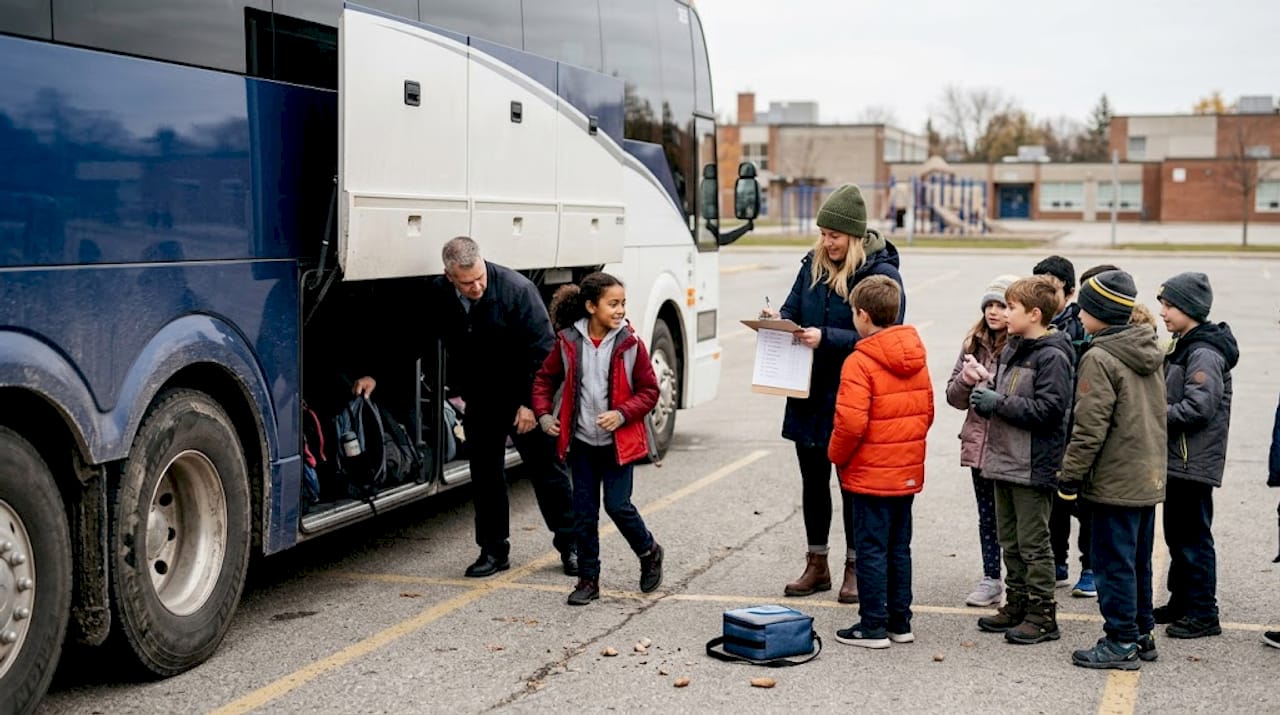
To understand why this matters at a national level, commercial bus safety data from transport regulators shows that structured safety oversight for commercial bus operations significantly reduces crash risk. Providers who operate without that structure carry measurably higher risk.
Here is how charter bus suppliers are typically vetted and monitored for school events:
- Licence and compliance review: Confirm the provider holds the appropriate operating licence and is in good standing with provincial regulators.
- Vehicle inspection records: Request maintenance logs and inspection certificates dated within the current year.
- Driver background checks: Ensure drivers have clean records and hold the correct class of licence for passenger transport.
- Emergency protocol review: Ask providers to supply their written emergency response plan.
- Insurance verification: Confirm coverage levels meet or exceed TDSB requirements for student transport.
| Safety criterion | Charter bus | Unvetted provider |
|---|---|---|
| Written compliance documentation | Yes | Often missing |
| Regular vehicle inspections | Scheduled | Variable |
| Driver qualification checks | Mandatory | Not always verified |
| Emergency response plan | Required | Rarely available |
| School board familiarity | Common | Uncommon |
Non-compliant providers risk suspension of service, which can strand students and expose schools to serious liability.
The planning benefits of charter buses extend well beyond safety alone. Coordinating with an accountable provider also dramatically simplifies the logistics of the day itself.
Operational advantages: streamlining logistics with charter buses
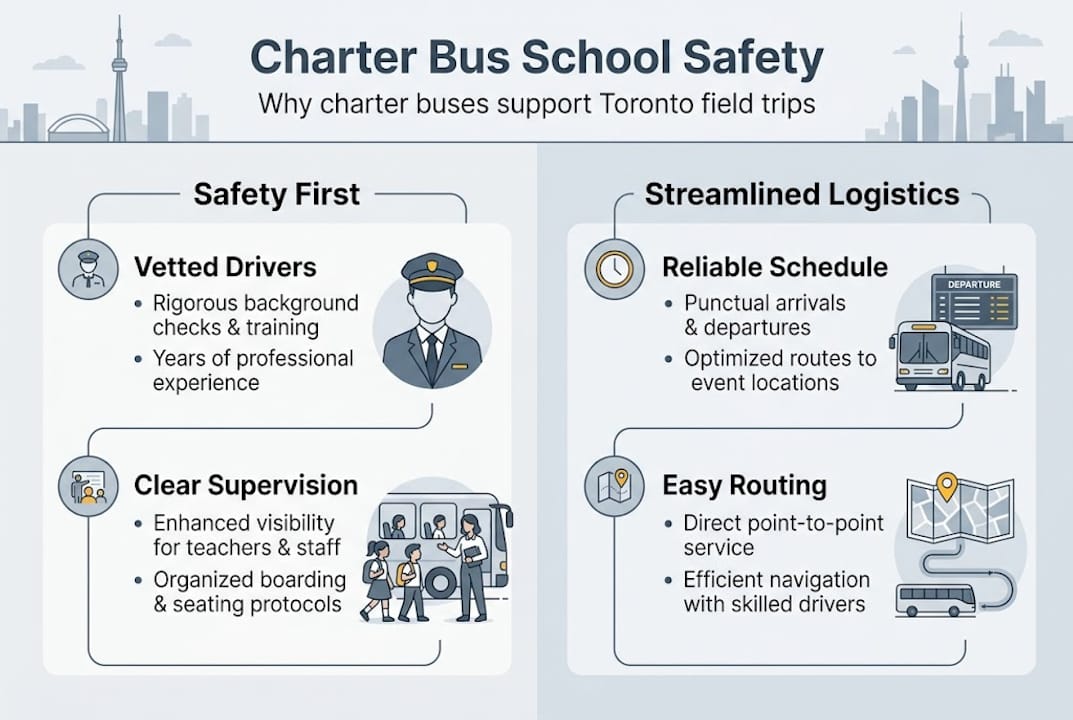
Safety compliance is the foundation, but the operational advantages of charter buses are what make day-of coordination far less stressful. Contracted charter providers take on responsibilities that would otherwise fall entirely on school staff.
According to the TDSB transportation framework, charter and motorcoach usage for school events simplifies routing and headcounts, creates clear provider accountability, and aligns event transportation with school-board safety procedures. These are not minor conveniences. They are structural advantages.
| Feature | Charter bus | School bus | Public transit |
|---|---|---|---|
| Dedicated vehicle | Yes | Sometimes | No |
| Provider accountability | Contractual | Board-managed | None |
| Route flexibility | High | Low | None |
| On-board amenities | Yes | Minimal | No |
| Headcount management | Simplified | Moderate | Difficult |
Charter buses resolve several common operational pain points for school coordinators:
- Routing: You can customise pick-up and drop-off points to match your event itinerary.
- Parent notification: Providers can supply exact departure and arrival windows, making communication easier.
- Headcount accuracy: A dedicated vehicle means every student on your list is on your bus.
- Emergency procedures: Your provider has a single point of contact for any issue that arises.
Pro Tip: Share your full event schedule with the provider at least one week before the trip. This allows them to plan for fuel stops, timing buffers, and alternative routes if needed. Explore charter bus event examples for ideas on how other Toronto schools have structured their events.
The difference between a smooth field trip and a chaotic one often comes down to whether the coordinator treated transport as a logistical partner or just a vehicle hire. For a full breakdown, our guide on charter service for planners explains exactly how to set up that partnership from the start.
Addressing accessibility, medical needs, and special considerations
Not every student on a school trip has the same mobility or medical needs, and this is one area where coordinators most frequently underestimate their responsibilities. The TDSB is clear that accessibility and supervision requirements must be met regardless of the transport type, with clear assignment of responsibilities between school staff and families.
Here is a step-by-step approach for handling special transport needs:
- Identify needs early: Collect accessibility and medical information from families at least two weeks before the event.
- Confirm with the provider: Share relevant details with your charter bus provider and ask what accommodations they can offer.
- Verify vehicle features: Confirm whether the vehicle includes lifts, secure wheelchair spaces, or storage for medical equipment.
- Assign supervision roles: Ensure a trained staff member is designated to support each student with elevated needs.
- Coordinate with families: Keep parents or guardians informed of the transport plan and confirm their consent in writing.
Common scenarios and best practices include:
- Wheelchair users: Confirm the vehicle has a certified lift and secured seating positions before booking.
- Students with medical devices: Arrange for safe storage of equipment and assign a staff member trained in its use.
- Students with behavioural or sensory needs: Seat them near a supervising adult and minimise disruptions by planning the seating arrangement in advance.
- Emergency medication: Ensure at least one school staff member is carrying any required medication and that the driver knows who that person is.
Our Toronto school bus rental options include vehicles suited to varying group sizes and accommodation needs.
Common misconceptions about charter bus safety and efficiency
One of the most persistent myths in school event planning is that booking a charter bus automatically guarantees the safest possible trip. It does not. The TDSB’s guidance makes clear that safety depends on provider compliance, driver fitness, and vehicle maintenance, not on vehicle branding.
“The safety value of any transport arrangement comes from the specific provider’s compliance and oversight practices, not from the category of vehicle alone.”
Coordinators who understand this distinction make far better decisions. Here are the criteria you should actually evaluate when comparing any provider:
- Compliance history: Have they operated without incidents or regulatory action?
- Driver qualifications: Are drivers licenced, trained, and subject to regular review?
- Vehicle maintenance records: Are inspections current and documented?
- School board experience: Have they worked with TDSB schools before?
- Insurance coverage: Is their liability coverage sufficient for student transport?
- Emergency responsiveness: Do they have a 24-hour contact for event-day issues?
A well-managed school bus contracted through the board can be just as safe as a charter bus, provided the same rigour is applied. The danger lies in assuming any provider, regardless of type, meets these standards without verification. Explore charter bus alternatives to see how different options compare when assessed against these criteria.
Expert perspective: what most planners miss about group transport for school events
After working with schools and event teams across Toronto, one pattern stands out clearly. Most coordinators focus almost entirely on cost and capacity when choosing a transport provider. They compare quotes, confirm seat counts, and move on. The deeper layers, such as provider accountability, compliance documentation, and the relationship between the charter company and school board policies, rarely come up until something goes wrong.
Experienced coordinators treat planning time reduction as a direct indicator of provider quality. A provider who asks the right questions about your event before you ask them is a provider who understands the school context.
The real risk is not a breakdown or a delayed departure. It is an unresolved accessibility gap or an unclear supervision arrangement that creates liability for your school. These issues rarely appear in a provider’s brochure, but they surface fast on event day.
Pro Tip: Ask every potential provider these three questions: “Have you transported students under TDSB policy before?” “Who is our single point of contact on the day?” and “What is your emergency escalation procedure?” The answers tell you more about provider quality than any pricing sheet ever will.
Find the right charter bus for your next Toronto school event
Choosing the right transportation partner is one of the most consequential decisions you will make when organising a school event. The right provider makes the day safer, smoother, and far less stressful.

At Toronto Bus Rentals, we work with school administrators and event coordinators across Toronto to match groups with the right vehicle, driver, and logistics support. Our fleet is maintained to rigorous standards and our team understands the specific requirements of school event transport. Learn more about the advantages of charter buses for group events, or explore our full range of group transportation services to find the right fit for your next event.
Frequently asked questions
Are charter buses in Toronto required to meet special school board safety standards?
Yes, all buses transporting students for school events must meet TDSB safety standards, including defined performance requirements and supervision responsibilities that apply to every provider.
What’s the difference between a charter bus and a school bus for a field trip?
Charter buses offer dedicated vehicles, provider accountability, and on-board amenities, while school buses follow board-managed booking and oversight processes. Provider accountability and safety protocol alignment are key motivators for choosing charter.
How should schools plan transportation for students with special needs?
Schools must match the vehicle to each student’s accessibility or medical needs and confirm supervision arrangements with families in writing, as TDSB outlines for all eligible student transport.
Are charter buses automatically safer for school events than school buses?
No. Safety depends on compliance, vehicle maintenance, and driver qualifications, not on the type or branding of the bus. Rigorous vetting is essential regardless of which option you choose.
Recommended
- Why use charter buses in Toronto: 50% less planning time
- What is charter service? Toronto event planners guide 2026
- 1 new message
- Examples of charter bus uses for Toronto events
- Premium event transport: Why it transforms airport transfers