
Bus tour organization steps: a group planner’s guide
TL;DR:
- Effective bus tour organization involves clear planning of group basics, buffer-rich itineraries, early bookings, and thorough passenger communication. Proper coordination ensures punctual departure, smooth transitions, and avoids delays caused by logistical oversights. Implementing these steps leads to a stress-free, well-executed group travel experience.
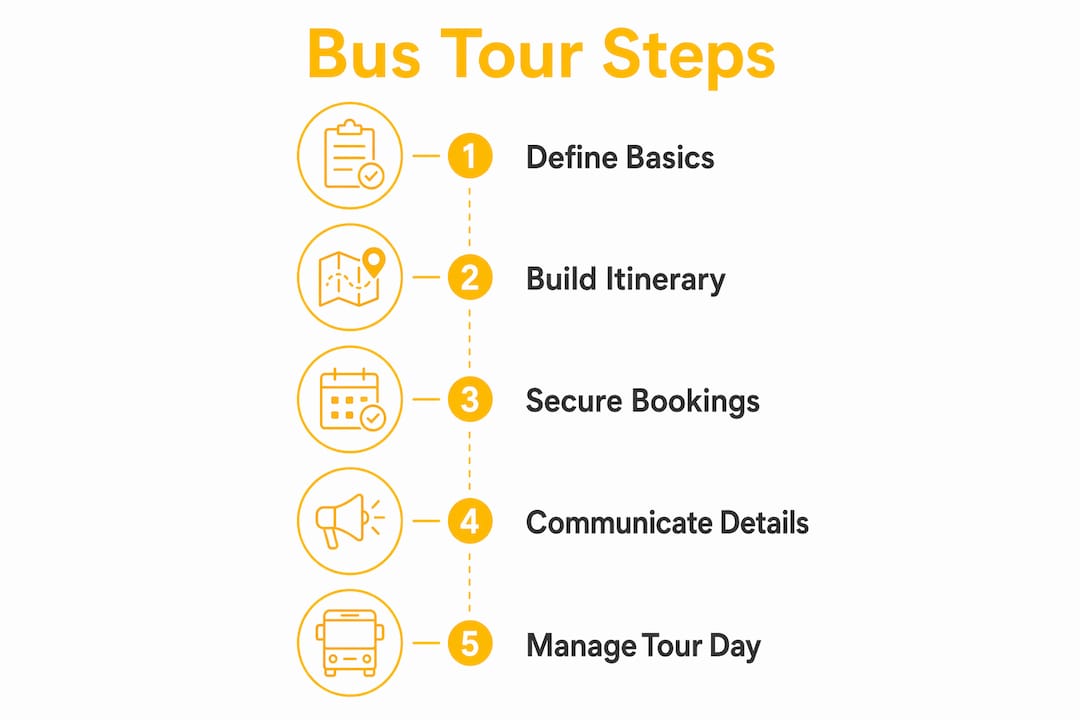
Bus tour organization steps are a structured process that moves your group from early planning through to smooth execution on travel day. Done right, they eliminate the confusion that derails most group trips before the bus even leaves the parking lot. This guide covers every phase: defining your group, building a realistic itinerary, securing bookings and permits, communicating with passengers, and managing the day itself. Whether you are coordinating a corporate outing, a school trip, or a weekend excursion, these steps give you a clear operational framework to follow.
What are the bus tour organization steps to start with?
The foundation of any well-run bus tour is knowing exactly who you are moving and why. Group basics like purpose, size, and needs must be defined before any booking or route planning begins. Skipping this step leads to undersized vehicles, missed accessibility requirements, and budget surprises mid-trip.
Start by answering these four questions:
- Who is travelling? Confirm your total headcount, including any passengers with mobility or accessibility needs. This directly determines which vehicle class you require. A useful reference is Torontobusrentals’ guide on bus capacity for groups to match your count to the right vehicle.
- What is the purpose? A corporate team-building day has different timing and stop requirements than a seniors’ heritage tour.
- What is the budget? Set a per-person or total ceiling early. It governs every downstream decision, from vehicle class to meal stops.
- Who is in charge? Assign a trip coordinator before anything else. This person owns the itinerary, communicates with the driver, and resolves issues on the day.
A designated trip coordinator is the single most important role in group travel. For groups over 30, consider adding a secondary contact who handles passenger communication while the coordinator liaises with the vehicle operator.
Pro Tip: Create a one-page group profile document listing headcount, accessibility needs, budget range, and coordinator contact details. Share it with every vendor you engage.

How do you build a realistic bus tour itinerary?
A realistic itinerary is the difference between a tour that runs on time and one that loses an hour at the first stop. Common delays in group travel include boarding, luggage loading, rest breaks, and event check-ins. Each one compounds the next if you have not built in buffer time.
Follow these steps when designing your route:
- Map every stop with realistic dwell times. Do not estimate how long a museum visit takes. Call the venue and ask for average group visit durations.
- Add 15–20 minutes of buffer per major transition. This covers boarding, regrouping, and facility limitations at each stop.
- Schedule rest breaks every 2–3 hours. Passengers need them. Drivers require them by law.
- Account for driver hours-of-service limits. Passenger vehicle drivers are limited to 10 driving hours per day and 15 total on-duty hours after a rest period. An itinerary that ignores these limits risks driver disqualification mid-trip.
- Plan around peak traffic windows. In Toronto, the 7:30–9:00 a.m. and 4:00–6:30 p.m. windows add significant travel time on any major corridor.
The table below shows how buffer time should scale with group size:
| Group Size | Recommended Buffer Per Stop | Reason |
|---|---|---|
| Under 20 passengers | 10 minutes | Faster boarding and regrouping |
| 20–40 passengers | 15 minutes | Moderate loading and check-in time |
| 40–55 passengers | 20–25 minutes | Larger groups need more facility time |
| Multi-stop full day | 30 minutes total reserve | Absorbs cascading delays across stops |
Pro Tip: For multi-stop days, add buffer for operational transitions including regrouping large groups and facility limitations at each venue. Build this into the schedule, not as an afterthought.
When should you secure bookings and permits?
Booking timelines are not flexible when peak season is involved. Book charter buses 3–6 months in advance for peak demand periods to secure availability and competitive pricing. Waiting until six weeks out for a July or September tour date in Toronto often means settling for whatever is left.
Key booking and permit considerations include:
- Vehicle size and amenities. Match your confirmed headcount to the right vehicle class. A 47-passenger coach for a group of 22 wastes money. An 18-passenger minibus for 30 people is a compliance issue.
- Permit requirements for venues and events. Large events require permit research and coordination with venue operations and security well in advance. Stadiums, festivals, and heritage sites often have designated drop-off zones with specific access rules.
- Contract terms. Your rental agreement should specify payment schedules, cancellation policies, and contingency clauses for weather or event postponements. Never sign a contract without a written refund or rescheduling policy.
The comparison below outlines what to confirm at each booking stage:
| Booking Stage | What to Confirm |
|---|---|
| Initial inquiry | Vehicle availability, size options, base pricing |
| Deposit payment | Contract terms, cancellation policy, driver assignment |
| 30 days before tour | Final headcount, pickup location, permit status |
| 1 week before tour | Driver contact, vehicle details, final itinerary |
A useful resource for this phase is Torontobusrentals’ guide on mastering the booking process for group bus rentals.
How do you communicate tour details to passengers?
Clear pre-trip communication is what separates a smooth departure from a chaotic one. Printing and distributing detailed itineraries before departure reduces confusion and prevents the flood of last-minute questions that slow boarding.
Your passenger communication package should include:
- Departure time and exact pickup location. State the address, not just a neighbourhood. Include a map link if possible.
- All stop locations and expected arrival times. Passengers who know the schedule are less likely to wander or delay the group.
- Trip coordinator contact information. One number, one person. Every passenger should have it saved before travel day.
- Emergency procedures. Include the vehicle operator’s contact number and a brief protocol for medical or safety situations.
- Packing and luggage guidelines. Specify bag limits and dimensions. Undersized luggage bays on minibuses fill quickly.
Send this package at least 72 hours before departure. A follow-up reminder the evening before reduces no-shows and late arrivals significantly.
Pro Tip: Use a group messaging app like WhatsApp or GroupMe to send the itinerary, reminders, and real-time updates. It keeps all communication in one thread and reduces the coordinator’s call volume on travel day.
What are the key steps for a smooth tour day?
Execution day is where preparation either pays off or falls apart. Formalising your operations flow from booking through to execution reduces day-of chaos. The steps below turn that flow into a repeatable departure routine.
- Confirm final headcount the morning of the tour. Do not wait until the bus arrives. Know your number by 7:00 a.m. if your departure is at 9:00 a.m.
- Treat the pickup location as a logistics project. Confirm bus positioning in advance to enable immediate boarding and avoid cascading delays. A bus that cannot pull to the kerb adds 10 minutes before a single passenger boards.
- Ask passengers to arrive 10–15 minutes early. Early arrival and role clarity are the two most effective tools for avoiding pickup delays and schedule problems.
- Assign one person to communicate with the driver. The coordinator speaks to the driver. Everyone else speaks to the coordinator. This chain prevents conflicting instructions.
- Set a firm departure time and hold to it. Announce it clearly in your pre-trip communication. Late passengers who know the bus leaves at 9:00 a.m. sharp arrive on time.
“The most preventable delays in group bus travel happen in the first 20 minutes. A confirmed pickup position, a firm departure time, and one designated contact eliminate most of them before they start.”
Plan a contingency buffer of 20–30 minutes somewhere in the first half of the day. Use it if needed. If you do not need it, you arrive early, which passengers always appreciate.
Key takeaways
Effective bus tour organisation requires defined group roles, a buffer-built itinerary, early bookings, and clear passenger communication before travel day begins.
| Point | Details |
|---|---|
| Define group basics first | Confirm headcount, accessibility needs, budget, and coordinator before any booking. |
| Build buffer into every itinerary | Add 15–25 minutes per major stop to absorb boarding, loading, and transition delays. |
| Book 3–6 months in advance | Peak season availability disappears fast; early booking secures better rates and vehicle choice. |
| Distribute itineraries 72 hours early | Passengers who know the plan arrive on time and ask fewer questions on travel day. |
| Hold to a firm departure time | A published, non-negotiable departure time is the single most effective tool against late arrivals. |
What i have learned after years of watching group tours go wrong
Most bus tour problems are not transportation problems. They are communication problems that show up at the vehicle.
I have seen well-funded corporate tours lose 45 minutes at the first stop because nobody confirmed the venue’s group entrance was on a different street than the main entrance. I have watched school trips sit in a parking lot for 20 minutes because the coordinator was fielding individual parent calls instead of managing the group. These are not edge cases. They are the norm when planning treats logistics as an afterthought.
The step that most planners skip is formalising the operations flow before the tour date. Booking, payment, confirmation, pre-trip communication, and execution should each have a defined owner and a checklist. When one phase is unclear, the next one absorbs the confusion.
The other underrated detail is the pickup location itself. Confirming that the bus can physically reach the boarding point, pull in, and hold position while passengers load is not a small thing. A bus blocked by a delivery vehicle or parked in the wrong lane creates a cascade that affects every stop on the itinerary.
My honest recommendation: spend as much time on the logistics of the first 30 minutes as you do on the entire route. That window sets the tone for the whole day.
— Firoz
Plan your next group tour with Torontobusrentals
Torontobusrentals makes the booking side of these steps straightforward. The fleet covers groups of all sizes, from compact minibuses for smaller outings to full-size motor coaches for large group travel across the Greater Toronto Area.

Every vehicle comes with a professional, experienced driver who knows Toronto’s routes and can work within your itinerary’s timing requirements. Safety compliance, including pre-trip inspections and hours-of-service adherence, is built into every booking. Whether you are organising a corporate day trip, a school excursion, or a multi-stop group tour, Torontobusrentals has the group transportation solutions to match your plan. Explore motor coach options for your group and get a quote today.
FAQ
How far in advance should you book a bus for a group tour?
Book at least 3–6 months ahead for peak season dates to secure availability and competitive pricing. Last-minute bookings in summer or during major events often result in limited vehicle options.
How many people does a standard charter bus hold?
Most full-size motor coaches hold between 47 and 55 passengers. Minibuses typically accommodate 18–20 passengers, making them suitable for smaller groups or secondary vehicles on large tours.
What should a bus tour itinerary include?
A complete itinerary lists departure and arrival times, all stop locations, dwell times, rest breaks, the trip coordinator’s contact details, and emergency procedures. Distribute it to all passengers at least 72 hours before travel day.
Do you need permits for a group bus tour?
Permit requirements depend on the venue and event type. Stadiums, festivals, and heritage sites often require designated drop-off coordination and advance approval from venue operations or local authorities.
What is the driver’s hours-of-service limit for charter buses?
Passenger vehicle drivers are limited to 10 driving hours per day and 15 total on-duty hours following a rest period. Itineraries must account for these limits to avoid driver disqualification during inspections.
Recommended
- Top benefits of bus rentals for Toronto events in 2026
- Corporate outing transport guide for Toronto planners
- Understanding bus capacity for groups: a planner’s guide
- Essential bus rental tips for safe Toronto school trips