
Bus rental insurance explained: protect group travel in Toronto
TL;DR:
- Many Toronto event planners mistakenly believe that booking a reputable bus company automatically includes all necessary insurance coverage, but this can lead to costly gaps. Commercial bus insurance is vital for protecting passengers and organizers from various risks, with key components like liability, physical damage, and general liability; confirming these in writing is essential. Asking detailed questions about coverage, liability limits, additional insured status, and proof of insurance helps ensure a safe, legally protected event.
Many Toronto event planners assume that booking a reputable bus company means all risks are automatically covered. That assumption is costly. Bus rental insurance generally refers to the commercial insurance coverages that protect a bus or charter operator and their customers if something goes wrong during a bus trip, and it operates very differently from standard auto or personal rental coverage. Understanding exactly what that protection includes, and where the gaps appear, is what separates a smoothly run group event from a financial and legal nightmare.
Table of Contents
- What is bus rental insurance and why does it matter?
- Key coverage types in bus rental insurance
- Common misconceptions and edge cases for event planners
- What Toronto event planners should ask before booking
- Why insurance details separate successful Toronto events from disasters
- Plan safer events with expert-reviewed bus rental options
- Frequently asked questions
Key Takeaways
| Point | Details |
|---|---|
| Comprehensive group protection | Bus rental insurance safeguards all passengers and organisers during event trips by providing commercial coverages beyond standard rental policies. |
| Multiple coverage types needed | Ensure your policy includes auto liability, physical damage, general liability, and excess limits for full peace of mind. |
| Watch for common pitfalls | Planners should request ‘additional insured’ status and carefully review all policy documents before booking. |
| Ask the right questions | Confirm policy limits, scope, and event-specific protections with the provider before finalising any group booking. |
What is bus rental insurance and why does it matter?
When event planners think about risk, they often picture a vehicle collision on the 401. That is one risk. But group travel introduces dozens more: a passenger slipping while boarding, luggage damaged in a storm, or an accident that injures 40 guests at once. Standard auto insurance simply is not built for these scenarios.
Bus rental benefits extend well beyond convenience when a solid insurance framework backs the booking. The key distinction is that commercial charter coverage is issued to the operator of the bus, covers all passengers as a group, and is calibrated to the scale of risk that large passenger transport creates. A personal auto policy covering your company vehicle is not remotely comparable.
The commercial fleet coverage standard applies because carrying paying passengers requires a higher duty of care than driving yourself to work. In Ontario, commercial passenger vehicles must carry liability limits far exceeding those on a personal policy. We are talking about minimums that can start at $1 million and climb much higher for large charter operations.
Here are the core components most commercial bus policies include:
- Commercial auto liability: Covers bodily injury and property damage to third parties if the bus is in an accident
- Physical damage coverage: Protects the bus itself from collision, fire, theft, or vandalism
- General liability: Addresses incidents that occur outside the vehicle, such as boarding injuries or loading zone accidents
- Workers’ compensation: Protects the driver and any staff employed by the bus company
- Umbrella or excess liability: Provides an additional layer of protection beyond the base policy’s limits
- Uninsured motorist coverage: Steps in if the bus is struck by a driver carrying no insurance
“Bus rental insurance generally refers to the commercial insurance coverages that protect a bus or charter operator and their customers if something goes wrong during a bus trip.” — Trusted Choice, Bus Insurance for Commercial Fleets
Consider a real scenario: a corporate group of 50 employees boards a charter bus headed to a team-building event outside Toronto. Twenty minutes into the trip, the bus is rear-ended on the highway. Three employees are hospitalised. Without adequate commercial liability coverage, the costs of medical bills, legal claims, and lost productivity fall somewhere between the bus company and the event organiser. Proper school bus insurance and charter bus policies are designed precisely to close that gap.
Key coverage types in bus rental insurance
With the big-picture definition clear, let’s break down the specific coverages you need to look for in a bus rental insurance policy.
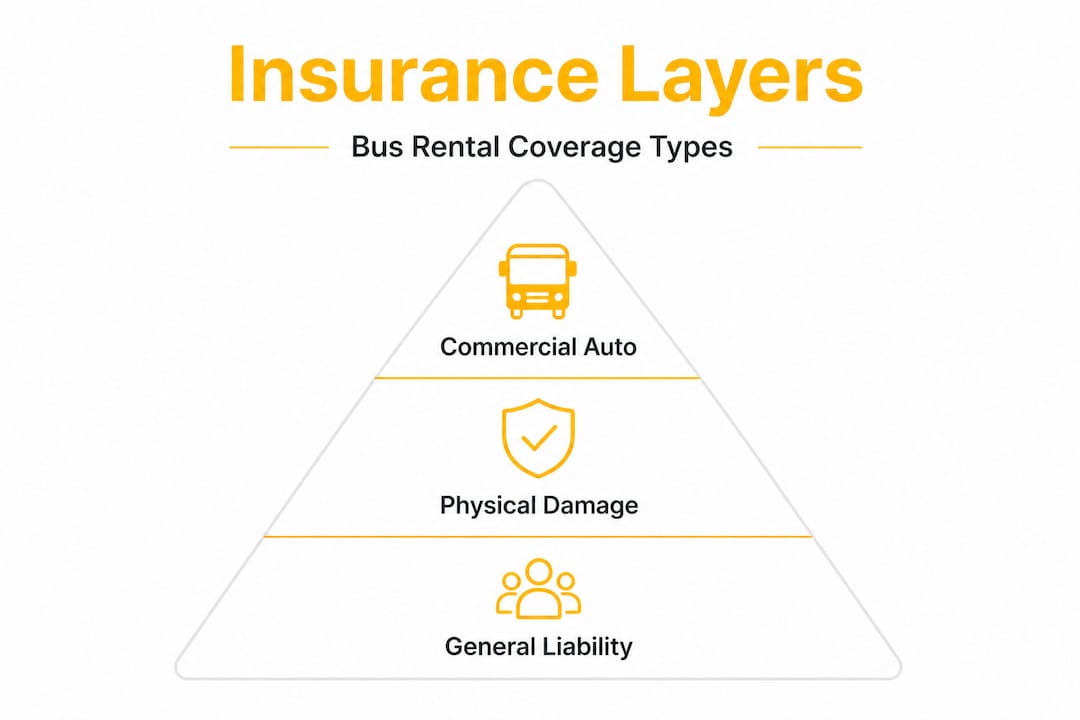
Charter bus insurance is typically treated as a passenger transport coverage set required for operating buses that carry groups in North America. That set of coverages is not one single policy but rather a suite of protections layered together to address different types of risk.
| Coverage type | What it protects | Toronto event scenario |
|---|---|---|
| Commercial auto liability | Third-party bodily injury and property damage | Bus clips a parked vehicle near a conference venue |
| Physical damage | The bus itself from collision, fire, theft | Bus damaged in a parking lot hailstorm overnight |
| General liability | Non-driving incidents on or near the bus | Guest sprains ankle on a wet step while boarding |
| Workers’ compensation | Driver or crew injuries during work | Driver injured assisting with loading heavy equipment |
| Umbrella or excess liability | Extra coverage above base policy limits | Major accident injures 30+ guests, claims exceed base limit |
| Uninsured motorist | Accidents caused by uninsured drivers | Bus struck by an uninsured driver on the Gardiner Expressway |
Commercial auto liability is the backbone. If the bus driver causes an accident and a third party is injured or their property is damaged, this coverage responds. For large groups, the liability exposure is significant because the number of potential claimants is high.
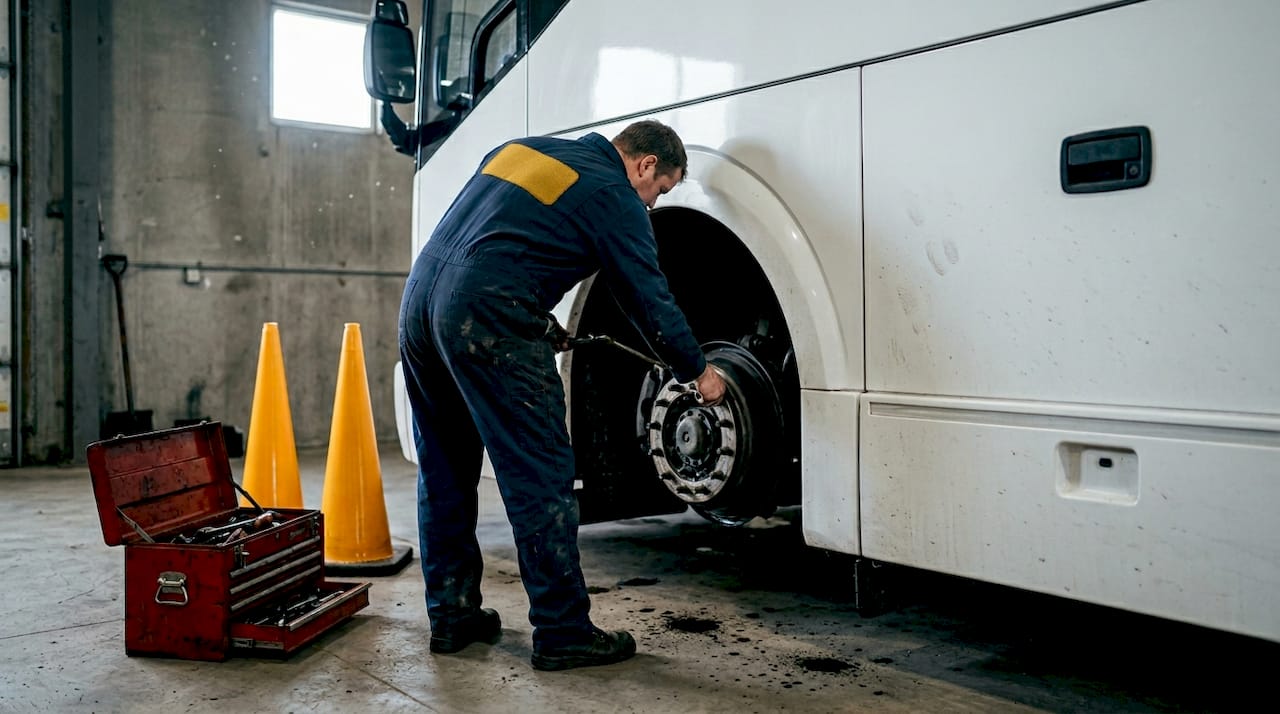
Physical damage matters because the asset is expensive. A charter bus can be worth $300,000 or more. Collision damage, fire, or theft without physical damage coverage could end a charter company’s operation entirely, leaving your group stranded with no alternative transport.
General liability is one of the most overlooked components. Many incidents happen outside the moving vehicle. Passengers trip at bus stops, fall while the bus is parked, or are injured during loading. If the policy only addresses driving incidents, those moments fall into a coverage gap.
Pro Tip: When reviewing a bus company’s coverage, specifically ask whether their general liability extends to boarding, alighting, and any time passengers are in the immediate vicinity of the vehicle. This is often where claims arise for corporate and school events.
Safe charter buses combine well-maintained vehicles with comprehensive policies, and understanding those layers before signing any event bus policy is non-negotiable. For further context on protecting your transport investment, these insurance tips for group transport offer helpful framing for businesses managing fleet risk.
Common misconceptions and edge cases for event planners
Even when you know the key coverages, many planners get tripped up by confusing terminology and hidden gaps. Here’s what to watch for.
One of the most pervasive myths is that any insurance attached to a rental vehicle is sufficient. It is not. Rental reimbursement is an auto-policy add-on that reimburses you for substitute transportation while your personal vehicle is being repaired. It is not commercial charter coverage for bus passengers. These are completely different products, and confusing them leaves your group exposed.
Another common misunderstanding involves liability limits. Many planners assume that a bus company carrying some insurance is the same as carrying adequate insurance. Coverage adequacy for large passenger groups is critical because liability limits for personal auto policies are often far lower than what a group incident requires. A personal auto policy might carry $200,000 in liability. A single serious injury claim from a group of 50 people could exceed that limit within hours.
Here is a comparison of what different coverage types do and do not protect:
| Coverage type | Covers group passengers | Covers organiser’s liability | Covers off-bus incidents |
|---|---|---|---|
| Commercial charter insurance | Yes | Potentially with additional insured | Often yes (general liability) |
| Personal auto insurance | No | No | No |
| Rental reimbursement add-on | No | No | No |
| Event liability insurance (separate) | No (transport) | Yes (event venue) | Yes (venue incidents) |
Edge cases planners should always ask about include:
- Non-driving incidents: Is a passenger injured while boarding or alighting covered? This is not always automatic.
- Loading zone accidents: What happens if luggage or equipment falls on a guest at the pick-up point?
- Extended wait periods: If the group waits at a venue for several hours, does the bus company’s liability still apply?
- Additional insured status: Does the event organiser have formal protection under the policy during the chartered period?
The additional insured designation is worth explaining. When you are listed as an additional insured on the bus company’s policy, you gain direct protection under that policy if a claim arises during the event. Without it, even if the bus company’s policy covers the incident, you may still face separate legal exposure as the organiser. Always request this in writing.
Pro Tip: Never assume additional insured status is automatic. Request a certificate of insurance that specifically names your company or organisation, confirms the policy limits, and notes the event date range. Keep a copy with your event documentation.
Use the bus rental insurance checklist to track these requirements before any booking, and review real charter bus uses to understand the variety of scenarios where coverage gaps can appear. For a broader view of how vehicle insurance verification works, this vehicle insurance checklist is a practical reference.
What Toronto event planners should ask before booking
With a clearer view of what’s at stake and the potential pitfalls, here’s a practical checklist to empower your next booking.
Asking the right questions before you sign a booking agreement is one of the most powerful risk-management tools available to you. Many planners skip this step because they feel awkward questioning a vendor’s insurance, but reputable companies expect and welcome it.
Commercial bus insurance covers passengers and operators alike when something goes wrong, and any professional company should be able to provide documentation quickly. If a company hesitates, that hesitation tells you something important.
Here are the essential questions to ask every bus company before booking:
- What are your liability limits, and can you provide a certificate of insurance? The certificate confirms coverage types and dollar amounts in writing.
- Will you list our organisation as an additional insured for the event period? This protects you directly under their policy.
- Does your general liability coverage apply while passengers are boarding and alighting, not just while the vehicle is moving? This closes the most common gap.
- Does your policy cover all passengers, including minors or guests with specific needs? Some group exclusions exist that planners rarely anticipate.
- What is the claims process if an incident occurs during our event? Knowing this ahead of time reduces chaos in a crisis.
- Is your coverage current, and does it remain valid on our event date? Policies lapse. Always verify.
- Are your drivers individually covered, or does coverage apply only to the vehicle? Driver-specific incidents sometimes require separate endorsements.
Pro Tip: Document all communication with your bus provider via email so you have a paper trail. If an incident occurs and a dispute arises over what was agreed, written documentation protects you. Verbal promises are not enforceable.
Review your bus rental agreements carefully alongside the insurance certificate, and understand the full booking process for charter buses so nothing falls through the cracks. The resource on flexible fleet coverage also outlines what comprehensive coverage verification looks like in practice.
Why insurance details separate successful Toronto events from disasters
We have seen it more than once. An event planner books a bus, confirms the price, arranges pick-up times, and moves on to decorations and catering. Then, at the event itself, a guest is injured stepping off the bus in a dark parking lot. The claim arrives weeks later. The bus company’s policy does not include the organiser as an additional insured. The organiser’s general business liability policy covers venues but not transport. Suddenly, the event organiser is personally exposed.
This is not a fringe scenario. It is a gap that exists in many Toronto event bookings today.
The uncomfortable truth is that most planners discover their insurance blind spots after an incident, not before. The industry rarely talks about this because bus companies want bookings and planners want smooth events. Nobody wants to linger on the worst-case scenario. But a single uncovered claim can cost more than dozens of successful events combined.
What truly works is not price-shopping alone. It is reviewing the actual policy, not just accepting a verbal confirmation of coverage. It is requesting the certificate before the deposit clears, not after. It is asking about additional insured status as a non-negotiable, not as an afterthought.
There is a contrarian view worth stating plainly: a cheaper bus rental with questionable insurance is not actually cheaper. When you factor in potential liability exposure, legal costs, and reputational damage, the $200 you saved on the booking becomes meaningless. The planners who consistently run incident-free events prioritise policy clarity over price every single time.
Understanding group transportation strategies from both a logistics and risk perspective is what elevates event planning from reactive to proactive. Insurance is not a formality. It is the foundation of responsible group travel.
Plan safer events with expert-reviewed bus rental options
Applying everything you have read here starts with choosing a bus rental provider who takes insurance as seriously as you now do.

At Toronto Bus Rentals, we work with event planners, schools, and corporate clients across Toronto who need more than just a vehicle. They need verified, comprehensive coverage they can count on. Our team makes insurance verification straightforward, with certificates available on request and the option to add your organisation as an additional insured. Whether you are arranging a school bus rental for a field trip or coordinating efficient group transportation for a corporate retreat, the right coverage should never be an obstacle. Explore our full range of bus rental benefits for events and book with confidence.
Frequently asked questions
Does bus rental insurance cover all event passengers?
Proper commercial bus rental insurance generally covers all listed passengers for liability and injuries, but always confirm with your provider for group-specific exclusions before booking.
What’s the difference between charter bus insurance and rental reimbursement?
Charter bus insurance protects group passengers and operators during event trips, while rental reimbursement only covers replacement vehicles if your personal car is being repaired.
Can an event planner be listed as an ‘additional insured’?
Yes. Reputable bus rental companies can add event organisers as additional insured to extend coverage protection during the full chartered event period.
Is general liability included in all bus rental insurance policies?
Not all policies automatically include general liability for off-bus incidents, so request the full policy details and confirm this coverage exists before signing any agreement.
What proof of insurance should a bus company provide?
Request a certificate of insurance that clearly shows the policy types, current liability limits, policy dates, and whether your organisation is named as additional insured for the event.
Recommended
- Why rent buses in Toronto for smoother group travel
- Bus rentals for Toronto events: Cost, comfort, reliability
- How bus rentals save costs for Toronto events: 2026 guide
- Master bus rental agreements for Toronto group travel
- Group Taxi Booking Explained: Cost Savings and Safety