
Master bus rental agreements for Toronto group travel
TL;DR:
- Bus rental agreements in Toronto include detailed terms on vehicle, driver, insurance, and cancellation policies.
- Reviewing crucial clauses like CVOR compliance, driver qualifications, and hidden fees ensures a smooth event.
- A well-negotiated contract provides safety, clarity, and contingency plans for reliable group transportation.
Most event planners in Toronto spend their first call asking about price and seat count. That’s understandable. But the clauses buried in a bus rental agreement often do more to determine your event’s success than the sticker price ever will. Vague cancellation terms, missing insurance details, or unclear driver qualifications can turn a smooth corporate outing or school trip into a logistical headache. This guide breaks down every critical element of a group bus rental contract, walks you through Ontario’s regulatory requirements, and gives you a practical framework for comparing your options with confidence.
Table of Contents
- What is a bus rental agreement?
- Key terms to review in your agreement
- Understanding Toronto/Ontario safety and regulatory requirements
- Comparing bus rental options: School bus vs. luxury coach
- What most contracts miss (and why planners must lead)
- Your next step: Secure a reliable Toronto group bus
- Frequently asked questions
Key Takeaways
| Point | Details |
|---|---|
| Clarify agreement terms | Always read and understand contract clauses on liability, payments, and cancellations before signing. |
| Demand safety compliance | Insist on Toronto/Ontario-certified operators with up-to-date vehicle inspections and proper licensing. |
| Match bus type to your event | Choose a school bus or luxury coach based on budget, comfort needs, and group size. |
| Spot hidden fees | Look for extra charges such as overtime, tolls, or cleaning not included in the initial quote. |
| Negotiate for your needs | Do not hesitate to negotiate terms like pickup times, route flexibility, or contingency planning. |
What is a bus rental agreement?
A bus rental agreement is a legally binding contract between your organisation and a transportation provider. You’ll also hear it called a charter contract or service agreement. Whatever the name, its purpose is the same: to define the terms under which a bus and driver are made available for your group’s use.
These agreements are more detailed than most planners expect. Bus rental agreements outline key terms including parties involved, vehicle details, permitted use, lease duration, payment schedules, insurance responsibilities, maintenance obligations, cancellation policies, and liability clauses. Each of those elements has real consequences if it’s vague or missing.
Here’s what you’ll typically find in a well-structured charter contract:
- Parties involved: Full legal names of the operator and the client organisation
- Vehicle details: Make, model, year, seating capacity, and any listed amenities
- Permitted use: Where the bus can travel, how it can be used, and passenger restrictions
- Lease duration: Exact dates, times, and planned route
- Payment schedule: Deposit amount, balance due date, and accepted payment methods
- Insurance responsibilities: Who carries coverage and minimum required limits
- Maintenance obligations: Who is responsible for mechanical upkeep during the hire
- Cancellation policy: Timelines, refund conditions, and rebooking options
- Liability clauses: Who is responsible in the event of delays, damage, or incidents
A charter contract is not simply a receipt for transport. It is your organisation’s primary document for managing risk, cost, and operational accountability on event day.
What sets a bus rental agreement apart from a car lease or a rideshare booking is the scope of shared responsibility. You’re not just paying for a vehicle. You’re entering a service relationship that includes a professional driver, a regulated vehicle, and a chain of legal obligations on both sides. For schools, corporations, and event organisers, that distinction matters enormously. If your group is planning a field trip or a corporate outing, Toronto school bus rentals are governed by these same foundational contract principles.
Key terms to review in your agreement
With a basic framework in hand, it’s time to zoom in on the clauses that will impact your event execution. Not all contracts are created equal, and some common omissions can cost you significantly.
Here’s a step-by-step review of the terms that matter most:
- Vehicle type and condition: Confirm the exact bus model, year, seating capacity, and any promised amenities are written into the contract. Verbal promises about Wi-Fi or air conditioning mean nothing if they’re absent from the document.
- Driver qualifications: The agreement should confirm your driver holds a valid commercial licence, has undergone defensive driving training, and meets Ontario’s hours-of-service limits.
- CVOR compliance: Your operator must hold a valid Commercial Vehicle Operator’s Registration. This is non-negotiable in Ontario and should be explicitly referenced in the contract.
- Permitted use: Restrictions on mileage, geography, or passenger types (e.g., minors) must be clearly stated.
- Insurance and liability: Confirm the operator carries adequate commercial passenger vehicle insurance. Know your own organisation’s exposure if an incident occurs.
- Payment schedule: Understand the deposit percentage, when the balance is due, and what happens if payment is late.
- Cancellation clauses: Look for the notice period required to receive a partial or full refund. Some Toronto operators charge up to 50% for cancellations within 72 hours.
Hidden fees are a genuine concern in the Toronto market. Costs for fuel surcharges, highway tolls, overtime beyond a contracted window, and post-trip cleaning can add meaningfully to your final invoice. Bus rentals are 40 to 60% cheaper per person compared to rideshares or taxis for groups of 20 or more, which makes the value compelling. But only if you capture all costs upfront.
Pro Tip: Always request an itemised rate sheet from your operator before signing. It should list the hourly rate, any per-kilometre charges, included amenities, and all potential surcharges. Compare this against the contract language line by line.
Understanding the advantages of charter buses beyond cost helps you frame what you’re actually paying for. And reviewing a bus amenities comparison before finalising your contract ensures no promised feature is left unwritten.
Understanding Toronto/Ontario safety and regulatory requirements
Even the best-drafted contract offers little comfort if safety or regulation isn’t up to scratch. Ontario has some of the most thorough commercial vehicle standards in Canada, and your rental agreement must reflect that.
Ontario operators must comply with Commercial Vehicle Operator’s Registration (CVOR), undergo monthly safety inspections, and employ drivers with commercial licences and defensive driving training. These aren’t optional. They are minimum legal requirements, and any operator unable to provide documentation should be removed from your shortlist immediately.

Here’s a summary of what compliance looks like across common vehicle types:
| Requirement | School bus | Motor coach | Minibus |
|---|---|---|---|
| CVOR registration | Required | Required | Required |
| Safety inspection frequency | Monthly | Monthly | Every 6 months |
| Driver licence class | Class B or E | Class B | Class F |
| Defensive driving certification | Required | Recommended | Recommended |
| Passenger capacity limit | Up to 72 | Up to 55 | Up to 24 |
You can verify an operator’s CVOR status directly through the Ontario Ministry of Transportation’s online registry. Any legitimate Toronto provider will share their CVOR number without hesitation. Ask for it before you sign anything.
Important figure: Ontario recorded over 2,400 commercial vehicle inspection orders in 2025 alone. Operators who maintain clean inspection records demonstrate a level of operational discipline that protects your passengers and limits your organisation’s exposure to liability.
The vehicle lease regulatory overview also highlights how licence and insurance requirements form the core of any compliant agreement. For event planners managing larger gatherings, the special event transportation guide covers how these regulations apply to high-volume event logistics in Toronto specifically.
Comparing bus rental options: School bus vs. luxury coach
Now that compliance is clear, choosing your ideal bus type is next. The contract terms you’ll encounter differ significantly between vehicle classes, and knowing those differences up front prevents surprises.
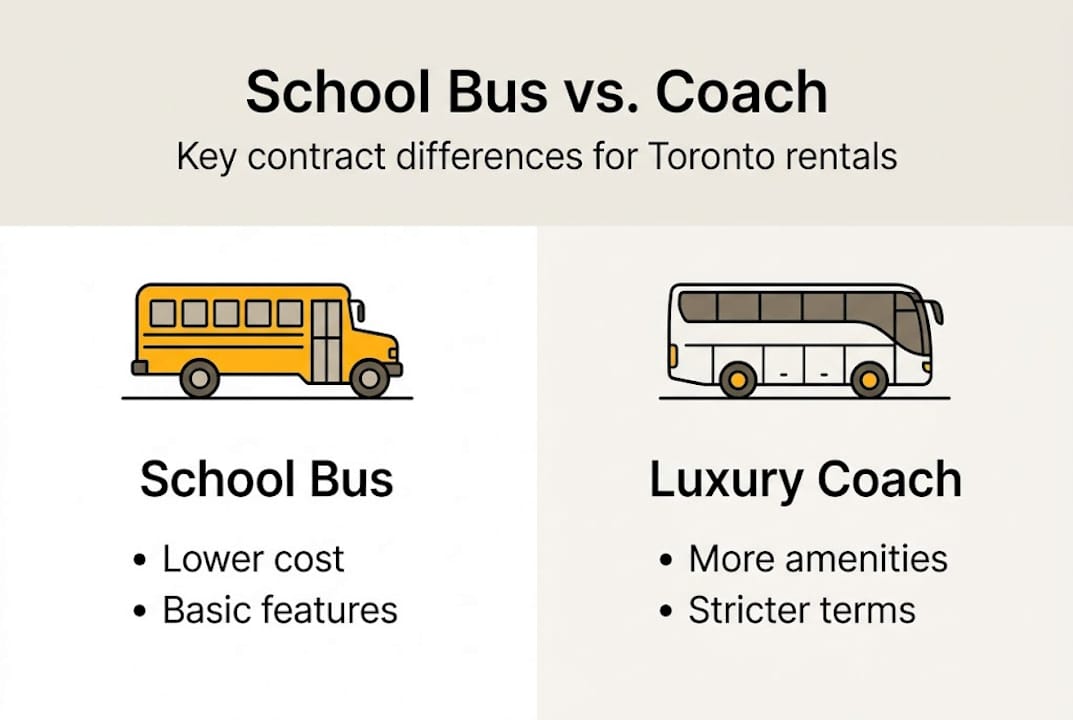
Here’s how the two most common options compare for Toronto group events:
| Feature | School bus | Luxury motor coach |
|---|---|---|
| Average hourly rate (CAD) | $85 to $100 | $150 to $200 |
| Seating capacity | Up to 72 | Up to 55 |
| Air conditioning | Basic | Premium climate control |
| Wi-Fi availability | Rare | Standard on modern coaches |
| Reclining seats | No | Yes |
| Typical deposit requirement | 20 to 25% | 25 to 35% |
| Minimum hire duration | 2 hours | 3 to 4 hours |
| Cancellation window (full refund) | 48 hours | 72 to 96 hours |
School buses are significantly cheaper than luxury coaches but offer fewer passenger amenities. That trade-off is worth it for many organisations. Here’s a quick guide on when each option makes sense:
- School bus: Field trips, athletic team travel, youth programmes, short urban routes, budget-conscious organisations
- Luxury motor coach: Corporate retreats, client entertainment, weddings, airport transfers, multi-hour group tours
From a contract perspective, luxury coach agreements typically carry stricter cancellation terms and higher deposit thresholds. You’ll also find that some Toronto operators impose parking coordination requirements for downtown venues. Building those logistics into the contract language protects everyone on event day.
The school bus rental features page outlines capacity and safety specifications in detail, while the coach amenities overview covers what premium options include. Reviewing both before comparing quotes puts you in a much stronger negotiating position.
What most contracts miss (and why planners must lead)
Here’s the uncomfortable reality: most standard bus rental agreements are written to protect the operator, not the client. That’s not necessarily bad faith. It’s just how boilerplate contracts work. The problem is that event planners often sign without pushing back, and then discover the gaps when something goes sideways on event day.
The most commonly overlooked areas are delay handling, inclement weather protocols, and driver contingency. What happens if your driver is ill? What if a snowstorm delays departure by 90 minutes? If the contract is silent on these points, the answer is almost always unfavourable to you.
We’ve seen groups scramble for rideshares when charter arrangements fell apart with no fallback plan written into the agreement. Compare that to groups who negotiated specific contingency clauses and had a replacement vehicle confirmed within the hour. The difference isn’t luck. It’s preparation.
Clarity on responsibility changes outcomes. When you know exactly who calls whom, and what they’re obligated to do, your group stays cohesive instead of fragmenting across a dozen separate cars. This is especially true for safe group travel involving students or large delegations.
Pro Tip: Never accept boilerplate language for high-stakes events. Request addenda that address your specific event needs, including weather contingencies, driver replacement, and arrival time guarantees.
Your next step: Secure a reliable Toronto group bus
Now you’re ready to apply this know-how. A well-negotiated bus rental agreement isn’t just paperwork. It’s the foundation for safe, punctual, and stress-free group transportation in Toronto.

Start by reviewing the advantages of Toronto charter buses to confirm the right vehicle class for your event. Then follow the practical steps in our guide on how to rent a bus for corporate events to move through the booking process efficiently. For a complete preparation tool, the bus rental checklist for Toronto events gives you everything you need to evaluate operators and contracts side by side before you commit.
Frequently asked questions
What should I check first in a Toronto bus rental agreement?
Start by verifying the operator’s CVOR registration and then review insurance coverage, driver qualifications, and cancellation clauses before anything else.
Are school bus contracts different from coach bus agreements?
Yes. School bus agreements are typically cheaper and have fewer amenity guarantees, and they carry unique driver certification and inspection requirements that differ from motor coach contracts.
What hidden costs are common in Toronto bus rentals?
Watch for fuel surcharges, tolls, post-trip cleaning fees, parking coordination charges, and overtime fees when your event runs past the contracted window.
Is a written agreement required for group bus rentals?
A written contract is essential. It is your primary protection for managing liability, confirming costs, and holding the operator accountable to all agreed-upon service terms.
Recommended
- Toronto Group Shuttle Bus Rental
- Toronto School Bus Rentals
- Minibus Rental in Toronto – Multi-Day Trip to USA
- Top 7 coachbusrentaltoronto.com Alternatives 2026