
Booking buses for schools 2026: the complete planning guide
TL;DR:
- Booking school buses in 2026 requires early planning, complete trip details, and verified safety documents. Administrators should request quotes in writing and book four to twelve weeks in advance, depending on trip type. Ensuring proper vehicle choice and safety verification helps secure better pricing and a smoother experience.
Booking buses for schools in 2026 is defined as the process of securing licensed, compliant group transportation for student trips, field excursions, and school events through advance planning, accurate trip documentation, and verified safety credentials. School administrators and event planners who start early, provide complete trip details, and confirm compliance documents get better pricing, better vehicles, and far fewer surprises on the day. Charter bus rental for schools differs from standard school bus hire in important ways, and knowing that distinction before you call a single provider saves time and money. This guide covers every step, from gathering your trip data to signing a contract with confidence.
What do you need to start booking buses for schools in 2026?
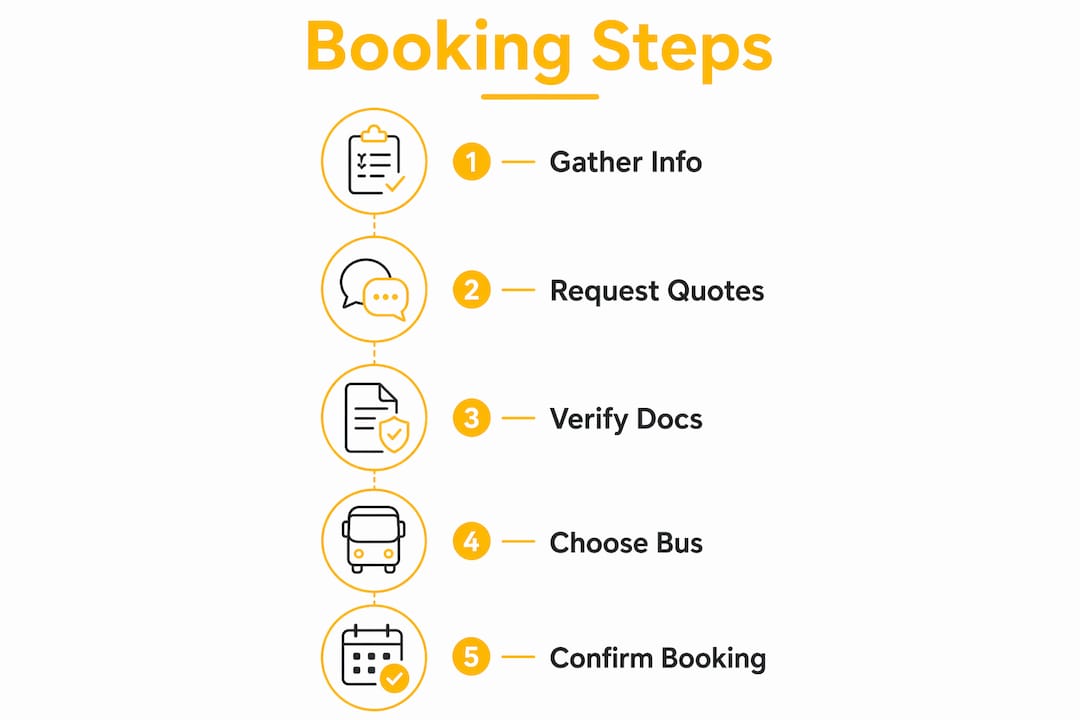
The single most important step in school bus rental is gathering complete trip information before contacting any provider. Providers who receive complete trip details upfront give more accurate quotes and are far less likely to add charges later. Vague requests produce vague quotes, and vague quotes become billing disputes.
Collect the following before making your first call:
- Total headcount: Include students, teachers, and chaperones. Providers size vehicles to passenger count, so an undercount means the wrong bus shows up.
- Pick-up and drop-off locations: Provide full addresses, not just neighbourhood names. School parking lot dimensions matter for larger motorcoaches.
- Departure and return times: Include buffer time for loading. A group of 50 students takes longer to board than most planners expect.
- Accessibility requirements: Confirm whether any students or chaperones require wheelchair lifts or other ADA-compliant features. Not every vehicle in a fleet carries this equipment.
- Number of vehicles: Large groups travelling together often need a coordinated fleet. Booking multiple buses as a single fleet plan simplifies billing and insurance documentation.
- Trip duration and distance: A day trip across the city and a two-day excursion to Niagara Falls require completely different vehicle types.
Once you have these details, request quotes from providers in writing. A written quote locks in the price and creates a paper trail.
| Document | Why it matters |
|---|---|
| Insurance certificate | Names your school or district as additionally insured |
| Driver background check | Confirms driver qualifications and criminal clearance |
| DOT compliance record | Verifies the vehicle meets federal transport safety standards |
| Vehicle inspection report | Shows the bus passed its most recent safety inspection |
| Signed contract | Locks in pricing, route, and cancellation terms |

Pro Tip: Ask for all compliance documents in writing before you sign anything. Verbal assurances do not protect your school if something goes wrong.
When should you book school buses in 2026?
Timing is the single variable that most administrators underestimate. The recommended booking window is 4–6 weeks ahead for local day trips and 8–12 weeks ahead for multi-day or peak season trips. Those windows exist because bus fleets are finite and popular dates fill quickly.
Here is how to think about your timeline by trip type:
- Local day trips (under 100 km round trip): Book 4–6 weeks out. These trips are the most common request, which means providers fill these dates first. Waiting until two weeks before the trip often means settling for whatever is left.
- Multi-day excursions: Book 8–12 weeks out. These trips require drivers to be scheduled for overnight stays, which limits availability significantly more than a single-day booking.
- Spring and end-of-year trips: Book as early as possible. Peak booking seasons like spring drive up demand sharply, leaving late bookers with limited vehicle options and higher prices.
- Summer camp and seasonal programmes: Some providers offer early booking incentives. Locking in your dates before the rush protects both your budget and your vehicle choice.
“Early booking is the most effective way to secure vehicles and pricing. Waiting until peak season means paying more for fewer options.” — industry guidance from AClass Corporate Travel
The financial case for booking early is straightforward. Late bookings during peak periods carry surcharges, and the vehicle you actually wanted may simply be unavailable. An administrator who books a spring field trip in january has more negotiating power than one who calls in april.
Pro Tip: Put your booking deadline on your school calendar at least two weeks before the actual booking window opens. That buffer gives you time to gather approvals and paperwork without rushing.
How do you choose the right bus type for school trips?
Charter buses and standard school buses are not interchangeable. Charter motorcoaches offer higher comfort and capacity than yellow school buses, making them the better choice for trips longer than 90 minutes each way. The right vehicle depends on group size, trip length, and budget.
| Bus type | Typical capacity | Best for | Approximate cost range |
|---|---|---|---|
| Standard school bus | 48–72 passengers | Short local trips, familiar routes | Lower end of market |
| Mini-bus | 18–30 passengers | Small groups, urban trips | $400–$700 per trip |
| Full-size motorcoach | 55–56 passengers | Long-distance, multi-day trips | $900–$1,800 per trip |
Mini-buses work well for smaller groups and urban routes where a full-size coach would be difficult to park or manoeuvre. School field trip pricing ranges from $400–$700 for mini-buses and $900–$1,800 for full-size motorcoaches, depending on distance, duration, and region. Those figures give you a realistic budget anchor before you request quotes.
Full-size motorcoaches carry 55–56 passengers with climate control, reclining seats, and overhead storage. That comfort level matters on a four-hour drive to a science centre or conservation area. Students arrive less fatigued, and chaperones have an easier time managing behaviour in a comfortable environment.
For large school groups, coordinating a fleet of two or more vehicles under a single booking is more cost-effective than booking each bus separately. It also consolidates your insurance documentation and billing into one contract, which reduces administrative work considerably.
You can review Toronto school bus rental options to compare vehicle sizes and capacities suited to different group sizes before committing to a provider.
What safety checks must administrators confirm before finalising a booking?
Safety verification is the school administrator’s direct responsibility. No provider can be assumed compliant. You must confirm driver and vehicle credentials yourself before signing any contract.
The non-negotiable checklist:
- Driver background checks: Request written proof that every driver assigned to your trip has passed a criminal background check and holds a valid commercial licence.
- Insurance certificate naming your district: The certificate must explicitly name your school or school district as an additionally insured party. A generic insurance document does not protect you.
- Department of Transportation compliance: Confirm the provider holds current DOT registration and that the specific vehicles on your booking are listed.
- Vehicle inspection records: Ask for the most recent inspection report for each bus. A reputable provider produces these without hesitation.
- Signed contract with cancellation terms: The contract should specify the route, passenger count, pricing, and what happens if either party needs to cancel.
“Requesting administrative documents like insurance certificates naming the school district and driver background check proofs at the earliest stage reduces booking delays and compliance issues.” — Urban Sherpa Travel
Administrators who request these documents early rarely face last-minute scrambles. Those who wait until the week of the trip often discover gaps that delay departure or, in serious cases, force a cancellation. Safety verification responsibility sits with the school, not the provider. That is the standard across Canadian school districts.
Key takeaways
Booking school buses effectively in 2026 requires complete trip data, the right vehicle type, early timing, and verified safety documentation before any contract is signed.
| Point | Details |
|---|---|
| Gather complete trip details first | Headcount, locations, times, and accessibility needs produce accurate quotes and prevent billing surprises. |
| Book 4–12 weeks in advance | Local trips need 4–6 weeks; multi-day or peak season trips need 8–12 weeks to secure vehicles and pricing. |
| Match bus type to trip length | Mini-buses suit small urban groups; full-size motorcoaches are better for long-distance or multi-day trips. |
| Verify safety documents in writing | Confirm driver background checks, DOT compliance, and insurance certificates before signing any contract. |
| Fleet bookings reduce admin burden | Booking multiple buses under one plan simplifies billing, insurance, and logistics for large groups. |
What I have learned from coordinating school transportation
After working with dozens of school administrators and event planners on group transportation, the pattern I see most often is the same: the trips that go smoothly are the ones where someone started the process earlier than felt necessary.
The most common mistake is treating the bus booking as the last item on the planning checklist. Administrators finalise the destination, get parent permission forms signed, and then call a bus company two weeks before the trip. At that point, the best vehicles are gone and the pricing reflects it. The bus is not a logistical afterthought. It is the trip.
The second mistake is being vague with providers. I have seen quotes come back wildly off-budget because the administrator said “about 40 kids” instead of “43 students, 4 teachers, and 2 chaperones, with one wheelchair user.” Specificity is free. Vagueness costs money.
The third thing I would tell any administrator is to build a relationship with one reliable provider rather than shopping from scratch every year. When a provider knows your school, your typical routes, and your documentation requirements, the booking process takes a fraction of the time. You also get better service when something unexpected happens, because you are a known client rather than a one-time inquiry.
Clear communication with all stakeholders matters too. The principal, the finance office, the trip coordinator, and the bus provider all need the same information at the same time. When one party is working from outdated details, the whole booking gets complicated.
— Firoz
Torontobusrentals: school group transportation in Toronto
School administrators in Toronto need a provider who already understands compliance documentation, fleet logistics, and the specific demands of student group travel.

Torontobusrentals offers a range of vehicles suited to school groups, from minibuses for smaller excursions to full-size motorcoaches for longer trips. The booking process is direct, and the team supports administrators with the documentation they need to satisfy district requirements. Whether you are planning a single field trip or a series of events across the school year, group transportation options are available to match your group size and schedule. Request a quote early to lock in your preferred vehicle and pricing before peak season demand reduces your choices.
FAQ
How far in advance should schools book a bus?
Book 4–6 weeks ahead for local day trips and 8–12 weeks ahead for multi-day or peak season trips. Early booking secures better pricing and vehicle availability.
What is the difference between a charter bus and a school bus?
Charter motorcoaches offer higher passenger comfort, climate control, and seating capacity of 55–56 passengers, making them better suited for longer trips than standard school buses.
What documents should a school request from a bus provider?
Request a driver background check, an insurance certificate naming your school district, DOT compliance records, and a vehicle inspection report before signing any contract.
How much does a school field trip bus cost?
Mini-buses typically range from $400–$700 per trip, while full-size motorcoaches range from $900–$1,800, depending on distance, duration, and season.
Is it cheaper to book multiple buses at once?
Booking a coordinated fleet under a single plan is more cost-effective than booking each bus separately. It also consolidates billing and insurance documentation into one agreement.
Recommended
- Essential bus rental tips for safe Toronto school trips
- School trip transportation explained: a 2026 guide
- School event transport guide for administrators