
Why book a bus for conferences: a smarter group travel solution
TL;DR:
- Booking a dedicated bus ensures synchronized arrival, reduces stress, and enhances brand professionalism at conferences.
- Scattered transportation options often lead to unpredictable costs, delays, and fragmented attendee experiences.
- For multi-venue events or larger groups, charter buses are the most operationally sound and efficient choice.
Organising group transport for a Toronto conference sounds straightforward until you’re juggling thirty different rideshare ETAs, fielding texts from attendees who missed their connection, and watching your opening keynote start without half the room. Many planners default to taxis or a fleet of individual cars because it feels flexible and familiar. That instinct is understandable, but it consistently creates more problems than it solves. This article walks you through why booking a dedicated bus is one of the most operationally sound decisions you can make for any mid-to-large corporate event, and when it might not be the right call.
Table of Contents
- The hidden costs of scattered and ad-hoc transport
- How booking a bus enhances the conference experience
- Coordinated logistics across multiple venues and time slots
- When is booking a bus not the best fit?
- A planner’s perspective: what experts wish more organizers knew
- Explore efficient group transportation solutions in Toronto
- Frequently asked questions
Key Takeaways
| Point | Details |
|---|---|
| Enhances professionalism | Booking a bus provides a coordinated, branded arrival that impresses attendees and clients. |
| Streamlines logistics | A dedicated bus reduces missed connections and helps your event run on time. |
| Improves attendee experience | Shuttles allow everyone to arrive stress-free and foster networking before events begin. |
| Best for larger groups | Conference buses are most cost-effective when transporting 15 or more people at set times. |
| Nuanced decision | Ad-hoc options suit small, flexible groups—know your needs before booking transport. |
The hidden costs of scattered and ad-hoc transport
Building from the introduction’s discussion of logistical headaches, let’s explore why relying on ad-hoc vehicle arrangements introduces more complexity than planners often realise.
When you rely on scattered transport options, the first thing you lose is predictability. Taxis and rideshares surge in price during peak hours in Toronto, and those costs are almost impossible to forecast accurately when you’re working with a fixed event budget. One delayed vehicle snowballs into a cascade of problems: guests arrive at staggered times, registration queues pile up, and your carefully timed agenda slips before the first speaker even takes the stage.
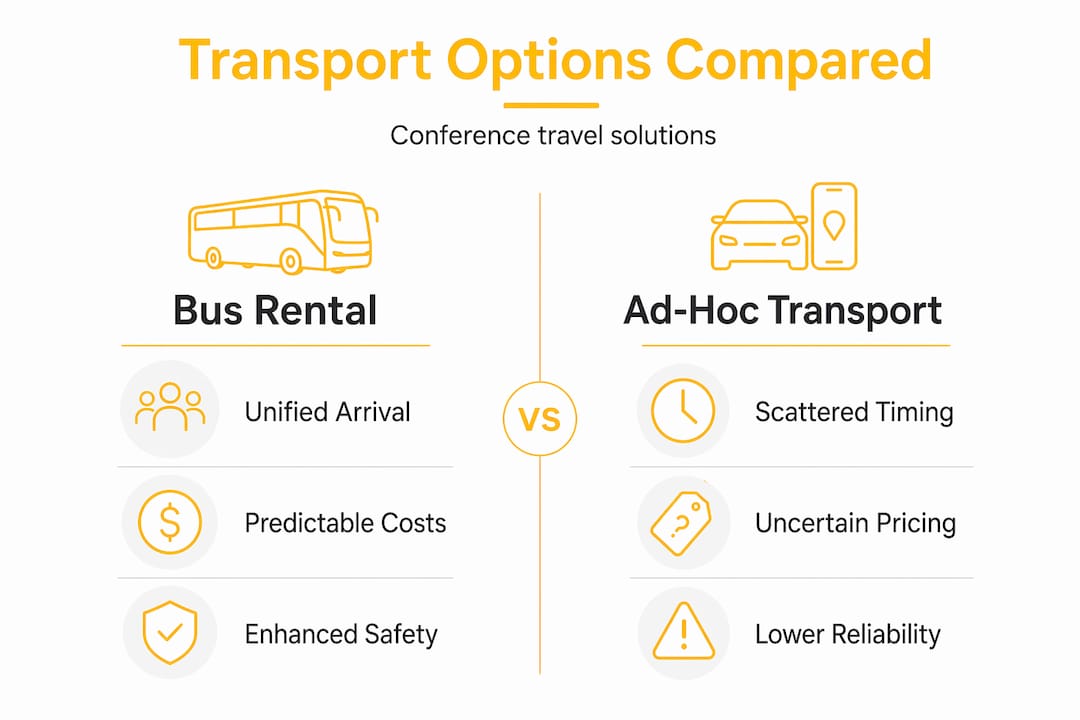
The indirect costs are often invisible on a spreadsheet but felt immediately by everyone in the room. Lost productivity during unplanned waiting, guest frustration that colours their entire event experience, and a fragmented first impression all chip away at the professionalism you’ve worked hard to project. These are real costs, even if they don’t appear on an invoice. Investing in solid group transportation solutions at the planning stage eliminates much of this exposure.
Typical setbacks of scattered transport options:
- Unpredictable surge pricing during peak Toronto traffic periods
- Guests arriving at different times, disrupting session flow
- No central point of accountability when a vehicle is late
- Attendees booking their own rides and choosing wrong pick-up locations
- Limited visibility into whether all guests have actually arrived
- Increased planner workload managing multiple providers simultaneously
Pro Tip: Before committing to any transport arrangement, calculate the full trip cost by including the value of lost time, potential delays, and the staff hours spent coordinating multiple providers. That number is almost always higher than a single charter quote.
As noted by industry sources, for small groups or highly flexible, ad-hoc travel, multiple vehicles may sometimes be operationally simpler, but this approach often introduces unpredictable costs and logistics that catch planners off guard as group size grows.
It is also worth considering charter bus safety as a factor. Professional charter vehicles come with vetted, licensed drivers and maintained fleets, whereas rideshare or taxi drivers are operating under entirely different regulatory frameworks. For a corporate event where your company’s reputation is on the line, that distinction matters.
How booking a bus enhances the conference experience
Having seen the downsides of scattered transport, let’s turn to the direct benefits that a properly booked conference bus delivers.
The single most immediate benefit is unified arrival. When every attendee boards the same vehicle and pulls up at the venue together, the event starts with a sense of cohesion and momentum. There’s no awkward period where half the room is waiting for the other half. Presenters can begin on time. Networking conversations that start on the bus continue naturally into the venue. That transition from transit to event feels seamless rather than fragmented.
Group bus travel also reduces the cognitive load on your attendees. Nobody is negotiating an unfamiliar app, worrying about being stranded, or second-guessing which entrance to use. They simply board, relax, and arrive ready to engage. That reduction in stress is not trivial. Attendees who arrive calm and on schedule participate more actively, ask better questions, and leave with a more favourable impression of the event overall. You can save planning time with buses precisely because this simplicity extends to the organisational side as well.
Key experiential benefits of a booked conference bus:
- Attendees network organically during the ride, extending your event’s value
- Stress-free boarding removes friction at the start of the day
- A single professional driver manages timing and route, not you
- Unified arrival projects organisational competence to all guests
- Guests feel cared for, which reflects well on your brand
- No one is left behind or confused about the meeting point
From a brand perspective, coordinated arrival improves brand perception at corporate conferences in a way that scattered individual vehicles simply cannot replicate. When your guests step off a clean, branded coach together, that moment communicates investment, professionalism, and attention to detail before a single slide is presented. For companies hosting clients, investors, or senior staff, this is not a minor detail. It is part of your event’s overall narrative.
Read through our event shuttle service guide for a thorough breakdown of shuttle formats and how to match them to your event structure.
Coordinated logistics across multiple venues and time slots
With the basics and key benefits clear, it is important to understand how booking a bus is essential when your conference includes several off-site events or parallel sessions.
Multi-venue conferences are where ad-hoc transport completely breaks down. Imagine your morning general session wraps up at the Metro Toronto Convention Centre, and your afternoon breakout sessions are split between two hotels a kilometre apart. With individual cars, you’re hoping guests navigate correctly, arrive at roughly the right time, and don’t get sidetracked. With a coordinated shuttle, everyone moves together on a fixed schedule, and your programme stays intact.

When conferences require synchronised movement across multiple venues, planners specifically choose shuttles and buses to coordinate timing so attendees arrive together for presentations and meetings. This is not just a convenience. It is a logistical necessity for any event with a tight, multi-location agenda.
| Factor | Charter bus | Ad-hoc vehicles |
|---|---|---|
| Cost predictability | Fixed quote, no surprises | Variable, surge-prone |
| Arrival timing | Synchronised, on schedule | Staggered, unreliable |
| Multi-venue coordination | Seamless, planned routes | Chaotic, uncoordinated |
| Planner oversight | Single point of contact | Multiple providers |
| Attendee experience | Relaxed, unified | Stressful, fragmented |
| Brand presentation | Professional, cohesive | Inconsistent |
Steps for coordinating shuttles across multiple conference venues:
- Map every venue location and identify travel time between each stop during peak hours.
- Build a buffer of at least ten minutes into each transfer to account for boarding and minor delays.
- Assign a staff member or volunteer as the on-site shuttle coordinator at each venue.
- Share the full shuttle schedule with attendees at least 48 hours before the event.
- Confirm pick-up points and drop-off locations are clearly signposted at each venue.
- Keep the driver’s contact number accessible to your coordination team throughout the day.
Explore our guide to efficient schedule management for templates and frameworks that work specifically for Toronto corporate events.
Pro Tip: Use a shared digital document or event app to push real-time shuttle updates to attendees. Even a simple group message with boarding times reduces the number of confused calls your team receives.
When is booking a bus not the best fit?
As with any solution, there are times when buses might not be optimal. Let’s highlight those exceptions so you can plan with confidence.
Buses are outstanding for groups of 15 or more with a defined schedule. But not every conference transport need fits that profile. The best choice depends on group size, schedule structure, and budget predictability, and honest planners account for that nuance rather than applying a one-size-fits-all approach.
| Scenario | Best option | Why |
|---|---|---|
| 20+ attendees, fixed schedule | Charter bus | Cost-efficient, coordinated |
| 5-8 attendees, flexible timing | Multiple vehicles | More agile, lower upfront cost |
| Multi-venue, timed sessions | Shuttle bus | Synchronised movement |
| VIP transport, individual needs | Executive car | Privacy, personalised service |
| Last-minute logistics change | Rideshare or taxi | Immediate availability |
When to consider alternatives to a charter bus:
- Your group has fewer than 12 to 15 people and timing is genuinely flexible
- Attendees need to depart at widely different times throughout the day
- The venue is within easy walking distance of hotels and no transfer is required
- Budget constraints make a charter cost prohibitive relative to group size
- Last-minute cancellations have significantly reduced your group count
Use our bus rental checklist to run through your event’s specific variables before making a final decision. And if you’re unsure which vehicle suits your headcount, our guide to finding the right bus type covers mini coaches, full-size coaches, and everything in between.
The key is to match the transport solution to the event, not the other way around. A smart planner doesn’t book a 55-seat coach for eight executives, and equally, they don’t put 40 conference delegates into a scramble of rideshares because it felt easier to arrange.
A planner’s perspective: what experts wish more organizers knew
Now that you know both the strong cases and exceptions for bus rental, here’s a candid insider perspective every Toronto planner should consider.
The most common mistake we see from even experienced event organisers is treating transport as the last item on the planning list. It gets addressed after the venue, the catering, the AV setup, and the speaker lineup. By that point, options are limited, pricing has increased, and the planning team is too fatigued to invest serious thought into logistics. Transport deserves a seat at the planning table from day one, not a rushed decision two weeks before the event.
There is also a persistent habit of fixating on the lowest possible cost rather than the most reliable outcome. A charter that costs slightly more but guarantees punctuality, professional conduct, and zero surprises is worth significantly more than a cheaper option that introduces risk into an otherwise tightly planned day. Your attendees will not remember what the bus cost. They will remember whether they arrived on time, felt comfortable, and started the day without stress.
One thing that genuinely surprises first-time bus bookers is how much the group dynamics shift on the ride itself. People talk. They decompress. Colleagues who rarely interact in the office find themselves in a casual conversation that carries energy into the event. That informal pre-event warmth is genuinely valuable for conferences built around networking or team cohesion, and it costs nothing extra once you’ve booked the bus.
Review our bus rental event tips for a detailed breakdown of how to communicate transport details to your guests effectively and set expectations that make the day run smoothly.
Finally, book early. Toronto is a busy city, and quality vehicles with experienced drivers get reserved quickly, particularly during the spring and autumn conference seasons. A booking placed three to four months in advance gives you far more vehicle choices, better pricing, and the breathing room to adjust your plan if your guest count changes.
Explore efficient group transportation solutions in Toronto
If you’re ready to take the hassle out of conference transport or want a head start on your next event, explore these resources and booking options.
Toronto Bus Rentals specialises in exactly the kind of coordinated, professional group transport that makes conferences run the way they’re supposed to. Whether you’re moving 20 delegates between hotels or shuttling 100 guests across multiple venues, the right vehicle and the right driver make a measurable difference to your event’s success.

Start by exploring how to maximise group travel efficiency with a modern motor coach fleet designed for corporate use. If you’re weighing your options, the guide to advantages of charter buses lays out exactly why organisations across Toronto choose chartered group transport over ad-hoc alternatives. When you’re ready to move forward, follow our clear steps to rent a corporate outing bus and get a quote tailored to your event’s specific needs. The right transport solution starts with a single, well-informed conversation.
Frequently asked questions
What group size is ideal for booking a bus for conferences?
Bus rentals are most efficient for groups with 15 or more attendees, where the per-person cost becomes competitive and the logistical benefits are fully realised. Smaller groups may find that individual vehicles offer more flexibility, as group size and schedule structure are the two primary factors in making that call.
How does a conference bus improve event punctuality?
A scheduled charter bus ensures all attendees depart and arrive at the same time, eliminating the staggered arrivals that disrupt session timing. When planners choose shuttles specifically to coordinate timing, late arrivals and missed sessions drop dramatically.
Are there branding benefits to booking a group bus?
Yes, significantly. A professional vehicle plan creates a unified arrival moment that signals organisational competence to every attendee and guest. Coordinated arrival improves brand perception in ways that scattered individual vehicles cannot, particularly when transporting clients or senior stakeholders.
Is booking a bus always the most cost-effective choice?
Not always. For very small or highly flexible groups, taxis or individually arranged vehicles may be more economical and logistically practical. As the industry notes, multiple vehicles can be simpler for small groups with unpredictable schedules, though this advantage typically disappears once your headcount exceeds 12 to 15 people.
Recommended
- Why book private buses for Toronto events: Cost, comfort, safety
- Top benefits of bus rentals for Toronto events in 2026
- Why bus rentals are essential for Toronto events: Cost, ease, safety
- Master the role of buses in corporate travel for Toronto events