
Choose the best transport types for Toronto corporate outings
TL;DR:
- Transport planning for large Toronto corporate events is complex, requiring careful consideration of group size, itinerary, and flexibility. Different vehicle types, from motor coaches to luxury vans, serve varying needs, with layered solutions often providing the best outcomes. Creative, adaptable transportation not only ensures punctuality but also enhances the attendee experience and overall event success.
Moving thirty, eighty, or even two hundred colleagues across Toronto without a hitch is genuinely one of the most underestimated challenges in corporate event planning. The venue can be perfect, the catering flawless, and the agenda tight — yet a single transportation misstep sends ripples through the entire day. Late arrivals, confused pickup points, and overloaded vehicles erode attendee experience before your event even starts. This guide breaks down every major transportation type available to Toronto planners, gives you a practical comparison framework, and helps you match the right vehicle to the right scenario so your next outing runs exactly as planned.
Table of Contents
- How to choose transportation for your corporate outing
- Comparing main transportation types for corporate outings
- Transportation types at a glance: feature comparison
- When to use which transport: making the smart call
- The hidden advantages of creative transportation planning
- Organise your next event with Toronto’s leading bus rental services
- Frequently asked questions
Key Takeaways
| Point | Details |
|---|---|
| Match vehicle to group | Select your transportation type based on group size, scheduling needs, and event flow. |
| Plan for flexibility | Always build buffer time and contingency options into your transportation plan. |
| Compare features | Check amenities and booking flexibility so attendees stay comfortable and on time. |
| Use scenario planning | Pair specific outing formats and attendee needs with the most fitting vehicle type. |
How to choose transportation for your corporate outing
After setting the scene on why getting transportation right is so important, let’s break down what to consider before you book anything.
The single most important factor is group size. A team of fifteen people has completely different needs than a company-wide gathering of two hundred. Vehicle-type selection should be driven by how many people need to move together and how tightly their arrival times must be protected. Get that wrong and every other decision becomes more difficult.
Beyond headcount, your itinerary structure shapes everything. A simple point-to-point transfer from office to venue is far less complex than a multi-stop outing that includes a team lunch, an afternoon activity, and an evening dinner at three separate locations across the city. Multi-stop schedules require vehicles with strong scheduling flexibility, experienced drivers who know Toronto’s traffic patterns, and communication systems that allow for real-time updates.
Before you shortlist any vehicle type, work through these criteria:
- Group size: Total headcount, plus an allowance of five to ten percent for late additions or plus-ones
- Journey distance: Short cross-town hops versus longer transfers to venues outside the core
- Schedule rigidity: Hard arrival deadlines (keynote speeches, tee times, reservation windows) versus relaxed social events
- VIP requirements: Executives or clients who expect a higher level of service and privacy
- Accessibility needs: Wheelchair access, mobility aids, or special seating arrangements
- Budget range: Per-person costs vary significantly across vehicle types and booking windows
Pro Tip: Always build a minimum fifteen-minute buffer into each leg of your itinerary. Toronto’s traffic is famously unpredictable, and a buffer between the Gardiner Expressway and downtown surface streets can mean the difference between an on-time arrival and a flustered group walking into a half-started presentation.
You can also get a head start on logistics by reviewing this Toronto outing transport guide, which walks through common planning scenarios specific to the city’s geography and event landscape.
Comparing main transportation types for corporate outings
With criteria in mind, it’s time to look at the primary vehicle types you can consider for your next event.
Motor coach buses are the workhorses of large-group corporate transport. Seating between 47 and 57 passengers, they offer on-board washrooms, luggage bays, reclining seats, air conditioning, and often Wi-Fi connectivity. For all-hands company outings, award ceremonies, or multi-day off-site retreats, a motor coach keeps everyone together, on schedule, and comfortable. The trade-off is that they require pre-planned pickup and drop-off points, and manoeuvring in tight urban areas requires skilled drivers.
Minibuses hit a sweet spot for teams of twenty to thirty-five. They offer more flexibility than a full coach in terms of route adjustments and pickup locations, while still delivering a professional, comfortable ride. Toronto planners frequently use minibuses for leadership team outings, client appreciation events, or departmental celebrations where you want a cohesive group experience without committing to a full-size coach.
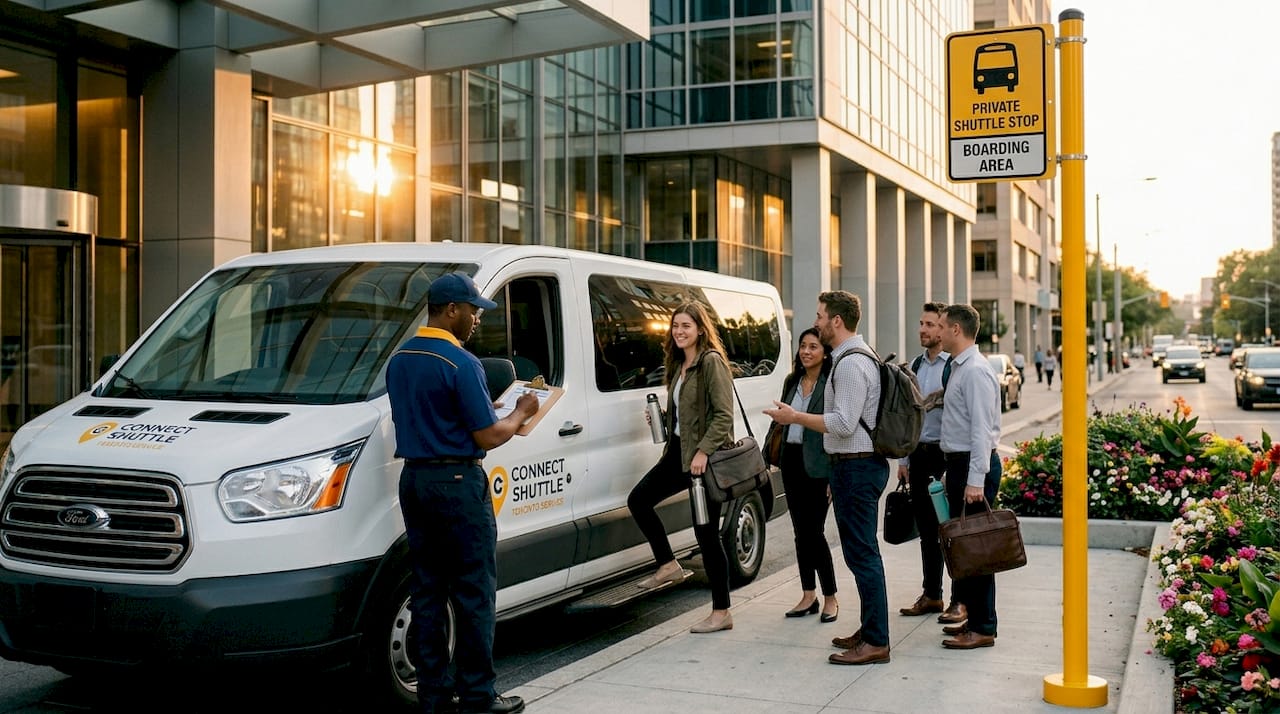
Van shuttles work best for smaller groups of up to fifteen or for splitting a larger group across staggered departure times. They are practical for airport transfers, off-peak pickups, or secondary transport legs. Their smaller footprint also makes them far easier to deploy in residential areas, underground parking facilities, or congested event zones.
Specialty and luxury vehicles serve a distinct purpose. Executive vans with leather interiors and privacy partitions are well-suited for VIP guests or board-level clients who expect white-glove service. For team-building or outdoor events, something like the specialty options for small groups offered by local operators can add an element of fun and novelty that becomes a talking point long after the event ends.
Smart transport solutions often combine two or three vehicle types. A motor coach handles the main group movement, while an executive van manages VIP transfers, and a van shuttle covers late arrivals or early departures. This layered approach is particularly effective for full-day events.
Planners should anticipate that common failure modes are operational — delays, confusing pickups, and peak congestion — and design mitigation into the plan through buffers, peak staging, and real-time coordination. Knowing this in advance means you build resilience into your transport plan from the very start rather than scrambling on the day.
Pro Tip: When booking group shuttle services, always confirm that your provider has a contingency vehicle available. A mechanical issue with no backup is a serious operational risk for any large-scale corporate outing.
Here is a quick overview of each type’s strengths:
- Motor coach: Large-group cohesion, long-distance comfort, strong amenity suite
- Minibus: Mid-size flexibility, easier urban navigation, cost-effective for medium groups
- Van shuttle: Small groups, staggered schedules, tight pickup locations
- Luxury/executive vehicle: VIP expectations, privacy, high-touch service
- Specialty vehicles: Unique experiences, team-building moments, smaller groups
Transportation types at a glance: feature comparison
Now that you know the main types, see how they stack up side-by-side for quick reference.
| Vehicle type | Typical capacity | On-board amenities | Price range | Booking flexibility | Best-use scenario |
|---|---|---|---|---|---|
| Motor coach | 47 to 57 passengers | Washroom, Wi-Fi, A/C, luggage bay | $$$ | Moderate | Large all-hands outings, retreats |
| Minibus | 20 to 35 passengers | A/C, comfortable seating | $$ | High | Team events, leadership outings |
| Van shuttle | Up to 15 passengers | A/C, basic comfort | $ | Very high | Small groups, staggered pickups |
| Executive/luxury van | 6 to 12 passengers | Leather seats, privacy, premium finish | $$$$ | High | VIP transfers, board events |
| Specialty vehicles | Varies | Varies widely | $ to $$$ | Moderate | Team-building, unique experiences |
This comparison makes it clear that no single vehicle type wins across every category. The motor coach dominates for large-group capacity and amenities but scores lower on flexibility. The van shuttle ranks highest for adaptability but is impractical at scale. Most experienced planners treat this table as a decision matrix and select combinations rather than a single solution.
Edge cases that planners should plan for include unpredictability from weather, traffic disruptions, and mechanical issues, along with VIP expectations and the need to design shuttles as flexible systems rather than rigid fixed schedules. This is especially relevant in Toronto, where a sudden snowstorm in March or a Blue Jays game can completely reshape traffic patterns across the downtown core.
It is also worth noting how event shuttle schedules can be structured to account for these edge cases. Staggered departure windows, floating pickup zones, and a designated on-the-ground coordinator all reduce the likelihood of a single disruption cascading into a full logistical breakdown.
A well-designed backup plan should include at minimum: a secondary vehicle on standby, a direct line to your transportation provider’s operations team, and a pre-communicated alternative pickup point for attendees if the primary location becomes untenable.
When to use which transport: making the smart call
Side-by-side comparisons are great for clarity, but real planning happens in the details. Here’s how to match actual events to transportation types.
Consider these common Toronto corporate outing scenarios and the transport solutions that fit them best:
100-person annual company outing to a venue outside the city core: Two motor coaches departing from a central office location, with staggered fifteen-minute departure windows. Assign a transport liaison to each coach and confirm the venue’s coach parking capacity in advance.
25-person leadership team off-site at a boutique venue in the distillery district: A minibus with a professional driver, scheduled for a mid-morning pickup and a flexible evening return. Build in a thirty-minute pickup window at the end to account for networking running long.
VIP client dinner at a restaurant in Yorkville: An executive van for up to eight guests, with the driver briefed on the guests’ names and any special requirements. Pre-arrange a discreet pickup location away from main traffic flow.
Cross-town team-building activity at multiple sites: A combination of two minibuses operating on parallel itineraries, coordinated through a shared real-time communication channel. Each group moves independently but arrives at shared milestones together.
Large conference with guests arriving from multiple hotels: A timed shuttle loop using two to three van shuttles running continuous circuits between hotels and the venue, with a published timetable and a live departure board at each pickup point.
“Your transport plan is your event’s backbone — overlooking it is the easiest way to undermine attendee satisfaction.”
Planners should anticipate that common failure modes are operational and should design mitigation, including buffers, peak staging, and real-time coordination, directly into the transportation plan. The scenarios above each embed that principle: staggered departures, flexible return windows, and communication tools all serve as built-in shock absorbers.
Pro Tip: Review the role of buses for events in detail before finalising your vehicle selection. Understanding how coaches integrate with venue logistics, parking restrictions, and attendee flow will save you significant time on the day of your event.
The hidden advantages of creative transportation planning
Having walked through the options and their use cases, here’s an angle most planners overlook when plotting group moves.
Most corporate transport planning stops at the practical question: how do we move people from A to B without incident? That is the floor, not the ceiling. The planners who consistently deliver exceptional events treat transportation as an experience layer, not an operational footnote.
Think about it this way. The moment your guests step into their transport, the event has already begun. A well-appointed coach with water bottles, branded headrests, and a curated playlist signals professionalism and care before anyone has shaken a single hand. Conversely, a cramped, delayed van with no clear pickup instructions signals disorganisation, regardless of how polished everything else is.
Toronto’s urban environment makes creative, adaptive planning an outright necessity. The city’s mix of expressway infrastructure, surface streetcar routes, construction zones, and event-day road closures means rigid transport plans fail regularly. Planners who build intentional flexibility, specifically split pickups at two or three rally points rather than one central location, reduce passenger wait times dramatically and absorb route disruptions without visible impact.
Generic, one-size-fits-all planning also misses commercial opportunities. Branded transport creates organic social media content. A unique vehicle experience, like a luxury coach with a branded interior for a product launch, becomes part of the event narrative. That kind of detail travels further than most planned activations.
The most memorable corporate outings we have seen get transportation seamlessly right. Guests do not think about the logistics because the logistics never surface as a problem. That invisibility is the goal, and it only happens through deliberate, layered planning. Exploring innovative transport ideas early in the planning process, rather than as a last-minute booking task, is what separates good events from genuinely great ones.
Organise your next event with Toronto’s leading bus rental services
Ready to put your plan into action? Here’s how Toronto’s top bus rental providers can simplify the process.
Toronto Bus Rentals offers a full fleet of motor coaches, minibuses, and specialty vehicles tailored specifically to corporate events. Whether you need a 46 passenger coach bus for a large all-hands outing or a more nimble vehicle for a VIP leadership day, the fleet is matched to real corporate needs.

You can explore the full range of seamless event bus rentals to understand what each vehicle type includes, from amenities to driver credentials. For a deeper look at the business case, the breakdown of corporate bus rental benefits covers how professional group transport reduces per-person costs, improves punctuality, and elevates the overall event experience. Reach out directly for a tailored quote based on your group size, event date, and itinerary requirements.
Frequently asked questions
How do I decide which type of bus or shuttle to book for my corporate outing?
Vehicle-type selection should be driven by how many people need to move together and how tightly their arrival times must be protected, so match group size, schedule flexibility, and budget before comparing vehicle options.
What are the most common problems with corporate group transport?
Common failure modes are operational, including delays, confusing pickups, and peak congestion, so build mitigation strategies like buffer time, clear pickup signage, and real-time coordination into your plan from the outset.
Should I rent a larger bus than my headcount requires?
Yes, reserving a slightly bigger vehicle than your confirmed headcount allows for last-minute additions, greater comfort during the ride, and contingencies that inevitably arise with large groups.
How can I make shuttle services flexible for unpredictable events?
Design routes and departure windows that allow for real-time changes, and always have a backup plan for disruptions like mechanical issues, weather delays, and peak-hour traffic, because shuttles work best as adaptable systems rather than fixed schedules.
Recommended
- Smart transportation ideas for Toronto corporate events
- Corporate outing transport guide for Toronto planners
- Master the role of buses in corporate travel for Toronto events
- Group transportation options in Toronto for events 2026